





Under an ordinary microscope, many minerals appear nearly colorless or difficult to distinguish. When examined using polarized light, however, the same minerals may reveal brilliant interference colors, distinctive extinction patterns, and subtle optical features that help geologists identify them.
These characteristics form the foundation of optical mineralogy, a branch of mineralogy that studies how light interacts with minerals and their crystal structures.
By examining thin sections of rocks under a petrographic microscope, geologists can identify mineral grains, investigate crystal relationships, and interpret the geological processes responsible for rock formation.
The optical properties of minerals include refractive index, relief, pleochroism, birefringence, interference colors, extinction, and other characteristics that describe how minerals interact with light.
This guide explains these properties, the differences between plane-polarized light (PPL) and crossed-polarized light (XPL), and how they are used to identify common minerals in thin section.
What Are the Optical Properties of Minerals?
Optical properties describe how minerals transmit, absorb, reflect, refract, and modify light.
These properties depend on a mineral’s chemical composition, crystal structure, and optical orientation.
Minerals with different atomic arrangements can behave differently even when they appear similar in hand specimens.
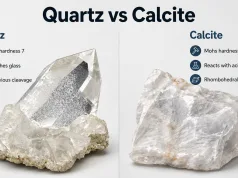
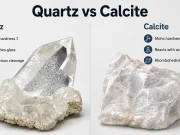
For example, quartz and calcite can both be transparent or colorless, but their birefringence and interference colors differ substantially.
Optical properties allow geologists to examine minerals at scales too small for reliable identification with the naked eye.
Important Optical Properties
| Property | What it reveals | Typical observation |
|---|---|---|
| Color | Absorption of visible light | PPL |
| Pleochroism | Direction-dependent absorption | PPL during stage rotation |
| Relief | Refractive-index contrast | PPL |
| Cleavage | Crystallographic breakage directions | PPL |
| Birefringence | Difference between refractive indices | XPL |
| Interference colors | Optical retardation | XPL |
| Extinction | Optical orientation of a grain | XPL |
| Twinning | Crystallographic relationships within a crystal | Commonly XPL |
| Interference figures | Optical symmetry and orientation | Conoscopic observations |
Individual minerals are identified using several properties together rather than relying on one characteristic.
The Petrographic Microscope
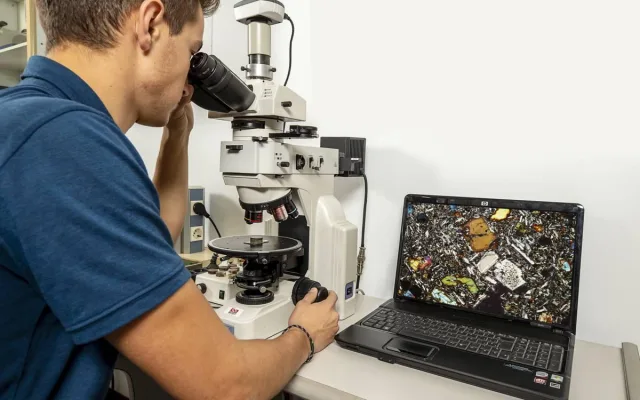
A petrographic microscope is a specialized optical microscope used to examine minerals and rocks through polarized light.
It typically includes a light source, polarizer, rotating stage, objective lenses, analyzer, and additional optical accessories.
How a Petrographic Microscope Works
Light passes through a polarizer before entering the mineral specimen.
The polarizer restricts transmitted light to a particular vibration direction.
When the analyzer is inserted, it is usually oriented perpendicular to the lower polarizer.
Anisotropic minerals can modify the polarization of transmitted light, producing interference effects that become visible under crossed polarizers.
Rotating the microscope stage allows geologists to observe changes in color, brightness, and extinction.
What Is a Thin Section?
A petrographic thin section is a very thin slice of rock mounted on a glass slide and polished or ground to a controlled thickness.
Standard transmitted-light rock thin sections are commonly approximately 30 micrometers (0.03 mm) thick.
At this thickness, many minerals that appear dark or opaque in hand specimens become sufficiently transparent for microscopic examination.
Some minerals, such as common opaque sulfides and oxides, remain opaque under transmitted light.
The consistent thickness of thin sections is particularly important when comparing interference colors and birefringence.
Plane-Polarized Light (PPL)
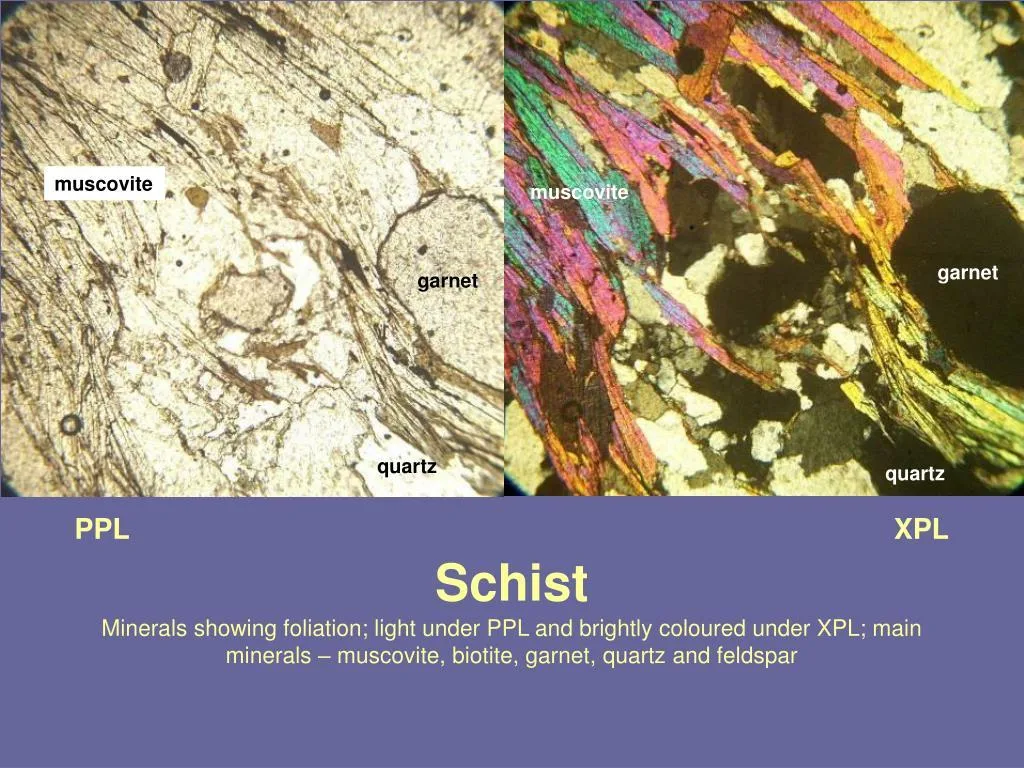
Plane-polarized light, commonly abbreviated PPL, is used when the lower polarizer is inserted and the upper analyzer is removed.
PPL is especially useful for examining mineral color, pleochroism, relief, cleavage, crystal shape, and inclusions.
Color Under PPL
Minerals may appear colorless or display characteristic colors under plane-polarized light.
Quartz, feldspar, and many other minerals commonly appear colorless in standard thin sections.
Biotite frequently appears brown or greenish brown, while some amphiboles display green, brown, or blue colors.
A mineral’s thin-section color may differ substantially from its appearance in a hand specimen because the section is extremely thin.
Relief
Relief describes how strongly mineral grain boundaries and surface imperfections stand out relative to their surroundings.
It is primarily influenced by differences between the refractive index of a mineral and that of the mounting medium or neighboring minerals.
Minerals with low relief blend visually into their surroundings.
Minerals with high relief appear more sharply outlined.
For example:
- Quartz: Generally low relief.
- Feldspar: Generally low relief.
- Pyroxene: Commonly moderate to high relief.
- Garnet: Commonly high relief.
Relief can be positive or negative relative to the mounting medium, and its apparent strength may vary with optical orientation.
Cleavage and Crystal Habit
Cleavage traces may appear as parallel lines or intersecting sets within a mineral grain.
These features can help distinguish minerals with similar colors.
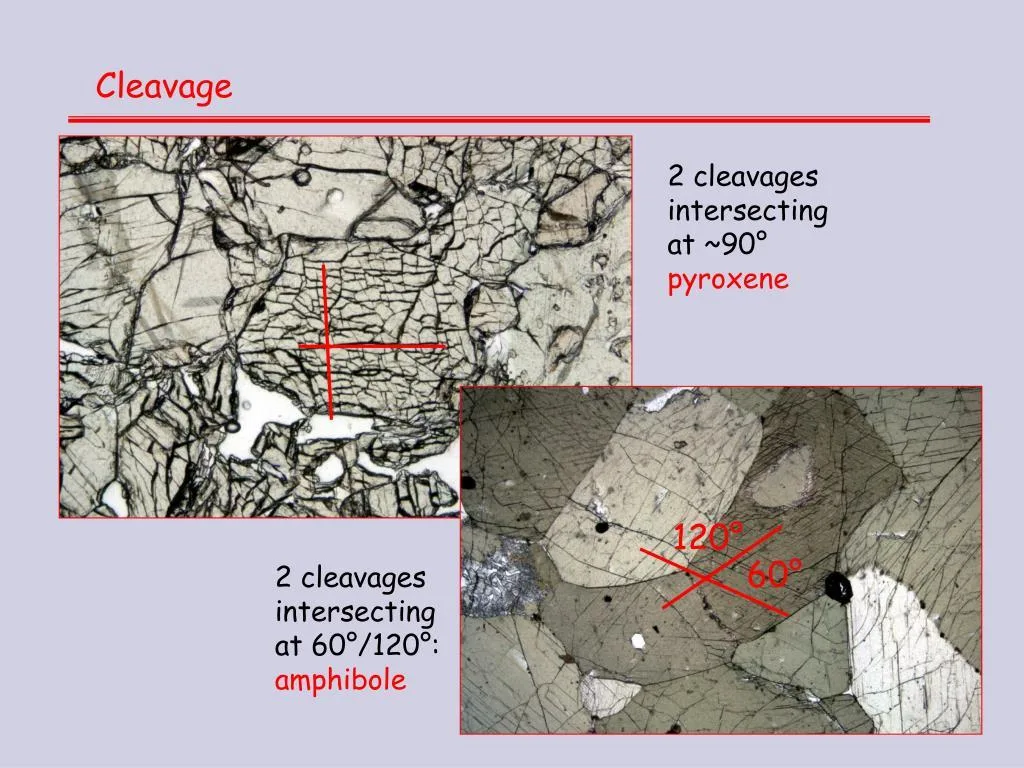
For example, many amphiboles display cleavage directions that intersect at approximately 56° and 124° in appropriately oriented sections.
Pyroxenes commonly show cleavage intersections close to 90°.
Crystal habit also provides useful evidence. Minerals may occur as elongated prisms, plates, irregular grains, or other recognizable forms.
However, the apparent shape of a mineral depends on how the three-dimensional crystal was cut by the thin section.
Pleochroism
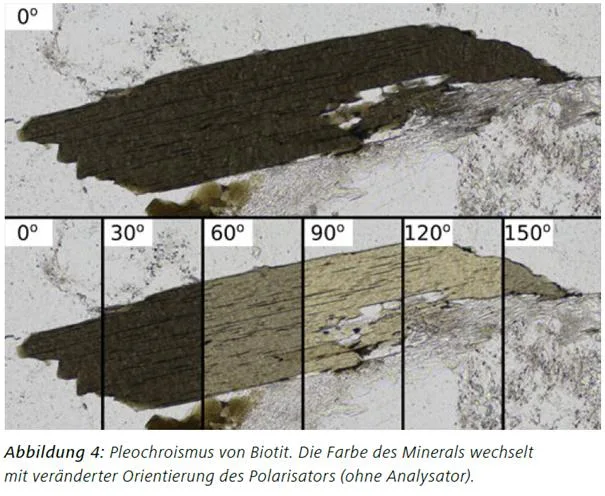
Pleochroism is a change in a mineral’s apparent color or color intensity as its orientation relative to polarized light changes.
It occurs because certain anisotropic minerals absorb light differently in different crystallographic directions.
To observe pleochroism, a geologist rotates the microscope stage under PPL.
A biotite crystal, for example, may change from relatively pale brown to dark brown during rotation.
Some amphiboles exhibit green, brown, or blue pleochroic colors.
Pleochroism is normally examined under PPL rather than XPL.
Cross-Polarized Light (XPL)
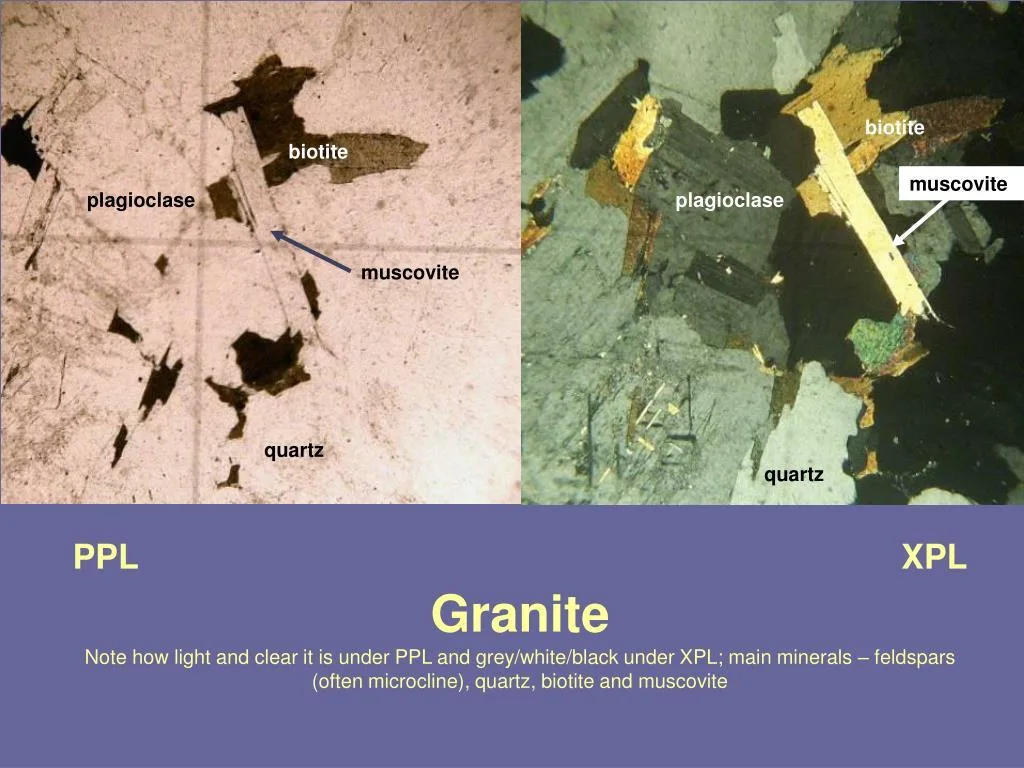
Cross-polarized light, abbreviated XPL or sometimes XP, is used when the analyzer is inserted perpendicular to the lower polarizer.
With no anisotropic specimen affecting the light, the crossed polarizers produce a dark field of view.
When an anisotropic mineral is present, it may modify the polarization of transmitted light, allowing some light to pass through the analyzer.
This produces interference colors and other characteristic optical effects.
What Can Be Observed Under XPL?
XPL is particularly useful for examining:
- Interference colors.
- Birefringence.
- Extinction behavior.
- Crystal twinning.
- Undulose extinction.
- Some internal crystal structures and zoning patterns.
The appearance of a mineral changes as the microscope stage rotates.
Many anisotropic mineral grains become dark at regular intervals and display their strongest interference colors between extinction positions.
PPL vs. XPL
| Feature | PPL | XPL |
|---|---|---|
| Analyzer | Removed | Inserted |
| Mineral body color | Usually observed clearly | May be obscured by interference effects |
| Relief | Easily observed | Less commonly assessed |
| Pleochroism | Observed by stage rotation | Not normally evaluated |
| Cleavage | Often clearly visible | May remain visible |
| Interference colors | Not produced in the usual crossed-polarizer sense | Commonly visible |
| Extinction | Not normally assessed | Important diagnostic feature |
| Twinning | Sometimes visible | Often especially clear |
Geologists routinely switch between PPL and XPL to build a more complete understanding of a mineral grain.
Isotropic vs. Anisotropic Minerals
Minerals are optically classified as isotropic or anisotropic according to how their refractive behavior varies with direction.
Isotropic Minerals
Isotropic minerals have the same refractive index in every optical direction.
Minerals belonging to the cubic crystal system are optically isotropic under ideal conditions.
Examples include garnet, spinel, and fluorite.
Transparent isotropic minerals can transmit light under PPL.
However, under ideal crossed-polarizer conditions, they remain dark as the microscope stage rotates because they do not produce birefringence.
Strain and other internal effects may occasionally create anomalous optical behavior.
Anisotropic Minerals
Anisotropic minerals have optical properties that depend on the direction in which light travels through the crystal.
They include minerals in the trigonal, tetragonal, hexagonal, orthorhombic, monoclinic, and triclinic crystal systems.
Quartz, calcite, feldspar, mica, amphibole, and pyroxene are familiar examples.
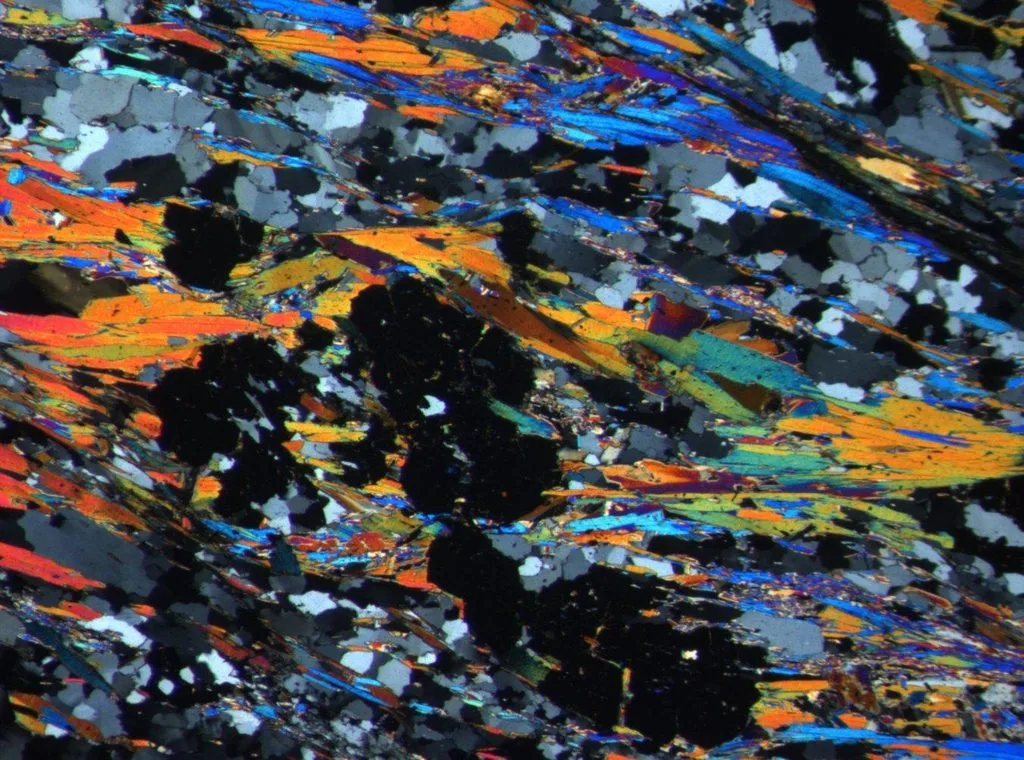
Anisotropic minerals commonly display interference colors and extinction under XPL.
However, a section viewed along an optic axis can show little or no birefringence and may remain dark under crossed polarizers.
Isotropic vs. Anisotropic Comparison
| Property | Isotropic | Anisotropic |
|---|---|---|
| Refractive behavior | Direction-independent | Direction-dependent |
| Birefringence | Ideally zero | Generally present except in special orientations |
| Appearance under PPL | May be transparent or colored | May be transparent or colored |
| Appearance under XPL | Usually remains dark | Often displays interference colors |
| Examples | Garnet, spinel | Quartz, calcite, biotite |
Refractive Index and the Becke Line
The refractive index describes the relationship between the speed of light in a vacuum and its phase velocity within a material.
It is one of the fundamental optical properties used in mineral identification.
Refractive indices vary among minerals and may depend on chemical composition, wavelength, and optical direction.
The Becke Line Test
The Becke line is a bright line that may appear near a boundary between materials with different refractive indices.
It can be used to compare the refractive indices of adjacent minerals or a mineral and its mounting medium.
In the conventional Becke line test, when the microscope is focused upward by increasing the distance between the objective and specimen, the Becke line generally moves toward the material with the higher refractive index.
When the focus is moved in the opposite direction, the line moves toward the material with the lower refractive index.
Correctly interpreting this movement requires knowing the microscope’s focusing direction and using suitable illumination.
The test is especially useful when two nearly colorless minerals have similar appearances.
Birefringence and Interference Colors
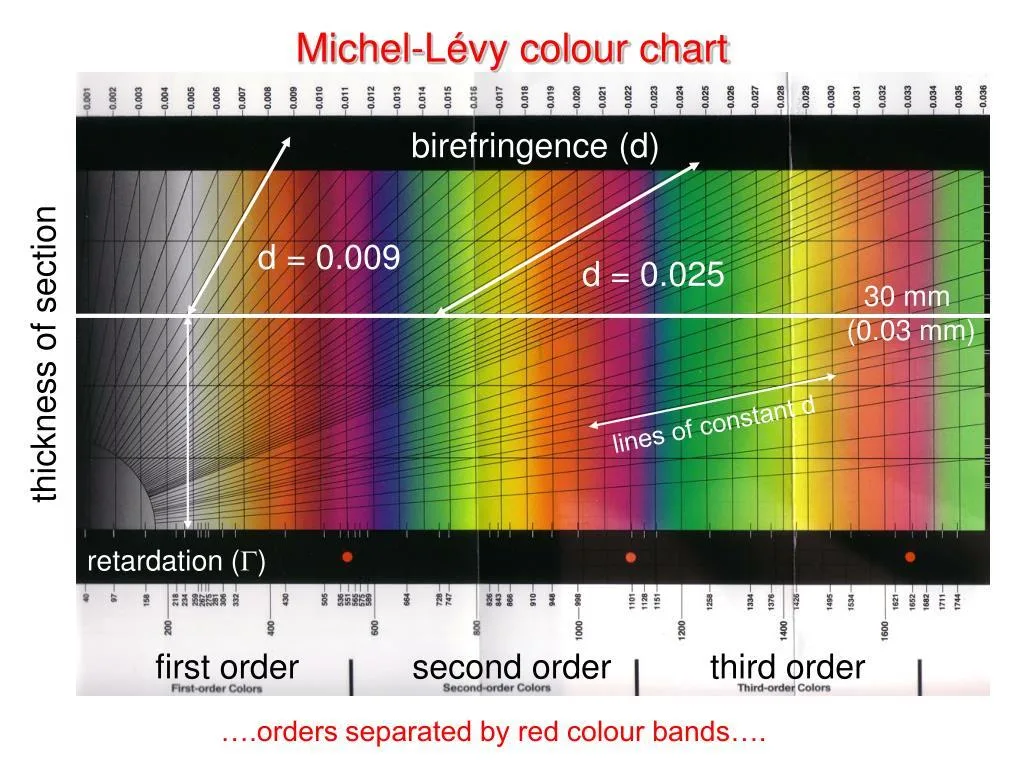
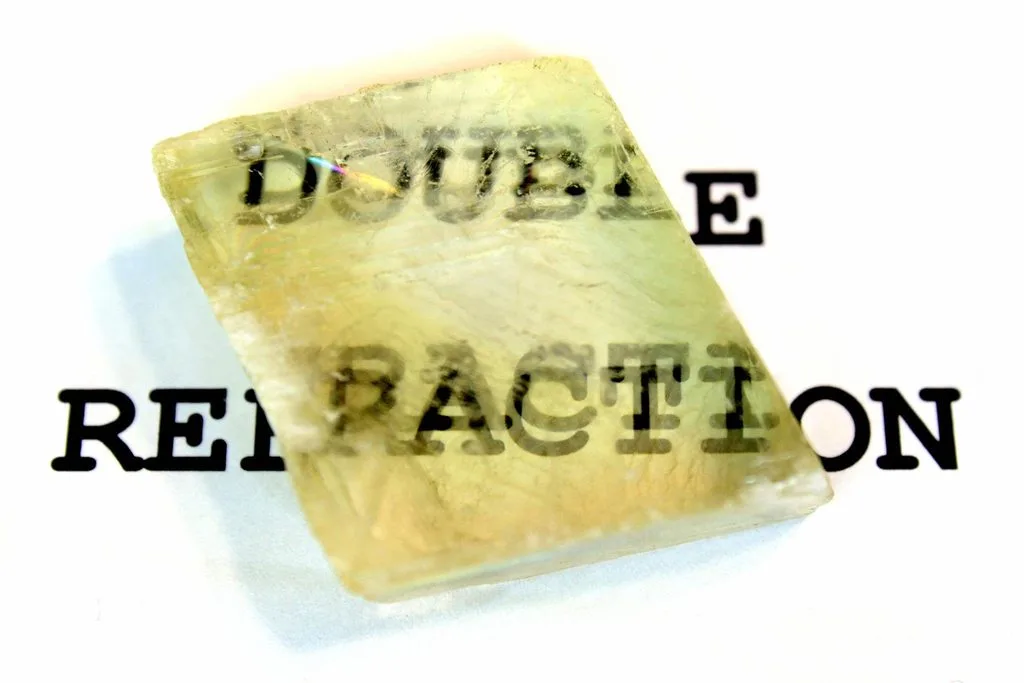
Birefringence is the difference between the refractive indices experienced by two permitted vibration directions in an anisotropic mineral.
When polarized light enters an appropriately oriented anisotropic crystal, two wave components can travel with different phase velocities.
As they pass through the mineral, they develop a phase difference.
When these components are recombined through the analyzer, they can produce interference colors.
What Controls Interference Colors?
The observed interference colors depend mainly on:
- The birefringence of the mineral in the observed orientation.
- The thickness of the mineral section.
- The orientation of the crystal relative to the light path.
The optical retardation can be expressed as:
Retardation = Thickness × Effective Birefringence
This relationship explains why minerals of similar thickness can display different interference colors.
Low-Order and High-Order Interference Colors
Minerals with low birefringence commonly display low-order interference colors.
Quartz and many feldspars usually exhibit gray to white first-order colors in standard thin sections.
Minerals with higher birefringence may display more vivid or higher-order colors.
Calcite, for example, commonly produces high-order interference colors.
Individual grains of the same mineral can display different colors because their crystallographic orientations differ.
The Michel-Lévy Interference Color Chart
The Michel-Lévy chart relates interference colors, optical retardation, birefringence, and section thickness.
For a standard thin section of approximately 30 µm, it helps estimate mineral birefringence from observed interference colors.
However, interference colors can be affected by crystal orientation, variations in section thickness, and the mineral’s own absorption.
The chart therefore provides estimates rather than a complete mineral identification by itself.
Extinction and Extinction Angles
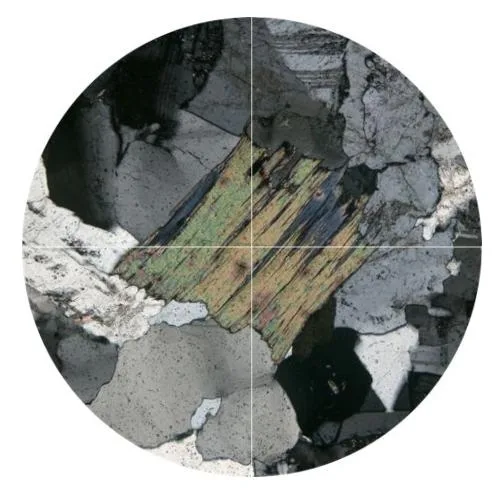
Extinction occurs when an anisotropic mineral grain becomes dark under crossed polarizers at particular stage orientations.
During a full 360° stage rotation, a typical anisotropic grain reaches extinction four times, with successive positions separated by approximately 90°.
The relationship between extinction positions and recognizable crystal directions can help identify minerals.
Parallel Extinction
Parallel extinction occurs when a mineral becomes dark as a recognizable crystallographic direction, such as cleavage or elongation, aligns with a microscope crosshair.
It is common in suitable sections of several minerals, including many orthorhombic minerals.
The exact behavior depends on the orientation of the section.
Inclined Extinction
Inclined extinction occurs when the mineral becomes dark at an angle to a reference direction such as cleavage or crystal elongation.
Many monoclinic minerals show inclined extinction in appropriate sections.
Some amphiboles and pyroxenes exhibit distinctive extinction angles useful for petrographic identification.
Symmetrical Extinction
Symmetrical extinction describes situations where the extinction direction is symmetrically related to two equivalent crystallographic directions or cleavage traces.
It may be observed in suitably oriented sections of several minerals.
Undulose Extinction
Undulose extinction occurs when different parts of a crystal become dark at slightly different stage positions.
Instead of extinguishing uniformly, the grain shows a sweeping or wavy pattern of darkness.
This feature is common in some strained quartz crystals and may indicate crystal deformation.
However, undulose extinction alone is not sufficient to reconstruct a complete deformation history.
Crystal Twinning and Zoning
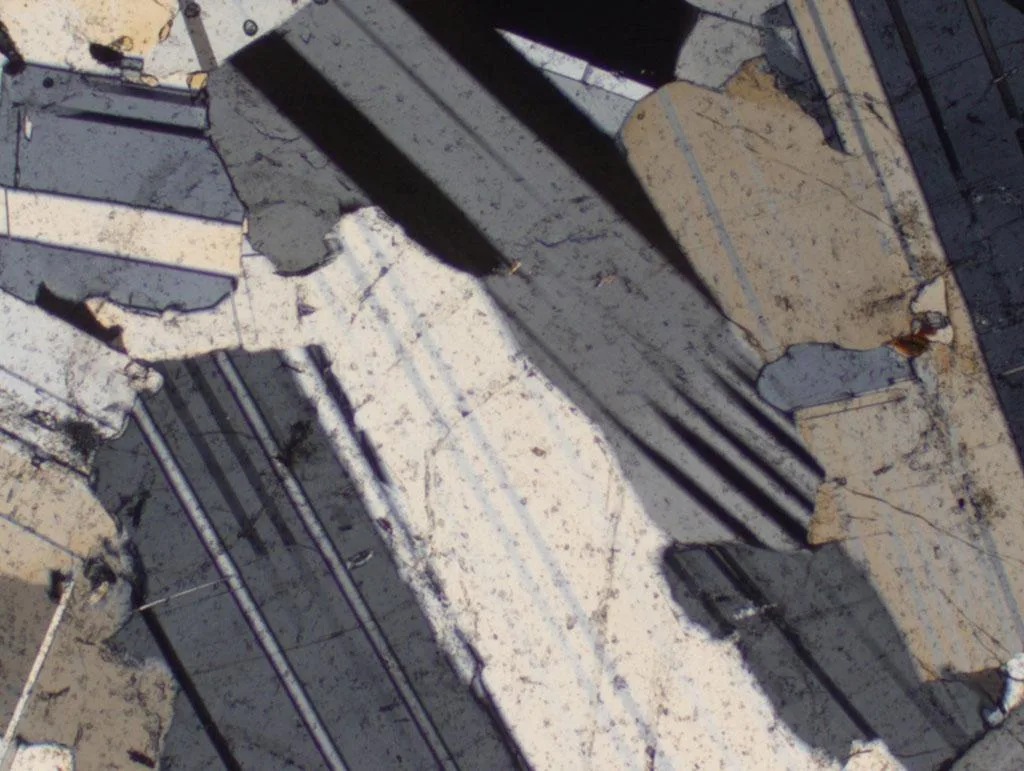
Crystal twinning occurs when two or more domains of a crystal share a specific crystallographic relationship.
Twinning may be formed during crystal growth, transformation, or deformation.
Under XPL, twin domains can show different interference intensities or extinction positions.
Polysynthetic Twinning in Plagioclase
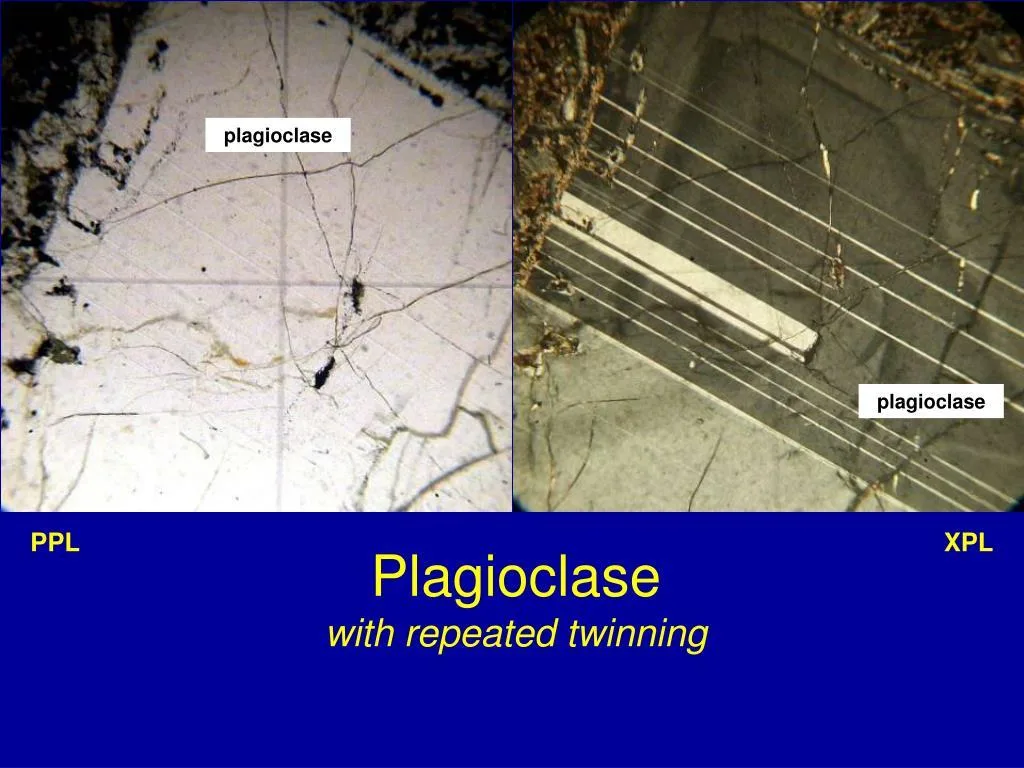
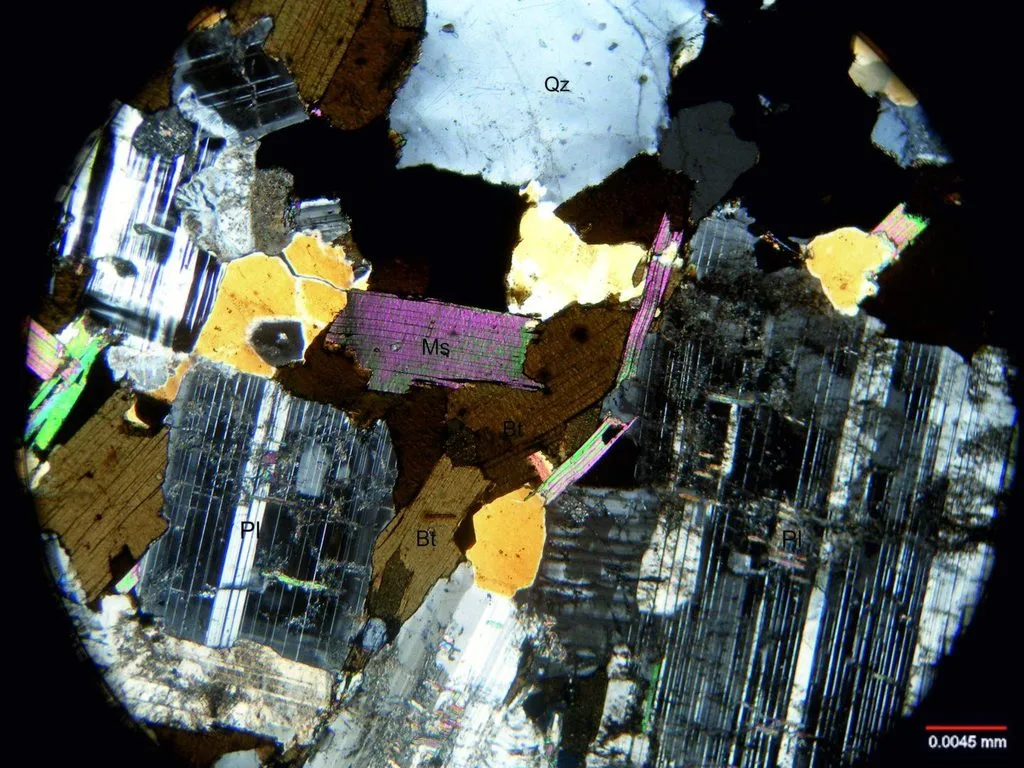
Plagioclase feldspar commonly displays repeated parallel twin lamellae.
Under crossed polarizers, these lamellae may appear as alternating light and dark bands.
This feature is particularly useful for distinguishing plagioclase from some other colorless minerals.
The appearance of the bands changes as the microscope stage rotates.
Other Twinning Patterns
Other minerals may display simple, repeated, or cross-hatched twinning patterns.
Microcline feldspar is well known for its characteristic cross-hatched, or tartan, twinning under XPL in suitable orientations.
Crystal Zoning
Crystal zoning occurs when the chemical composition or other internal characteristics of a growing mineral change over time.
Plagioclase commonly shows compositional zoning associated with changes in magma chemistry and crystallization conditions.
Zoning may be visible through differences in optical properties, interference colors, or extinction behavior.
Twinning and zoning are different phenomena, although both can appear as internal patterns within a crystal.
Uniaxial and Biaxial Minerals
Anisotropic minerals are classified optically as uniaxial or biaxial.
Uniaxial Minerals
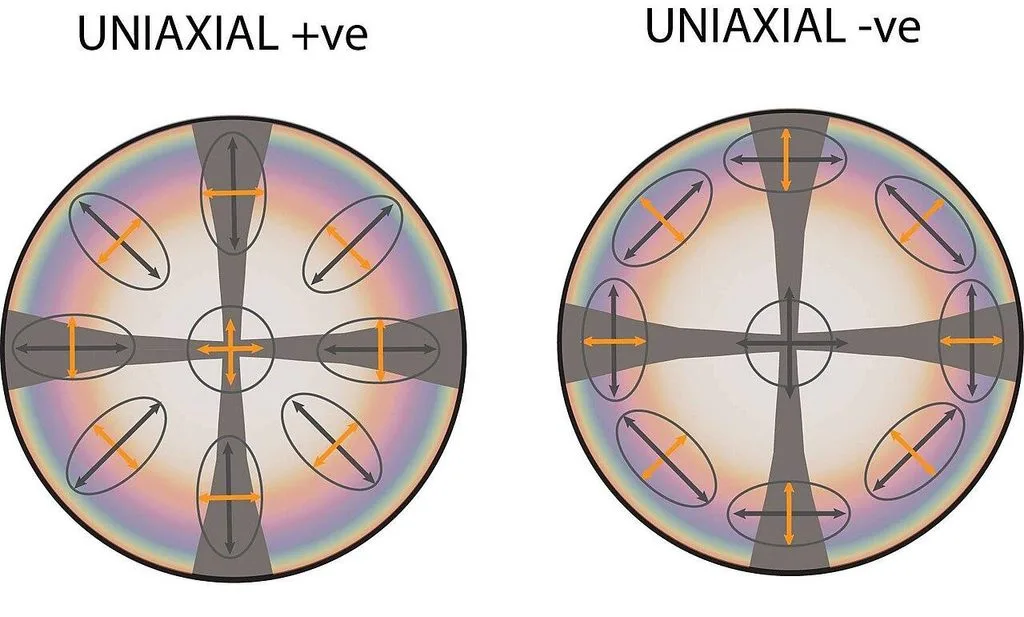
Uniaxial minerals have one optic axis.
Minerals belonging to the trigonal, tetragonal, and hexagonal crystal systems are generally optically uniaxial.
Quartz and calcite are examples.
They are also classified as optically positive or negative according to the relationship between their ordinary and extraordinary refractive indices.
Biaxial Minerals
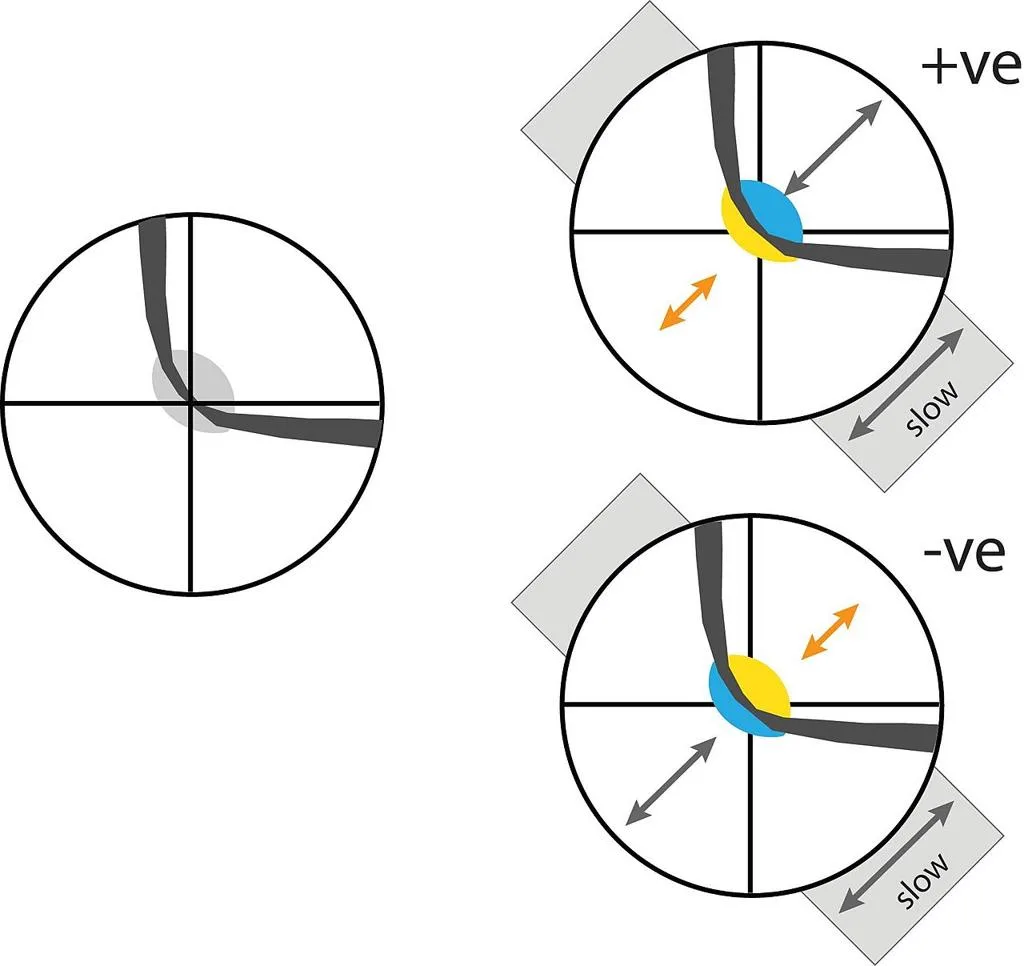
Biaxial minerals have two optic axes.
Minerals belonging to the orthorhombic, monoclinic, and triclinic crystal systems are generally optically biaxial.
Many feldspars, amphiboles, pyroxenes, and micas are examples.
Their optical behavior can be described using three principal refractive indices.
Interference Figures
Uniaxial and biaxial optical behavior can be examined using conoscopic illumination and suitable microscope accessories.
The resulting interference figures contain characteristic dark bands and colored patterns.
These features help determine optic-axis orientation, optical character, and optical sign.
Because interference-figure analysis requires specialized microscope settings and careful interpretation, it is generally introduced after basic PPL and XPL observations.
Optical Properties of Common Minerals
The following table summarizes typical features of several important rock-forming minerals.
These are general identification clues rather than absolute rules for every composition or crystal orientation.
| Mineral | Typical PPL appearance | Typical XPL appearance | Useful diagnostic clue |
|---|---|---|---|
| Quartz | Colorless, low relief, no cleavage | Low first-order gray to white | Undulose extinction may occur |
| Plagioclase | Colorless, low relief | Low-order colors, commonly twinned | Polysynthetic twinning |
| K-feldspar | Colorless, low relief | Low-order colors | Microcline may show tartan twinning |
| Calcite | Colorless, high and variable relief | High-order interference colors | Very high birefringence |
| Biotite | Brown or greenish, commonly pleochroic | Moderate to high interference colors, sometimes masked by body color | One prominent cleavage |
| Amphibole | Green, brown, or blue in many species | Variable colors, often inclined extinction | Cleavage near 56° and 124° |
| Pyroxene | Colorless to pale green or brown | Commonly first- to second-order colors | Cleavage intersections close to 90° |
| Garnet | Commonly colorless to pale, high relief | Usually dark under XPL | Optical isotropy |
Mineral chemistry, optical orientation, alteration, and section thickness may modify these appearances.
How to Identify Minerals in Thin Section
Mineral identification is most reliable when observations are made systematically.
Step 1: Begin With PPL
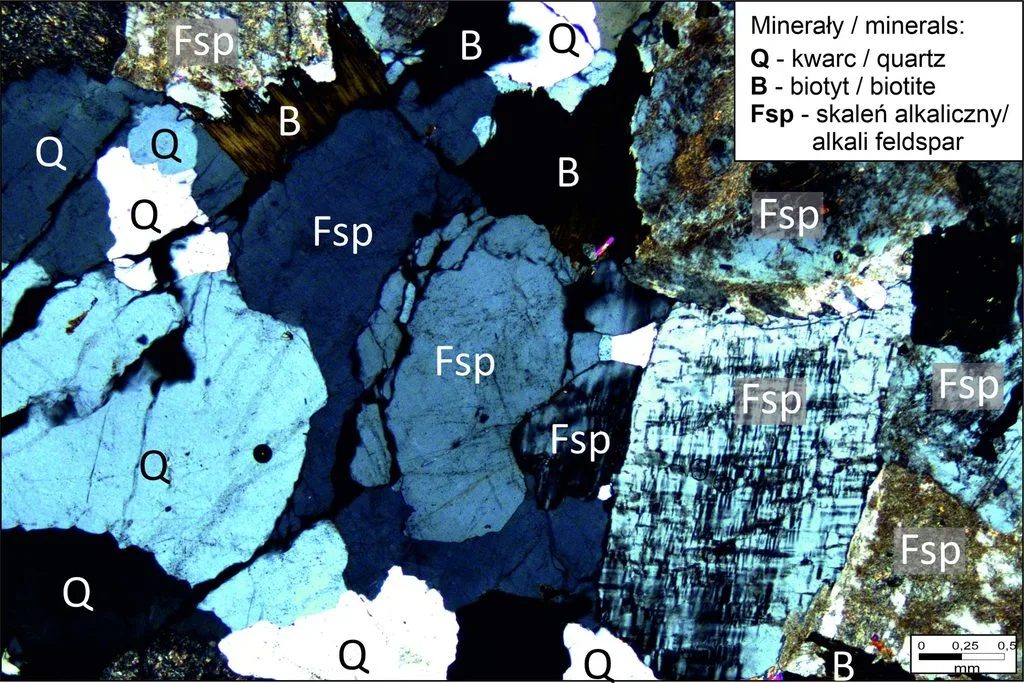
Examine the general rock texture and locate recognizable mineral grains.
Record color, crystal habit, cleavage, relief, and any visible inclusions.
Step 2: Rotate the Stage Under PPL
Look for changes in mineral color or intensity that indicate pleochroism.
This is particularly useful for colored minerals such as biotite and some amphiboles.
Step 3: Switch to XPL
Insert the analyzer and examine interference colors.
Determine whether a grain behaves as isotropic or anisotropic.
Step 4: Observe Extinction
Rotate the stage to identify extinction positions.
Compare extinction directions with cleavage traces or crystal elongation where possible.
Step 5: Examine Twinning and Zoning
Look for repeated twin lamellae, cross-hatched patterns, or compositional zoning.
These features can help distinguish feldspars and other minerals.
Step 6: Consider Mineral Associations
Examine surrounding grains and the overall rock texture.
For example, quartz and feldspar are common in granitic rocks, while amphibole and plagioclase may occur together in amphibolite.
Mineral associations provide useful geological context but do not replace optical observations.
Step 7: Confirm the Identification
Compare the observed characteristics with trusted optical mineralogy references.
When necessary, use interference figures, accessory plates, or laboratory methods such as electron microscopy and mineral chemistry.
A reliable identification should be consistent with multiple observations.
Why Optical Mineralogy Is Important
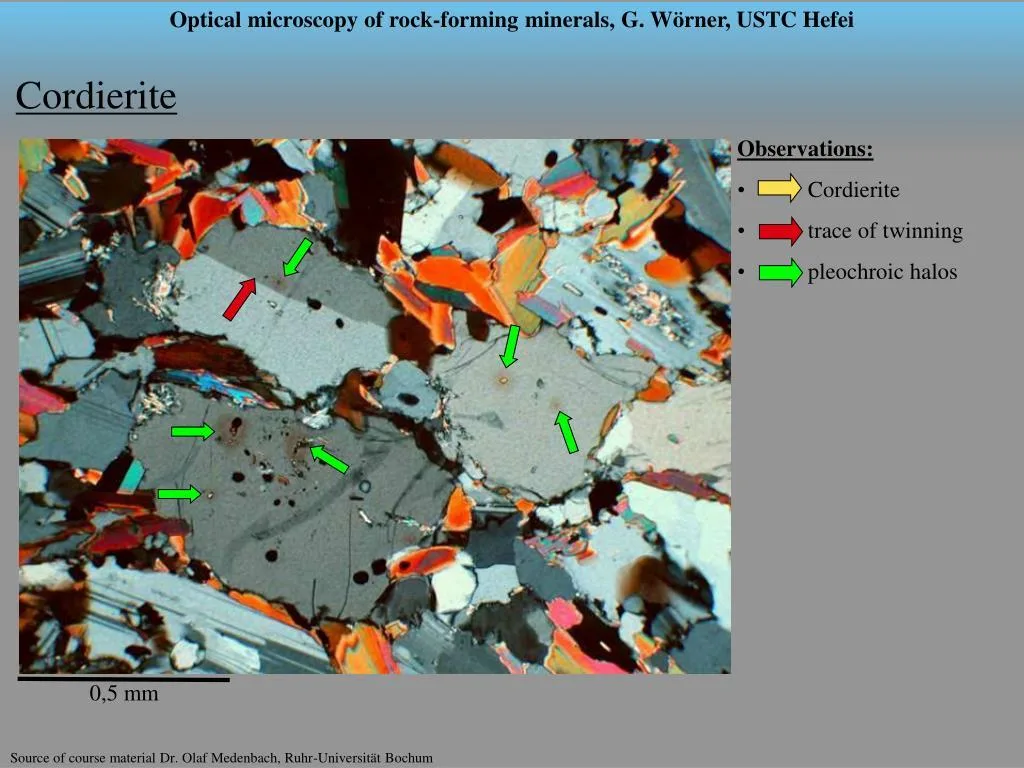
Optical mineralogy is a fundamental tool in petrology, geological mapping, and mineral research.
Igneous Petrology
Thin-section observations help identify mineral assemblages, crystal textures, and relationships between early and late crystallizing minerals.
This information supports the classification and interpretation of igneous rocks.
Metamorphic Petrology
Optical mineralogy helps recognize minerals, recrystallization, foliation, deformation features, and mineral reactions.
These observations are essential for investigating metamorphic conditions and geological history.
Sedimentary Petrology
Thin sections help geologists identify detrital grains, mineral cements, pore spaces, and diagenetic textures.
These characteristics provide evidence of sediment provenance, transport, deposition, and alteration after burial.
Economic and Engineering Geology
Petrographic examination can identify minerals and textures relevant to ore deposits, aggregate quality, rock durability, and engineering behavior.
In some applications, additional analytical techniques are needed to confirm mineral species and assess hazards.
Frequently Asked Questions About Optical Properties of Minerals
What are the optical properties of minerals?
They are characteristics describing how minerals interact with light, including refractive index, relief, pleochroism, birefringence, interference colors, and extinction.
What is the difference between PPL and XPL?
PPL uses a single polarizer and is useful for examining color, relief, pleochroism, and cleavage. XPL uses crossed polarizers and reveals interference colors, extinction, and many twinning patterns.
Why do minerals show different colors under XPL?
Anisotropic minerals change the relative phase of polarized light components, producing interference colors determined by birefringence, thickness, and crystal orientation.
Do isotropic minerals appear black under PPL?
No. Transparent isotropic minerals may transmit light under PPL. They generally remain dark under XPL in ideal conditions.
What is birefringence?
Birefringence is the difference between refractive indices for different vibration directions in an anisotropic mineral.
Why is a standard thin section about 30 µm thick?
This thickness allows transmitted light to pass through many common minerals while providing consistent optical conditions for comparing interference colors.
What is mineral relief?
Relief describes how strongly a mineral grain stands out from its surroundings, mainly because of refractive-index differences.
What is pleochroism?
Pleochroism is a change in a mineral’s apparent color or absorption when its orientation relative to polarized light changes.
What is extinction under crossed polarizers?
Extinction is the darkening of an anisotropic mineral grain at particular orientations under XPL.
Why does plagioclase show stripes under XPL?
Plagioclase commonly develops polysynthetic twins whose domains show different brightness or extinction behavior under crossed polarizers.
Which minerals remain dark under crossed polarizers?
Optically isotropic minerals such as garnet usually remain dark. Anisotropic minerals viewed along an optic axis can also appear dark.
Can every mineral be identified using optical microscopy?
No. Some minerals have overlapping optical properties, and very fine-grained or altered specimens can be difficult to identify. Additional analytical methods may be required.
Conclusion
The optical properties of minerals reveal valuable information about their crystal structures, chemical compositions, and geological histories.
Plane-polarized light provides observations of color, pleochroism, relief, and cleavage, while crossed-polarized light reveals interference colors, extinction, twinning, and other optical features.
By combining these observations, geologists can distinguish minerals that appear similar in hand specimens and investigate the textures and processes preserved within rocks.
Understanding optical mineralogy is an essential step toward interpreting igneous, sedimentary, and metamorphic rocks through petrographic microscopy.
Scientific References and Further Reading
- Raith, M. M., Raase, P., and Reinhardt, J. (2012). Guide to Thin Section Microscopy. Mineralogical Society of America. https://www.minsocam.org/msa/OpenAccess_publications/Guide_Thin_Sctn_Mcrscpy/Thin_Sctn_Mcrscpy_1_prnt_eng.pdf
- The Open University. An Introduction to Minerals and Rocks Under the Microscope. https://www.open.edu/openlearn/science-maths-technology/an-introduction-minerals-and-rocks-under-the-microscope/content-section-0/
- University of Granada. Optical Mineralogy – OpticalMine. https://edafologia.ugr.es/optmine/indexw.htm
- Geosciences LibreTexts. Optical Mineralogy. https://geo.libretexts.org/Bookshelves/Geology/Mineralogy_%28Perkins_et_al.%29/05%3A_Optical_Mineralogy
- Nesse, W. D. (2013). Introduction to Optical Mineralogy, 4th Edition. Oxford University Press.