



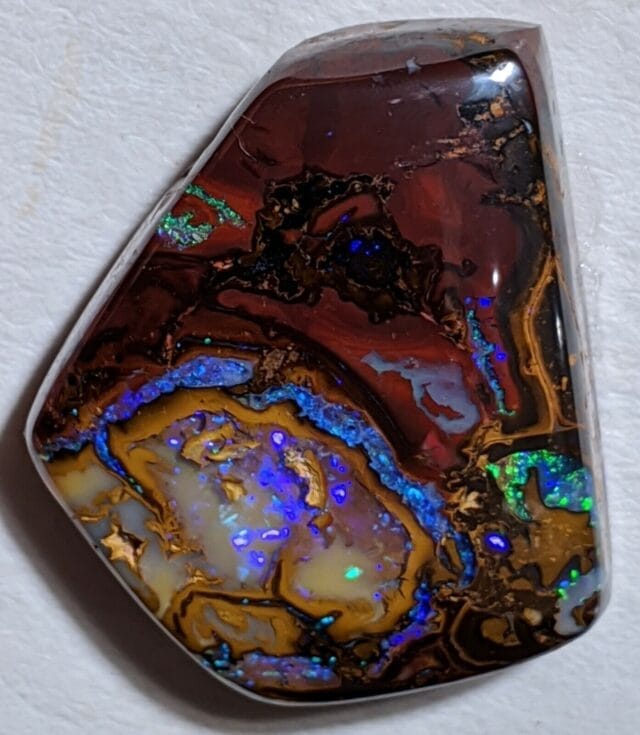
The Hidden Colorful Evolution Inside Australia’s Ironstone
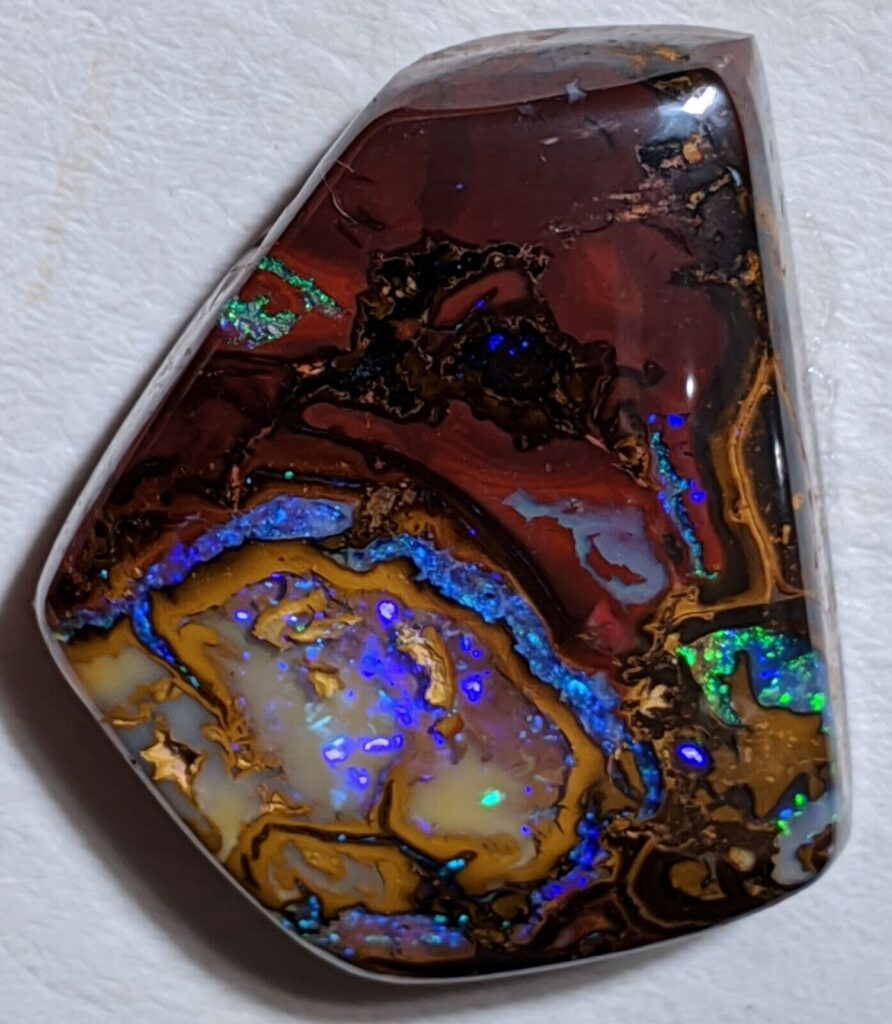
Yowah Opal looks like an ordinary stone from the outside; brown, matte, heavy and quiet. But once it is opened, a completely different world appears. It is as if the inside of the stone bursts open and colors erupt from within: red, green, blue, purple, gold tones… all shimmering on the dark background of ironstone.
For many people, Yowah Opal is not just a gemstone but one of nature’s hidden artworks.
But for a geology website, the value of this stone is not only in its beauty. Its worth lies in how it formed, what geological processes shaped it, what properties it carries, what patterns it displays, and the scientific story behind it.
1. What Is Yowah Opal?
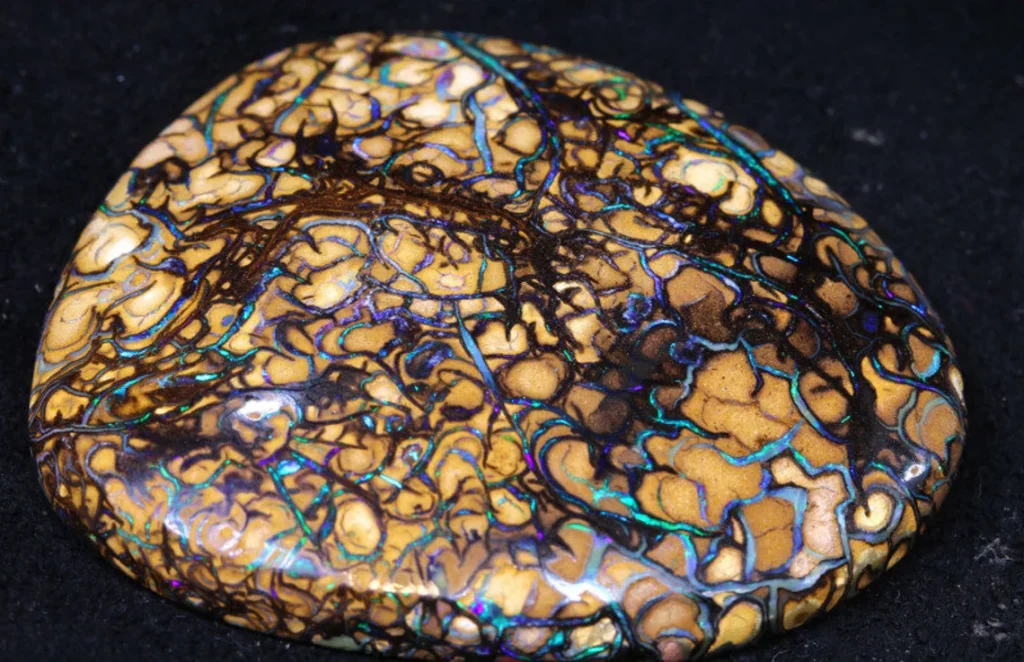
Yowah Opal is a type of matrix opal found in the Yowah region of Queensland, Australia.
“Matrix opal” means that opal does not occur as an independent mass but instead forms inside ironstone, appearing as veins, pockets, mosaics or flashes inside the host rock.
The distinguishing features of Yowah Opal are:
- It is found inside natural concretions (nuts).
- The dark ironstone background dramatically enhances the colors.
- Internal patterns are incredibly unique; no two stones look alike.
- Its play of color can be strong and often appears even more intense thanks to the contrast.
What makes Yowah Opal special is the combination of geological complexity and visual beauty inside a single stone.
2. How Does Yowah Opal Form?
The formation of Yowah Opal is geologically fascinating because multiple rare processes come together.
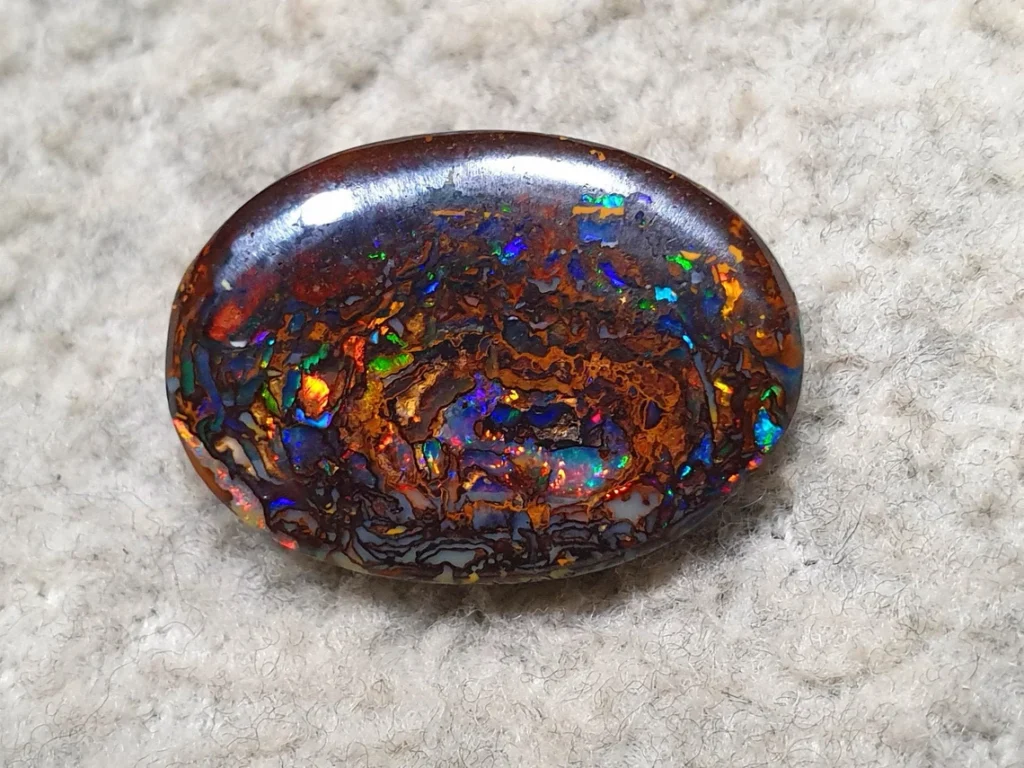
A) Sediments of ancient inland seas
Millions of years ago, the region now known as Yowah was covered by a vast inland sea. As the sea retreated, layers of:
- sand,
- clay,
- iron-rich mud,
- fine mineral particles
accumulated.
These sediments compacted over time and formed ironstone concretions.
These concretions act as the “shell” of Yowah Opal.
B) Silica-rich groundwater
Over time, surrounding rocks weathered and released silica into groundwater.
This silica-rich water seeped into:
- cracks,
- micro spaces,
- porous zones
inside the concretions.
C) Slow transformation of silica into opal
Through countless cycles of heating, cooling, evaporation and refilling underground, the water left behind tiny amounts of silica after each cycle.
This silica:
- turned into millions of tiny spheres,
- arranged themselves in layers,
- created a microstructure capable of diffracting light,
- and eventually became opal.
When these silica spheres line up in an orderly way, play of color appears.
D) Ironstone matrix intensifying the opal
The most striking feature of Yowah Opal is its dark brown ironstone matrix.
This matrix:
- enhances the brightness of opal
- makes the play of color more visible
- increases the contrast of red, blue and green flashes
This is why Yowah Opal often looks more dramatic than lighter opal varieties.
3. Geologic Setting
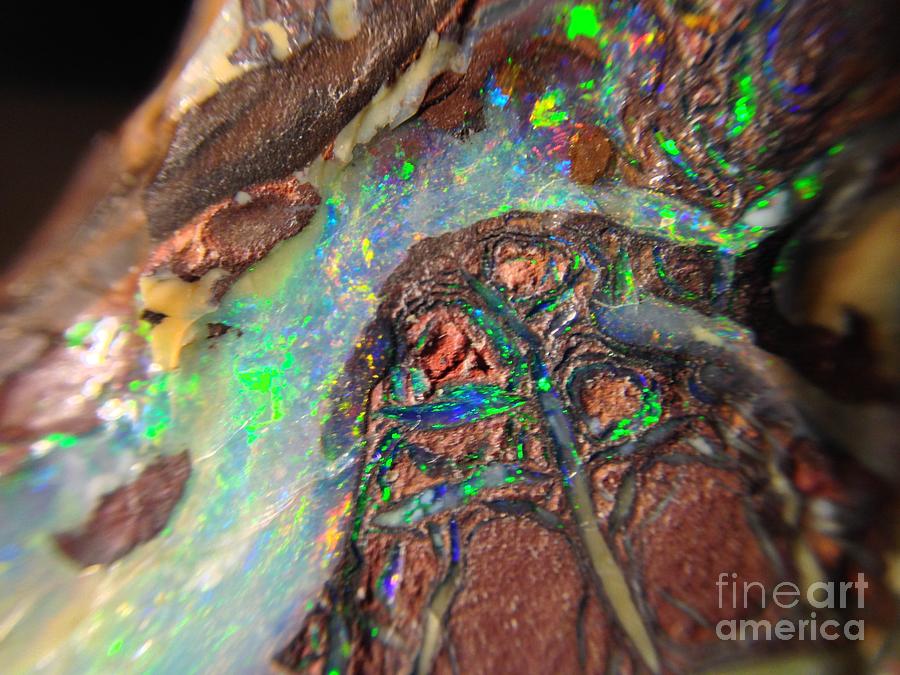
The Yowah region sits on Australia’s well-known “Opal Belt.”
This belt has ideal conditions for opal formation:
- abundant silica sources
- active groundwater movement
- porous sediment layers
Yowah’s unique feature is the abundance of ironstone concretions, which act as natural containers that trap silica solutions inside.
Geologically, the region is a remarkable intersection of:
- ancient sea beds
- iron oxide-rich sediments
- fluctuating groundwater
- silica circulation
All of which play a role in opal formation.
4. Physical Properties of Yowah Opal
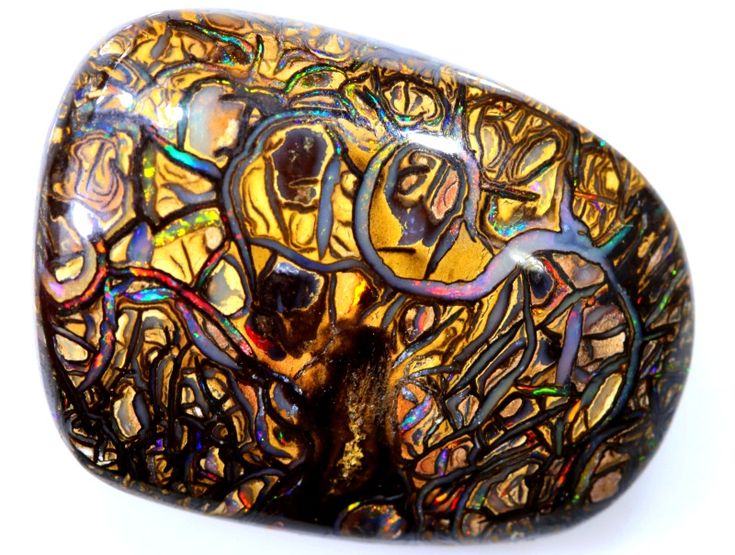
Chemical Composition:
SiO₂·nH₂O (hydrated silica)
Hardness:
5.5 – 6.5 on the Mohs scale
Density:
Higher than most opals due to the heavy ironstone matrix.
Color:
Can show a wide range of play of color: red, green, blue, purple, gold and more.
Transparency:
- Opal pockets are transparent or translucent,
- the matrix is opaque,
- some areas appear completely opaque.
Fracturing:
Opal is naturally fragile, but the ironstone matrix makes Yowah Opal slightly more durable.
5. Pattern Types

The internal patterns of Yowah Opal are among the most searched and most captivating features.
Each pattern reflects a different geological process.
Ring Pattern
Opal forms a circular band along the inner wall of the concretion.
This happens when silica solutions accumulate right at the boundary.
Mosaic Pattern
Repeated filling of micro-cracks inside the ironstone creates separated pieces of opal.
The result is a natural mosaic effect.
Vein Pattern
Silica moves through cracks and solidifies as thin opal veins.
These veins can look like lightning bolts inside the stone.
Spiderweb Pattern
A network of micro-cracks becomes completely filled with opal, forming a web-like pattern.
Galaxy Pattern
Slowly filled opal pockets create nebula-like, cloud-like patches that resemble deep-space views.
Picture Stone Pattern
Random mineral distributions sometimes create images that look like landscapes or silhouettes.
6. Where Is Yowah Opal Found?
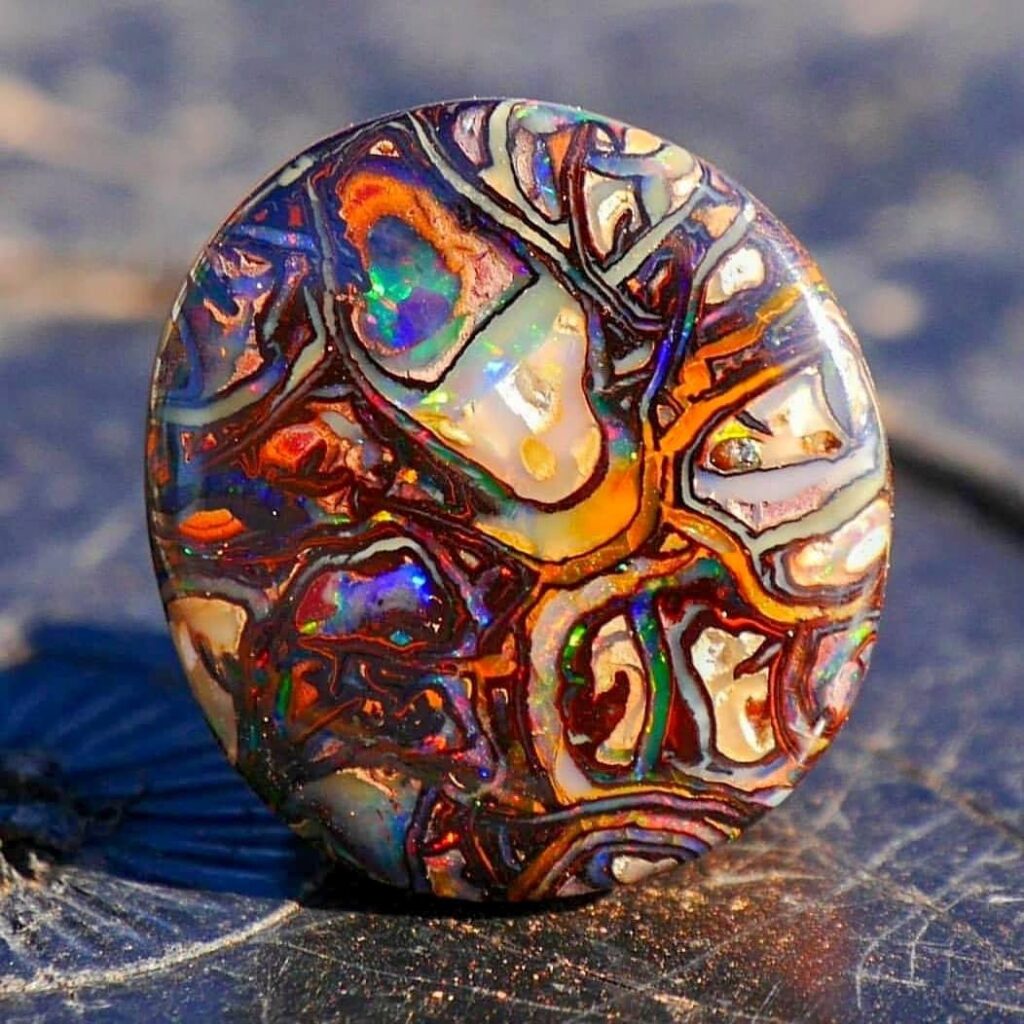
Yowah Opal occurs only in the Yowah area of Queensland, Australia.
Its geographical distribution is extremely limited.
The opal is usually found:
- deep underground,
- inside ironstone concretions,
- through labor-intensive hand sorting and cutting.
While other regions may produce matrix opal, none match the density, complexity and beauty of Yowah Opal.
7. Why Is It Rare?
Three major reasons explain its rarity:
- It forms only in the Yowah district.
- Most concretions are empty and contain no opal.
- Opalization requires thousands to millions of years.
Because of this, high-quality Yowah Opal is increasingly valuable.
8. Value – Price – Collecting
Several factors determine the value of a Yowah Opal:
- strength of play of color
- variety of colors (red is the rarest and most valuable)
- rarity of pattern
- size and usable surface area
- absence of cracks
- strong contrast between opal and matrix
Full-face opals are the most valuable type.
Collectors also look for:
- whole concretions
- sliced slabs
- polished cabochons
- unique pattern specimens
9. Real vs Fake (How to Identify)
Fake Yowah Opal is becoming increasingly common.
Real Yowah Opal can be recognized by:
- natural ironstone matrix (not painted)
- angle-dependent color play
- organic and irregular mosaic patterns
- natural weight due to the matrix
- no glue lines or inserted plates
Fakes often involve:
- resin coatings
- dyed matrix
- lab-made opal
- thin opal sheets glued onto ironstone
10. Lapidary Use
Lapidary artists appreciate Yowah Opal because:
- the matrix provides stability
- it takes a strong polish
- internal patterns inspire creative designs
- freeform shapes work beautifully
Cutting requires care because:
- some opal pockets may be hollow
- heat can damage the opal
- edges can fracture if over-pressured
11. Metaphysical Beliefs
Although not scientific, many people are curious about the symbolic meaning of Yowah Opal.
Common beliefs include:
- enhancing creativity
- helping with emotional openness
- strengthening intuition
- grounding negative energy
- supporting transformation and change
These ideas come from cultural traditions, not geology.
12. Conclusion
Yowah Opal is far more than a gemstone.
It is a geological story carried from ancient seas to the modern age, a natural artwork shaped through millions of years, and a rare creation combining the strength of ironstone with the brilliance of opal.
Its value comes from:
- the unique ironstone matrix
- the vibrant play of color
- the one-of-a-kind internal patterns
- the extreme rarity of its location
- the long geological timeline required to form it
From a geological perspective, Yowah Opal represents the perfect intersection of groundwater movement, silica precipitation, sedimentation and concretion formation.
From an artistic perspective, it is nature’s patient masterpiece.