








Silicate Minerals
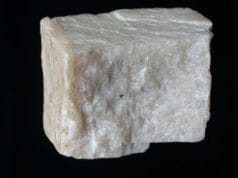
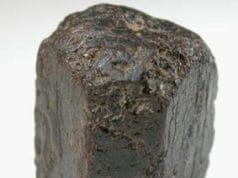
Silicate minerals are by far the most abundant minerals on our planet, forming in effect the vast bulk of Earth’s crust and mantle thanks to their fundamental silicon-oxygen tetrahedral unit (SiO₄) and its countless ways of linking, sharing oxygens and accommodating various metal cations—whether magnesium, iron, aluminium, sodium or potassium. In simpler terms: you have tiny SiO₄ tetrahedra that may float alone (as in olivine), link into chains (pyroxenes), double-chains (amphiboles), sheets (micas and clays) or full 3-D frameworks (feldspars and quartz), and every structural variation changes how the mineral behaves, where it forms and how it breaks apart or weathers. Because silicates are so versatile, they show up in igneous, metamorphic and sedimentary rocks, drive engineering and geotechnical issues (think: clay swelling, feldspar weathering), and carry stories of tectonics, temperature, pressure and fluid flows. In this category you'll explore not just the chemistry and crystal architectures of silicates, but also how recognizing groups like olivine, pyroxene, mica or feldspar in the field or core can tell you about geological history, site behaviour or material performance—and why as a geologist, engineer or site-practitioner this matters deeply.
Astrophyllite
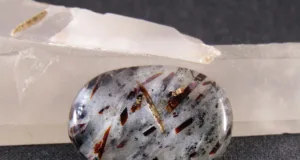
Astrophyllite is a rare and unique mineral that belongs to the group of complex silicate minerals. Its name is derived from the Greek words...
Benitoite
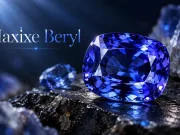
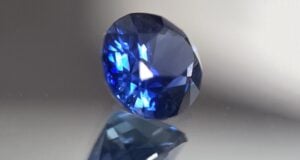
Benitoite, a strikingly beautiful and rare gemstone, is celebrated for its vibrant blue hues and intriguing geological origin. First discovered in California, this gemstone...
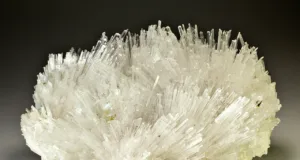
Scolecite
Scolecite is a mineral that belongs to the zeolite group, which is a group of tectosilicate minerals characterized by a three-dimensional framework of tetrahedrons....
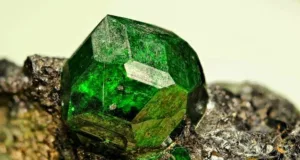
Uvarovite
Uvarovite is a rare and valuable member of the garnet mineral group. It is named after Russian statesman and mineral collector Count Sergey Semenovitch...
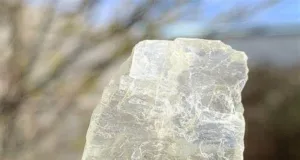
Hiddenite
Hiddenite is a fascinating gemstone that belongs to the mineral family of spodumene. It is a green variety of spodumene and is named after...
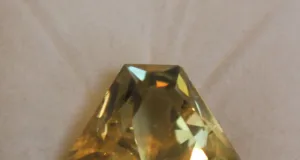
Bytownite
Bytownite is a mineral that belongs to the plagioclase feldspar group, which is a class of rock-forming minerals commonly found in igneous and metamorphic...
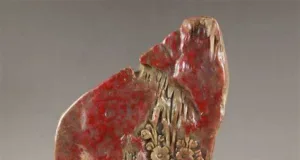
Chicken-Blood Stone
Chicken-Blood Stone, also known as "Ji Xue Shi" in Chinese, is a unique and highly prized gemstone that holds cultural and aesthetic significance, particularly...
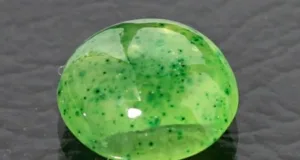
Vesuvianite (Idocrase)
Vesuvianite, also known as idocrase, is a complex calcium aluminum silicate mineral with the chemical formula (Ca, Na)19(Al, Fe, Mn)13(Mg, Fe)5(Si, Al, B)18O68(OH,F)4. This...
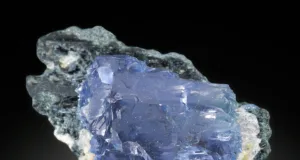
Jeremejevite
Jeremejevite is a rare and beautiful mineral that is known for its striking blue to colorless or pale yellow crystals. It belongs to the...
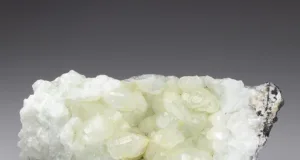
Datolite
Datolite at first glance is not stone that calls person by shouting. Doesn't scatter light like brilliant diamond, doesn't make color explosion like opal....
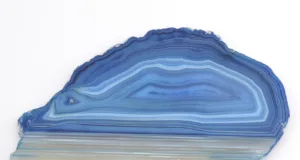
Blue Lace Agate
Blue Lace Agate is a variety of chalcedony, which is a type of microcrystalline quartz. It is known for its delicate blue and white...
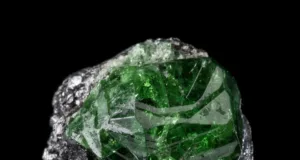
Tsavorite
Tsavorite is a gemstone that belongs to the garnet family. It is known for its stunning green color, which ranges from a vivid, intense...