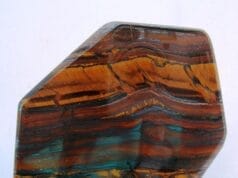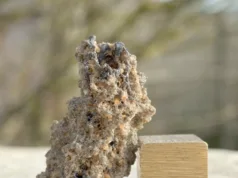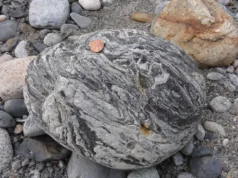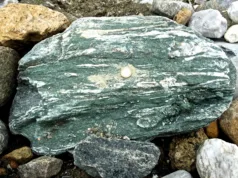






The Intermediate Stage Where Rocks Change Silently
Some rocks shout. Their crystals shine, their veins are sharp, they make themselves known at first glance.
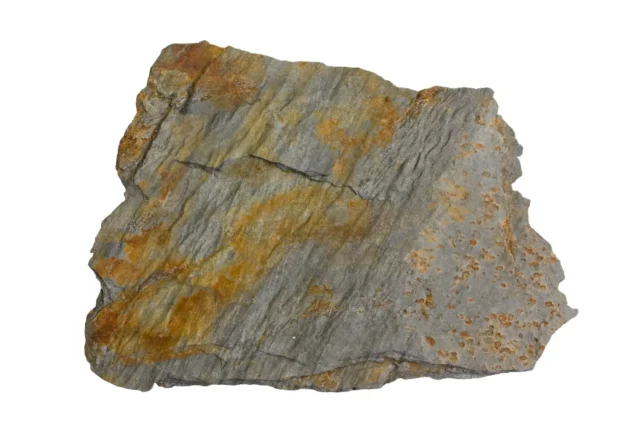
Some are silent. When you pick them up, they seem “insignificant.” But when you play with the light a bit, you notice a strange silky sheen on their surface. Neither completely flat, nor completely crystalline. Neither sedimentary, nor magmatic.
Phyllite is exactly such a rock.
In geology, phyllite is often described as an intermediate stop: After slate, before schist.
But this definition is incomplete. Because phyllite isn’t just a rock “stuck in between.” It represents the point where low-grade metamorphism works silently. It’s the stage where pressure increases, temperature gradually rises, minerals haven’t yet grown but are already starting to shift positions.
This article will treat phyllite not as a transitional stone, but as a geological record in its own right.
What Is Phyllite?
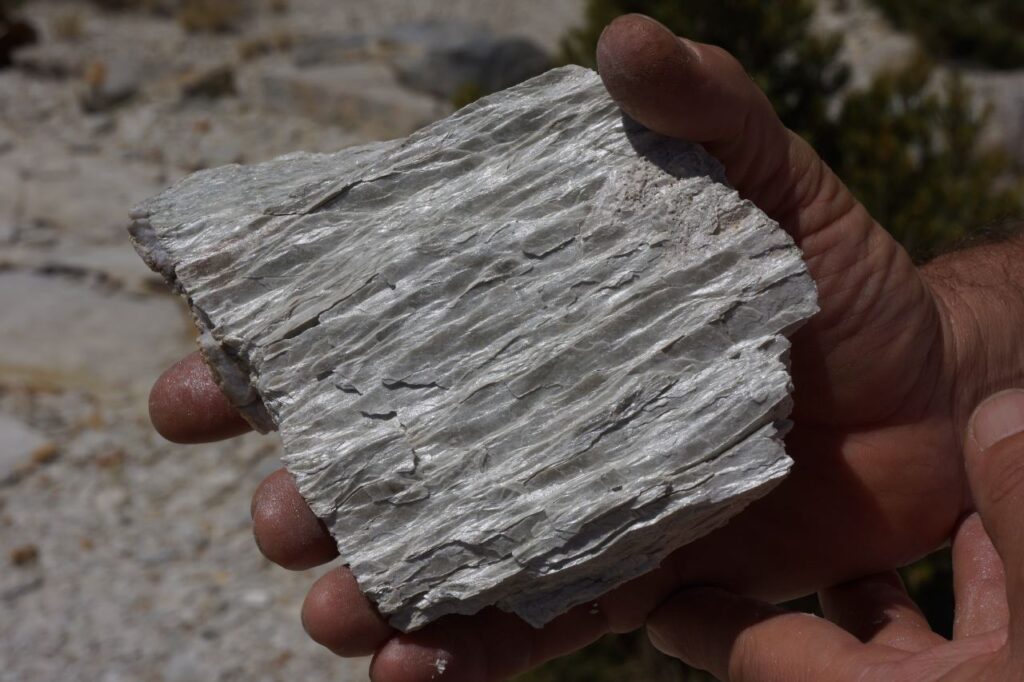
Phyllite is a fine-grained, foliated metamorphic rock that forms under low to medium-grade metamorphic conditions.
It generally forms from the metamorphism of fine-grained sedimentary rocks such as:
- Shale
- Mudstone
- Siltstone
In geological positioning, phyllite:
Slate → phyllite → schist
is in the middle of this sequence.
But this isn’t just a sequence. This sequence is a living indicator of how increasing pressure and temperature transform rock texture.
Why Does Phyllite Look Different?
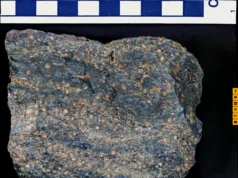
The first thing you notice when you pick up phyllite is usually a silky or satiny sheen. This sheen is not coincidental.
In slate, minerals are so small they can’t be distinguished by eye. In schist, minerals have grown noticeably. In phyllite, we’re at the exact midpoint.
Mica minerals (especially sericite and fine muscovite)
Reoriented layers
Mineral flakes aligned parallel to the surface
reflect light at certain angles. That’s why phyllite has:
- Slightly wavy surfaces
- A shiny but non-crystalline appearance
- Fine foliation
This appearance shows that metamorphism hasn’t yet completed, but has reached a point of no return.
How Does Phyllite Form? (Geological Process)
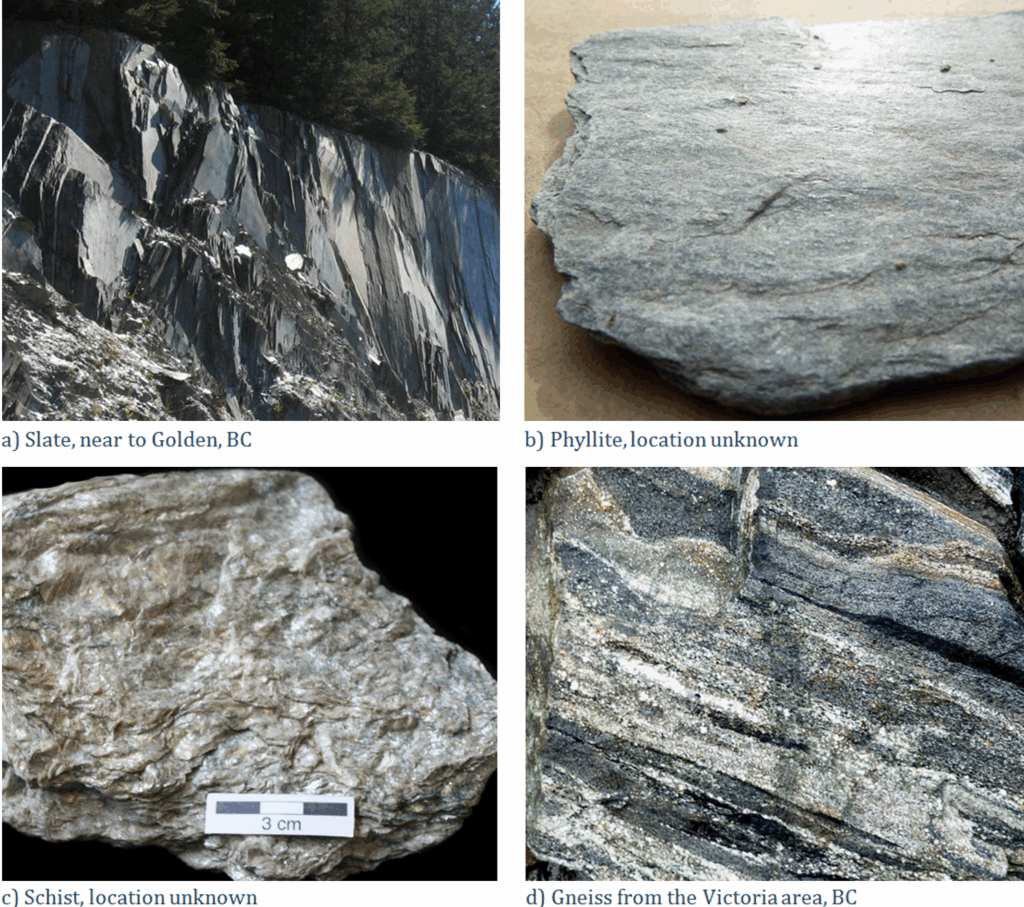
Phyllite’s story begins with a sedimentary rock.
Initially:
- Fine-grained muds settle
- Layers form
- Clay minerals dominate
When this rock begins to be buried deep:
- Pressure increases
- Temperature gradually rises
But there’s not yet:
- Complete recrystallization
- Formation of large crystals
At this stage, clay minerals reorient. Atoms don’t completely form new minerals, but existing structures are reorganized. Mica-like flakes emerge.
This point is phyllite.
It’s neither completely sedimentary, nor a fully metamorphic “mature” rock.
That’s why phyllite is the transitional moment of metamorphism.
Phyllite in Terms of Metamorphic Grade

Metamorphic rocks are generally classified by grade:
- Low-grade
- Medium-grade
- High-grade
Phyllite sits in the transition from low-grade to medium-grade.
It develops at approximately:
- 300–450 °C temperature
- Increasing directed pressure
conditions.
These conditions are frequently seen:
- In continental collision zones
- In mountain-building processes
- In deep burial areas
That’s why phyllites are quite common in orogenic belts (mountain belts).
The Difference Between Phyllite and Slate and Schist
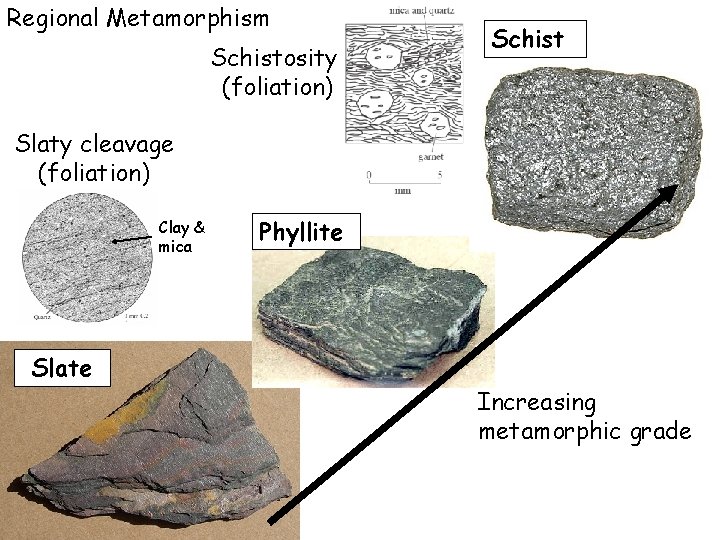
This comparison is the key to understanding phyllite.
Phyllite vs Slate
- Slate is matte, phyllite is shiny
- Slate is finer and sharper
- Mineral orientation is more pronounced in phyllite
Phyllite vs Schist
- In schist, minerals are distinguishable to the naked eye
- In phyllite, minerals are microscopic
- Schist has a coarser texture
These differences aren’t just name changes; they’re records of geological conditions.
Phyllite’s Texture and Foliation
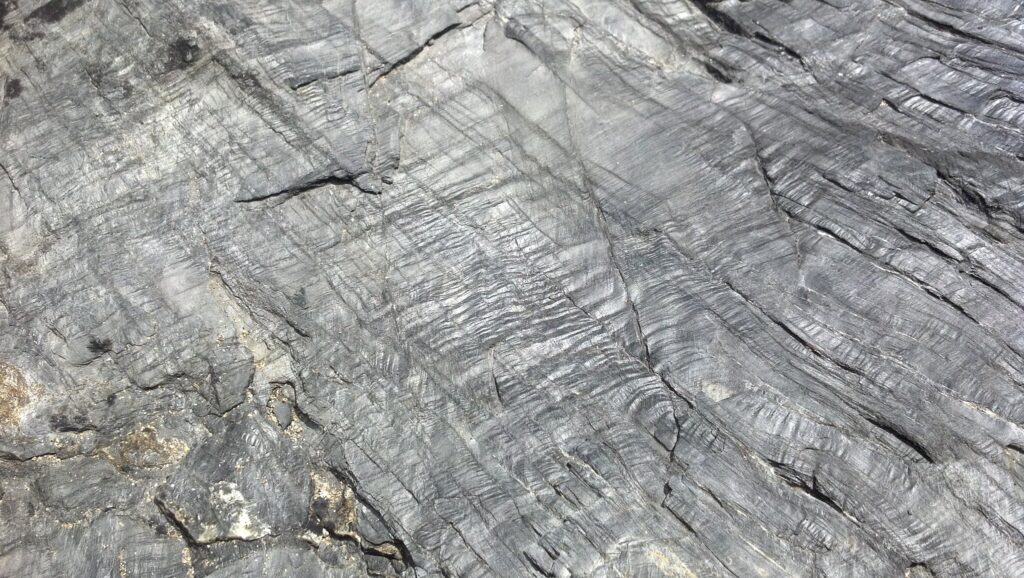
Phyllite has distinct foliation. This foliation is:
- Not sedimentary layering
- Pressure-dependent orientation
Meaning the rock has reshaped itself in the direction it was compressed.
This causes phyllite to:
- Easily separate layer by layer
- Show not flat, but slightly wavy surfaces
This waviness shows that stress within the rock wasn’t homogeneous.
Where Is Phyllite Found?
Phyllite is generally found:
- In old mountain belts
- Within metamorphic basement rocks
- In continental collision zones
Worldwide:
- Alpine–Himalayan belt
- Appalachian Mountains
- Scotland
- Central Europe
- In Turkey, especially in metamorphic massifs
it’s widespread.
In Turkey, phyllites are frequently seen in areas that have undergone regional metamorphism and are often found together with schists.
Physical Properties of Phyllite
Phyllite is a rock that appears “ordinary” at first glance but exhibits quite distinctive physical properties when examined carefully. All of these properties are a direct result of it being a product of low–medium-grade metamorphism.
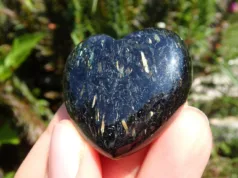
Phyllite’s most characteristic physical property is its silky (satiny) sheen. This sheen doesn’t come from a polished surface, but from microscopic mica flakes reflecting light at certain angles. When the rock is rotated, a wavy light movement is noticed on the surface.
Phyllite is:
- Not completely matte (like slate)
- Its crystals aren’t large enough to be distinguished by the naked eye (like schist)
This intermediate state is the most reliable way to identify phyllite.
Physical Properties of Phyllite – Table
| Property | Value / Range | Explanation |
|---|---|---|
| Color | Gray, greenish gray, blackish | Depends on mineral content |
| Luster | Silky – satiny | Orientation of mica minerals |
| Texture | Fine-grained, foliated | Metamorphic foliation |
| Hardness (Mohs) | 3 – 4 | Due to mica minerals |
| Density | ~2.6 – 2.8 g/cm³ | Typical metamorphic rock density |
| Foliation | Distinct, wavy | Pressure-dependent orientation |
| Crystal size | Microscopic | Not distinguishable by eye |
| Parting | Easy along layers | Foliation planes |
This table clearly shows us: Phyllite has structurally separated from sedimentary rock but isn’t yet a fully crystalline metamorphic rock.
Chemical and Mineralogical Properties of Phyllite
Phyllite’s chemical composition is largely inherited from the parent rock (protolith). Since most phyllites originate from clay-rich sedimentary rocks, their chemical composition parallels this.
Principal mineral components:
- Fine-grained muscovite
- Sericite
- Chlorite
- Quartz
- Small amounts of feldspar
The common characteristic of these minerals is:
- Having a layered structure
- Easily orienting under pressure
General Chemical Composition (approximate)
| Component | Explanation |
|---|---|
| SiO₂ | From quartz and silicate minerals |
| Al₂O₃ | Mica and clay-origin minerals |
| K₂O / Na₂O | Muscovite and feldspar contribution |
| FeO / MgO | Related to chlorite presence |
In phyllite, chemical change is limited compared to high-grade metamorphic rocks. Here, the main change is:
- Not atoms completely forming new minerals
- But reorganization of existing minerals
This explains why phyllite is defined as a “transitional rock.”
Metamorphic Conditions: In What Environment Does Phyllite Form?

Phyllite is the product of a specific pressure–temperature (P–T) range.
Approximate conditions:
- Temperature: 300–450 °C
- Pressure: Medium-level directed pressure
- Environment: Regional metamorphism
These conditions generally develop in:
- Continental collision zones
- Mountain-building belts
- Long-term burial areas
That’s why phyllite is often found not alone but together with:
- Slates
- Schists
- Zones showing transition toward gneisses
Phyllite is a geological phase where rocks “haven’t yet decided.”
Engineering and Use Areas of Phyllite
Although phyllite is mineralogically interesting, it has limited industrial use. The reason is that its foliated structure isn’t always advantageous from an engineering perspective.
However, it’s not completely useless either.
1. Building Stone and Cladding (Limited)
Some phyllite types, when they are:
- Regularly foliated
- Aesthetically surfaced
- Homogeneously textured
can be used as:
- Wall cladding
- Landscape stone
- Decorative rock
However, it’s not preferred in structures requiring strength. Because there’s a risk of easy separation along foliation planes.
2. Importance as a Geological Indicator Rock
This is where phyllite’s real value emerges.
In geology, phyllite:
- Is an indicator of metamorphic grade
- Determines the boundaries of regional metamorphism
- Carries traces of mountain-building processes
That’s why for field geologists, phyllite is:
- Not an “intermediate rock”
- But a key rock
Seeing phyllite in a region allows us to understand:
- How deep that area was buried in the past
- What types of pressures it was exposed to
Misconceptions: Is Phyllite a Weak Rock?
There’s a common misconception: “Phyllite is an intermediate rock, so it’s insignificant.”
This is incorrect.
Phyllite:
- Isn’t weak
- But shows directional weakness
Meaning:
- Its resistance to pressure isn’t bad
- But it’s prone to breaking along layer directions
This property doesn’t make it “bad,” but problematic when not used in the right place.
Conclusion: Phyllite Is the Record of Change
Phyllite is neither the beginning, nor the end.
It’s a phase where rocks change silently, where minerals haven’t yet grown but can no longer return to their former states.
That’s why phyllite is:
- Not showy
- But geologically extremely valuable
When you look at a piece of phyllite, you actually see: A moment where time, pressure, and patience work together.
Metamorphism doesn’t happen by shouting. Phyllite is the best proof of this.