























Syenite is a coarse-grained intrusive igneous rock dominated by alkali feldspar, with subordinate plagioclase and little or no quartz. In the standard QAPF classification, syenite occupies field 7: quartz constitutes less than 5% of the normalized felsic mineral assemblage, and alkali feldspar represents 65–90% of the total feldspar. Syenite crystallizes within the crust and occurs in many alkaline intrusive complexes. Trachyte is its approximate volcanic counterpart.
What Is Syenite?
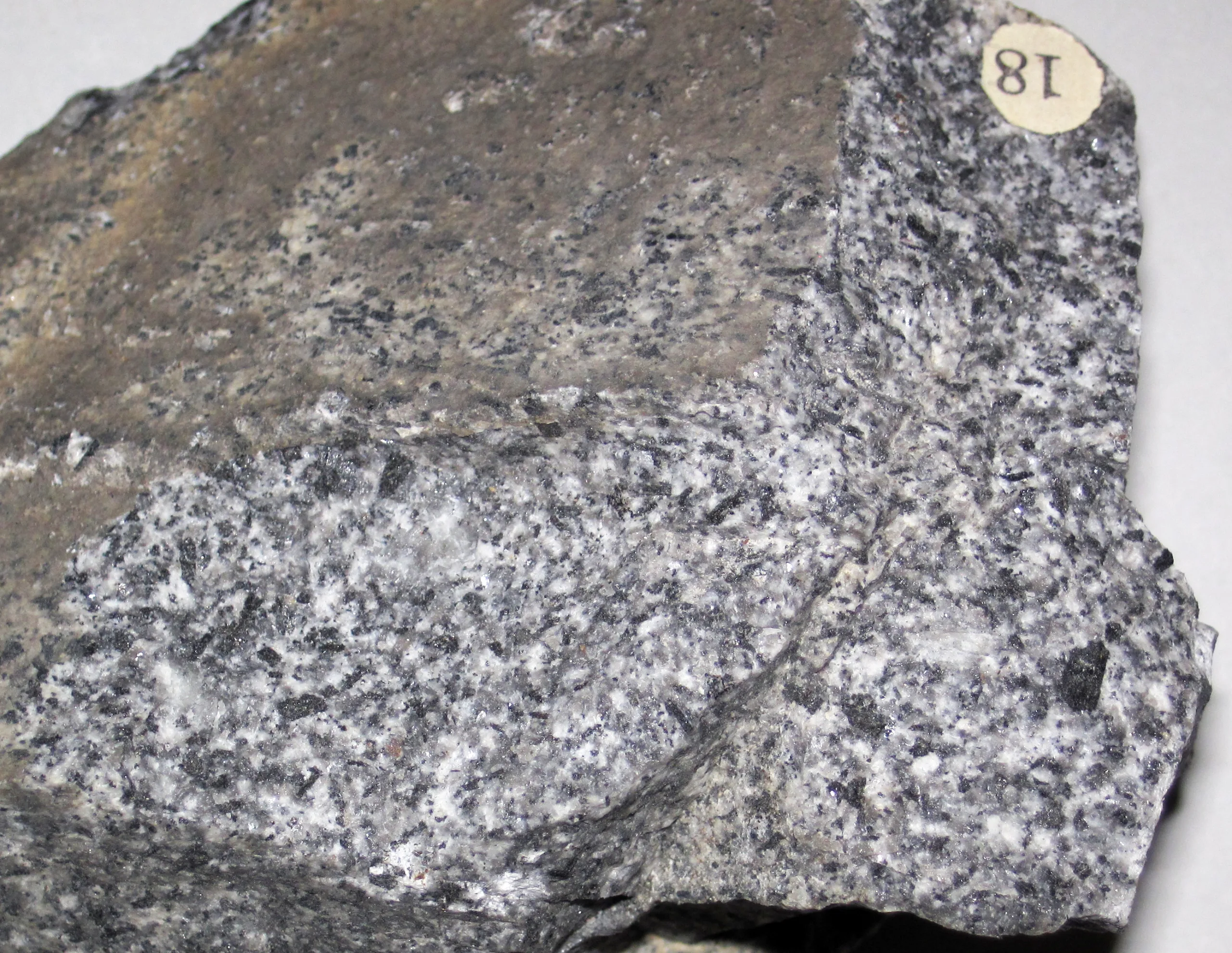
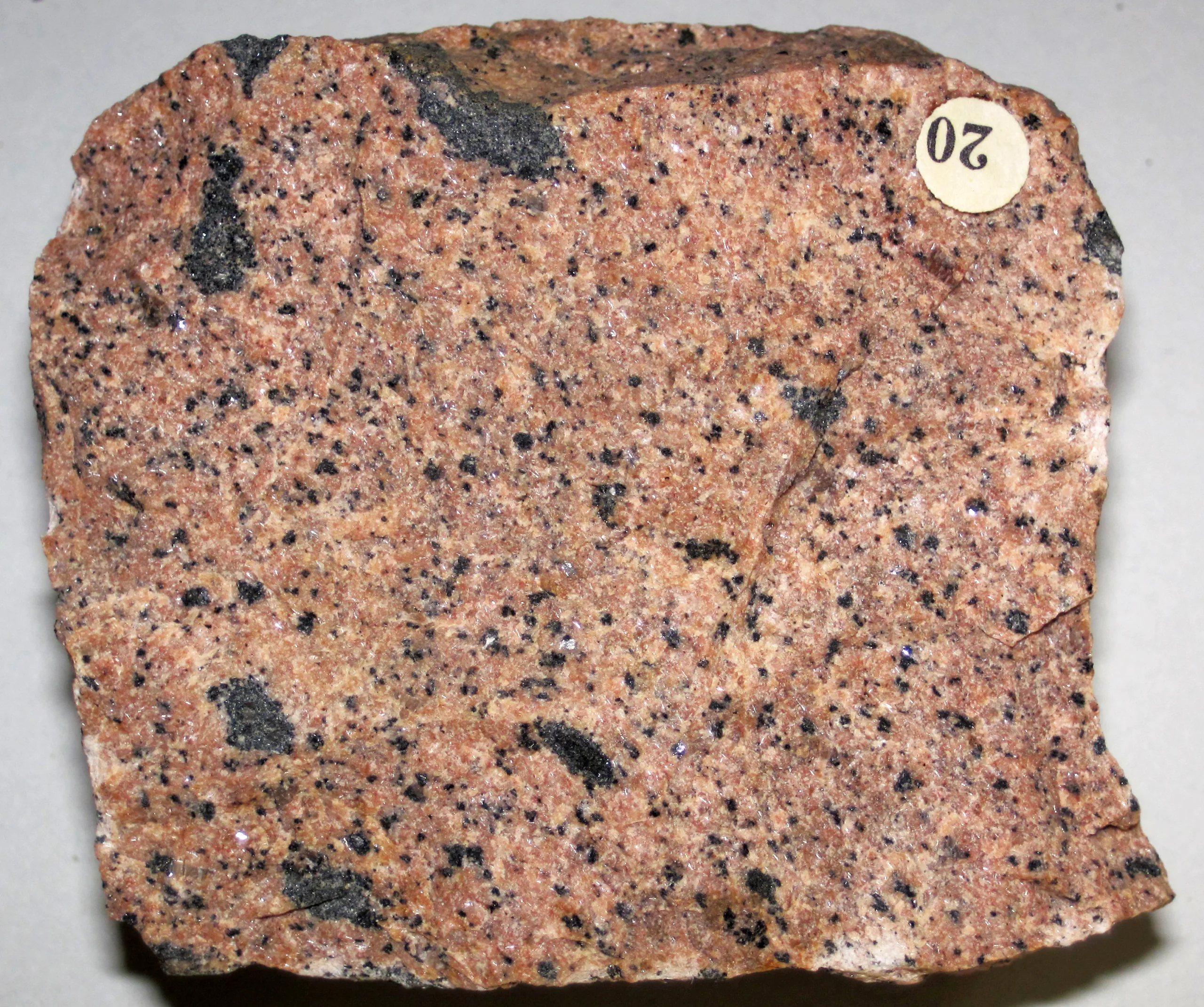
Syenite resembles granite in its interlocking crystalline texture but contains much less quartz. Alkali feldspar commonly forms large pink, cream or gray grains, with darker amphibole, pyroxene or biotite distributed between them. The name derives from Syene, the ancient name of Aswan in Egypt, although rocks historically described as syenite there do not all satisfy the modern petrographic definition.
| Property | Typical characteristics |
|---|---|
| Rock group | Intrusive (plutonic) igneous rock |
| QAPF field | 7 |
| Quartz | 0–5% of normalized Q + A + P in the quartz-bearing scheme |
| Alkali feldspar | 65–90% of A + P |
| Plagioclase | 10–35% of A + P |
| Common dark minerals | Amphibole, pyroxene, biotite |
| Texture | Phaneritic, often medium- to coarse-grained |
| Color | Gray, pink, cream, reddish or dark gray |
| Density | Often about 2.6–2.8 g/cm³ for fresh compact specimens; variable |
| Volcanic counterpart | Approximately trachyte |
Mineral Composition
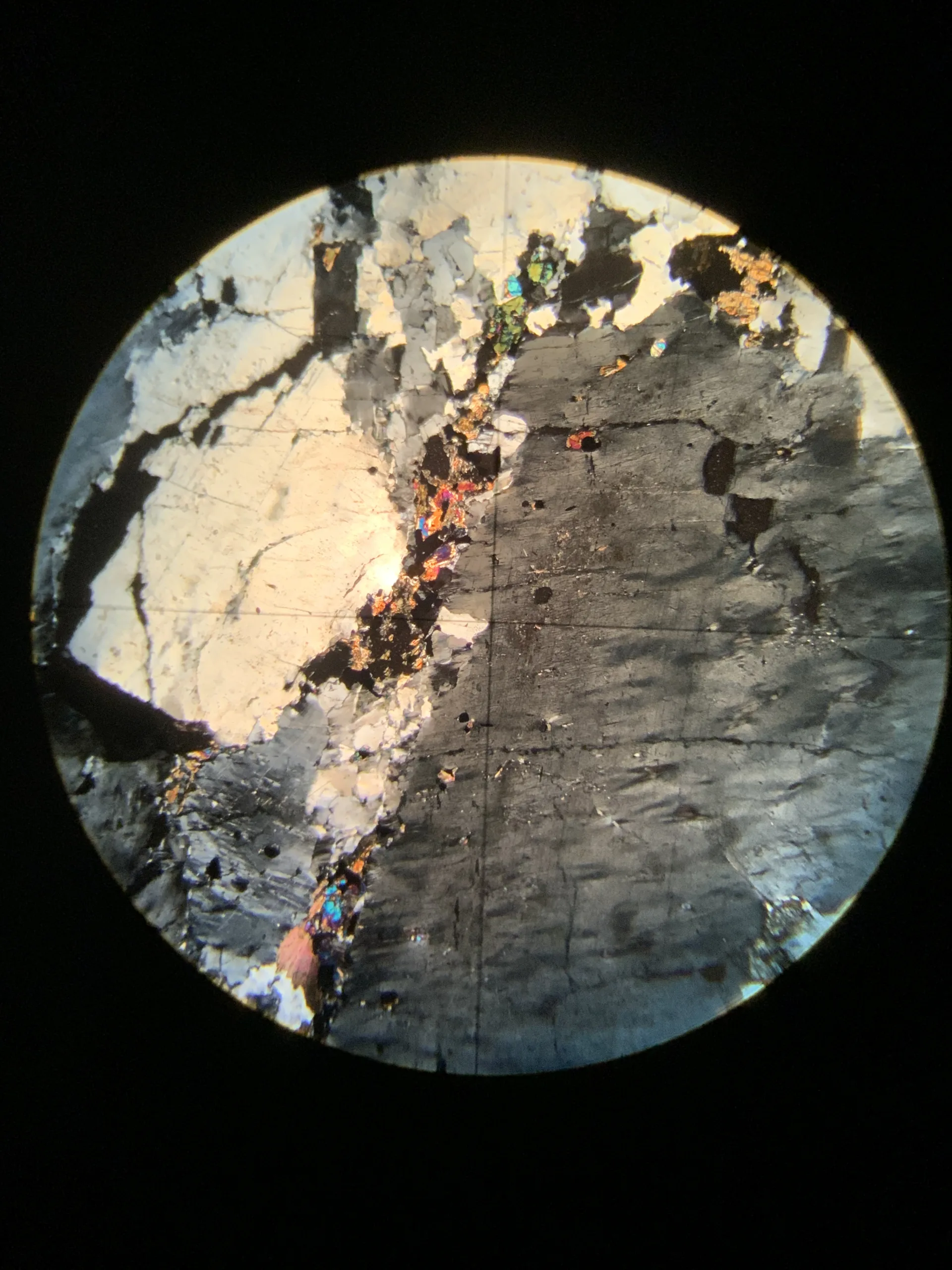
The dominant mineral group is feldspar. Alkali feldspar includes orthoclase, microcline and other potassium-rich or sodium-rich feldspar compositions. Slowly cooled alkali feldspar may develop perthitic intergrowths of sodium-rich and potassium-rich domains. In a hand specimen, perthite can appear as fine pale streaks or patches; microscopy is often needed to establish its texture.
| Mineral | Identification and role |
|---|---|
| Alkali feldspar | Commonly pink, cream or gray; two prominent cleavage directions; perthitic intergrowths may occur. |
| Plagioclase | Subordinate feldspar; repeated twin lamellae may be visible in thin section. |
| Amphibole | Dark elongate crystals with cleavage near 56° and 124°; composition varies. |
| Pyroxene | Dark or greenish crystals with near-right-angle cleavage; alkaline varieties may contain sodic pyroxenes. |
| Biotite | Dark brown or black mica with perfect basal cleavage. |
| Quartz | Minor or absent; glassy irregular grains lacking cleavage. |
| Accessory minerals | Apatite, titanite, zircon, magnetite and other minerals; some alkaline suites host uncommon accessory phases. |
Feldspar color is not a reliable indicator of its composition. Pink feldspar is not necessarily orthoclase, and pale feldspar need not be plagioclase. In alkali-rich magmatic systems, dark minerals may include aegirine or sodic amphiboles, but these are not mandatory for the rock to be named syenite.
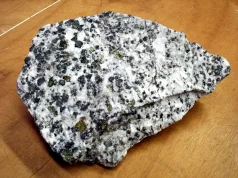
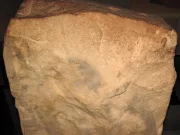
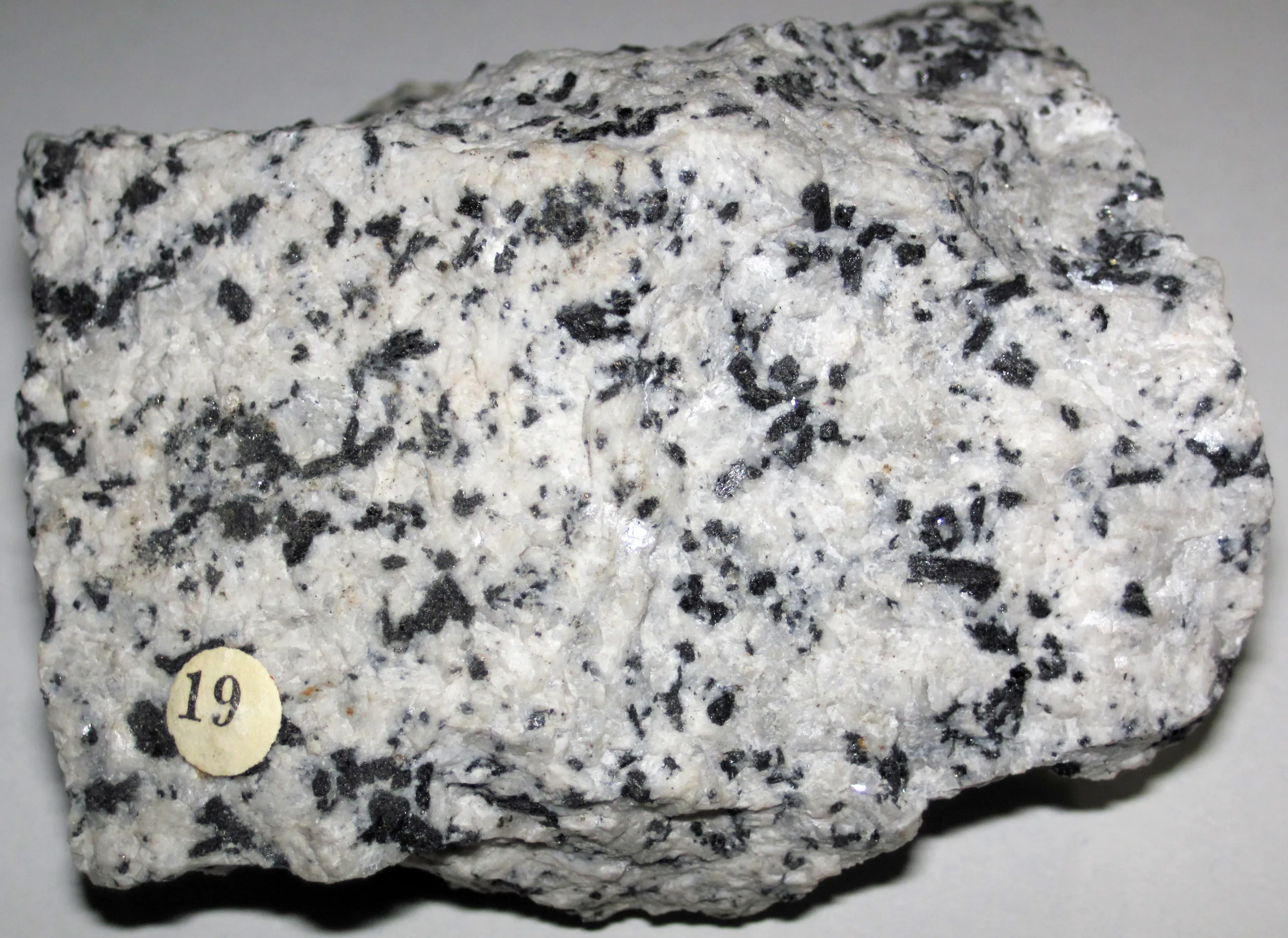
Pink or salmon-colored alkali feldspar can give syenite its characteristic pink appearance. Fine iron oxide inclusions, commonly hematite, can contribute to this coloration. However, alkali feldspar may also be white, cream or gray, as shown by the Vermont specimen below. Both pink and gray syenites can satisfy the same modal classification; color alone does not distinguish syenite from granite or monzonite.
QAPF Classification of Syenite
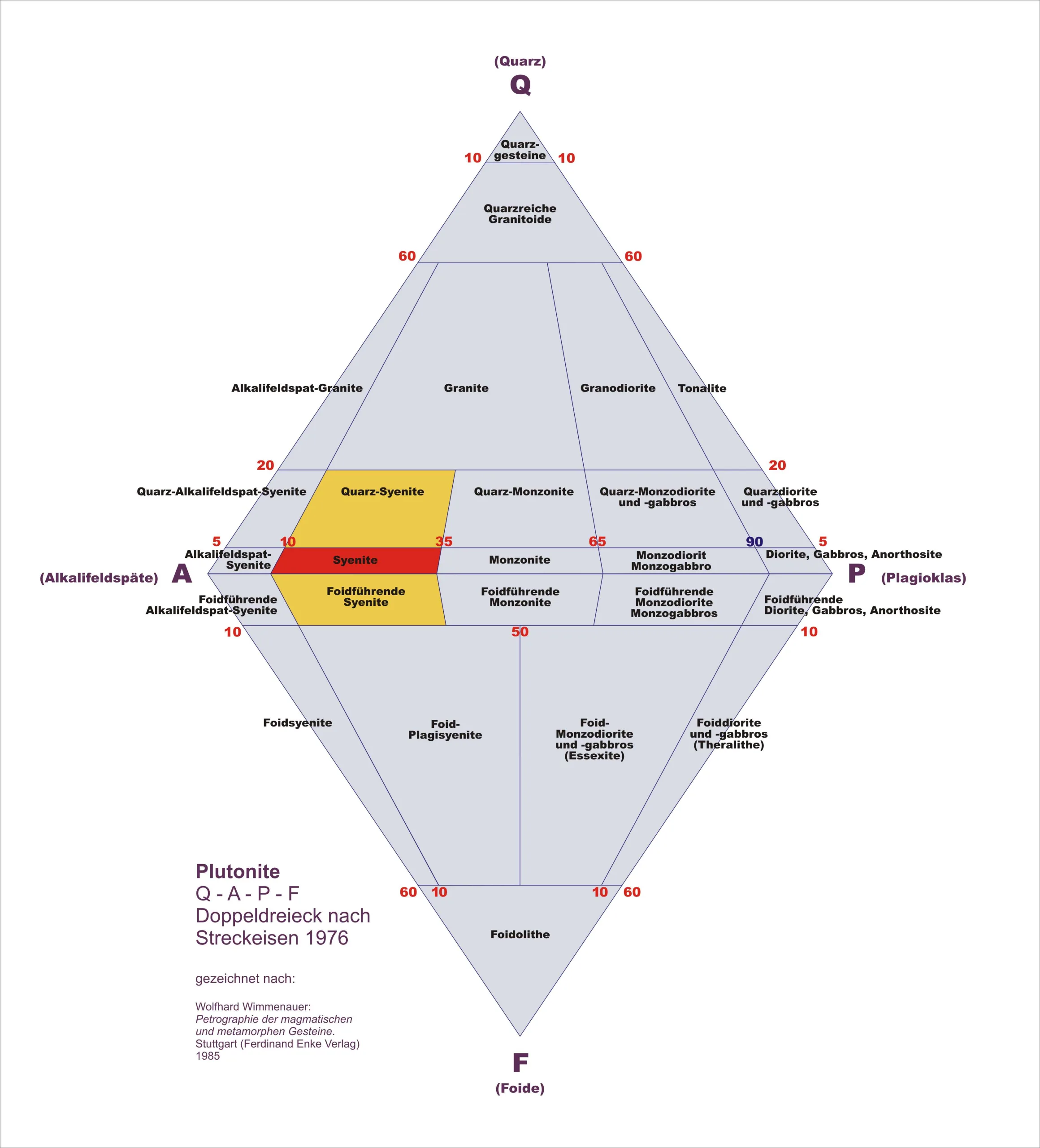
The QAPF diagram classifies suitable crystalline igneous rocks according to modal proportions of quartz (Q), alkali feldspar (A), plagioclase (P) and feldspathoids (F). Mafic and other excluded minerals are removed from the calculation before the remaining relevant minerals are normalized to 100%. Quartz and feldspathoids ordinarily occupy separate parts of the diagram because they are not stable together in typical equilibrium igneous assemblages.
For ordinary syenite, Q is below 5% of Q + A + P and A/(A + P) is between 65% and 90%. Small amounts of feldspathoids in a quartz-free sample require the appropriate foid-bearing name. A rock with more than 90% alkali feldspar among its feldspars belongs to the alkali-feldspar syenite field rather than ordinary syenite.
Worked classification example
A specimen contains 65 vol% alkali feldspar, 20% plagioclase, 2% quartz and 13% mafic minerals. The normalized quartz proportion is 2/(65 + 20 + 2) × 100 = 2.3%. The alkali feldspar proportion of total feldspar is 65/(65 + 20) × 100 = 76.5%. Both values fall within the syenite field.
| Related QAPF rock | Distinguishing modal criterion |
|---|---|
| Alkali-feldspar syenite | Quartz below 5%; alkali feldspar exceeds 90% of total feldspar. |
| Syenite | Quartz below 5%; alkali feldspar 65–90% of total feldspar. |
| Quartz syenite | Normalized quartz 5–20%; same feldspar range as syenite. |
| Monzonite | Quartz below 5%; alkali feldspar 35–65% of total feldspar. |
| Foid-bearing syenite | Feldspathoids below 10% of normalized A + P + F; quartz absent. |
| Foid syenite | Feldspathoids 10–60% of normalized A + P + F in field 11; alkali feldspar exceeds 50% of total feldspar. Nepheline syenite is named when nepheline is the dominant feldspathoid. |
Chemical Composition and Silica Saturation
Syenite is generally rich in sodium and potassium relative to many other plutonic rocks. Its major-element chemistry depends on feldspar composition, mafic mineral content and magmatic evolution. A fixed range of SiO₂ is not part of its modal definition. Silica weight percentage and quartz volume percentage measure different properties: much of the silica in syenite is chemically bound within feldspars and other silicates.
Silica saturation provides additional information about magma chemistry. Quartz-bearing syenitic rocks are silica-oversaturated, whereas feldspathoid-bearing rocks are silica-undersaturated. Quartz-free, feldspathoid-free syenite may be silica-saturated or close to saturation, depending on the detailed mineral assemblage. Alkalinity and silica saturation are not interchangeable terms. Some alkali-rich intrusive suites contain quartz-bearing rocks as well as strongly undersaturated members.
How Does Syenite Form?
Magmatic differentiation and partial melting
Syenitic melts can arise through several petrogenetic pathways. Fractional crystallization of suitable alkaline parental magmas can change the residual melt composition as mafic minerals and feldspars crystallize. Partial melting of mantle or crustal sources under appropriate conditions, followed by differentiation, can also contribute to syenitic magmatism. Crystal accumulation, assimilation and magma mixing may modify the final rock composition. No single sequence of mineral crystallization applies to all syenites.
Intrusion and crystallization
Magma may be emplaced as a stock, pluton, ring intrusion, sill or other intrusive body. Cooling within the crust commonly allows large interlocking crystals to develop. Feldspar exsolution during subsequent cooling can form perthitic microstructures. Magmatic flow, repeated injection and crystal accumulation may produce aligned feldspars, compositional layering or contrasting rock units. Uplift and erosion eventually expose some of these intrusive complexes.
Textures and Physical Properties
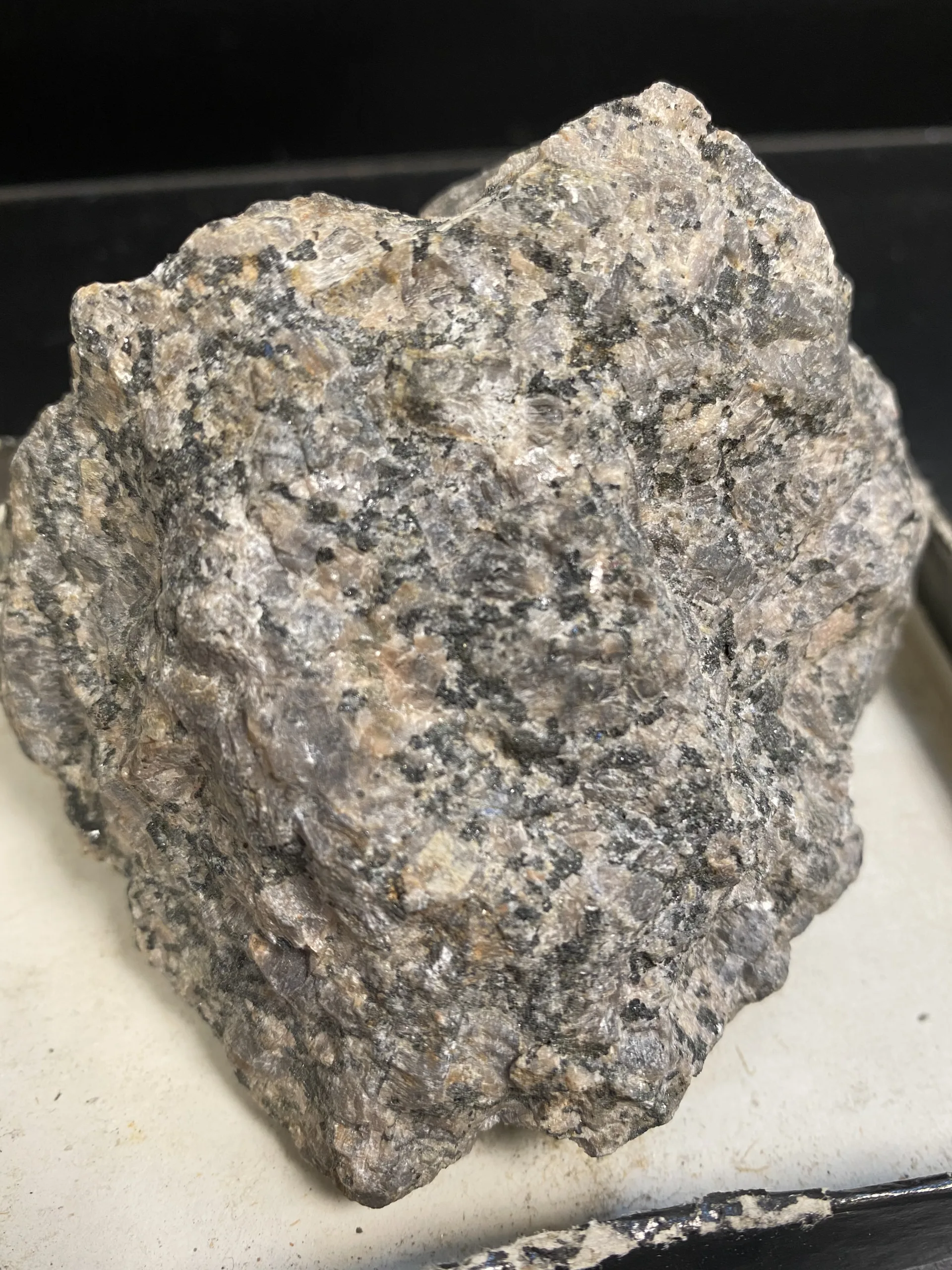
Syenite is typically phaneritic, but its grain size may range from medium to very coarse. Equigranular varieties contain similarly sized crystals, whereas porphyritic examples contain larger feldspars within a finer crystalline matrix. Aligned feldspars may record magmatic flow; solid-state deformation can subsequently modify their original shapes and orientations.
Fresh compact syenite commonly has low primary porosity and substantial intact-rock strength. Feldspar has a Mohs hardness near 6, but the bulk rock does not have a unique Mohs hardness or compressive strength. Fracture patterns, grain boundaries, mineral alteration and weathering can influence strength and permeability.
Types and Related Syenitic Rocks
Mineral modifiers such as hornblende syenite, biotite syenite or fayalite-bearing syenite describe characteristic accessory or mafic assemblages. Microsyenite is a medium-grained equivalent. Quartz syenite and alkali-feldspar syenite are formal QAPF names, whereas terms such as alkaline syenite describe broader petrological associations and do not replace a modal classification.
Nepheline syenite contains substantial nepheline and belongs to the silica-undersaturated foid-syenitic family. It should not be confused with ordinary syenite. Ijolite is a distinct feldspathoid–clinopyroxene-rich rock, not a variety of ordinary syenite. Larvikite, often sold commercially as blue pearl granite, is generally classified as monzonitic rather than assumed to be syenite.
Where Is Syenite Found?
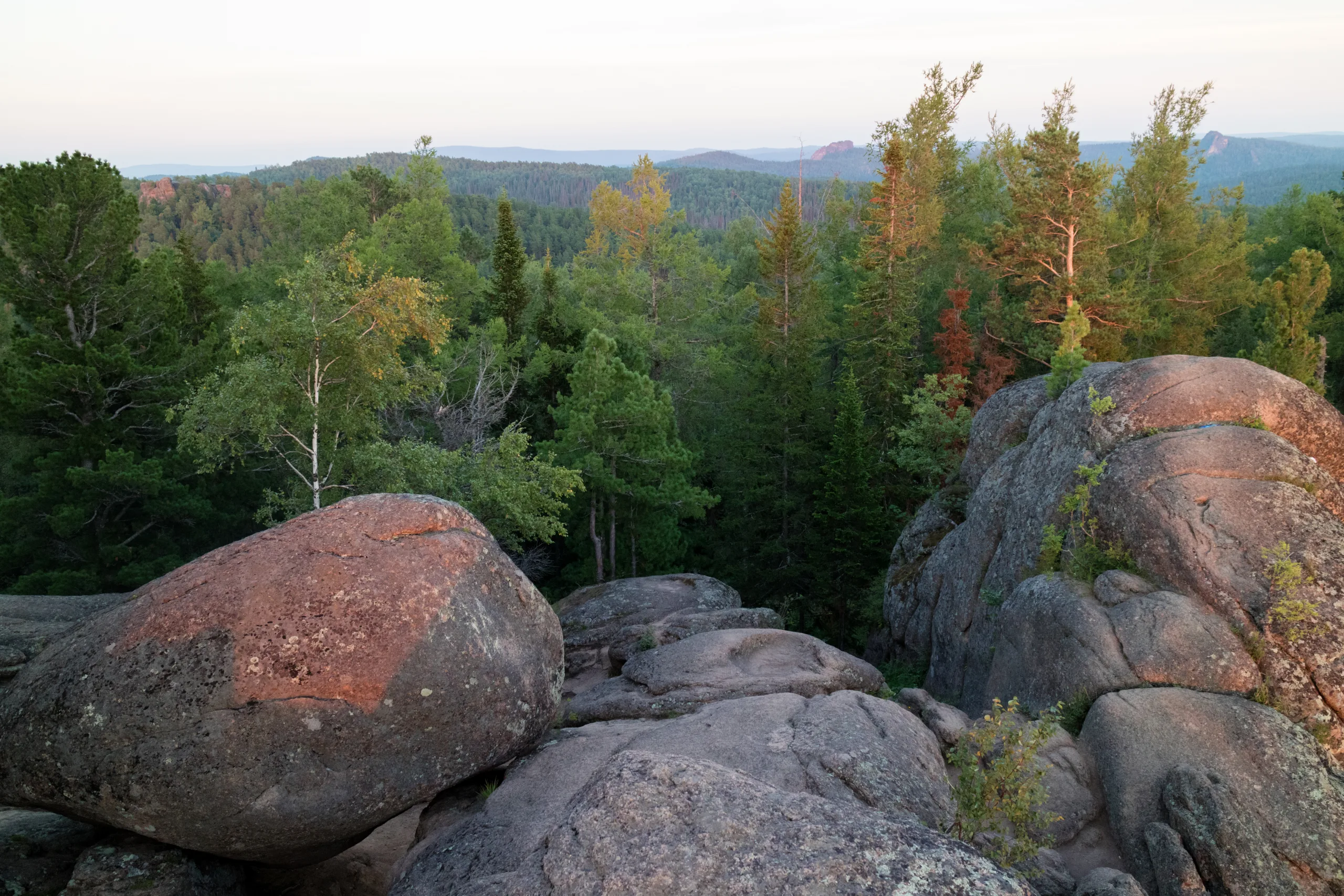
Syenitic rocks occur in alkaline igneous provinces, continental rifts, intraplate complexes and some post-collisional or arc-related magmatic suites. An alkaline complex can contain several rock types, so a geographic name alone is not sufficient to identify the lithology of an individual sample.
| Locality | Geological context |
|---|---|
| Cuttingsville Complex, Vermont, USA | Cretaceous alkaline intrusive rocks, including perthitic feldspar-rich syenite. |
| Concord gabbro–syenite complex, North Carolina, USA | Associated mafic and syenitic intrusive rocks. |
| Red Hill, New Hampshire, USA | Mesozoic alkaline intrusive complex with syenitic rocks. |
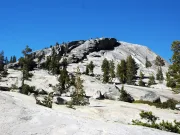
| Krasnoyarsk Pillars, Russia | Prominent weathered syenitic rock formations. |
| Kipawa, Québec, Canada | Alkaline complex with related syenitic rocks and rare-element mineralization. |
How to Identify Syenite in the Field
Examine a representative fresh surface with a hand lens. Look for abundant interlocking feldspar and relatively little glassy quartz. Assess the proportion of alkali feldspar relative to plagioclase using cleavage, twinning and grain relationships. Dark amphibole, pyroxene or biotite may support the description but are not decisive on their own.
- Record grain size, feldspar texture and any mineral alignment.
- Look for minor quartz in spaces between feldspar crystals.
- Check multiple representative areas rather than a single feldspar-rich patch.
- Use a thin section or suitable feldspar staining and modal analysis to distinguish syenite from monzonite or granite.
- Examine intrusive contacts, veins and associated rocks to determine the geological setting.
Syenite vs. Granite, Monzonite, Diorite and Trachyte
| Rock | Principal distinction |
|---|---|
| Granite | Normalized quartz 20–60%; feldspar proportions vary. |
| Monzonite | More nearly balanced proportions of alkali feldspar and plagioclase. |
| Diorite | Plagioclase strongly dominates feldspar; mafic minerals are common. |
| Trachyte | Approximate volcanic compositional counterpart; commonly fine-grained or porphyritic. |
| Nepheline syenite | Silica-undersaturated related intrusive rock containing substantial nepheline. |
A gray or pink coarse-grained specimen can resemble several of these rocks. The diagnostic differences are modal mineral proportions and texture, not simply color or geographic occurrence.
Weathering, Engineering Properties and Uses
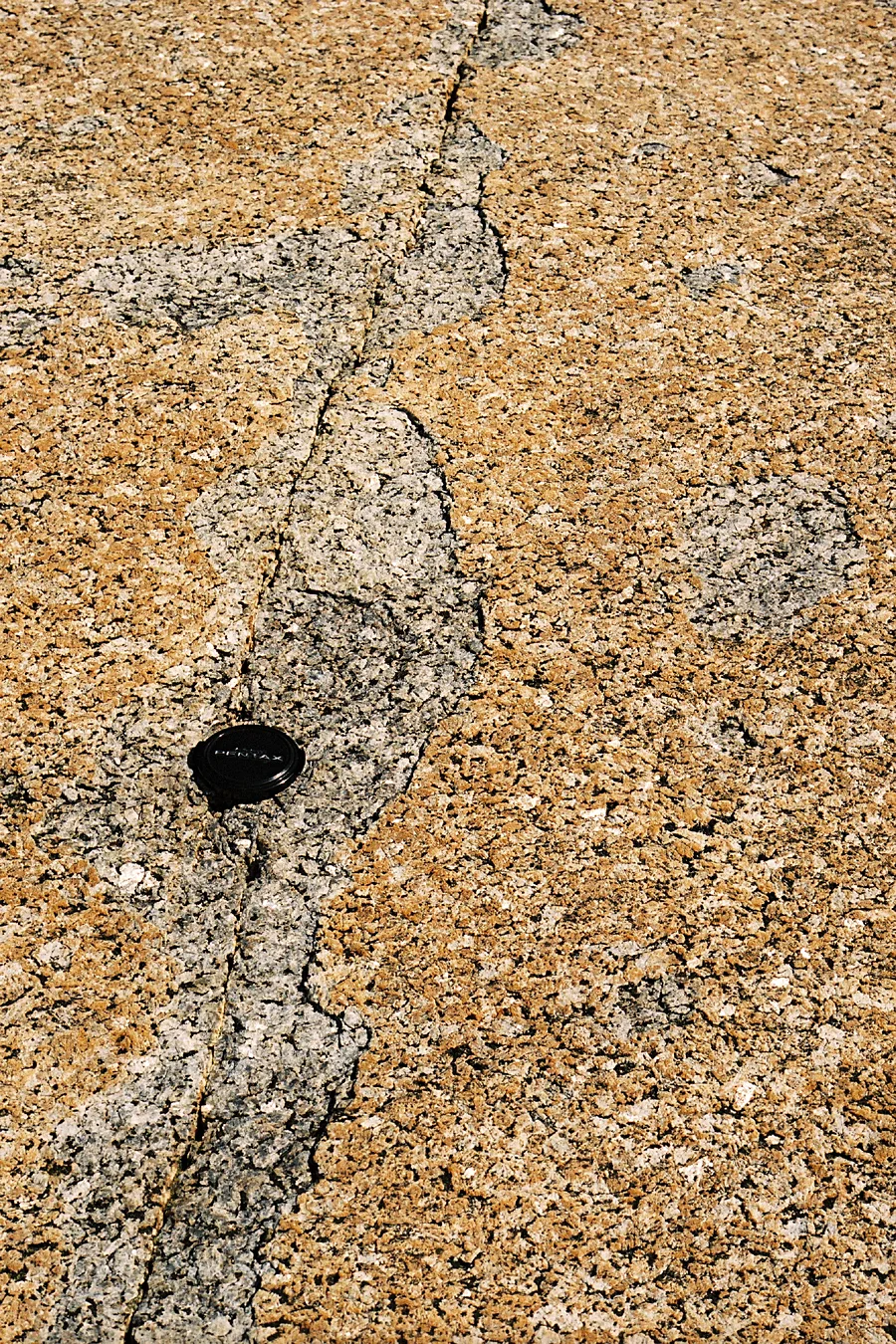
Feldspar can alter to clay minerals or fine mica, while iron-bearing minerals can oxidize and stain the rock. Weathering may progress along joints and grain boundaries. Exfoliation and granular disintegration can produce curved surfaces or loose debris. In slope or foundation investigations, discontinuity geometry, weathering and groundwater can govern rock-mass performance more strongly than the lithological name.
Suitable compact syenite is quarried locally for decorative dimension stone, paving, cladding, monuments and crushed aggregate. Related nepheline syenite is an important industrial source of alumina and alkalis for glass and ceramics, but not all ordinary syenites meet the same raw-material specifications. Some alkaline complexes host rare-earth elements, zirconium or niobium-bearing minerals; their economic value depends on grade, mineralogy and processing feasibility.
Construction uses require testing of water absorption, abrasion, frost resistance and intact-rock strength as appropriate. The absence of abundant quartz does not automatically establish that an aggregate is suitable for concrete. Quarry products and weathered rock masses require separate evaluation.
Frequently Asked Questions
Is syenite intrusive or extrusive?
Syenite is intrusive. Trachyte is its approximate volcanic counterpart.
What is the difference between syenite and granite?
Syenite contains less than 5% normalized quartz, whereas granite contains 20–60% in the standard QAPF granite fields.
Can syenite contain quartz?
Yes. Small amounts are allowed; quartz syenite contains 5–20% normalized quartz.
Is nepheline syenite the same as syenite?
No. Nepheline syenite is a related silica-undersaturated rock containing substantial nepheline.
How can syenite be identified reliably?
By estimating quartz and feldspar proportions and confirming them with petrographic modal analysis when necessary.
References and Image Credits
- British Geological Survey — Syenite classification
- British Geological Survey — Quartz-syenite
- British Geological Survey — Foid-syenitic-rock
- Smith College — Syenite petrography and hand specimens
- USGS — Lithologic classification of geologic map units
- Le Maitre, R. W. (ed.), 2002. Igneous Rocks: A Classification and Glossary of Terms. Cambridge University Press.
- Deer, W. A., Howie, R. A., and Zussman, J. (2013). An Introduction to the Rock-Forming Minerals. Mineralogical Society of Great Britain and Ireland.
Featured image: pink porphyritic syenite from the Mesoproterozoic Wausau Syenite Complex, Wisconsin, USA. James St. John, Wikimedia Commons, CC BY 2.0; resized and converted to WebP.