



















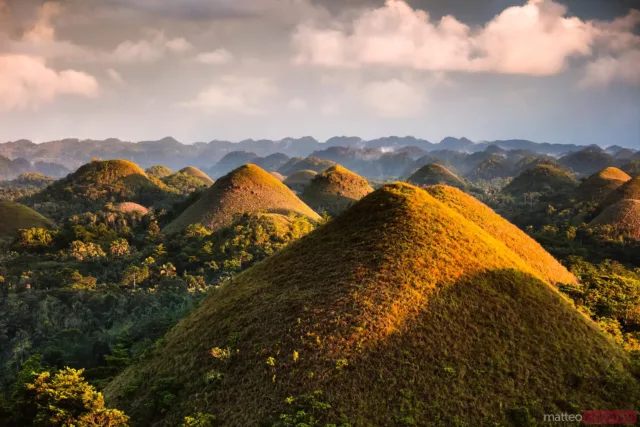
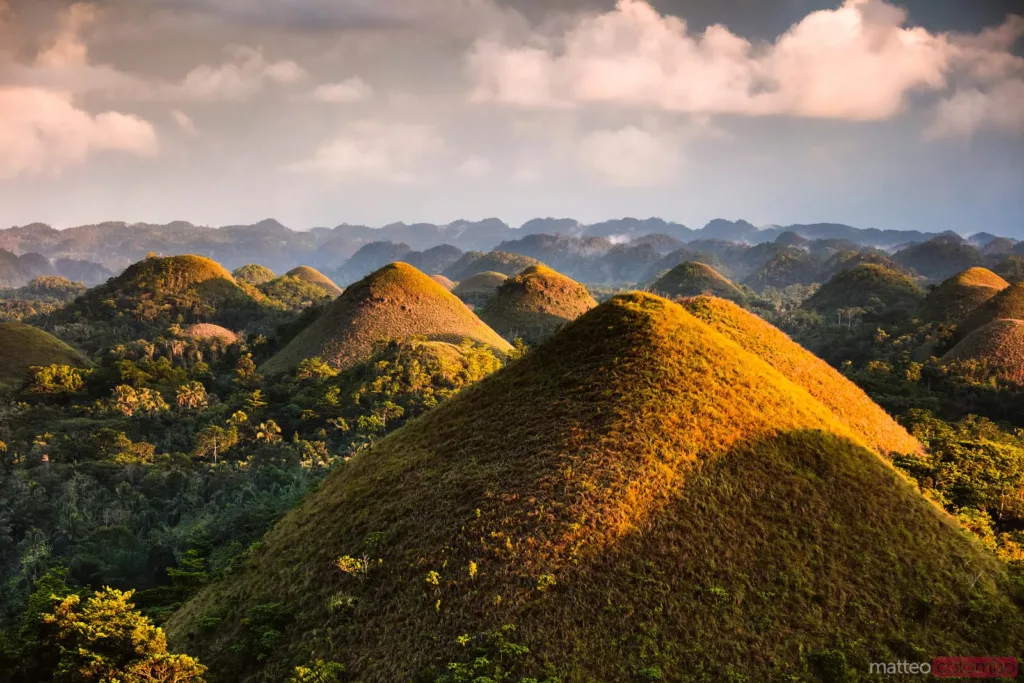
Among the thousands of islands that make up the Philippines, one place stands out as both mysterious and mesmerizing — the Chocolate Hills of Bohol. These perfectly shaped, cone-like mounds stretch across the heart of the island, turning brown in the dry season and green when it rains. From above, the scene resembles a sea of giant chocolate drops spread evenly across the landscape.
The Chocolate Hills Philippines are one of the most recognizable natural landmarks in Southeast Asia. They attract scientists, photographers, and tourists who are equally fascinated by their beauty and by the question: How did these hills form?
Location and Overview
The Chocolate Hills are located in the towns of Carmen, Batuan, and Sagbayan in the province of Bohol, approximately 55 kilometers from Tagbilaran City.
The area spans more than 50 square kilometers, with between 1,268 and 1,776 individual hills depending on which survey is cited. The hills range from 30 to 120 meters in height and are spread across rolling plains, creating a landscape that appears almost otherworldly.
From above, these cone-shaped hills resemble giant molehills, perfectly scattered across the terrain. Their uniform size and spacing give the impression of a carefully designed landscape — yet everything here is the result of natural geological forces working over millions of years.
Geological Formation and Composition

Geologists classify the Chocolate Hills as an example of karst topography — a type of landscape formed from the dissolution of soluble rocks such as limestone, dolomite, and marble.
The area was once a shallow marine environment during the late Pliocene to early Pleistocene epochs, about two to three million years ago. At that time, coral reefs and marine organisms accumulated layers of calcium carbonate at the sea floor, forming thick beds of limestone.
As tectonic movements uplifted the seafloor above sea level, rainwater — slightly acidic due to dissolved carbon dioxide — began to dissolve the limestone. Over long periods, chemical weathering and groundwater erosion sculpted the landscape into countless cone-shaped hills.
This process, known as karstification, is also responsible for underground drainage systems, caves, and sinkholes found in the region.
The uniform shape of the hills suggests a unique balance between rainfall, rock composition, and vegetation cover. Seasonal rainfall and erosion gradually removed softer materials while leaving behind resistant limestone cores. Over time, these residual mounds were shaped into smooth cones covered by a thin layer of soil and grass.
Scientific Theories and Ongoing Studies

Although the karst origin is widely accepted, several theories attempt to explain the near-perfect symmetry of the Chocolate Hills.
Some geologists suggest that the area once experienced tectonic uplift combined with subaerial erosion, resulting in a uniform pattern of cone-like remnants. Others believe differential weathering — the varying resistance of limestone to erosion — played a major role.
Recent studies conducted by Filipino and international geologists emphasize the role of climate and groundwater fluctuation in shaping these forms. Seasonal cycles of wet and dry periods may have influenced the slopes’ regularity by stabilizing vegetation and controlling erosion rates.
In short, the Chocolate Hills are the cumulative result of marine sedimentation, uplift, chemical dissolution, and long-term surface weathering — a textbook example of nature’s artistry through geological time.
Cultural Significance and Local Legends
For the people of Bohol, the Chocolate Hills are more than a scientific curiosity — they are woven into the island’s folklore and spiritual heritage.
Several legends explain their origin:
- The Tale of Two Giants: According to one popular story, two giants once fought a long and furious battle, hurling rocks and boulders at each other for days. When they eventually reconciled, they left behind the scattered stones — the Chocolate Hills.
- The Story of Arogo and Aloya: Another romantic version tells of a giant named Arogo who wept endlessly after losing his beloved Aloya. His tears, falling to the earth, hardened into the mounds seen today.
These legends highlight how the local community has long tried to interpret the landscape through emotion and imagination — an expression of humanity’s timeless connection to nature.
Conservation and UNESCO Geopark Status

The Philippine government declared the Chocolate Hills a National Geological Monument in 1997, recognizing their exceptional scientific and aesthetic importance.
In 2023, the entire Bohol Island gained recognition as a UNESCO Global Geopark, officially acknowledging its geological diversity and promoting education, research, and sustainable tourism.
However, this recognition also brought challenges. In 2024, a controversial resort project near the protected zone sparked public outrage. The development was accused of violating environmental regulations and threatening the delicate karst ecosystem. The backlash led to national investigations and renewed discussions about how to balance economic growth with conservation.
The event reminded Filipinos and the global community that even the most beautiful landscapes can be vulnerable to overdevelopment.
Protecting the Chocolate Hills means protecting both a geological heritage site and a cultural treasure.
Tourism, Threats, and Sustainable Management

TTourism remains a cornerstone of Bohol’s economy. The viewing platforms at Carmen and Sagbayan Peak allow visitors to appreciate the breathtaking 360-degree panorama of the hills. Local tour operators offer eco-trips, bike rides, and cultural experiences that highlight the region’s beauty.
Yet, increasing tourism also creates environmental pressure. Unregulated building, road expansion, and quarrying threaten the natural balance of the area. Heavy foot traffic and vehicle emissions can disturb the thin soil layer that stabilizes the grass and prevents erosion.
Local authorities have begun implementing stricter sustainable tourism policies, including:
- Limiting construction near sensitive areas
- Promoting electric transport for visitors
- Supporting local guides and community-based tourism
- Educating travelers about the geology and ecology of Bohol
These measures aim to ensure that tourism benefits both the people and the planet, maintaining the harmony that gives the Chocolate Hills their enduring charm.
Flora, Fauna, and Surrounding Ecosystem
Although the hills themselves are mostly covered in coarse grass (Imperata cylindrica), the surrounding lowlands host a diverse range of plant and animal life.
Patches of secondary forest and coconut groves sustain numerous species, including the Philippine tarsier (Tarsius syrichta) — one of the smallest primates in the world.
These ecosystems are part of the broader karst forest network of Bohol, which plays a key role in water retention and soil protection. Conserving these areas is essential not only for biodiversity but also for preventing erosion that could damage the hills’ structural integrity.
The Chocolate Color Phenomenon
The “chocolate” color that gives the hills their name is not due to any mineral content but rather to the seasonal cycle of the region’s tropical climate.
During the dry season (November to May), the sun dries the grass, turning it a deep brown. When the rainy season returns, the green vegetation grows back, creating a completely different — yet equally stunning — scene.
This natural transformation has become one of the most photographed moments in the Philippines. Sunrise and sunset provide the best lighting for visitors, when soft golden tones highlight the symmetry and depth of the hills.
Conclusion
The Chocolate Hills Philippines are a living testament to the creative forces of nature. Formed through millions of years of geological processes — from marine sedimentation and uplift to erosion and weathering — they represent both the power and patience of Earth itself.
Beyond geology, these hills tell stories of culture, legend, and identity. They are a symbol of the Philippines’ natural beauty and resilience, and their preservation reflects the country’s growing commitment to sustainable development.
As long as the balance between tourism, conservation, and community remains, the Chocolate Hills will continue to inspire awe and wonder for generations to come — reminding us that sometimes, the sweetest treasures of our planet are carved not by hands, but by time.