

















Structural Geology
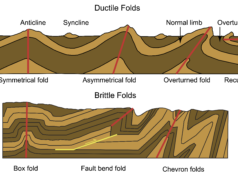
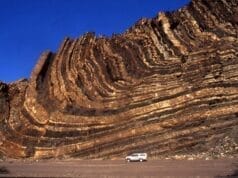
Structural geology is the branch of geology that investigates how rocks and structures within the Earth’s crust deform over time — how they bend, break, fold, fault and flow under stress and pressure. Whether forming mountain ranges, controlling ore deposit locations, or influencing earthquake behavior, structural geology reveals the hidden architecture of the planet. In this section you’ll find practical guides on faults, folds, joints, structural mapping, and tectonic processes that shape the Earth’s surface and interior.

Stress and Strain
Stress and strain are fundamental concepts in structural geology that describe how rocks respond to tectonic forces and other forms of deformation. Stress refers...
Fault and Types of Faults
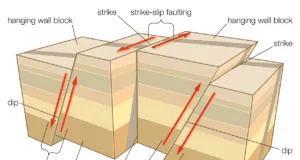
Fault is a fracture or crack where two rock blocks slide past one to another. If this movement may occur rapidly, it can be causes earthquike or slowly, in the form of creep.Types of faults include strike-slip faults, normal faults, reverse faults, thrust faults, and oblique-slip faults.
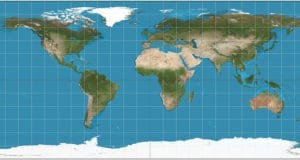
Types of Maps
ProjectionsBecause the shape of the world is spherical, it is difficult to represent it on a plain paper. Cartographers use projections to make...
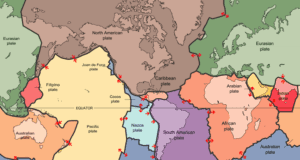
Plate Tectonics: How Earth’s Moving Plates Shape Continents, Mountains, and Oceans
The theory of plate tectonics is the unifying framework of modern geology.It explains how the Earth’s rigid outer shell — the lithosphere — is...