
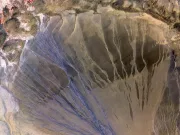

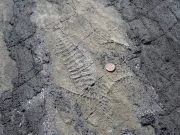























Folds are curved or bent geological surfaces produced by deformation of rock layers, mineral fabrics or other planar markers. They range from microscopic structures in metamorphic minerals to regional structures extending across mountain belts. Their geometry records how rocks accommodated strain, although fold shape alone does not uniquely determine the stresses or mechanisms responsible.
Anatomy of a fold
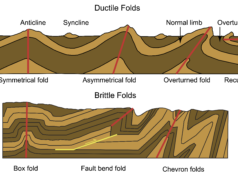
The hinge is the region of greatest curvature in a folded layer. A hinge line connects hinge points along that layer; the limbs extend away from it. An axial surface connects hinge lines in successive layers and may be curved rather than planar. It contains the hinge lines, rather than being perpendicular to them. Its intersection with a map or section is the axial trace. In a cylindrical fold, the fold axis is parallel to the direction along which the profile repeats. Trend and plunge describe the orientation of that direction.
The interlimb angle measures the opening between limbs in a profile perpendicular to the fold axis. Wavelength describes spacing between successive equivalent hinges, while amplitude measures the magnitude of folding relative to a reference surface. These measurements depend on section orientation; an oblique roadcut can distort the apparent geometry.
Anticlines, synclines and monoclines
An anticline contains older strata toward its core, whereas a syncline contains younger strata toward its core. In normally facing sequences, anticlines usually arch upward and synclines curve downward. Where stratigraphic ages are unknown, use antiform for an upward-convex fold and synform for a downward-convex fold. Overturned sequences can produce antiformal synclines and synformal anticlines. A monocline is a step-like bend linking relatively gently inclined layers through a steeper limb. Domes and basins have closed or approximately closed structural contours.
Fold classification
| Criterion | Type | Diagnostic feature |
|---|---|---|
| Interlimb angle | Gentle / open | 180–120° / 120–70° |
| Interlimb angle | Close / tight | 70–30° / 30–0° |
| Interlimb angle | Isoclinal | Approximately parallel limbs |
| Axial surface | Upright / inclined / recumbent | Steep / intermediate / nearly horizontal |
| Hinge orientation | Non-plunging / plunging | Horizontal / inclined hinge |
| Facing | Overturned | One limb has inverted stratigraphic younging |
Angle boundaries are conventional. Symmetry, hinge sharpness and layer thickness provide additional descriptions. Chevron folds have relatively straight limbs and angular hinges; harmonic folds maintain a consistent pattern across adjacent layers, while disharmonic folds change geometry between layers.
How folds form
Layer-parallel shortening can cause mechanically competent beds to buckle within weaker material. The wavelength depends on layer thickness, mechanical contrast and deformation conditions. Flexural slip accommodates bending through displacement along bedding surfaces, much like pages sliding in a bent book. Distributed flow, pressure solution and crystal-plastic deformation can also accommodate folding. Passive folds develop when pre-existing markers are carried by a deforming rock mass. Fault-related folds form above ramps, fault tips or other changes in fault geometry. Folding can coexist with fractures and faults, including at shallow crustal depths.
Temperature, confining pressure, pore-fluid pressure, strain rate and rock composition influence deformation. Mineral hardness alone does not predict rock competence. Fold asymmetry may indicate shear or transport direction in an appropriate structural context, but it is not a unique stress indicator.
Field identification and measurement
Map repeated stratigraphic units, measure bedding strike and dip on both limbs, and establish younging using graded bedding, cross-bedding or other reliable sedimentary indicators. Measure hinge trend and plunge directly where exposed. Where hinges are inaccessible, plot bedding poles on a stereonet; for an approximately cylindrical fold, the pole to the best-fit great circle through those poles estimates the fold axis. Record cleavage, faults and cross-cutting relationships to distinguish successive deformation events.
For an illustrative upright symmetrical fold with limbs dipping 35° in opposite directions in a true profile, the interlimb angle is 180° − 35° − 35° = 110°, an open fold. This calculation does not apply unchanged to arbitrary oblique sections or overturned limbs.
Examples in nature
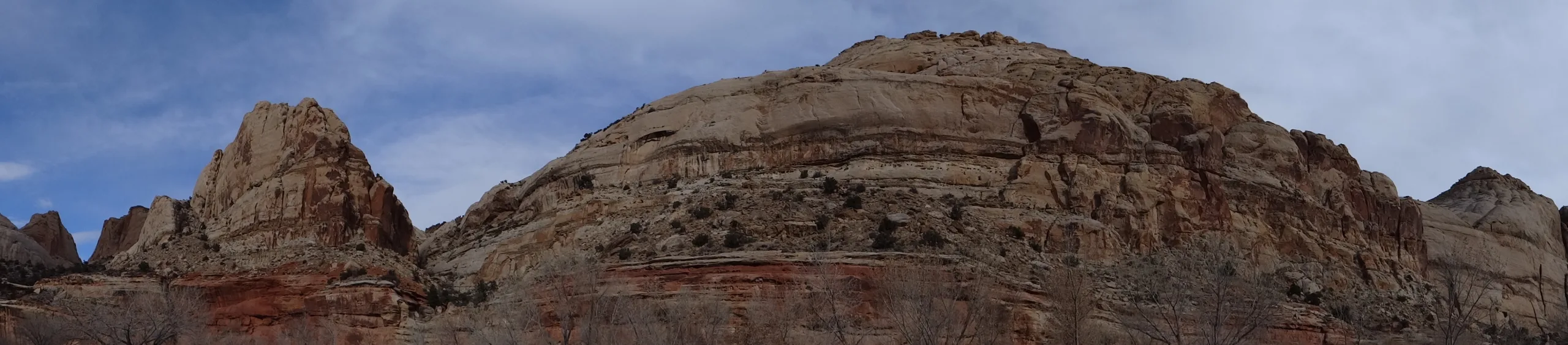
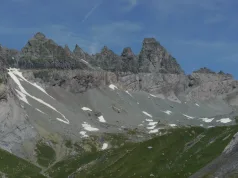
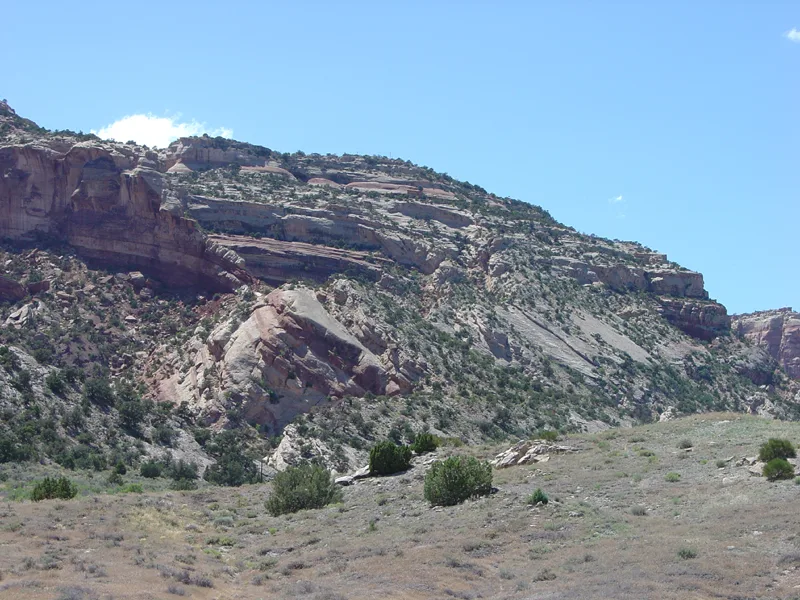
The Waterpocket Fold in Capitol Reef National Park, Utah, is a regional monocline. At Colorado National Monument, steeply bent sedimentary beds are associated with the Redlands Fault. The Appalachian Valley and Ridge province contains repeated folds and thrusts, while the Alps and Zagros illustrate shortening across continental collision belts. Erosion can expose fold cores and produce ridges or valleys depending on the resistance of the constituent layers; an anticline is not necessarily a topographic ridge.
Economic and engineering significance
Anticlines may provide structural traps for hydrocarbons where a porous reservoir, effective seal, closure and appropriate charge history coexist. Folding can influence fracture networks, groundwater flow and mineralized veins, but a fold alone does not establish the presence of ore or petroleum. In engineering geology, bedding orientation and discontinuity persistence affect slope stability, tunnel support and foundation conditions. Fold hinges may contain fractured rock, whereas some limbs present bedding surfaces that daylight into excavations. Site-specific mapping and geotechnical testing are necessary.
Frequently asked questions
What is the difference between a fold and a fault? A fold describes bending of a geological marker; a fault is a fracture or zone across which displacement has occurred. Both can develop together.
Can folds form without tectonic compression? Yes. Gravity-driven slumping, shear and differential compaction can also bend layers.
How do you distinguish an anticline from an antiform? An anticline is identified by older strata at its core; an antiform is identified by its upward-convex geometry.
References
Waldron and Snyder, Introductory Structural Geology: Folds
Panchuk, Physical Geology: Folds
USGS: Colorado National Monument monoclinal fold