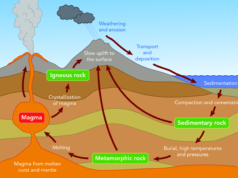
























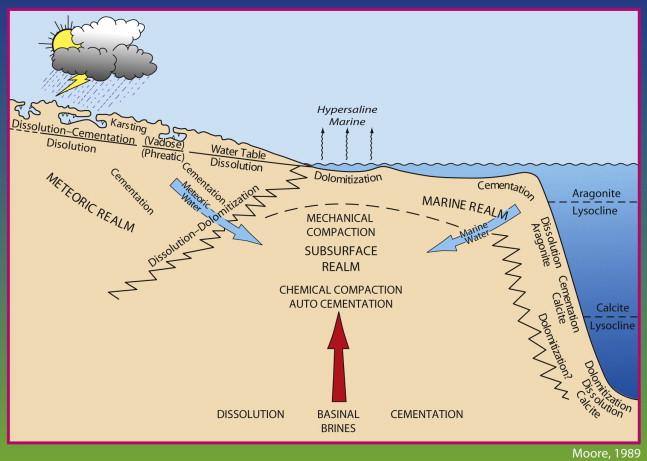
Diagenesis is the suite of physical, chemical and biological changes that affect sediment after deposition, during lithification and throughout its subsequent history at conditions below metamorphism. It changes mineral composition, grain contacts, pore geometry and mechanical properties. Unlike deposition, which establishes the original sedimentary fabric, diagenesis modifies that fabric and can either preserve or obscure evidence of the depositional environment.
Stages of diagenesis
Eogenesis describes near-surface alteration under the influence of marine water, meteoric water or shallow pore fluids. Early carbonate cement, microbial mineral precipitation and dewatering may occur before substantial burial. Mesogenesis describes burial-related alteration as effective stress, temperature and fluid chemistry evolve. Telogenesis describes alteration associated with uplift and renewed access of near-surface fluids. These stages are descriptive rather than fixed depth or temperature intervals; a rock may experience several cycles of burial and uplift.
Compaction and pressure solution
Mechanical compaction reduces sediment volume through grain rearrangement, expulsion of pore water, bending of mica and deformation of ductile rock fragments. Mud-rich sediment commonly undergoes greater volume loss than clean sand. Effective stress, approximately total stress minus pore pressure in unconsolidated saturated sediment, controls much of this behavior. Elevated pore pressure can retard compaction.
Chemical compaction involves dissolution at stressed grain contacts and transport of dissolved material through pore fluids. Concavo-convex or sutured contacts in sandstone and stylolites in limestone are common evidence. Dissolved material may precipitate elsewhere as cement, so pressure solution and cementation can be coupled without being identical processes.
Cementation and dissolution
Cementation is chemical precipitation of minerals in pore spaces or at grain contacts. Quartz overgrowths, calcite, dolomite, iron oxides and authigenic clays are common examples. Early cement can support the grain framework against subsequent compaction, although the cement itself occupies pore space. Later cement can block narrow pore throats and sharply reduce permeability.
Dissolution occurs when pore fluids are undersaturated with respect to a mineral. Feldspar leaching or carbonate cement dissolution can create secondary pores, including grain molds and vugs. Such pores improve fluid transmission only if they connect to the existing network. Dissolved material may also reprecipitate nearby, offsetting local gains in porosity.
Recrystallization and replacement
Recrystallization modifies crystal size, shape or arrangement, commonly without changing the dominant mineral species. Fine carbonate mud may develop a coarser calcite mosaic. Replacement changes the original mineral composition; examples include silicification of carbonate fossils and dolomitization of limestone by magnesium-bearing fluids. Replacement can preserve external grain shapes while destroying internal textures. Its effect on pore space depends on reaction pathways, fluid supply and subsequent cementation.
Biological and organic changes
Microorganisms consume organic matter and alter pore-water chemistry. Sulfate reduction can generate sulfide that reacts with available iron to form pyrite. Changes in alkalinity may promote carbonate precipitation. Organic matter also undergoes early biochemical alteration; with deeper heating, thermal maturation and hydrocarbon generation are commonly described separately as catagenesis. Fossil preservation through mineral infilling or replacement is another important consequence of post-depositional alteration.
Processes and diagnostic features
| Process | Diagnostic evidence | Typical pore-space effect |
|---|---|---|
| Mechanical compaction | Deformed grains, tighter packing | Loss |
| Pressure solution | Sutured contacts, stylolites | Loss or redistribution |
| Cementation | Quartz rims, calcite pore fill | Loss; may preserve framework |
| Dissolution | Molds, etched grains, vugs | Gain, not necessarily connected |
| Replacement | Dolomite rhombs, silicified fossils | Variable |
| Recrystallization | Crystal mosaics, altered textures | Variable |
Controls on diagenesis
The original grain size, sorting, mineralogy and mud content determine initial pore geometry and reactive surface area. Burial history controls stress and heating, while fluid composition, pH, redox state, salinity and mineral saturation determine which reactions are favored. Fluid pathways and residence time influence whether reaction products remain local or are transported away. Temperature accelerates many reactions but does not uniquely predict the final mineral assemblage. There is no universal temperature boundary separating diagenesis from low-grade metamorphism.
Sandstone, limestone and mudrock
In sandstone, quartz overgrowths, carbonate cement and clay mineral growth compete with dissolution and compaction. Grain coatings may inhibit quartz growth but can also restrict flow. In limestone, early marine cement, meteoric dissolution, burial cementation and dolomitization can produce complex pore networks. Mudrocks undergo substantial dewatering, alignment of clay particles and mineral transformations such as progressive illitization of smectite under suitable burial conditions. These processes influence sealing capacity, anisotropy and strength.
Porosity and permeability
Porosity is the fraction of bulk rock volume occupied by pores: φ = Vp / Vb × 100%. Permeability describes the ability of a connected pore network to transmit fluid and is commonly expressed in darcies or square metres. Two rocks with identical porosity can have very different permeability because pore-throat dimensions and connectivity differ.
For an illustrative rock sample of 100 cm³ containing 25 cm³ of pores, porosity is 25%. If cement fills 10 cm³ of pore space without changing bulk volume, porosity falls to 15%. This simplified calculation isolates cementation; compaction would also change bulk volume. Permeability cannot be calculated from these volumes alone.
Recognizing diagenetic history
Field observations reveal concretions, cemented beds, veins, stylolites and weathered dissolution surfaces. Thin-section microscopy distinguishes detrital grains from authigenic minerals and identifies cross-cutting or overgrowth relationships. Cathodoluminescence can distinguish generations of carbonate and quartz cement; scanning electron microscopy resolves fine pore textures, and X-ray diffraction identifies clay and other minerals. Stable isotopes and fluid inclusions may constrain fluid origins and precipitation conditions, subject to independent geological constraints.
A USGS study of the Sussex B sandstone illustrates how core observations, thin sections and mineralogical analyses can reconstruct successive episodes of compaction, cement precipitation and dissolution. Such a sequence, called a paragenesis, helps explain why reservoir quality varies even within a single sandstone unit.
Geological and engineering significance
Diagenesis controls groundwater flow, hydrocarbon reservoir quality, carbon storage capacity and the sealing properties of mudrocks. Cement distribution and dissolution also influence rock strength, excavation behavior and durability. Geological interpretation should therefore distinguish primary depositional properties from later alterations rather than assume that all rocks of the same lithology behave alike.
Frequently asked questions
Is diagenesis the same as lithification?
No. Lithification converts loose sediment into coherent rock; diagenesis includes lithification and subsequent alteration.
Does diagenesis always reduce porosity?
No. Compaction and pore-filling cement usually reduce it, whereas dissolution may create secondary porosity.
How does diagenesis differ from metamorphism?
Diagenesis generally occurs under lower-temperature and lower-grade conditions. The transition is gradual and depends on mineral assemblages, reaction history and geological setting.
Scientific references
USGS — Diagenetic history of the Sussex B sandstone.
Houseknecht — Assessing compaction and cementation in sandstones.
Sedimentology — Order of diagenetic events and carbonate pore networks.