






Beneath the green hills of New Zealand’s North Island, there is an extraordinary place where the ceiling of a cave looks like a night sky filled with stars.
This is the Waitomo Glowworm Caves.
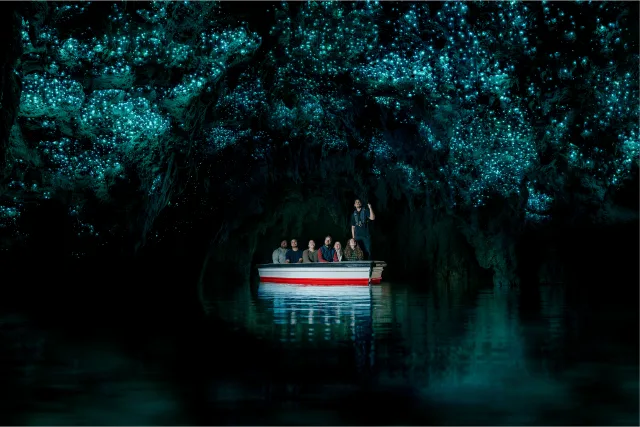
When visitors enter the darker parts of the cave, thousands of tiny blue-green lights appear on the ceiling.
They are not stars.
They are not artificial lights either.
Most of these lights are produced by the larvae of a small fungus gnat species called Arachnocampa luminosa, which is native to New Zealand.
But the story of Waitomo started long before the glowworms arrived.
Around 30 million years ago, during the Oligocene Epoch, the area where Waitomo is located today was beneath the sea. Calcium carbonate-rich marine remains accumulated on the seafloor and slowly became compacted, cemented, and transformed into limestone.
Much later, tectonic uplift and erosion brought these limestone rocks closer to the surface.
Rainwater and groundwater started moving through fractures in the rock.
As the water absorbed carbon dioxide from the soil, it became slightly acidic and slowly began dissolving the limestone.
Small fractures became wider.
Underground water routes developed.
Over time, cave passages, chambers, and underground streams formed.
The cave system we see at Waitomo today developed much later than the approximately 30-million-year-old limestone around it.
This difference is important:
The limestone at Waitomo is about 30 million years old. The cave itself is not 30 million years old.
Geology first created the rock.
Water later carved the cave.
And life eventually filled the darkness with thousands of tiny lights.
Where Are the Waitomo Glowworm Caves?
The Waitomo Glowworm Caves are located near the village of Waitomo in the Waikato region of New Zealand’s North Island.
However, Waitomo is not just one single cave.
The area is part of a much larger karst landscape.
Around Waitomo, you can find:
- caves,
- underground streams,
- sinkholes,
- limestone outcrops,
- natural bridges,
- solution channels,
- and streams that disappear underground.
The Waitomo Glowworm Cave is the most famous, but other important caves nearby include Ruakuri Cave and Aranui Cave.
The Oligocene limestone beneath the region provides the geological foundation for all of these features.
What Does “Waitomo” Mean?
The name Waitomo comes from two Māori words.
“Wai” means water.
“Tomo” means an entrance, hole, or opening leading underground.
The name Waitomo is therefore commonly explained as:
“the stream which flows into the hole in the ground.”
This name actually describes the geology of the area very well.
A large part of the water around Waitomo does not remain on the surface. Instead, it enters openings in the limestone and becomes part of the underground drainage system.
How Did the Limestone at Waitomo Form?
To understand the Waitomo caves, we first need to understand how the rock surrounding them formed.
The main limestone units in the region date from the Oligocene Epoch.
These rocks are roughly 23 to 34 million years old, and the limestone around Waitomo is generally associated with marine conditions around 30 million years ago.
At that time, large parts of what is now New Zealand were low-lying or beneath the sea.
Around Waitomo, calcium carbonate-rich biological remains accumulated on the seafloor.
A large part of this material came from the hard remains of marine organisms.
Bryozoans and other calcareous marine organisms were especially important contributors to these sediments.
Over time, more sediment accumulated on top of the older layers.
The lower layers became buried.
Pressure increased.
Calcite minerals recrystallized and cemented the sediments together.
Eventually, thick layers of limestone formed.
The rock that makes up the walls of the Waitomo caves today is therefore a geological record of an ancient marine environment.
How Did the Limestone Reach the Surface?
The formation of limestone did not mean that the caves already existed.
At first, the rock formed in a marine environment and later remained buried beneath other sediments.
As the tectonic evolution of New Zealand continued, uplift, deformation, and erosion affected the region.
Especially during the last few million years, uplift and erosion played an important role in bringing the limestone units closer to the surface.
The rock also contained fractures, joints, and bedding planes.
These were very important for the later development of caves.
Groundwater usually does not move randomly through solid limestone.
Instead, it follows existing cracks, fractures, and zones of weakness.
Over time, these pathways became wider and formed the basic structure of the cave system.
How Did the Waitomo Caves Form?
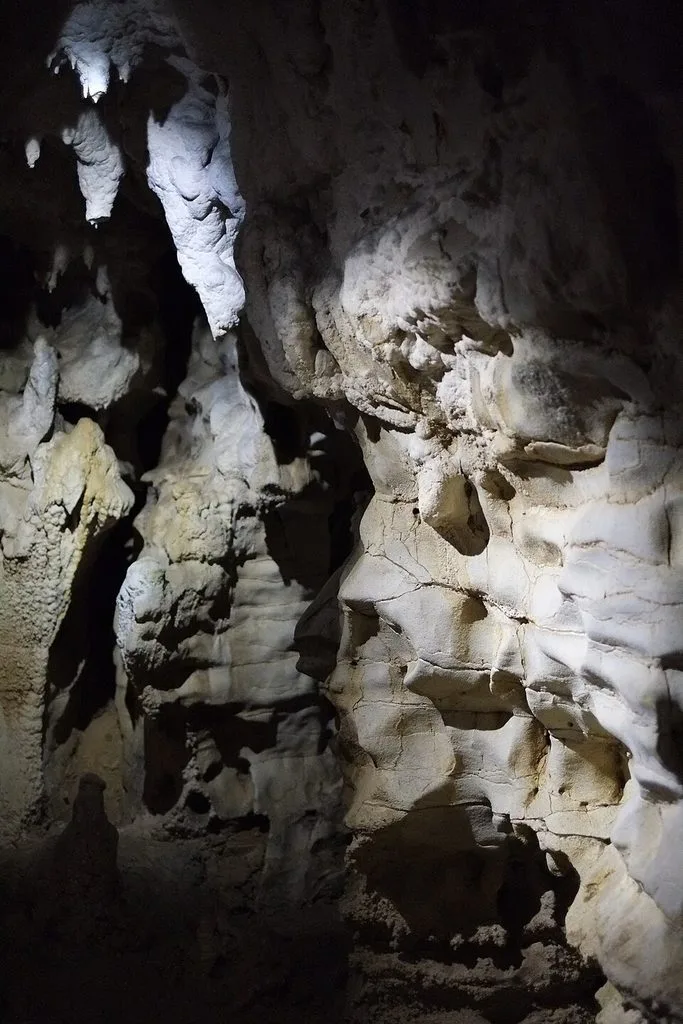
At the center of Waitomo cave formation is a simple but very powerful process:
the dissolution of limestone by slightly acidic water.
Rainwater absorbs carbon dioxide from the atmosphere and especially from the soil.
When carbon dioxide combines with water, it forms weak carbonic acid:
CO₂ + H₂O → H₂CO₃
This is not a strong or dangerous acid.
But when it acts on limestone for very long periods of time, it can create major changes.
The main component of limestone is calcium carbonate:
CaCO₃
When water containing carbonic acid comes into contact with limestone, calcium carbonate can dissolve.
The process can be simplified like this:
CaCO₃ + CO₂ + H₂O → Ca²⁺ + 2HCO₃⁻
Only a very small amount of rock is dissolved during one rainfall event.
But the same water pathways are used again and again.
Small fractures become slightly wider.
More water begins to pass through the widened cracks.
More rock dissolves.
When this positive feedback continues for hundreds of thousands of years, small fractures can develop into large underground passages.
The Waitomo Glowworm Cave itself is not 30 million years old.
Geological sources classify the cave development as Quaternary, which is much younger.
So there are two different geological periods to understand in the story of Waitomo:
Oligocene — limestone formation
and later:
Quaternary — cave and karst development
What Is Karst?
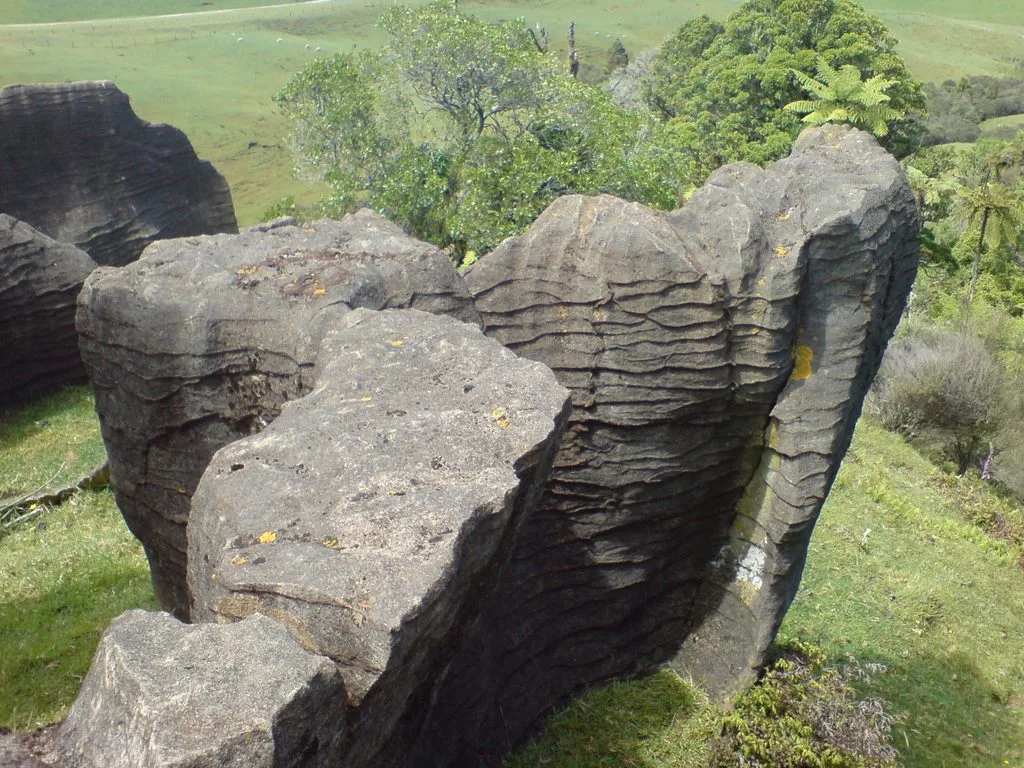
The landscape around Waitomo is known as karst.
Karst is a special type of landscape that develops when soluble rocks, especially limestone, are chemically dissolved by water.
In karst areas, water does not always remain on the surface.
A stream may disappear underground at one location, travel through underground passages, and return to the surface somewhere else.
Common karst features include:
- caves,
- sinkholes,
- underground rivers,
- disappearing streams,
- springs,
- natural bridges,
- limestone pinnacles,
- and solution channels.
The Waitomo region is one of New Zealand’s most important karst areas.
The Glowworm Cave is only one of the most famous parts of this much larger underground system.
The Underground River
One of the most striking features of Waitomo Glowworm Cave is the water flowing through its lower sections.
The famous boat ride through the Glowworm Grotto is possible because of this underground water system.
Groundwater is important in cave formation in two main ways.
First, it chemically dissolves the limestone.
Second, when the flow becomes strong enough, it can physically carry loose sediment and small pieces of rock.
Because of this, caves are not formed only by chemical dissolution.
Water flow, sediment transport, and occasional flooding can also help shape underground passages.
The cave does not remain completely unchanged over time.
Water is still an active part of the underground system today.
How Do Stalactites Form?
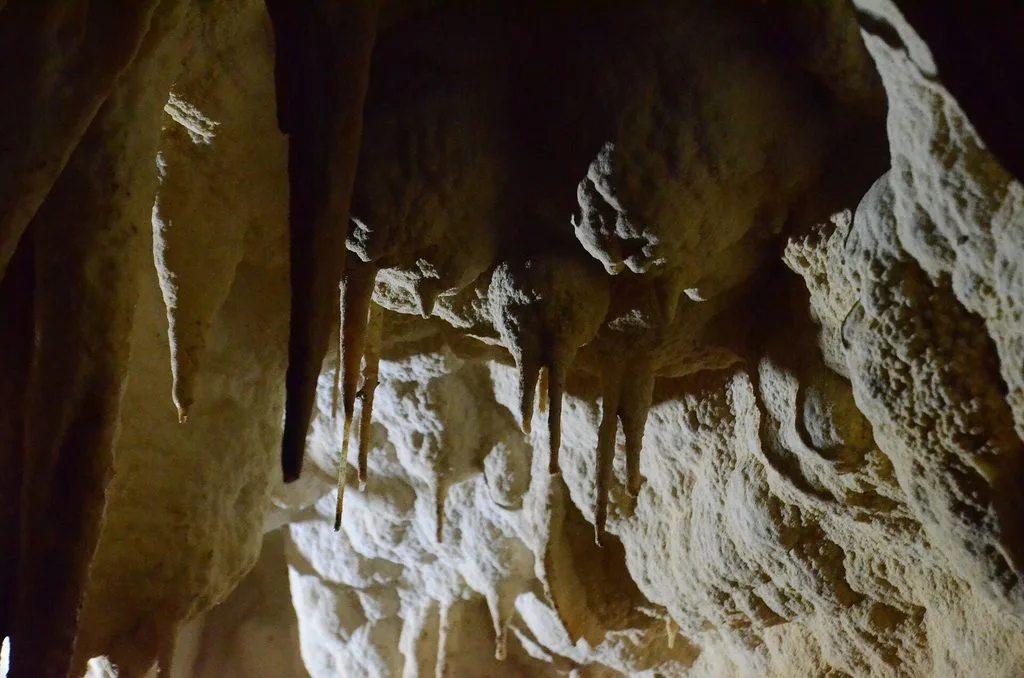
One of the interesting things about Waitomo is that the same water that helps create the cave can later begin building new rock inside it.
Water moving through limestone underground carries dissolved calcium and bicarbonate.
When this water reaches the cave ceiling, it may appear as small droplets.
As a drop comes into contact with cave air, some carbon dioxide can escape from the water.
This causes the chemical reaction to move in the opposite direction.
Calcium carbonate begins to precipitate again.
Each drop leaves behind only a tiny amount of calcite.
But when water drips from the same place for thousands of years, those thin mineral layers slowly grow.
Formations that grow downward from the ceiling are called stalactites.
How Do Stalagmites and Columns Form?
When a drop of water falls from the ceiling and reaches the cave floor, it may still contain dissolved minerals.
The drop can leave behind another small amount of calcium carbonate.
This time, the mineral deposit grows upward from the floor.
This formation is called a stalagmite.
If a stalactite grows downward and a stalagmite grows upward beneath it, the two may eventually meet after a very long time.
When this happens, they can form a column.
Waitomo caves may also contain flowstone and other types of speleothems.
There is an interesting geological contrast here.
The same water can dissolve limestone in one place,
and later deposit calcium carbonate somewhere else.
These two processes together help create both the empty spaces of the cave and the mineral formations inside it.
Are Waitomo Glowworms Really Worms?
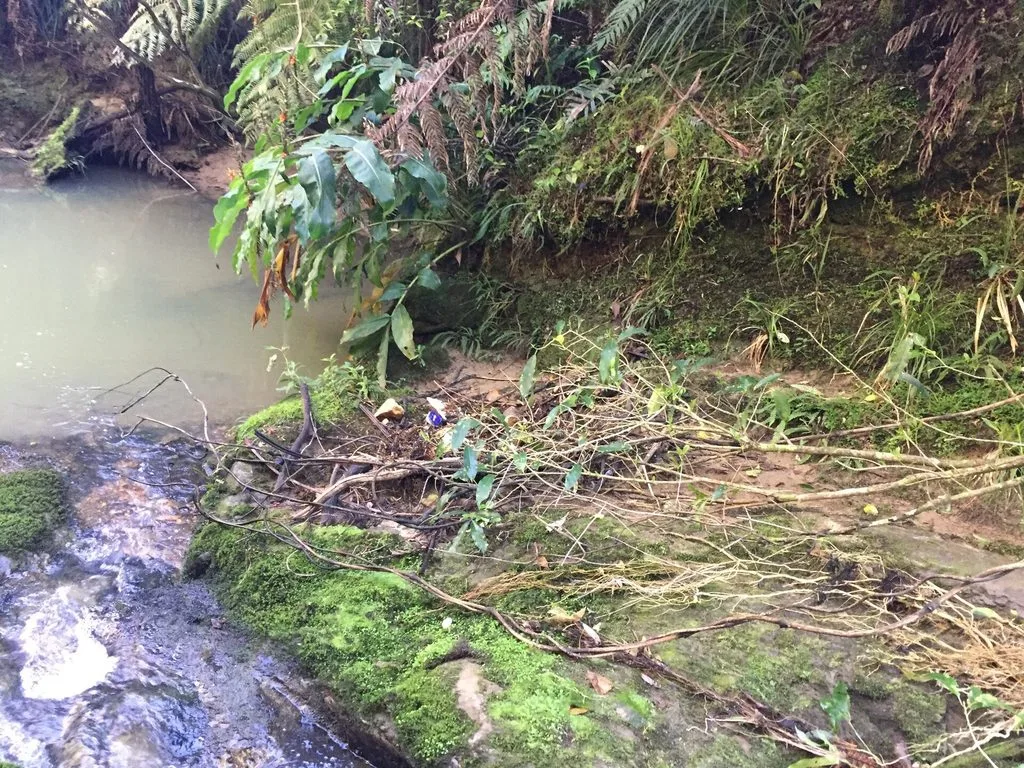
No.
The glowworms at Waitomo are not actually worms.
Their scientific name is:
Arachnocampa luminosa
They are a species of fungus gnat.
Taxonomically, they belong to:
- Animalia
- Arthropoda
- Insecta
- Diptera
- Keroplatidae
- Arachnocampa
- Arachnocampa luminosa
The species is endemic to New Zealand.
The worm-like animal that visitors see glowing in the cave is actually the larval stage of the insect.
After growing, the larvae become pupae and later develop into small adult fungus gnats.
In Māori, these glowing insects are also known as titiwai.
Why Do Glowworms Glow?
The light show inside Waitomo Cave is not produced to impress visitors.
The light is mainly a hunting tool.
Larvae of Arachnocampa luminosa produce blue-green light through a biological process called bioluminescence.
In the darkness of the cave, small flying insects can be attracted toward this light.
This means the glowworm does not have to actively chase prey through the darkness.
Instead, it attracts the prey toward itself.
But the light is only the first part of the hunting system.
Below the glowworm is an even more effective trap.
The Glowworm’s Sticky Fishing Lines
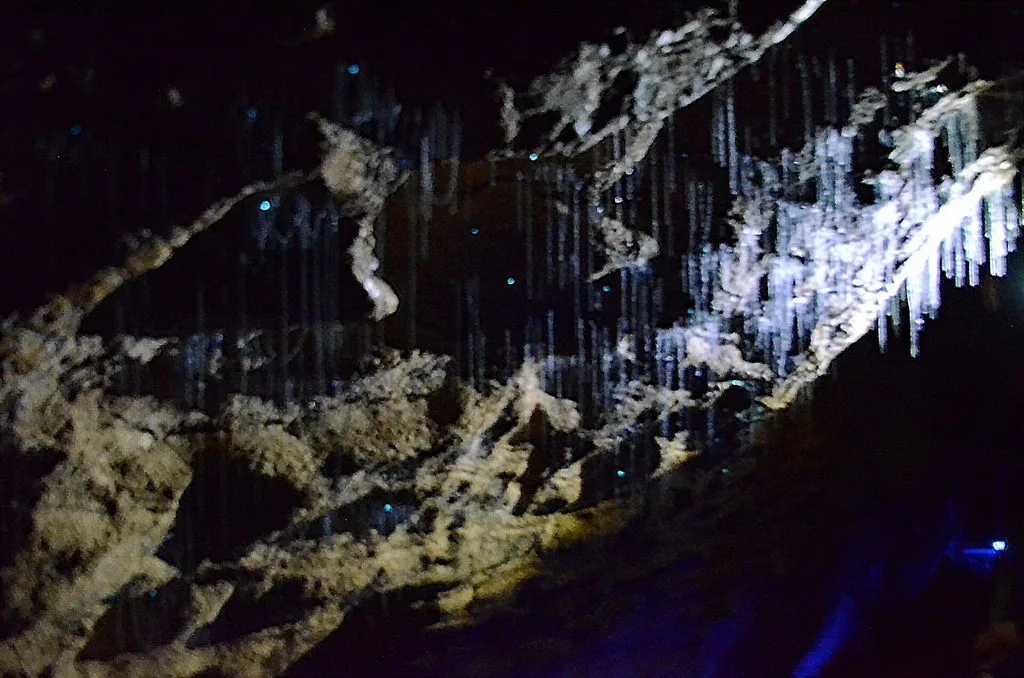
Glowworm larvae suspend sticky silk threads from cave ceilings to trap small insects attracted by their bioluminescent light.A glowworm larva creates a small silk structure on the cave ceiling or another humid and protected surface.
From this structure, many thin silk threads hang downward.
Sticky droplets cover these threads.
Because of their appearance and function, scientific studies often describe them as “fishing lines.”
The hunting system is simple:
light attracts prey
↓
prey flies toward the light
↓
insect touches a sticky thread
↓
prey becomes trapped
↓
larva retrieves the line and feeds
High humidity is especially important for these traps.
When the sticky droplets lose moisture, the ability of the fishing lines to capture prey decreases.
Scientific studies have shown that high relative humidity is an important part of the glowworm’s hunting system.
Why Is Waitomo Such a Good Habitat for Glowworms?
Glowworms cannot live in large numbers everywhere.
A suitable environment needs to be:
- humid,
- dark,
- protected,
- and relatively free from strong air movement.
Waitomo Cave provides these conditions.
High humidity helps the sticky fishing lines remain effective.
Low air movement prevents the long, delicate threads from constantly tangling together.
The underground stream is also important because insects associated with the water can become potential prey for glowworms.
In caves such as Waitomo, thousands of larvae may live close to one another.
This large population creates the famous starry-sky appearance on the cave ceiling.
The Life Cycle of a New Zealand Glowworm
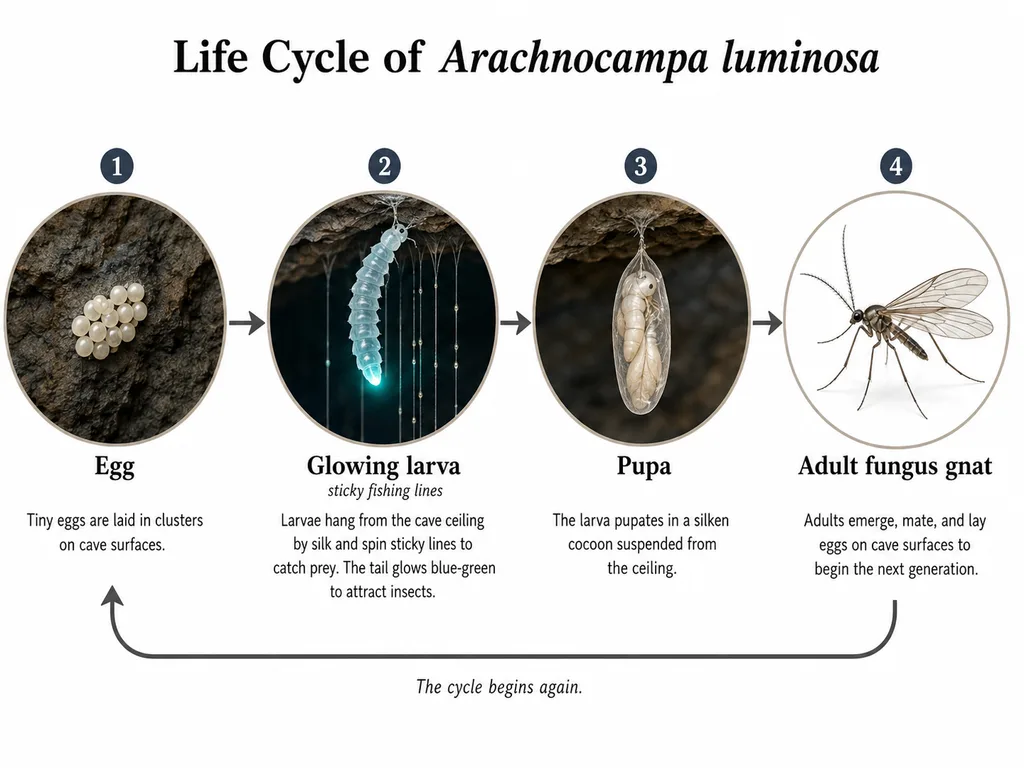
The life cycle of Arachnocampa luminosa has four main stages:
egg → larva → pupa → adult
The larval stage is the longest part of the life cycle.
Depending on environmental conditions, it can last for many months and in some cases may approach a year.
This is the stage when the glowworm actively feeds and catches prey.
Later, the larva becomes a pupa.
Finally, an adult fungus gnat emerges.
The adult stage is very short.
Adults have reduced mouthparts and do not feed.
Their main purpose is reproduction.
There is also an interesting detail here.
The famous large-scale light display inside Waitomo is produced mainly by larvae, but scientific research has shown that female pupae and adult females of Arachnocampa luminosa can also produce bioluminescence.
So it is not completely correct to say that only larvae can glow.
Why Is the Glowworm Grotto Famous?
The best-known part of Waitomo Glowworm Cave is called the Glowworm Grotto.
Visitors move silently by boat through the dark cave while thousands of small lights shine above them.
Because the cave ceiling itself almost disappears in the darkness, only the blue-green points of light remain visible.
This can make it difficult to judge the distance and shape of the ceiling.
The lights can look almost like real stars in the night sky.
But behind every glowing point is a biological hunting system.
That is one of the most interesting parts of Waitomo.
The beautiful scene is actually the result of a continuous struggle between predators and prey.
Human History of Waitomo Glowworm Cave
The Waitomo caves were known to local Māori communities before Europeans arrived in the region.
However, one of the first well-documented explorations of the inner parts of Glowworm Cave took place in 1887.
Local Māori Chief Tane Tinorau explored the cave together with English surveyor Fred Mace.
They entered the underground system using a raft made from flax stems and travelled through the darkness by candlelight.
One of the most remarkable areas they encountered was the Glowworm Grotto.
The ceiling was covered with thousands of tiny lights.
More sections of the cave were explored during later visits.
In 1889, Tane Tinorau opened the cave to tourists.
Tane Tinorau and his wife Huti guided visitors through the cave.
In 1906, control of the cave was taken over by the government.
A major change happened many decades later.
In 1989, the cave and surrounding land were returned to descendants of the original Māori owners.
Today, some of the people working at the cave are direct descendants of Tane Tinorau and Huti.
Waitomo is therefore important not only geologically and biologically, but also culturally.
How Old Is Waitomo Glowworm Cave?
It is not correct to simply say that Waitomo Glowworm Cave is 30 million years old.
The thing that is approximately 30 million years old is the limestone.
The cave passages formed much later.
Geological sources describe Waitomo Glowworm Cave as a:
Quaternary cave formation
developed within:
Oligocene limestone
The Quaternary covers roughly the last 2.6 million years of Earth’s history.
However, this does not mean that every passage in Waitomo formed at exactly the same time or exactly 2.6 million years ago.
The cave developed through different stages over time.
The safest way to describe its age is:
The limestone is about 30 million years old, while the cave itself formed much later during the Quaternary.
Is Waitomo Cave Still Changing Today?
Yes.
Waitomo is not a finished geological structure where nothing changes anymore.
Water still moves through the cave system.
In some areas, limestone can continue to dissolve.
In other places, calcite can continue to precipitate and very slowly grow speleothems.
Underground streams can transport sediment.
Flooding can affect parts of the cave.
The cave microclimate is also important for glowworms.
Temperature, humidity, air movement, and carbon dioxide levels can influence the cave environment and its ecosystem.
Waitomo is therefore still an active and changing system, both geologically and biologically.
Why Is Waitomo Geologically Important?
Waitomo is not the only limestone cave in the world.
Stalactites and stalagmites are not unique to Waitomo either.
Arachnocampa luminosa also lives in other parts of New Zealand.
What makes Waitomo unusual is the way all these processes come together in one place.
Here we can see:
- Oligocene marine limestone,
- Quaternary cave development,
- limestone dissolution,
- karst drainage,
- underground streams,
- stalactites,
- stalagmites,
- flowstone,
- bioluminescence,
- glowworm predation,
- cave microclimate,
- and Māori cultural history.
In a way, geology created the conditions for the famous glowworm display.
Without limestone, there would be no cave.
Without water, the cave would not have been carved.
And without the dark, humid, protected cave environment, there would not be such large glowworm colonies.
Frequently Asked Questions About Waitomo Glowworm Caves
How were the Waitomo Glowworm Caves formed?
The Waitomo caves developed when groundwater absorbed carbon dioxide from the soil, became slightly acidic, and slowly dissolved the Oligocene limestone along fractures and zones of weakness. Over long periods of time, small cracks widened into cave passages and chambers.
Is Waitomo Cave really 30 million years old?
No. The limestone is about 30 million years old. The cave passages formed much later and are classified as Quaternary cave formations.
Are Waitomo glowworms really worms?
No. Waitomo glowworms are the larvae of a fungus gnat species called Arachnocampa luminosa.
Is Arachnocampa luminosa found only in New Zealand?
Yes. Arachnocampa luminosa is endemic to New Zealand.
Why do Waitomo glowworms glow?
The larvae use bioluminescence mainly to attract small flying insects. The insects can then become trapped in sticky silk threads hanging from the cave ceiling.
Do only glowworm larvae produce light?
No. The large glow display inside the cave is mainly produced by larvae, but female pupae and adult females of Arachnocampa luminosa are also known to produce light.
How do glowworms catch their prey?
Larvae hang silk threads covered with sticky droplets from the cave ceiling. Small insects attracted to the light can become trapped in these threads, and the larva then pulls the prey upward and feeds on it.
What does Waitomo mean?
“Wai” means water and “tomo” means an entrance or hole. Waitomo is commonly interpreted as “the stream which flows into the hole in the ground.”
How do stalactites form in Waitomo Cave?
Water containing dissolved calcium and bicarbonate can lose carbon dioxide as it drips from the cave ceiling. Calcite then precipitates, slowly building stalactites over long periods of time.
Is Waitomo Glowworm Cave still forming today?
Yes. Water still moves through the cave system. Limestone can continue to dissolve in some areas, while calcium carbonate can continue to precipitate and form new mineral deposits in others.
When was Waitomo Glowworm Cave explored?
The cave was already known to local Māori. Tane Tinorau and Fred Mace carried out a documented exploration of its inner sections in 1887, and Tane Tinorau opened the cave to tourists in 1889.
Conclusion
When people enter Waitomo Glowworm Cave, the first thing that catches their attention is the thousands of tiny lights above them.
But the story behind this view did not begin with glowworms.
Around 30 million years ago, the Waitomo region was beneath the sea.
Calcium carbonate-rich sediments accumulated on the seafloor and slowly became limestone.
Millions of years later, tectonic uplift and erosion brought these rocks closer to the surface.
Rainwater entered the soil.
It absorbed carbon dioxide.
It became slightly acidic.
As the water moved through fractures in the limestone, it slowly dissolved the rock.
The fractures became wider.
Underground passages developed.
Water continued to shape the cave.
In some places, rock dissolved.
In other places, calcite precipitated again and created stalactites and stalagmites.
Later, the dark, humid, and protected environment became an ideal habitat for Arachnocampa luminosa.
The larvae settled on the cave ceiling.
They lowered their sticky fishing lines.
They used blue-green light to attract small insects.
When thousands of glowworms live together, the cave ceiling becomes a field of stars.
The real story of Waitomo is therefore not only the story of glowing animals.
Geology created the rock.
Water carved the cave.
And life filled the darkness with light.
References
Earth Sciences New Zealand / GNS Science. Stratigraphy of New Zealand – Oligocene Marine Sedimentary Rocks and Waitomo Karst.
GNS Science / GeoTrips. Waitomo Glowworm Cave – Speleothems and Glowworms. Oligocene limestone; Quaternary cave formation.
Department of Conservation New Zealand. Karst Management Guidelines. Limestone dissolution, karst systems, cave hydrology and speleothems.
Te Ara – The Encyclopedia of New Zealand. Paul Williams. Limestone Country – Karst.
Te Ara – The Encyclopedia of New Zealand. New Zealand’s Glow-worms.
Museum of New Zealand Te Papa Tongarewa. Arachnocampa luminosa – Titiwai Taxonomic Record.
New Zealand Organisms Register. Arachnocampa luminosa – Taxonomic Classification and Endemic Status.
Meyer-Rochow, V. B. (2007). Glowworms: A Review of Arachnocampa spp. and Kin. Luminescence.
von Byern, J., Chandler, P., Merritt, D., et al. (2019). Biomechanical Properties of Fishing Lines of the Glowworm Arachnocampa luminosa. Scientific Reports, 9, 3082.
Merritt, D. J., et al. (2020). Carbon Dioxide-Induced Bioluminescence Increase in Arachnocampa Larvae. Journal of Experimental Biology.
Discover Waitomo. About Waitomo – The Meaning of Waitomo and the Geological History of the Region.
Discover Waitomo. The History of Waitomo Glowworm Cave – Tane Tinorau and Fred Mace.