





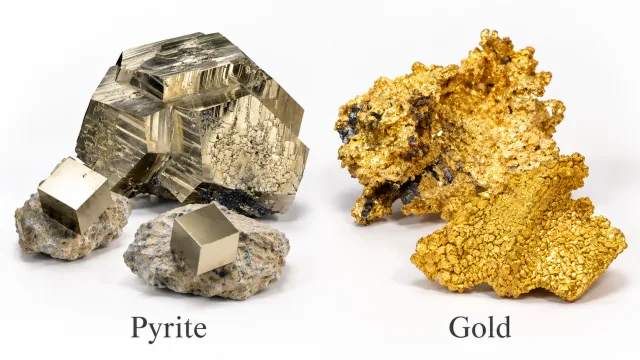
When you notice bright, yellow, metallic-looking particles inside a rock, it is natural to wonder whether you have found gold. This is especially common when shiny yellow grains appear in quartz veins, stream sediments, or rocks collected from mineralized areas.
However, in many cases, the yellow mineral turns out to be pyrite rather than gold.
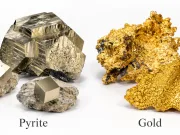
Pyrite has long been known as “fool’s gold” because its metallic luster and brassy-yellow color can closely resemble real gold at first glance.
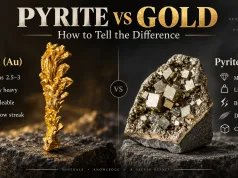
Pyrite is an iron sulfide mineral with the chemical formula FeS₂, while gold is a naturally occurring metallic element with the chemical symbol Au. Although the two can look similar, their physical properties are very different.
Fortunately, you do not need advanced laboratory equipment to distinguish them in many cases. Several simple observations and tests can help you determine whether a shiny yellow mineral is more likely to be gold or pyrite.
Why Are Gold and Pyrite So Often Confused?
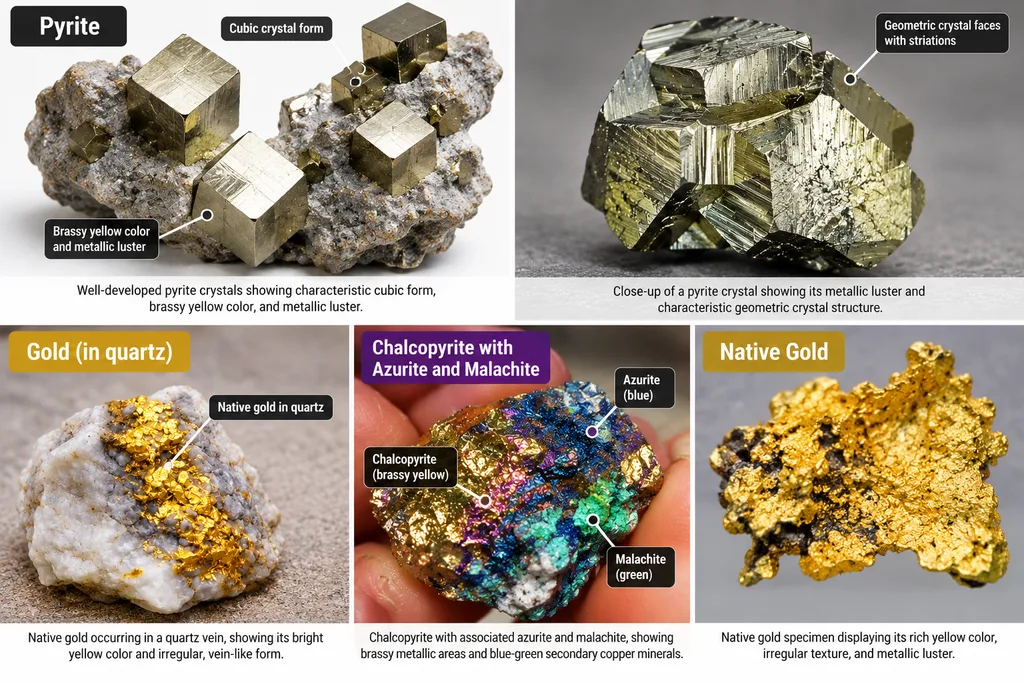
Both gold and pyrite can have a metallic luster and a yellowish color.
When the grains are small and exposed to bright sunlight, the difference between them may be difficult to recognize at first.
Pyrite can also occur in quartz veins, and gold is commonly associated with certain hydrothermal quartz vein systems. Because of this, the two minerals may sometimes occur in similar geological environments.
There is another important complication.
In some ore deposits, pyrite can actually contain microscopic amounts of gold. The gold may occur as extremely small particles within the pyrite or along crystal boundaries.
This means that finding pyrite does not necessarily mean that a geological area contains no gold.
However, identifying whether the shiny yellow mineral itself is gold or pyrite is usually possible by comparing several important physical properties.
1. Look Carefully at the Color
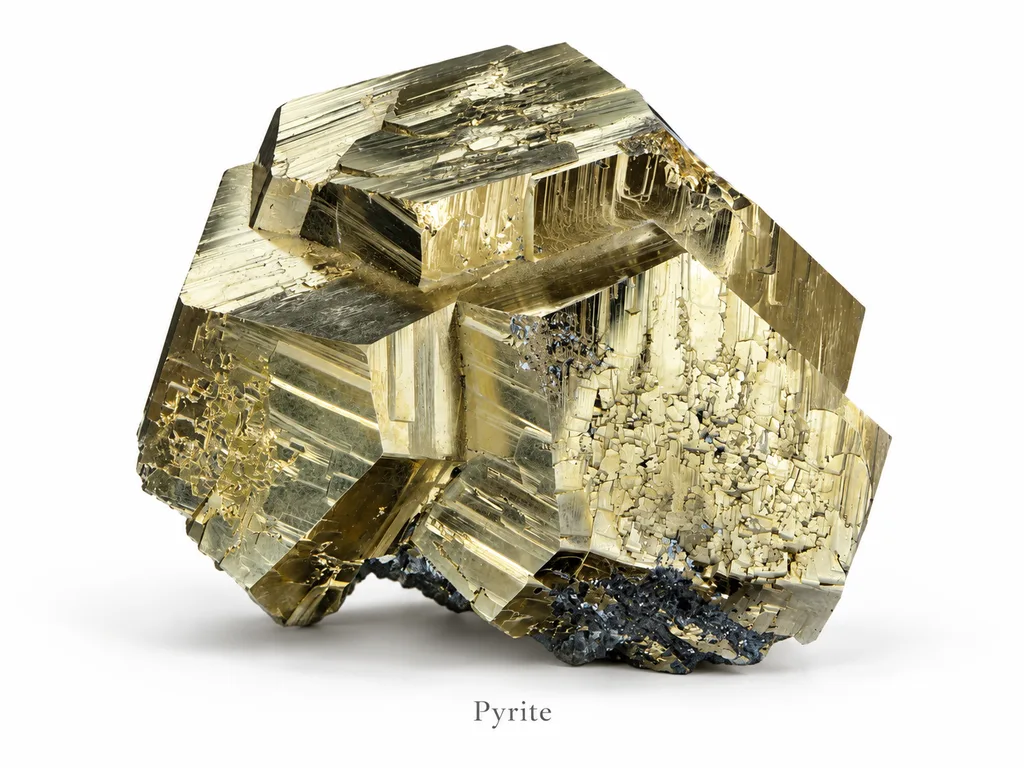
Color is often the first clue.
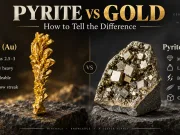
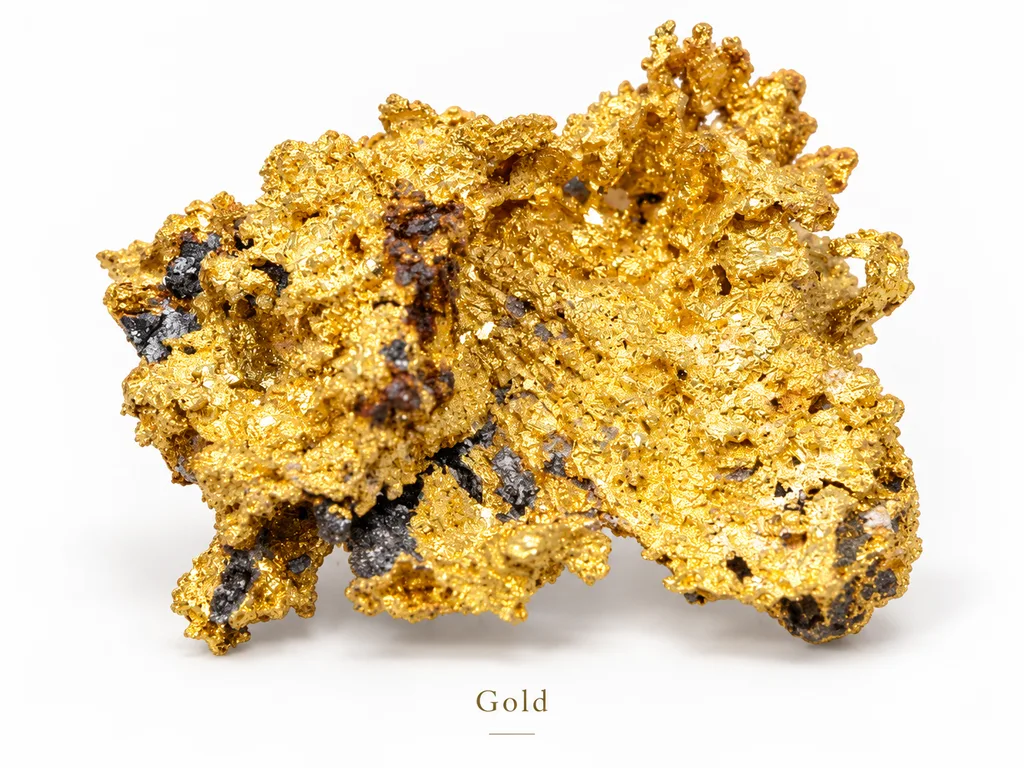
Natural gold usually has a rich, warm, deep yellow color that is difficult to mistake once you become familiar with it.
Pyrite generally has a paler and more brassy appearance.
Pyrite may appear:
- brassy yellow,
- pale yellow,
- slightly greenish yellow,
- or bronze-yellow.
Gold usually has a stronger and more saturated yellow color.
However, color alone is not a reliable identification method.
Oxidation, surface weathering, lighting conditions, moisture, and surrounding minerals can all affect how a specimen looks.
For this reason, color should be treated only as an initial clue rather than definitive proof.
2. Examine the Crystal Shape
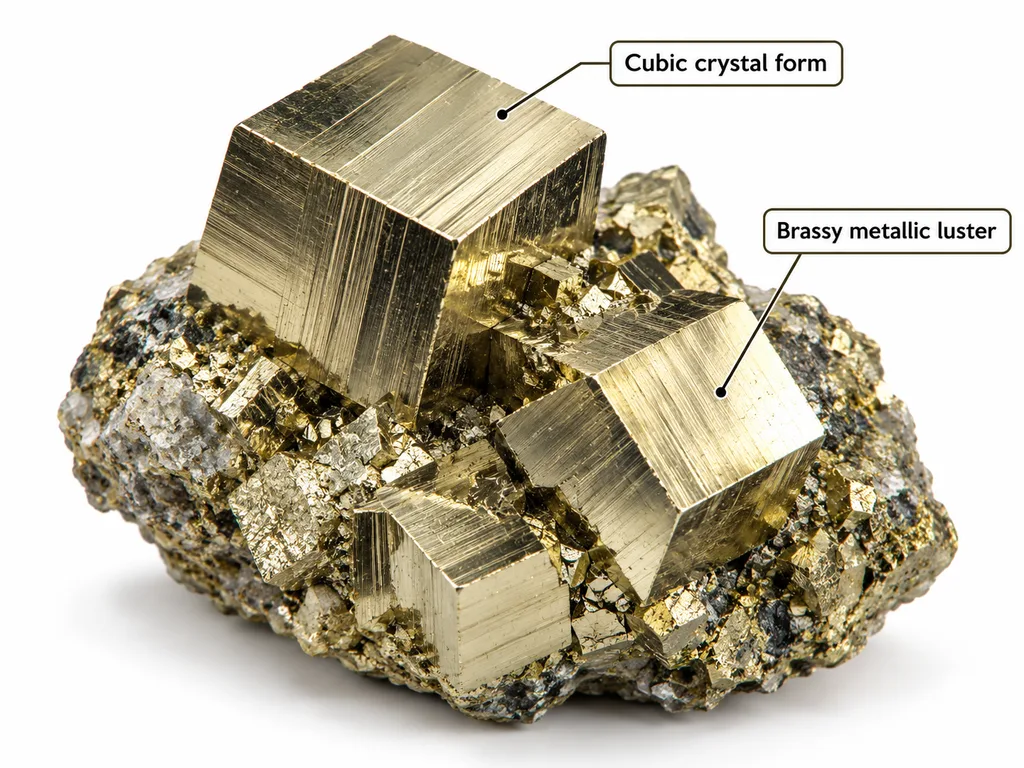
Crystal shape can provide one of the strongest visual clues.
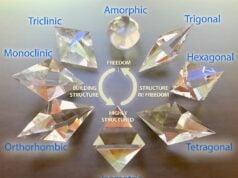
Pyrite crystallizes in the isometric crystal system and often forms very distinctive geometric crystals.
Cubic pyrite crystals are especially common and recognizable.
Pyrite may also form:
- pyritohedral crystals,
- octahedral crystals,
- intergrown crystal masses,
- or granular aggregates.
The crystal faces may show fine parallel lines known as striations.
Natural gold usually does not occur as perfect cubic crystals.
Instead, placer gold and gold found in weathered deposits commonly occurs as:
- irregular grains,
- flattened flakes,
- rounded particles,
- small nuggets,
- or irregular masses.
If the yellow mineral in your rock forms sharp, well-developed cubes or other strongly geometric crystals, pyrite is much more likely.
3. Perform a Streak Test
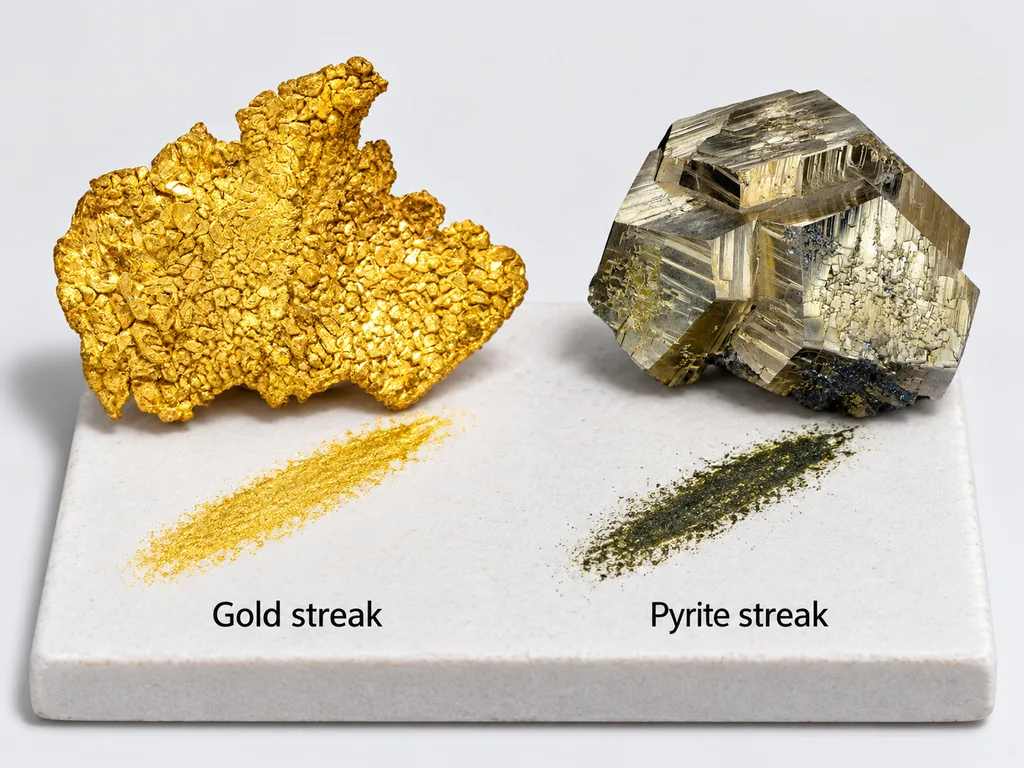
The streak test is one of the most useful simple tests used in mineral identification.
A mineral’s streak is the color of its powdered form.
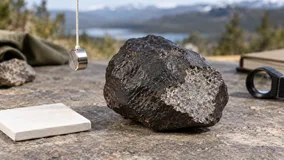
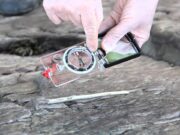
To perform the test, gently rub the mineral across a piece of unglazed porcelain.
Then examine the color of the mark left behind.
Gold:
usually produces a yellow to golden-yellow streak.
Pyrite:
typically produces a dark streak ranging from greenish-black to brownish-black.
This is one of the easiest ways to distinguish the two minerals.
A mineral can look bright yellow on its surface while producing a completely different streak color.
However, streak testing is destructive.
If you have an attractive, well-developed crystal or a potentially valuable collector specimen, avoid scratching a visible surface.
Instead, test a small inconspicuous area if possible.
4. Test the Hardness
Gold and pyrite have very different hardness values.
On the Mohs hardness scale, gold has a hardness of approximately:
2.5 to 3
Pyrite is much harder, with a hardness of approximately:
6 to 6.5
This difference is significant.
Gold can be scratched relatively easily with many metal objects.
Pyrite is much more resistant to scratching.
In fact, pyrite may scratch materials that would easily scratch gold.
Therefore, if the yellow mineral is surprisingly hard and resists scratching, it is unlikely to be native gold.
Hardness testing should still be performed carefully because surrounding minerals in the rock can affect the result.
For example, a tiny gold grain embedded in quartz may be difficult to test directly because the quartz surrounding it is considerably harder.
5. Does It Bend or Break?
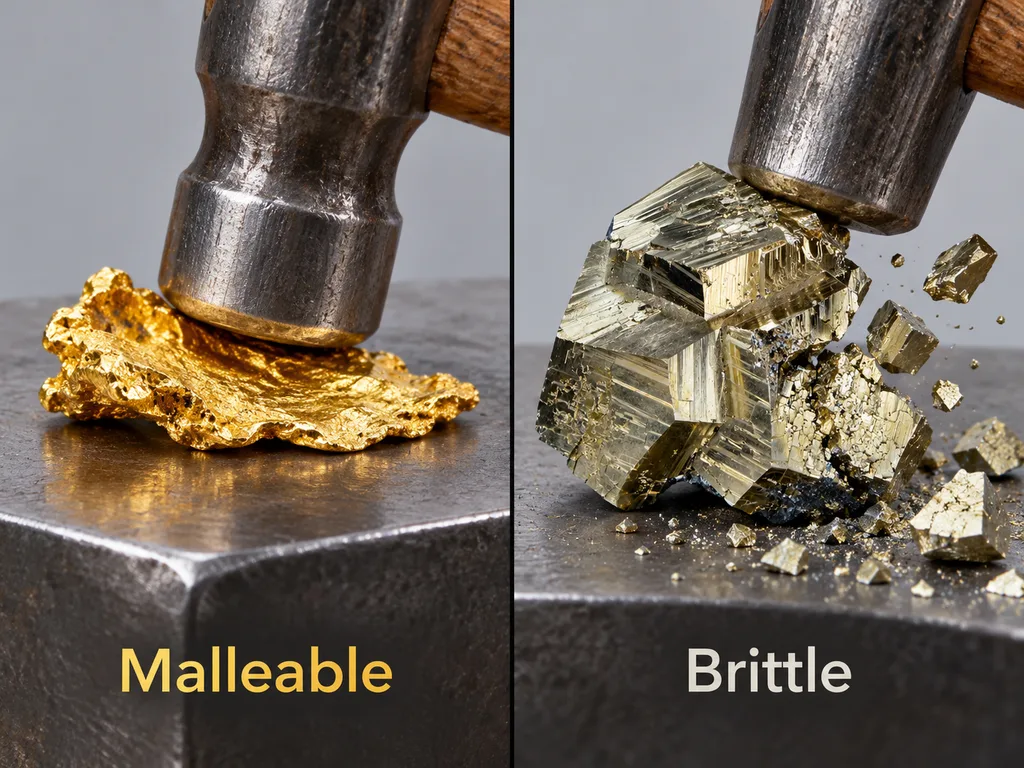
This is one of the most useful differences between gold and pyrite.
Gold is malleable.
This means it can deform under pressure.
If a small gold particle is pressed or gently struck, it may:
- flatten,
- bend,
- dent,
- or change shape.
Pyrite behaves very differently.
Pyrite is brittle.
Instead of flattening under pressure, it is more likely to:
- crack,
- chip,
- crumble,
- or break into smaller fragments.
This gives you a very useful practical question:
Does the particle flatten, or does it break?
If it flattens and changes shape without breaking, gold becomes more likely.
If it shatters or crumbles, pyrite or another brittle mineral is much more likely.
6. Check the Weight and Density
Gold is exceptionally dense.
Pure gold has a specific gravity of approximately:
19.3
Pyrite has a specific gravity of approximately:
5
This means that a piece of gold will feel dramatically heavier than a similarly sized piece of pyrite.
This difference is one of the reasons experienced prospectors can sometimes recognize gold simply by handling a specimen.
A small piece of gold can feel surprisingly heavy for its size.
However, judging density by hand can be difficult when dealing with very small particles.
A more accurate method is to measure specific gravity using water displacement.
The basic process involves:
- weighing the specimen in air,
- measuring its apparent weight while suspended in water,
- calculating its specific gravity.
Natural gold specimens may contain silver, copper, quartz, or other minerals, so their overall density may be lower than the theoretical value for pure gold.
Even so, gold-rich material is usually considerably denser than pyrite.
7. Observe How It Reflects Light
Light reflection can provide another useful clue, although it should never be used alone.
Gold tends to maintain its characteristic yellow color when viewed from different angles.
Pyrite often produces sharp, mirror-like flashes from its flat crystal surfaces.
When a pyrite crystal is moved under bright light, the reflection may suddenly appear and disappear as the angle changes.
This effect can make pyrite look especially bright in sunlight.
Small particles of mica can behave in a similar way, producing intense flashes when the light hits their flat surfaces.
For this reason, the statement:
“It shines brightly, so it must be gold”
is not reliable.
Hardness, streak, crystal shape, density, and malleability are much better indicators.
Gold vs. Pyrite: Key Differences
| Property | Gold | Pyrite |
|---|---|---|
| Color | Rich golden yellow | Brassy yellow |
| Luster | Metallic | Metallic |
| Mohs Hardness | About 2.5–3 | About 6–6.5 |
| Streak | Yellow | Greenish-black to brownish-black |
| Mechanical Behavior | Malleable | Brittle |
| Specific Gravity | About 19.3 | About 5 |
| Typical Form | Irregular grains, flakes, nuggets | Cubic and geometric crystals |
| Chemical Composition | Au | FeS₂ |
Can a Magnet Distinguish Gold From Pyrite?
Magnet testing is often recommended online, but it is not a reliable primary test for distinguishing gold from pyrite.
Pure gold is not magnetic.
However, ordinary pyrite is also not strongly attracted to a standard magnet.
Therefore, this conclusion is incorrect:
“It does not stick to a magnet, so it must be gold.”
A rock may also contain magnetite or other magnetic minerals.
In such cases, the entire specimen may react to a magnet even though the yellow mineral itself is unrelated to the magnetic response.
A magnet can occasionally provide additional information, but it should not replace more useful tests such as:
- streak,
- hardness,
- density,
- crystal form,
- and malleability.
Can Pyrite Contain Real Gold?
Yes.
This is one of the most interesting aspects of pyrite.
Identifying a mineral as pyrite does not necessarily mean that the rock has no geological or economic significance.
In some gold deposits, very small quantities of gold can occur:
- inside pyrite crystals,
- along crystal boundaries,
- in microscopic fractures,
- or associated with other sulfide minerals.
This gold may be too small to see with the naked eye.
In some mining operations, pyrite-rich ores can therefore be important sources of gold.
However, an important distinction must be made.
Gold occurring inside pyrite does not mean that the visible pyrite crystal itself is gold.
Determining how much gold is present generally requires laboratory analysis.
What Other Minerals Can Be Mistaken for Gold?
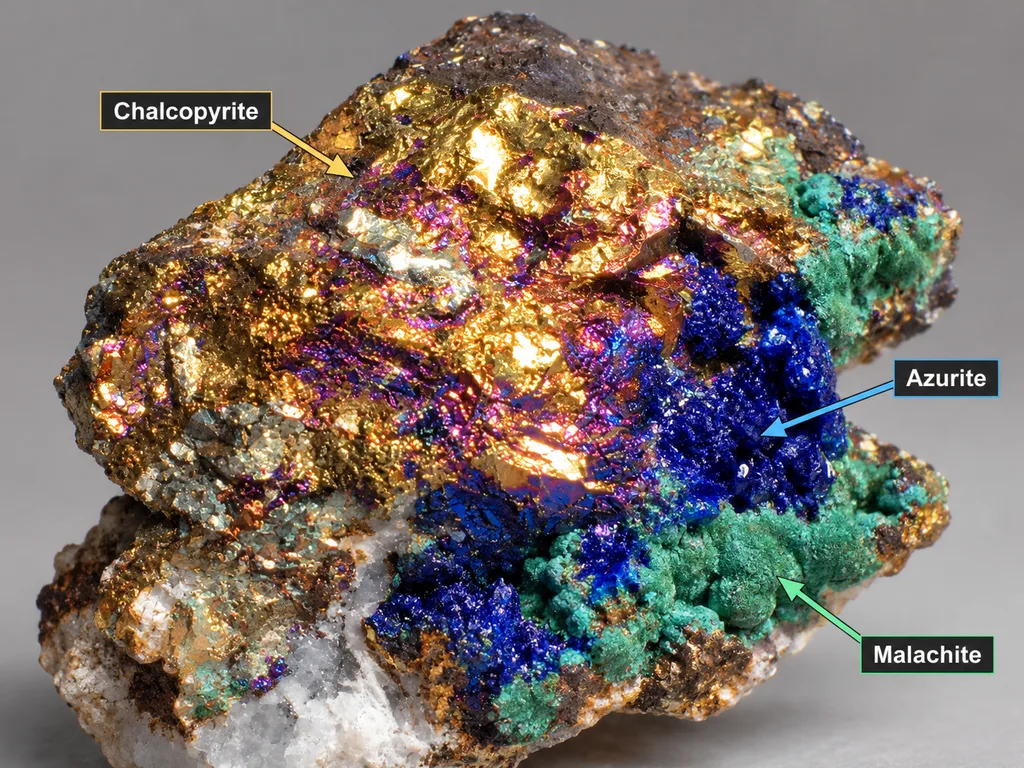
Pyrite is the most famous mineral confused with gold, but it is not the only one.
Other common look-alikes include:
- chalcopyrite,
- mica,
- weathered sulfide minerals,
- and certain iron-rich minerals.
Chalcopyrite
Chalcopyrite is another metallic sulfide mineral with a brassy-yellow color.
Its chemical formula is:
CuFeS₂
Chalcopyrite is softer than pyrite, with a Mohs hardness of approximately:
3.5 to 4
Its streak is generally dark and may appear greenish-black.
Weathered chalcopyrite surfaces may develop iridescent colors including:
- blue,
- purple,
- green,
- and bronze.
Fresh chalcopyrite can still look surprisingly similar to gold, particularly when it occurs as small grains.
Mica
Certain mica minerals can also produce gold-like reflections.
Thin flakes of mica can appear extremely bright when sunlight reflects from their flat surfaces.
However, mica behaves very differently from gold.
Mica tends to:
- split into thin sheets,
- flake apart,
- bend in thin layers,
- and produce sharp flashes of reflected light.
Gold does not split into thin sheets in the same way.
Can the Yellow Mineral in Quartz Be Gold?
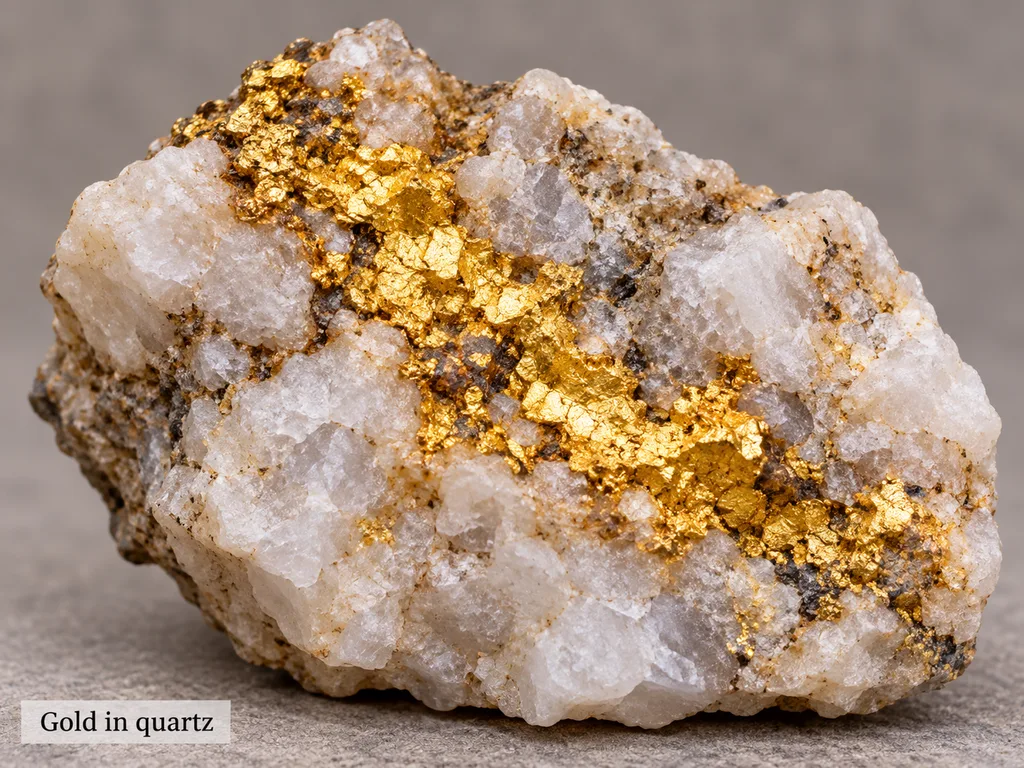
Yes, it can.
Gold commonly occurs in association with quartz in many hydrothermal mineral systems.
This is why quartz veins have historically attracted the attention of gold prospectors.
However, not every yellow mineral inside quartz is gold.
Quartz veins may also contain:
- pyrite,
- chalcopyrite,
- arsenopyrite,
- mica,
- and other metallic minerals.
If you find a yellow mineral in quartz, examine several properties before reaching a conclusion.
Look at:
- crystal shape,
- hardness,
- streak color,
- brittleness,
- malleability,
- density.
Sharp cubic crystals strongly suggest pyrite.
An irregular yellow particle that is unusually heavy and flattens rather than breaking is more consistent with gold.
Which Test Is the Most Reliable?
For home identification, it is better to combine several tests rather than rely on a single characteristic.
For example, if a mineral:
- produces a dark streak,
- is relatively hard,
- forms cubic crystals,
- and breaks under pressure,
it is most likely pyrite.
If a mineral:
- produces a yellow streak,
- is relatively soft,
- feels unusually heavy,
- and flattens or bends instead of breaking,
the possibility of gold increases significantly.
Even then, home tests cannot always provide absolute certainty.
If the specimen may be valuable or comes from a promising geological area, professional mineralogical or geochemical analysis is the safest way to confirm its composition.
Important: Be Careful With Valuable Mineral Specimens
If you have a well-formed crystal or an attractive mineral specimen, avoid immediately scratching, breaking, or crushing it.
Some natural mineral specimens have considerable collector value.
A well-developed pyrite crystal, for example, may be more valuable as a collectible specimen than as a source of metal.
Before performing destructive tests:
- photograph the specimen,
- examine its crystal form,
- inspect it under magnification,
- try non-destructive observations first,
- test only a small hidden area if necessary.
Preserving the original crystal form can sometimes be more important than confirming the mineral with a destructive test.
Conclusion
Gold and pyrite can look surprisingly similar at first glance, but their physical properties are very different.
Pyrite is a hard, brittle iron sulfide mineral that commonly forms geometric crystals.
Gold is a dense, soft, malleable metal that usually occurs as irregular grains, flakes, or nuggets.
For this reason, color and shine alone should never be used to identify gold.
Instead, examine several characteristics together:
- streak color,
- hardness,
- density,
- crystal shape,
- brittleness,
- and malleability.
A dark streak, high hardness, cubic crystal shape, and brittle behavior strongly suggest pyrite.
A yellow streak, low hardness, very high density, and the ability to flatten rather than break are much more consistent with gold.
The next time you notice a glittering yellow mineral inside quartz or along a stream bed, do not rely on appearance alone.
It might be gold.
But very often, the mineral producing that golden sparkle is pyrite.
Frequently Asked Questions
Is pyrite actually gold?
No. Pyrite is an iron sulfide mineral with the chemical formula FeS₂. Gold is a naturally occurring element represented by the chemical symbol Au.
Can pyrite contain real gold?
Yes. In some geological deposits, microscopic gold may occur inside or around pyrite crystals. Laboratory analysis is generally required to determine how much gold is present.
Does gold stick to a magnet?
Pure gold is not magnetic. However, a mineral not reacting to a magnet does not mean it is automatically gold.
What is the easiest way to tell gold from pyrite?
The streak and malleability tests are among the most useful simple methods. Gold produces a yellow streak and can flatten under pressure, while pyrite produces a dark streak and is brittle.
Is pyrite harder than gold?
Yes. Pyrite has a Mohs hardness of approximately 6 to 6.5, while gold has a hardness of about 2.5 to 3.
Can yellow particles in quartz be gold?
Yes, but pyrite, chalcopyrite, and other minerals can also occur in quartz veins. Color alone is not enough for identification.
Is pyrite valuable?
Pyrite is generally much less economically valuable than gold. However, well-formed pyrite crystals can be desirable mineral specimens, and pyrite may also be associated with gold-bearing ore deposits.
References
- U.S. Geological Survey (USGS). What is “Fool’s Gold?”
https://www.usgs.gov/faqs/what-fools-gold - Geology.com. Pyrite Mineral – Uses and Properties.
https://geology.com/minerals/pyrite.shtml - Geology.com. Fool’s Gold and Real Gold – How to Tell the Difference.
https://geology.com/gold/fools-gold/ - Geology.com. Chalcopyrite: Mineral Uses and Properties.
https://geology.com/minerals/chalcopyrite.shtml - Mindat.org. Pyrite – Mineral Information, Data and Localities.
https://www.mindat.org/min-3314.html - Mindat.org. Gold – Mineral Information, Data and Localities.
https://www.mindat.org/min-1720.html