



Minerals are the building blocks of rocks, but every mineral crystal also records a story.
A quartz crystal growing from hot water inside a fracture forms under completely different conditions from an olivine crystal developing inside cooling magma. Gypsum deposited in an evaporating salt basin has little in common with garnet growing several kilometers underground during metamorphism.
Yet all of these processes have something fundamental in common.
Minerals form when chemical elements are brought together under physical and chemical conditions that allow a stable mineral structure to develop.
Temperature, pressure, chemical composition, water, gases, oxidation state, available space, and time can all influence which minerals form and what those minerals eventually look like.
There is no single universal classification that divides all mineral formation into exactly seven processes. Mineral-forming environments overlap, and one geological system can involve several processes at the same time.
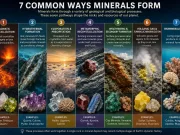
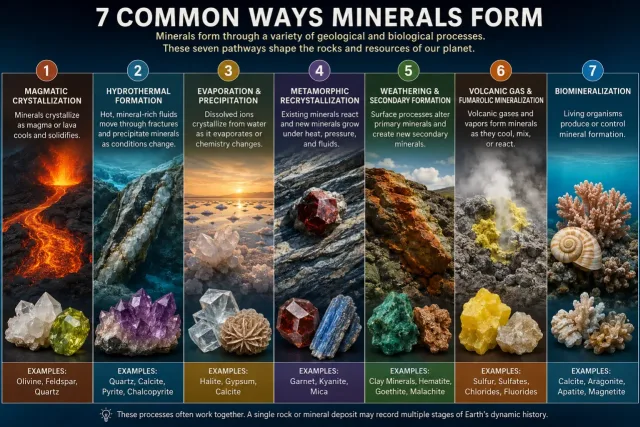
However, most mineral formation can be understood through several common geological pathways:
- Magmatic crystallization
- Hydrothermal mineral formation
- Evaporation and precipitation from water
- Metamorphic recrystallization and mineral reactions
- Weathering and secondary mineral formation
- Volcanic gas and fumarolic mineralization
- Biomineralization
Understanding these processes explains not only how crystals grow, but also why particular minerals occur together and what they can reveal about Earth’s geological history.
What Has to Happen for a Mineral to Form?
A mineral cannot form simply because its chemical elements are present.
Those elements must also encounter the right environmental conditions.
Quartz, for example, is made of silicon and oxygen. But silicon and oxygen occur in countless rocks and melts without necessarily producing large quartz crystals.
The surrounding conditions determine what happens.
Important controls include:
- Temperature
- Pressure
- Chemical composition
- Water and other fluids
- Oxidation-reduction conditions
- Cooling or heating rate
- Degree of saturation
- Availability of open space
- Movement of chemical components
- Presence of existing crystal surfaces
When conditions favor a particular mineral, atoms or ions can begin arranging themselves into its characteristic atomic structure.
Once a stable crystal nucleus forms, additional material may attach to it and the crystal can grow.
But this process is not identical in every geological environment.
Some minerals crystallize from molten rock.
Others precipitate from water.
Some develop through chemical reactions between pre-existing minerals while the rock remains solid.
Others are produced or controlled by living organisms.
That diversity is what makes mineralogy so closely connected to nearly every branch of geology.
1. Magmatic Crystallization
One of the most important mineral-forming processes begins with magma.
Magma is molten or partially molten rock beneath Earth’s surface. When magma reaches the surface and erupts, the molten material is called lava.
A magma contains many chemical components, commonly including:
- Silicon
- Oxygen
- Aluminum
- Iron
- Magnesium
- Calcium
- Sodium
- Potassium
At very high temperatures, these components exist mainly within the melt rather than as fully developed mineral crystals.
As the magma cools, however, conditions change.
Certain mineral phases become stable and begin to crystallize.
Different Minerals Crystallize Under Different Conditions
Not every mineral crystallizes at the same temperature.
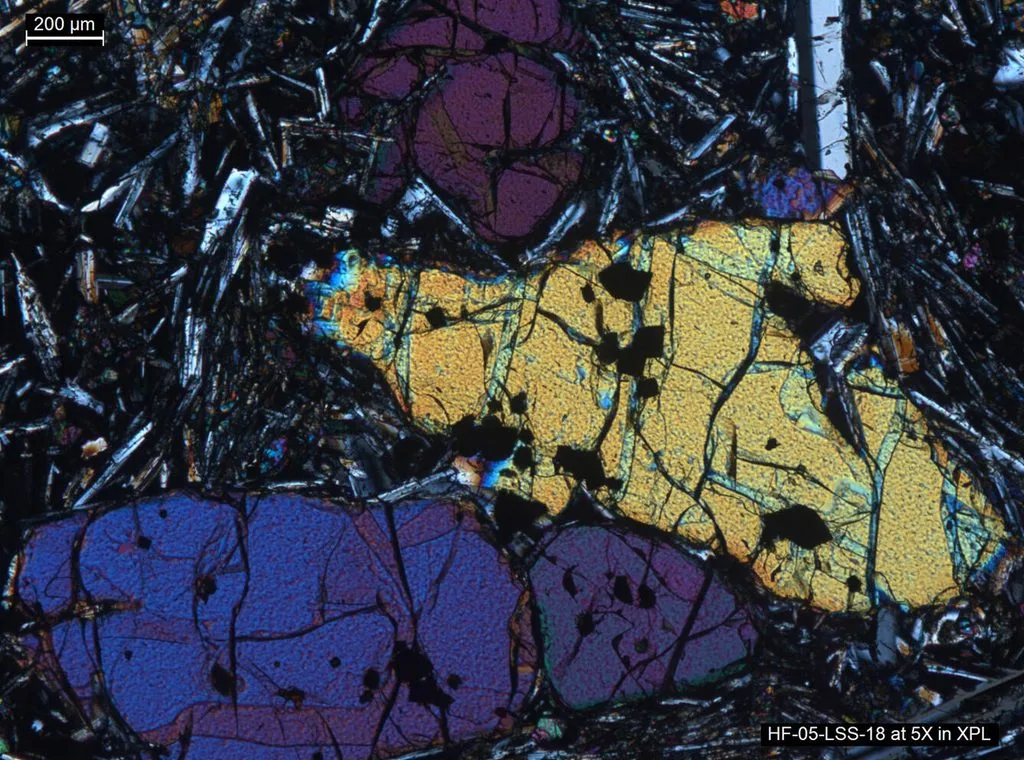
In many mafic magmas, minerals such as olivine and pyroxene can begin crystallizing at relatively high temperatures.
As crystallization continues, the composition of the remaining melt changes because some chemical elements have already been incorporated into earlier minerals.
Other minerals may then become stable.
Depending on magma composition, pressure, water content, and temperature, these can include:
- Plagioclase
- Amphibole
- Biotite
- Potassium feldspar
- Muscovite
- Quartz
This general relationship is illustrated by Bowen’s Reaction Series, although real magma systems can be considerably more complex than a single idealized crystallization sequence.
Magma mixing, changing pressure, addition or loss of water, and interaction with surrounding rocks can all modify the minerals that ultimately form.
Why Do Some Igneous Rocks Have Large Cryst+als?
Crystal size is commonly related to cooling history, but cooling rate is not the only control.
Magma cooling underground usually provides more favorable conditions for visible crystal growth than lava cooling rapidly at Earth’s surface.
This is why intrusive rocks such as granite commonly contain easily visible crystals.
Volcanic rocks such as basalt commonly have much finer crystals.
And if lava cools so quickly that an ordered crystal structure cannot develop, it may solidify as volcanic glass.
Obsidian is the best-known example.
But crystal size also depends on:
- Nucleation rate
- Degree of undercooling
- Chemical diffusion
- Water and volatile content
- Melt viscosity
- Availability of chemical components
- Growth space
So the simple rule that “slow cooling always produces large crystals” is useful as an introduction, but natural mineral growth is more complicated.
Pegmatites: Extreme Crystal Growth in Magmatic Systems
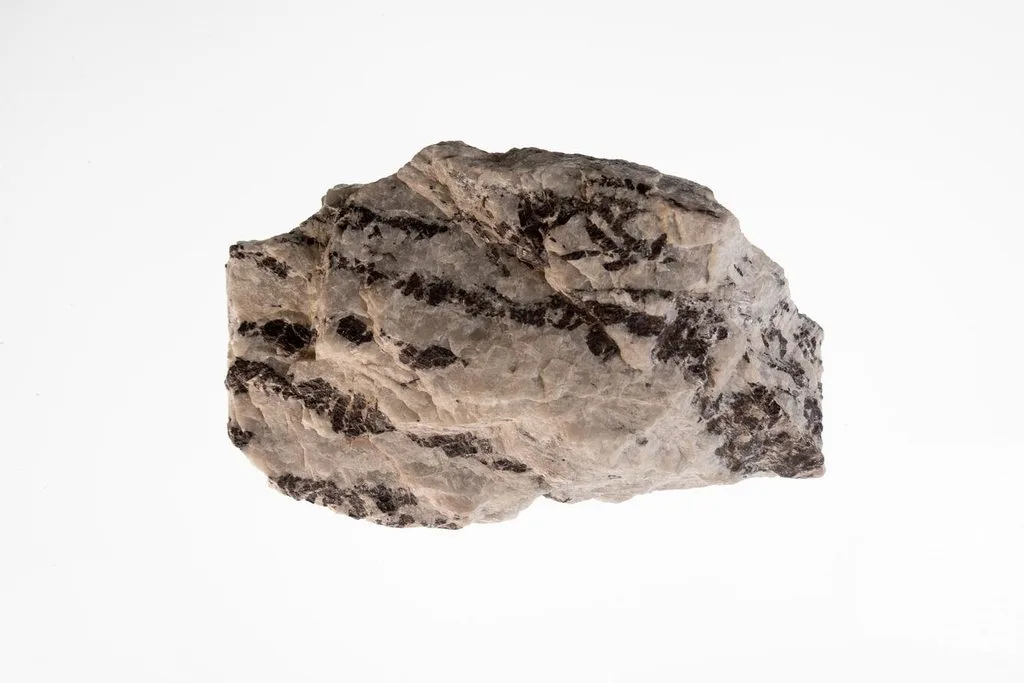
Pegmatites deserve special attention because they can contain some of the largest mineral crystals found on Earth.
They are usually extremely coarse-grained igneous rocks and are particularly common in association with granitic systems.
A common misconception is that pegmatite crystals become enormous simply because the magma cooled extremely slowly.
The real explanation is more interesting.
During the evolution of some granitic magmas, late-stage melts can become enriched in substances that were not easily incorporated into earlier-forming minerals.
These may include:
- Water
- Boron
- Fluorine
- Lithium
- Beryllium
- Cesium
- Tantalum
- Niobium
Water and other volatile components can greatly increase the mobility of chemical species.
In some pegmatitic systems, melt and aqueous fluid may coexist, allowing elements to move rapidly toward growing crystals.
Undercooling, fluid exsolution, rapid chemical transport, and relatively low rates of crystal nucleation can all contribute to extremely coarse crystal growth.
As a result, pegmatites can produce spectacular crystals of:
- Quartz
- Feldspar
- Muscovite
- Tourmaline
- Beryl
- Spodumene
- Topaz
Some pegmatites are also economically important sources of lithium, tantalum, cesium, beryllium, and other rare elements.
Pegmatites are therefore best understood as specialized igneous environments, not as a completely separate fundamental mineral-forming mechanism.
2. Hydrothermal Mineral Formation
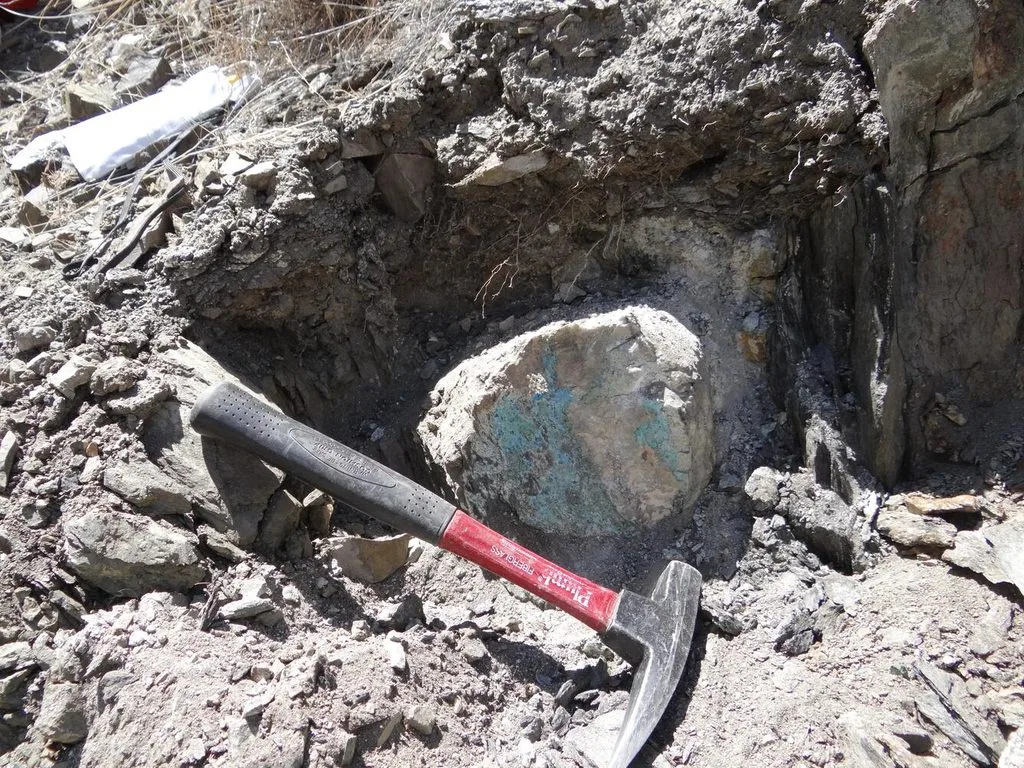
Some of Earth’s most impressive mineral veins form from hot aqueous fluids moving through the crust.
These systems are called hydrothermal systems.
Hydrothermal fluids can transport dissolved chemical components through:
- Fractures
- Faults
- Pores
- Cavities
- Permeable rock layers
Many hydrothermal systems are associated with magma, but hydrothermal water does not always originate directly from magma.
Fluids can involve:
- Magmatic water
- Groundwater
- Seawater
- Metamorphic fluids
- Sedimentary basin brines
These fluids may circulate through hot rocks and interact chemically with them.
How Do Hydrothermal Veins Form?
At elevated temperatures, fluids can transport substantial quantities of dissolved material.
Depending on the system, this may include:
- Silica
- Calcium
- Sulfur
- Iron
- Copper
- Zinc
- Lead
- Silver
- Gold
As the fluid moves through the crust, its physical and chemical environment changes.
Minerals may precipitate when the fluid:
- Cools
- Boils
- Experiences a pressure drop
- Mixes with another fluid
- Reacts with surrounding rocks
- Changes acidity
- Changes oxidation state
A fracture may therefore begin as an empty crack and gradually become filled with minerals.
Repeated fluid movement can produce thick hydrothermal veins.
Quartz is one of the most common vein minerals, but hydrothermal systems can also produce:
- Calcite
- Fluorite
- Barite
- Pyrite
- Chalcopyrite
- Galena
- Sphalerite
And many economically important ore deposits are hydrothermal in origin.
Gold, silver, copper, lead, zinc, tin, and other metals can become concentrated when hydrothermal fluids transport them through the crust and later deposit them.
A quartz vein is therefore more than a crack filled with quartz.
It can represent the fossilized pathway of an ancient underground fluid system.
3. Evaporation and Precipitation From Water
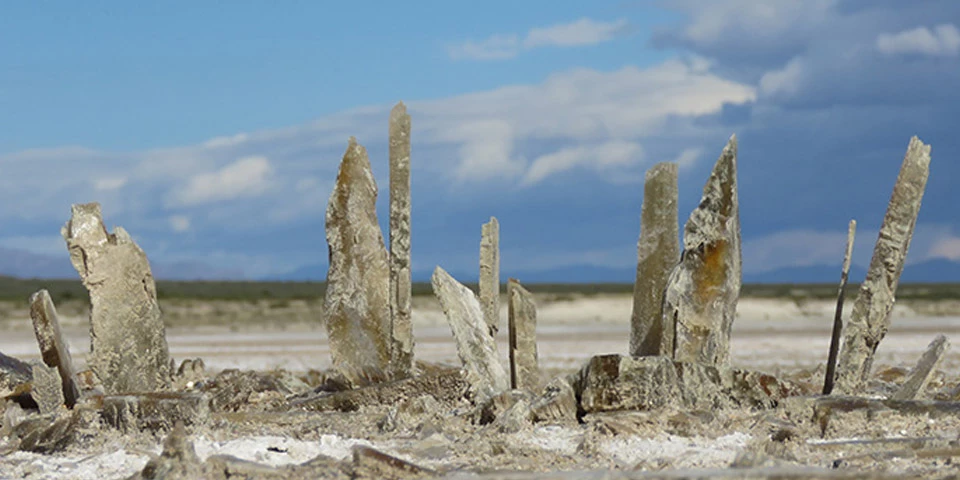
Minerals do not need magma or extreme temperatures to form.
Many crystallize directly from water.
Natural water contains dissolved ions obtained through weathering, groundwater circulation, volcanic activity, and interaction with rocks.
If conditions change, those dissolved components can precipitate as minerals.
One of the simplest examples is evaporation.
Evaporite Minerals
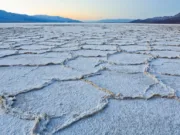
Imagine a shallow saline lake in an arid climate.
Water enters the basin carrying dissolved material.
But if the basin has little or no external drainage and evaporation is intense, the water gradually disappears while dissolved ions remain behind.
Their concentration increases.
Eventually, the water becomes saturated with respect to certain minerals.
Crystallization begins.
Common evaporite minerals include:
- Gypsum
- Halite
- Anhydrite
- Sylvite
Different minerals begin to precipitate under different chemical conditions.
As evaporation progresses, the composition of the remaining water changes.
This can produce sequences of different evaporite minerals.
Over geological time, repeated flooding and evaporation can create extremely thick deposits.
Some ancient evaporite formations contain enormous quantities of rock salt and gypsum.
Mineral Precipitation Does Not Always Require Evaporation
A mineral can precipitate from water even when the water itself does not disappear.
A good example is calcite formation inside caves.
Groundwater passing through limestone can carry dissolved calcium and bicarbonate.
When this water enters a cave, pressure and carbon dioxide conditions change.
Carbon dioxide may escape from the solution.
This shifts the chemical equilibrium and causes calcium carbonate to precipitate as calcite.
Layer by layer, calcite growth can produce:
- Stalactites
- Stalagmites
- Flowstone
- Columns
Similar precipitation processes can also produce mineral cements inside sedimentary rocks during diagenesis.
Minerals such as calcite, quartz, dolomite, and pyrite can grow between sediment grains long after the original sediment was deposited.
4. Metamorphic Recrystallization and Mineral Reactions
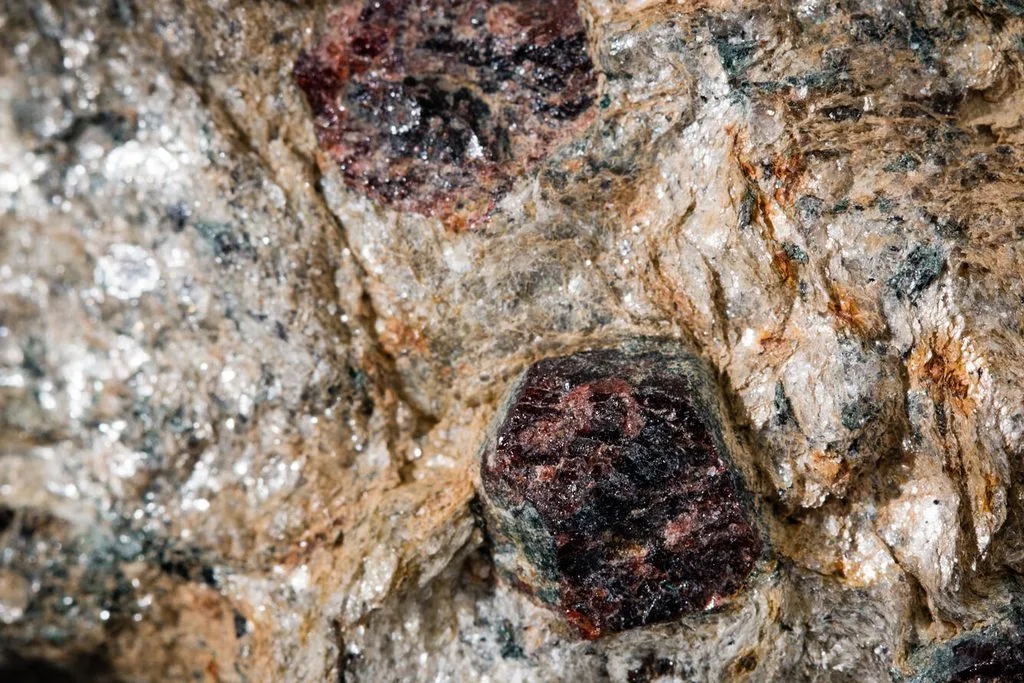
Minerals can also form while a rock remains essentially solid.
This happens during metamorphism.
A rock buried deep within Earth’s crust may encounter temperatures, pressures, deformation, and fluid conditions very different from those under which it originally formed.
Minerals stable under the original conditions may become unstable.
Chemical reactions occur.
Atoms are redistributed.
New minerals grow.
The rock does not have to melt.
New Minerals From Old Rocks
Consider a clay-rich sedimentary rock buried during mountain building.
As pressure and temperature increase, the original minerals begin to change.
With increasing metamorphic conditions, new minerals may appear.
These can include:
- Mica
- Garnet
- Staurolite
- Kyanite
- Sillimanite
These minerals can provide important information about the conditions the rock experienced.
For this reason, some metamorphic minerals are used as index minerals.
Their presence can help geologists estimate the pressure-temperature history of metamorphic rocks.
Contact Metamorphism
Contact metamorphism occurs when hot magma intrudes into cooler surrounding rocks.
The heat from the intrusion changes the mineralogy and texture of nearby rock.
Limestone, for example, can recrystallize into marble.
Under chemically favorable conditions, fluids released from an intrusion can also react with carbonate rocks and form mineral-rich skarn systems.
Skarns may contain minerals such as:
- Garnet
- Pyroxene
- Epidote
- Vesuvianite
- Wollastonite
Some skarns also contain important deposits of copper, iron, tungsten, zinc, and other metals.
Regional Metamorphism
Regional metamorphism affects much larger areas.
It commonly occurs during:
- Continental collision
- Mountain building
- Deep burial
- Crustal thickening
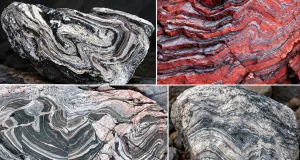
Mineral growth may happen while rocks are being intensely deformed.
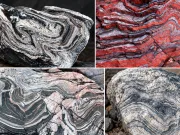
Platy minerals such as mica can become aligned, producing the characteristic foliation seen in rocks such as:
- Slate
- Phyllite
- Schist
- Gneiss
Metamorphic minerals therefore preserve a record of conditions that may have existed many kilometers below ancient mountain ranges.
5. Weathering and Secondary Mineral Formation
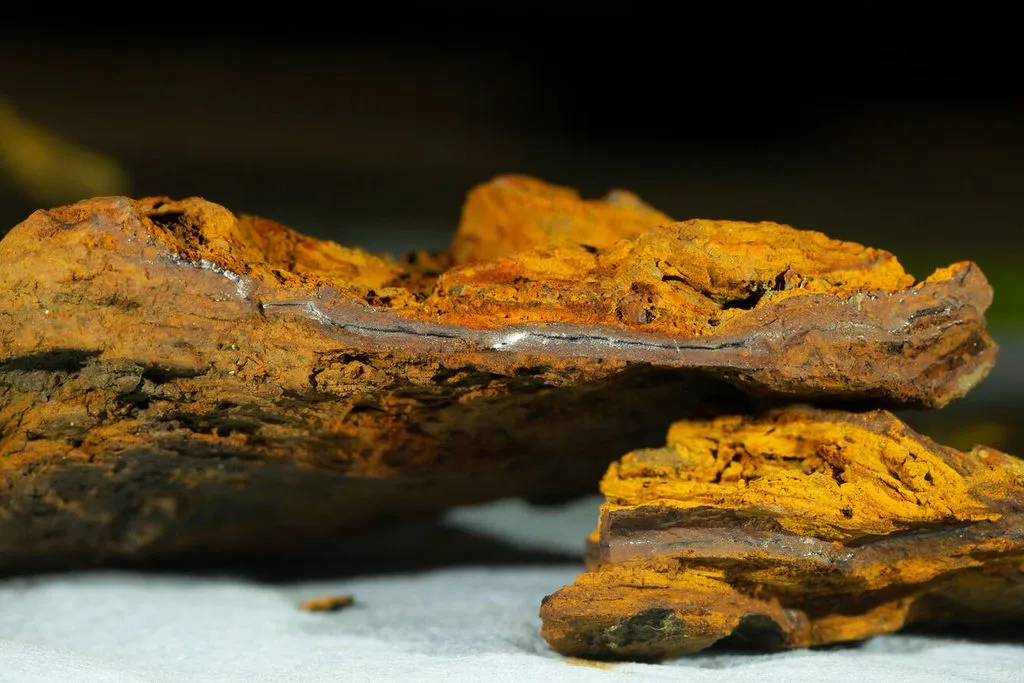
The Earth’s surface is a hostile environment for many minerals that formed deep underground.
A crystal that was stable inside magma at hundreds of degrees Celsius may eventually reach the surface and encounter:
- Oxygen
- Rainwater
- Carbon dioxide
- Organic acids
- Microorganisms
- Repeated wetting and drying
Under these new conditions, the mineral may no longer be stable.
Chemical weathering begins.
But weathering does more than destroy minerals.
It also creates new ones.
From Feldspar to Clay
Feldspar is one of the most abundant mineral groups in Earth’s crust.
But feldspars are not always stable under surface conditions.
Reaction with slightly acidic water can gradually alter them.
Elements are removed or redistributed, and new clay minerals can form.
Over enormous periods of time, these reactions help create soils and sediment.
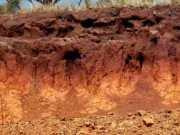
Iron Oxidation
Iron-bearing minerals undergo another familiar transformation.
When exposed to oxygen-rich water, iron can become oxidized.
New iron oxides and oxyhydroxides may form.
These minerals are responsible for many of the:
- Red
- Orange
- Yellow
- Brown
colors seen in weathered rocks and soils.
Hematite and goethite are common examples.
Secondary Minerals in Ore Deposits
Weathering can dramatically alter mineral deposits near Earth’s surface.
Sulfide minerals may react with oxygen and groundwater.
Some chemical components dissolve and are carried downward.
Others remain near the surface or reprecipitate as new minerals.
Iron-rich weathered caps called gossans can develop above sulfide deposits.
Secondary copper minerals such as malachite and azurite may also develop in oxidized zones of some copper deposits.
Weathering therefore creates entirely new mineral assemblages from older geological material.
6. Volcanic Gas and Fumarolic Mineralization
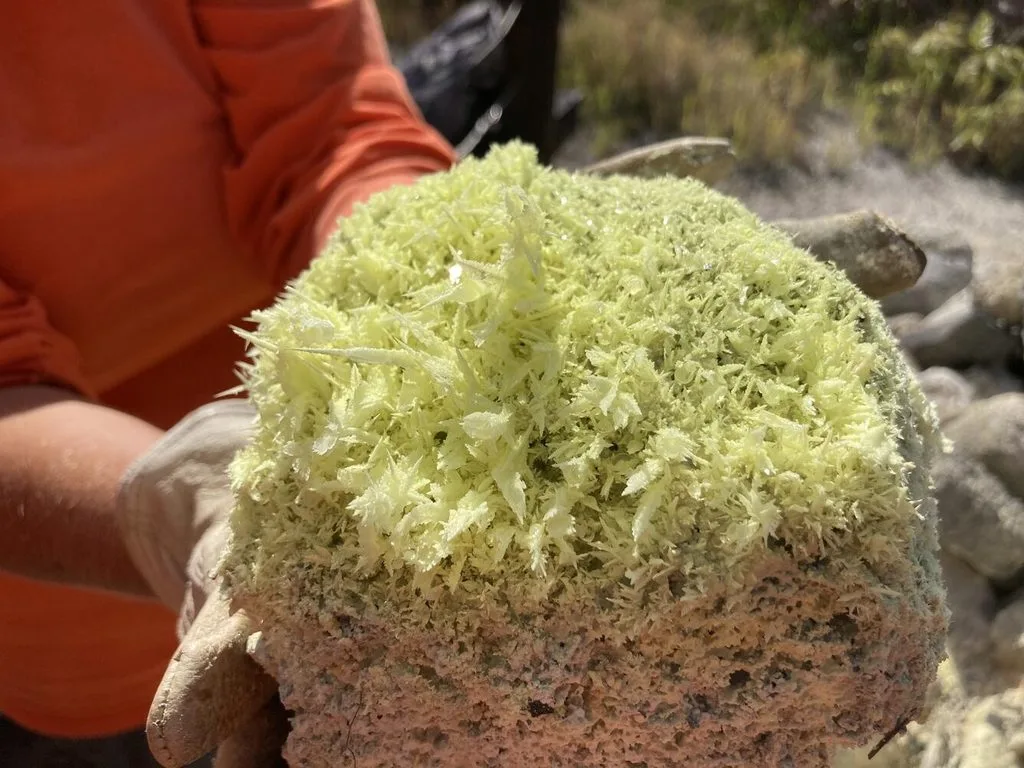
Lava is not the only material released by volcanoes.
Volcanic systems also emit gases containing compounds of:
- Sulfur
- Chlorine
- Fluorine
- Carbon
- Hydrogen
- Water
These gases can escape through cracks and vents known as fumaroles.
Around fumaroles, temperature and chemistry can change extremely rapidly.
This creates unusual mineral-forming environments.
How Do Fumarolic Minerals Form?
Some minerals can form as hot volcanic gases cool.
But direct cooling is only one mechanism.
Mineral formation around fumaroles can also involve:
- Gas mixing with air
- Oxidation reactions
- Condensation of acidic fluids
- Gas-rock reactions
- Precipitation from condensed volcanic fluids
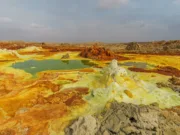
One of the most recognizable products is native sulfur.
Bright yellow sulfur deposits can accumulate around volcanic vents as sulfur-bearing gases undergo chemical reactions near the surface.
Other fumarolic environments can contain:
- Sulfates
- Chlorides
- Sulfides
- Fluorides
- Oxide minerals
Because fumaroles can change quickly, these mineral deposits may also be short-lived compared with minerals locked inside deeper rocks.
Volcanoes therefore continue creating and altering minerals even when lava is not erupting.
7. Biomineralization
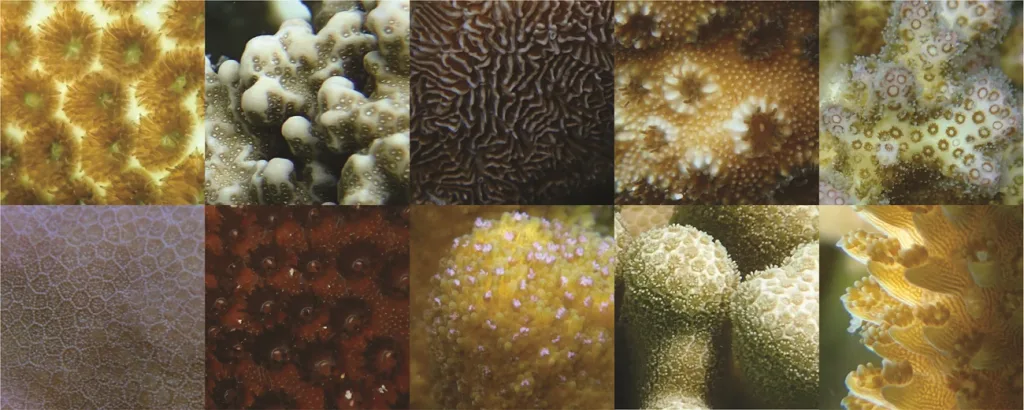
Not every mineral-forming process is purely geological.
Living organisms can also control or strongly influence the formation of minerals.
This process is known as biomineralization.
Organisms use dissolved chemical components from their environment and create hard mineralized structures.
Shells and Skeletons
Many marine organisms build shells or skeletons from calcium carbonate.
Depending on the organism and environmental conditions, this material may occur primarily as:
- Calcite
- Aragonite
Mollusks, corals, foraminifera, and many other organisms produce mineralized structures.
After death, these remains can accumulate on the seafloor.
Over geological time, enormous quantities of biological carbonate can contribute to the formation of limestone.
Life can therefore influence mineral formation on a planetary scale.
Other Biological Minerals
Biomineralization is not limited to calcium carbonate.
Different organisms can produce or control the formation of other materials.
Examples include:
Apatite
Calcium-phosphate mineral phases are major components of vertebrate bones and teeth.
Silica
Diatoms and some other organisms construct intricate silica-rich structures.
Magnetite
Magnetotactic bacteria can produce tiny magnetic mineral particles that help them orient themselves relative to Earth’s magnetic field.
Living organisms therefore participate directly in Earth’s mineral cycle.
Biology and geology are far more closely connected than they might first appear.
Why Do Crystals Have Different Sizes?
The size of a mineral crystal depends on much more than how long it exists.
Crystal growth is controlled by the competition between nucleation and growth.
If huge numbers of crystal nuclei form at the same time, available chemical material is divided among many crystals.
The result may be a fine-grained rock.
If relatively few nuclei form but chemical components can reach them efficiently, individual crystals may grow much larger.
Important controls include:
- Temperature
- Pressure
- Degree of undercooling
- Fluid composition
- Melt composition
- Chemical diffusion
- Volatile content
- Supersaturation
- Available space
- Number of competing crystals
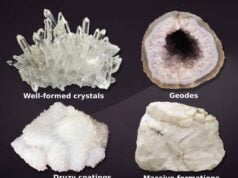
This explains why some geological cavities contain beautifully formed individual crystals while other rocks consist of countless microscopic mineral grains packed tightly together.
Why Do Crystals Have Geometric Shapes?
Mineral crystals do not develop geometric forms by accident.
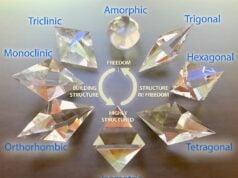
Their external shapes are related to their internal atomic structures.
Atoms inside a crystalline mineral are arranged in ordered repeating patterns.
As the crystal grows, these internal arrangements influence the orientations along which crystal faces can develop.
Quartz commonly forms six-sided prisms because of its underlying crystal symmetry.
Halite commonly forms cubes.
Garnets frequently develop distinctive dodecahedral or trapezohedral forms.
But a mineral does not always show perfect crystal faces.
If crystals grow tightly packed against one another, there may simply be no room for complete external crystal forms to develop.
A perfect crystal shape therefore usually requires both the correct internal structure and sufficient growth space.
Can the Same Mineral Form in Different Ways?
Yes.
This is one of the most important concepts in mineralogy.
The same mineral species can form in completely different geological environments.
Quartz
Quartz can crystallize:
- From magma
- In pegmatites
- From hydrothermal fluids
- Inside volcanic cavities
- During metamorphism
- During sedimentary diagenesis
A quartz crystal alone therefore does not reveal its entire history.
Calcite
Calcite can form:
- In marine sediments
- In caves
- In hydrothermal veins
- Through biological processes
- During diagenesis
- During alteration and metamorphic reactions
Again, the mineral name alone is not enough.
Context matters.
How Do Geologists Determine How a Mineral Formed?
Geologists rarely interpret a mineral in isolation.
They examine its geological context.
Important clues include:
- Host rock
- Associated minerals
- Crystal shape
- Grain boundaries
- Cross-cutting relationships
- Mineral zoning
- Chemical composition
- Trace elements
- Isotopic composition
- Fluid inclusions
- Pressure-temperature relationships
A tiny fluid inclusion trapped inside quartz, for example, can preserve a microscopic sample of the fluid from which the crystal grew.
Mineral zoning can record changes in magma or fluid chemistry during growth.
A mineral vein cutting across another vein can reveal which mineralizing event happened first.
Metamorphic mineral assemblages can reveal approximate pressure and temperature conditions.
Minerals are therefore not just components of rocks.
They are geological archives.
Seven Common Mineral-Forming Processes
| Process | How Minerals Form | Examples |
|---|---|---|
| Magmatic Crystallization | Minerals crystallize as molten rock cools and evolves | Olivine, pyroxene, feldspar, quartz |
| Hydrothermal Formation | Hot fluids transport dissolved components and later precipitate minerals | Quartz, calcite, fluorite, sulfides, gold-bearing minerals |
| Evaporation & Precipitation | Dissolved ions crystallize as water chemistry changes or evaporation increases concentration | Halite, gypsum, calcite |
| Metamorphic Reactions | Existing minerals react or recrystallize under changing temperature and pressure | Garnet, kyanite, staurolite, mica |
| Weathering & Secondary Formation | Surface reactions alter primary minerals and form new ones | Clay minerals, hematite, goethite, malachite |
| Fumarolic Mineralization | Volcanic gases, condensed fluids and gas-rock reactions produce minerals | Sulfur, sulfates, chlorides |
| Biomineralization | Organisms control or influence mineral formation | Calcite, aragonite, apatite, magnetite |
These categories overlap.
A single geological system may involve several of them during different stages of its history.
A magma chamber, for example, may first produce minerals through magmatic crystallization, later generate a pegmatite, release hydrothermal fluids, and eventually feed fumarolic activity near the surface.
Nature rarely follows perfectly separated categories.
Why Mineral Formation Matters
Understanding mineral formation helps geologists reconstruct processes that may have disappeared millions or even billions of years ago.
Minerals can reveal:
- How a magma cooled
- Whether hydrothermal fluids once moved through a rock
- How deeply a rock was buried
- What temperatures existed during metamorphism
- Whether an ancient basin experienced intense evaporation
- How an ore deposit developed
- How surface weathering changed a landscape
- Whether biological activity contributed to sediment formation
Minerals are also essential to modern society.
Copper ores record ancient hydrothermal systems.
Lithium-bearing pegmatites preserve the final stages of evolved magmas.
Iron oxides may record oxidation and weathering.
Evaporites contain salt, gypsum, and potash resources.
Carbonate minerals record interactions between the atmosphere, oceans, rocks, and life.
Understanding how minerals form therefore connects fundamental geology with mining, environmental science, climate history, planetary science, and the materials modern societies depend on.
Conclusion
Minerals form through a remarkable range of natural processes.
Some crystallize directly from cooling magma.
Others grow from hot hydrothermal fluids moving through fractures deep underground.
Some precipitate when lakes and seas evaporate, while others appear when existing rocks are transformed by heat, pressure, deformation, and chemically active fluids.
Near Earth’s surface, weathering destroys older minerals and creates new ones.
Around volcanoes, gases and condensed fluids form unusual fumarolic minerals.
And living organisms build mineralized shells, skeletons, teeth, and microscopic structures through biomineralization.
Even spectacular pegmatites belong within this larger story: they represent specialized igneous environments where volatile-rich, chemically evolved systems can produce extraordinarily large crystals and unusual minerals.
Despite these different pathways, the fundamental principle remains the same:
A mineral forms when the chemical components and physical conditions of an environment allow a stable mineral structure to develop and grow.
Magma cools.
Fluids circulate.
Water evaporates.
Rocks are buried and transformed.
Mountains rise and weather away.
Volcanoes release gases.
Living organisms extract elements from their surroundings.
Through all of these processes, Earth’s chemical ingredients are continuously reorganized into minerals.
That is why a crystal is much more than a beautiful geometric object.
It is a physical record of the environment in which it formed — a small piece of Earth’s geological history preserved in stone.
Sources & Further Reading
- American Museum of Natural History — How Do Minerals Form? Mineral-Forming Environments
- Australian Museum — How Do Minerals Form?
- U.S. Geological Survey — Research on the derivation and crystallization of granitic pegmatites
- The ISME Journal — Research on calcium-carbonate and magnetite biomineralization