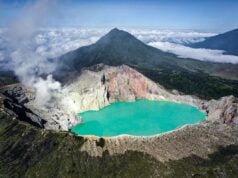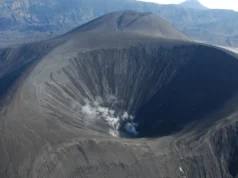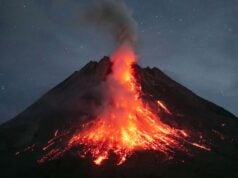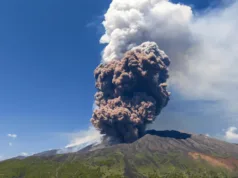









Not all volcanoes have the classic cone shape. Some, such as Mauna Loa in Hawaii, form enormous mountains with broad bases and gentle slopes that extend for many kilometers. Others, such as Mount Fuji or Mount St. Helens, are much steeper, taller, and more cone-shaped.
This difference is not just about appearance.
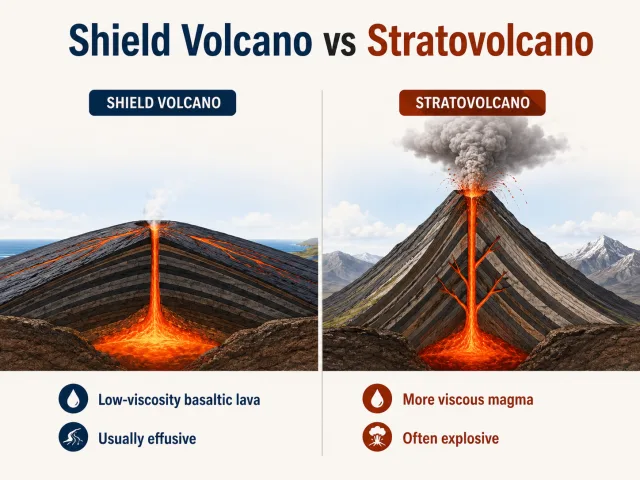
The shape of a volcano is closely related to the composition and viscosity of its magma, the amount of gas it contains, and the way eruptions occur. Comparing a shield volcano with a stratovolcano therefore means comparing two very different styles of volcanic construction and behavior.
In the simplest terms:
Shield volcanoes are broad, gently sloping volcanoes commonly built by repeated flows of low-viscosity basaltic lava.
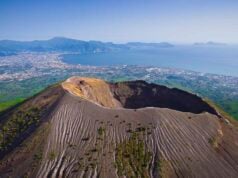
Stratovolcanoes are steeper volcanoes built from layers of lava, ash, and other volcanic material, and they are often associated with more explosive eruptions.
However, saying that “shield volcanoes are quiet and stratovolcanoes are explosive” is too simple. Both types can behave differently depending on magma, gas, water interaction, and other conditions.
What Is a Shield Volcano?
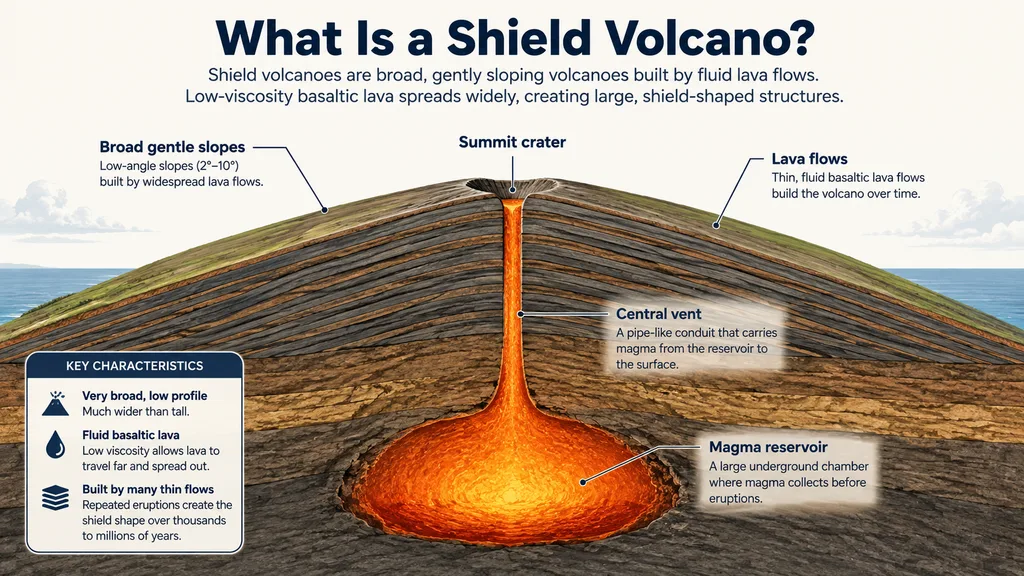
A shield volcano is a type of volcano known for its broad base and gently sloping sides.
Its name comes from its shape.
Viewed from the side, it can resemble a large warrior’s shield lying on the ground.
The main reason for this shape is the fluid nature of the lava.
Shield volcanoes commonly erupt basaltic magma. Basaltic magma generally contains less silica than more evolved magmas and usually has relatively low viscosity.
In other words, it flows more easily.
When lava erupts from the summit or from fissures along the flanks of a shield volcano, it may travel many kilometers before cooling and solidifying.
Instead of piling up close to the vent, the lava spreads outward.
Over thousands or millions of years, repeated lava flows overlap and gradually create an enormous volcanic mountain with gentle slopes.
The Hawaiian Islands contain some of the best-known examples.
Mauna Loa and Kīlauea are both shield volcanoes.
What Is a Stratovolcano?
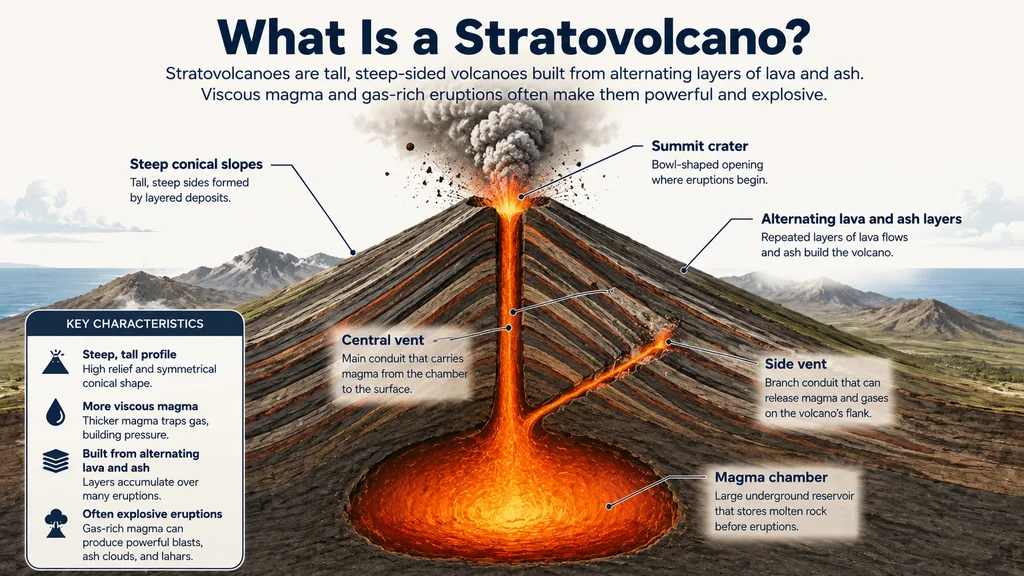
Stratovolcano diagram showing steep conical slopes alternating lava and ash layers central vent side vent and magma chamberA stratovolcano, also known as a composite volcano, is typically a tall volcano with steep slopes and a prominent cone-shaped profile.
The word “strato” refers to layers.
These volcanoes grow through repeated accumulation of different volcanic materials, including:
- lava flows,
- volcanic ash,
- tephra,
- pyroclastic deposits,
- other fragmented volcanic material.
Stratovolcanoes are commonly associated with andesitic to dacitic magma, although their magma compositions can vary.
These magmas are generally more viscous than the basaltic magmas that dominate classic shield volcanoes.
Higher viscosity has two major effects.
First, the lava cannot travel as easily over long distances. It tends to form shorter and thicker flows closer to the vent.
Second, volcanic gases can have more difficulty escaping from the magma.
As gas pressure builds, eruptions can become powerful and highly explosive.
Well-known stratovolcanoes include Mount Fuji, Mount St. Helens, Mount Vesuvius, and Mount Pinatubo.
Shield Volcano vs Stratovolcano: Key Differences
| Feature | Shield Volcano | Stratovolcano |
|---|---|---|
| Shape | Broad, gently sloping | Tall, steep-sided cone |
| Common magma | Mostly basaltic | Commonly andesitic to dacitic |
| Magma viscosity | Low | Moderate to high |
| Lava behavior | Fluid, can travel long distances | Usually thicker and shorter flows |
| Typical eruption style | Often effusive | Frequently explosive |
| Main materials | Repeated lava flows | Lava, ash, tephra, and pyroclastic deposits |
| Typical tectonic setting | Hotspots and some divergent settings | Commonly subduction zones |
| Major hazards | Lava flows, gases, fissure eruptions | Pyroclastic flows, ash, lahars, explosive eruptions |
| Famous examples | Mauna Loa, Kīlauea | Mount Fuji, Mount St. Helens, Vesuvius |
The visible difference in shape is therefore the result of deeper differences in magma behavior.
Why Are Shield Volcanoes So Wide and Flat?
The broad shape of a shield volcano is mainly controlled by low-viscosity lava.
Imagine pouring two different liquids onto a flat surface.
Water spreads quickly.
Honey remains much closer to the place where it was poured.
Magma is far more complicated than either example, but the comparison helps explain viscosity.
Basaltic lava from many shield volcanoes behaves more like the first case.
It can remain mobile long enough to travel considerable distances before cooling.
Each eruption adds another relatively thin lava flow.
Over time, thousands of flows accumulate.
Instead of growing mainly upward, the volcano expands both outward and upward.
The result can be enormous.
Mauna Loa has relatively gentle slopes, yet when measured from its base on the ocean floor to its summit, it is one of the largest volcanic mountains on Earth.
A volcano does not need steep slopes to be extremely large.
Why Are Stratovolcanoes So Steep?
Stratovolcanoes grow in a different way.
Their lava is commonly more viscous, so it does not travel as easily across the landscape.
Lava flows therefore tend to remain closer to the vent and can form thicker deposits.
Explosive eruptions can also deposit ash, blocks, and other pyroclastic material around the volcano.
Repeated cycles of:
lava flow → explosive deposits → lava flow → ash and tephra
gradually build the layered structure that gives composite volcanoes their name.
Because much of the erupted material remains relatively close to the central vent, the volcano grows strongly upward.
The result is the steep volcanic cone seen in mountains such as Mount Fuji.
Why Does Magma Viscosity Matter So Much?
Viscosity is one of the most important factors in understanding the difference between shield volcanoes and stratovolcanoes.
Viscosity describes how strongly a fluid resists flowing.
Low-viscosity magma flows more easily.
High-viscosity magma moves with greater difficulty.
Several factors influence magma viscosity, but silica content and temperature are especially important.
Basaltic magmas are generally:
- hotter,
- lower in silica,
- less viscous.
Andesitic, dacitic, and rhyolitic magmas generally contain progressively more silica and can be increasingly viscous.
In silica-rich melts, the internal molecular structure becomes more interconnected, making the magma more resistant to flow.
This also affects volcanic gases.
In fluid magma, gases may escape relatively easily.
In more viscous magma, gas bubbles can become trapped.
As magma rises toward the surface and pressure decreases, those bubbles expand.
If the gas cannot escape efficiently, pressure can build until the magma fragments violently.
This is one reason many stratovolcano eruptions can become highly explosive.
Which Is More Explosive: a Shield Volcano or a Stratovolcano?
In general, stratovolcanoes are more strongly associated with explosive eruptions.
Their relatively viscous magma can trap gases and allow pressure to build before eruption.
This can produce:
- high eruption columns,
- widespread ash fall,
- pyroclastic flows,
- volcanic bombs,
- lahars,
- explosive crater formation.
Shield volcano eruptions are more commonly effusive, meaning lava reaches the surface and flows outward rather than being violently fragmented.
But the difference is not absolute.
Shield volcanoes can also produce explosive eruptions.
If magma interacts with groundwater or surface water, rapid steam formation can trigger powerful phreatomagmatic explosions.
Gas-rich basaltic magma can also produce significant explosive activity.
So shield volcanoes are not incapable of explosions.
They are simply more commonly dominated by fluid lava eruptions.
Which Type of Volcano Is More Dangerous?
There is no single answer because danger depends on the type of volcanic hazard and where people live.
Stratovolcanoes can produce some of the most rapidly destructive volcanic processes on Earth.
Pyroclastic Flows
These are fast-moving mixtures of hot gas, ash, and volcanic fragments.
They can travel down volcanic slopes at very high speeds and destroy almost everything in their path.
Ash Fall
Explosive eruptions can send ash high into the atmosphere and spread it across hundreds or even thousands of kilometers.
Heavy ash can damage roofs, contaminate water supplies, disrupt aviation, and affect agriculture.
Lahars
When volcanic ash mixes with water, it can form fast-moving volcanic mudflows.
Lahars can travel long distances through valleys and remain dangerous even after an eruption has ended.
Shield volcanoes create different hazards.
Lava Flows
Fluid basaltic lava can travel considerable distances and destroy:
- homes,
- roads,
- farmland,
- utility networks.
People can often evacuate ahead of slowly moving lava, but buildings and infrastructure may still be impossible to save.
Volcanic Gases
Sulfur dioxide and other gases can create serious air-quality problems.
Fissure Eruptions
Eruptions do not always remain at the summit.
Magma can move underground and emerge through long fractures on the flanks of a shield volcano.
So the question “Which volcano is more dangerous?” depends on the hazard being considered.
Stratovolcanoes generally have greater potential for sudden catastrophic explosive events, while shield volcanoes can still cause enormous economic and environmental damage.
Why Are Shield Volcanoes Common in Hawaii?
Hawaii lies above a mantle hotspot.
As the Pacific Plate moves over this long-lived source of magma, volcanoes form one after another.
The magma produced in Hawaii is predominantly basaltic.
Its relatively low viscosity allows lava to spread widely across the surface.
Repeated eruptions gradually build enormous shield volcanoes from the ocean floor upward.
This process has produced volcanoes such as:
- Mauna Loa,
- Mauna Kea,
- Kīlauea.
Hawaiian volcanoes are therefore very different in shape and typical eruption style from many volcanoes around the Pacific Ring of Fire.
Why Are Stratovolcanoes Common at Subduction Zones?
Many of the world’s most famous stratovolcanoes occur above subduction zones.
At these plate boundaries, one tectonic plate sinks beneath another.
Water and other volatile substances released from the descending plate enter the overlying mantle and help promote melting.
The magma produced in these environments can continue to evolve as it rises through the crust.
Processes such as:
- fractional crystallization,
- magma mixing,
- crustal assimilation
can help generate intermediate and more silica-rich magma compositions.
These magmas are commonly associated with volcanic arcs around the Pacific Ocean.
Examples are found in:
- Japan,
- Indonesia,
- the Philippines,
- the Andes,
- the Cascades.
Together, many of these volcanic arcs form part of the famous Pacific Ring of Fire, where stratovolcanoes are especially common.
Shield Volcano vs Composite Volcano: Are They the Same?
No.
A composite volcano is another name for a stratovolcano.
So:
stratovolcano = composite volcano
A shield volcano is a different volcanic form.
The word “composite” refers to the fact that stratovolcanoes are built from multiple types of volcanic deposits rather than being dominated mainly by repeated thin lava flows.
This terminology can cause confusion because some textbooks use “composite volcano” while others use “stratovolcano.”
In most cases, they refer to the same volcano type.
Do Shield Volcanoes Only Produce Basalt?
Basaltic lava dominates many classic shield volcanoes, but nature does not always fit perfectly into simple categories.
Shield volcanoes are primarily defined by their broad morphology and long-term construction rather than by a rule that every eruption must produce exactly the same magma composition.
Some volcanic systems can evolve over time and produce somewhat different magma types.
Nevertheless, low-viscosity basaltic lava is the characteristic material responsible for the classic shield-volcano shape.
Without repeated fluid lava flows, it would be difficult to build the enormous gentle slopes seen at volcanoes such as Mauna Loa.
Are All Stratovolcanoes Extremely Explosive?
No.
Stratovolcanoes can produce a wide range of eruption styles.
Some eruptions may consist mainly of lava flows or relatively modest explosions.
Others can become catastrophic.
The behavior of an individual eruption depends on factors including:
- magma composition,
- magma temperature,
- dissolved gas content,
- magma volume,
- conduit conditions,
- interaction with water,
- whether the volcanic vent is open or blocked.
Even the same volcano can behave very differently from one eruption to another.
A stratovolcano may produce relatively quiet lava flows during one period and a major explosive eruption during another.
Volcano classification therefore provides useful clues, but it cannot predict every eruption by itself.
Can a Shield Volcano Become a Stratovolcano?
Not in the simple sense of one volcano suddenly changing from one category into another.
These classifications reflect the long-term way a volcanic edifice has been constructed.
A shield volcano develops through a history dominated by broad lava flows.
A stratovolcano develops through repeated accumulation of lava and pyroclastic deposits around a more concentrated volcanic center.
However, volcanic systems can evolve.
Changes in magma supply, composition, and tectonic conditions can alter eruption styles through time.
Some volcanic edifices also have complex histories and do not fit perfectly into one ideal category.
Shield volcano and stratovolcano are therefore useful geological classifications, not rigid rules that every volcano must follow perfectly.
Mauna Loa vs Mount Fuji: A Clear Example
Comparing Mauna Loa with Mount Fuji makes the difference easy to visualize.
Mauna Loa
Mauna Loa in Hawaii is a classic shield volcano.
Its lava is mainly basaltic.
Repeated fluid lava flows have built an enormous volcanic mountain with gentle slopes.
Its eruptions are often characterized by lava fountains, fissures, and extensive lava flows.
Mount Fuji
Mount Fuji in Japan is a stratovolcano.
Its steep, symmetrical cone was built by repeated eruptions that produced both lava and pyroclastic material.
Its tectonic environment is very different from the Hawaiian hotspot setting.
The contrast between the two mountains shows how magma properties and tectonic setting can influence volcano shape.
How Can You Identify a Shield Volcano or Stratovolcano by Shape?
Shape provides a useful first clue.
A shield volcano usually has:
- an enormous base,
- long gentle slopes,
- a relatively low profile.
A stratovolcano commonly has:
- a narrower base,
- much steeper slopes,
- a prominent summit,
- a classic cone-shaped profile.
However, shape alone is not always enough.
Erosion can dramatically modify old volcanoes.
Caldera collapse can remove a summit.
Later eruptions can build new cones on older volcanic structures.
The best classification combines morphology with:
- rock composition,
- eruption deposits,
- internal structure,
- volcanic history.
Why Do Stratovolcanoes Sometimes Collapse?
Large stratovolcanoes can become structurally unstable.
Their steep slopes are made from alternating layers of lava, ash, and fragmented volcanic material.
Hydrothermal alteration can also weaken rocks inside the volcano.
During earthquakes, magma intrusion, or eruptions, part of a volcanic flank may collapse.
This can produce a massive debris avalanche.
The 1980 eruption of Mount St. Helens is a famous example.
A large part of the volcano’s northern flank collapsed, rapidly reducing pressure on the magma system and contributing to a powerful lateral blast.
This shows that volcanic hazards are not limited to lava flows and explosions.
The volcano itself can physically fail.
What Do Shield Volcanoes and Stratovolcanoes Have in Common?
Despite their differences, both are built by magma reaching Earth’s surface.
Both can:
- erupt lava,
- release volcanic gases,
- develop summit craters,
- produce earthquakes as magma moves underground,
- change shape through repeated eruptions,
- remain active over long periods.
Neither volcano type is defined by a single eruption.
Their characteristic forms represent the cumulative result of many eruptions over long geological timescales.
Frequently Asked Questions
What is the main difference between a shield volcano and a stratovolcano?
Shield volcanoes are broad and gently sloping because they are mainly built by fluid lava flows. Stratovolcanoes are steeper and commonly built from alternating layers of lava, ash, and other volcanic deposits.
Which is more explosive, a shield volcano or a stratovolcano?
Stratovolcanoes are generally more likely to produce highly explosive eruptions because their magma is often more viscous and can trap volcanic gases. Shield volcanoes can still produce explosive eruptions under certain conditions.
Is a composite volcano the same as a stratovolcano?
Yes. Composite volcano and stratovolcano are generally two names for the same volcano type.
Why are shield volcanoes not steep?
Their low-viscosity lava can travel long distances before cooling. Repeated thin lava flows spread outward and gradually create broad, gentle slopes.
Why are stratovolcanoes so steep?
Their more viscous lava usually travels shorter distances, while ash and pyroclastic material also accumulate around the vent. This causes the volcano to grow more strongly upward.
Which volcano type has more fluid lava?
Shield volcanoes usually have more fluid basaltic lava.
Can shield volcanoes explode?
Yes. Although effusive eruptions are more common, shield volcanoes can produce explosive activity, especially when magma interacts with water or when volcanic gas accumulates.
Is Mount Fuji a shield volcano?
No. Mount Fuji is a stratovolcano.
Is Mauna Loa a stratovolcano?
No. Mauna Loa is one of the world’s best-known shield volcanoes.
Which volcano type is more dangerous?
Stratovolcanoes generally have greater potential for sudden explosive hazards such as pyroclastic flows, widespread ash fall, and lahars. Shield volcanoes can still be dangerous because of lava flows, gases, and fissure eruptions.
Final Thoughts
Shield volcanoes and stratovolcanoes are both created by magma rising from inside Earth, but they can produce dramatically different landscapes.
Shield volcanoes are broad because their relatively fluid, commonly basaltic lava can travel far from the vent before cooling. Thousands of overlapping lava flows gradually build enormous mountains with gentle slopes.
Stratovolcanoes grow differently.
Their generally more viscous magmas and repeated explosive eruptions cause lava, ash, and pyroclastic material to accumulate closer to the vent, producing steep and often spectacular volcanic cones.
The difference also affects their hazards.
Shield volcanoes are strongly associated with extensive lava flows and volcanic gases, while stratovolcanoes can generate pyroclastic flows, widespread ash fall, lahars, and major explosive eruptions.
Yet neither category is absolute.
Shield volcanoes can explode, stratovolcanoes can erupt lava relatively quietly, and individual volcanoes can change behavior through time.
The shape visible above the ground is therefore only the final expression of processes occurring much deeper below it.
To understand why one volcano becomes a broad Hawaiian shield while another grows into a steep cone like Mount Fuji, the key is to look at the magma—how easily it flows, how much gas it contains, and what happens as it approaches the surface.