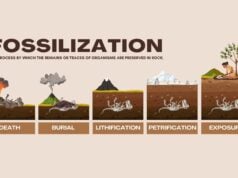
























Fossils are preserved remains or traces of past organisms. Famous fossil discoveries have changed our understanding of animal diversification, vertebrate evolution, dinosaur anatomy and human origins. Their scientific value depends on both the specimen and its geological context: rock type, stratigraphic position, age and preservation.
The nine examples below include individual specimens, fossil assemblages and trace fossils. Ages are approximate geological ages, not the dates on which the fossils were found.
1. Burgess Shale — Cambrian animal diversity
The Burgess Shale of British Columbia, Canada, preserves marine communities from about 508 million years ago. Charles D. Walcott began investigating the famous quarry in 1909. Unlike ordinary shell beds, this deposit preserves outlines and anatomical details of organisms that lacked mineralized skeletons.
Opabinia, Hallucigenia and early arthropods reveal combinations of features that help researchers reconstruct the branching history of animal groups. Exceptional preservation resulted from burial and chemical conditions that inhibited normal tissue destruction; oxygen depletion alone is not a complete explanation. The deposit illustrates how preservation bias can hide much of an ancient ecosystem. See the Royal Ontario Museum Burgess Shale resource.
2. Tiktaalik — The origin of limbs
Discovered in 2004 on Ellesmere Island in the Canadian Arctic, Tiktaalik roseae lived approximately 375 million years ago. Its remains occur in Late Devonian sedimentary rocks deposited in an ancient river system. The fish combined scales and fin rays with a flattened skull, mobile neck and robust internal fin bones.
The arrangement of bones in its pectoral fins helps explain how weight-bearing appendages evolved. It did not possess true digits, and its anatomy does not prove that it routinely walked on dry land. Tiktaalik represents a branch close to the origin of limbed vertebrates, not necessarily their direct ancestor.
3. Archaeopteryx — Feathered dinosaurs and birds
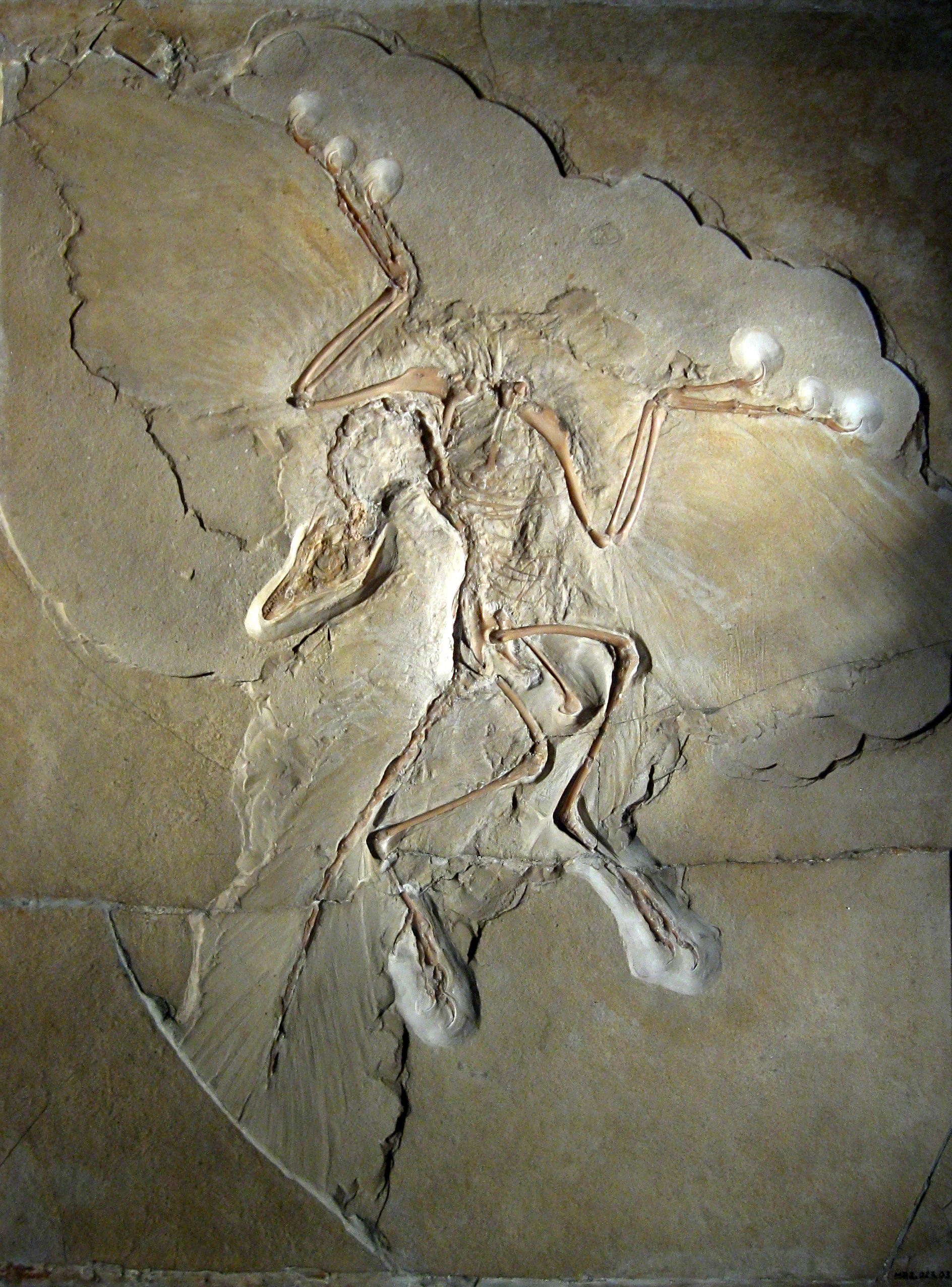
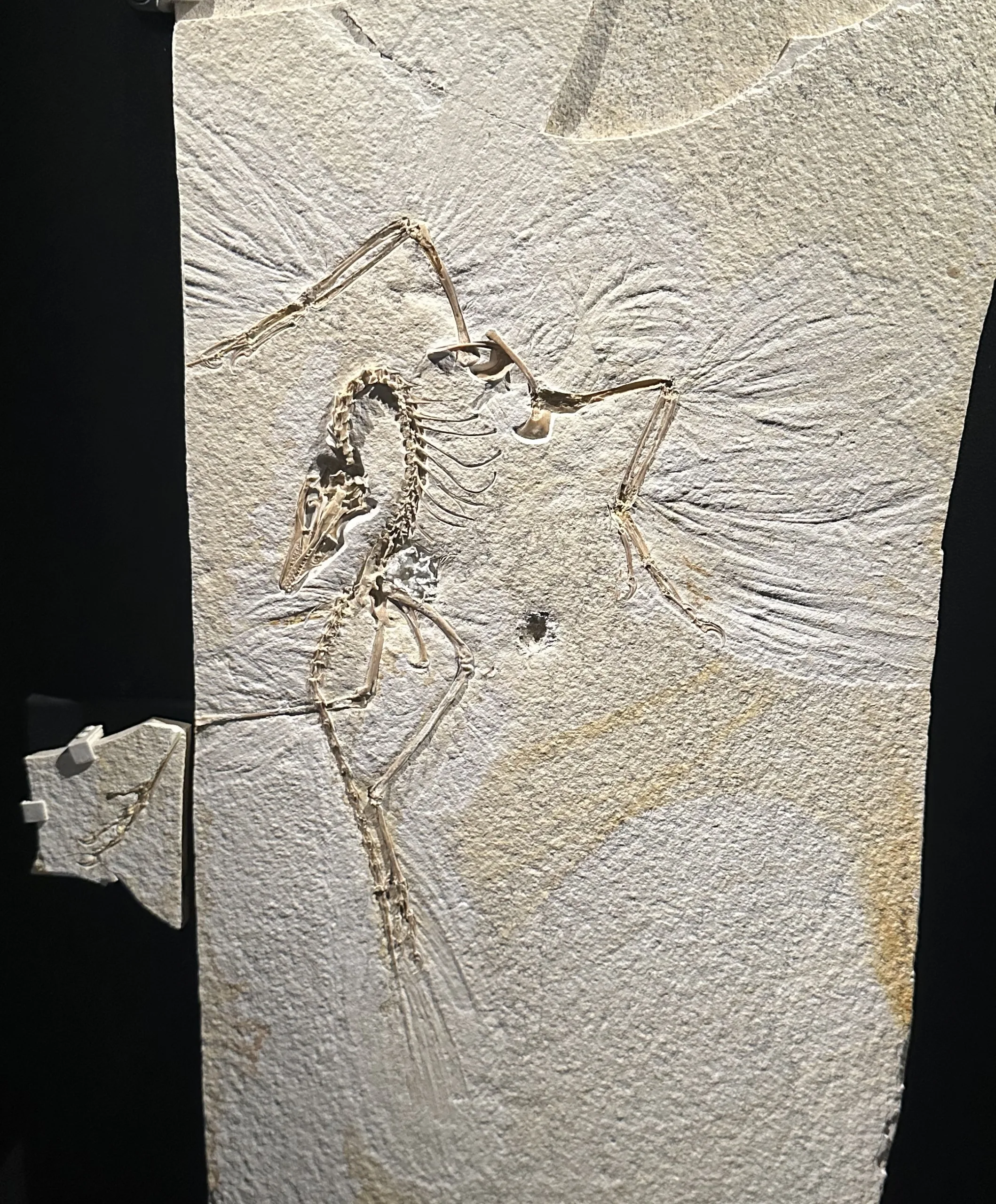
Late Jurassic limestones in southern Germany preserve Archaeopteryx, an early avialan approximately 150 million years old. A feather and skeletal material became known to science in 1861. Fine-grained carbonate sediment preserved feather impressions alongside delicate bones.
The animal combined flight feathers with teeth, clawed fingers and a long bony tail. These features support the evolutionary relationship between birds and theropod dinosaurs. Its precise flight capabilities remain debated; feathers had already evolved in other dinosaurs, so their presence alone does not establish powered flight.
4. Iguanodon — The reconstruction of dinosaurs
Gideon Mantell described Iguanodon in 1825 using fossil teeth from England. The discovery of numerous skeletons at Bernissart, Belgium, in 1878 subsequently transformed interpretations of its anatomy. These Early Cretaceous animals had a cropping beak and rows of teeth adapted for processing plants.
The five-digit hand included a prominent thumb spike, three central weight-bearing digits and a more mobile outer digit. The spike had initially been interpreted as a horn on the nose. More complete skeletons showed why isolated fragments can produce misleading reconstructions. Iguanodon could use both two-legged and four-legged locomotion.
5. Tyrannosaurus rex — Late Cretaceous predators
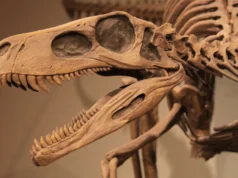
Tyrannosaurus rex inhabited western North America roughly 68–66 million years ago. Barnum Brown recovered important early specimens, and Henry Fairfield Osborn named the species in 1905. Its skull, teeth and limb bones document the anatomy of a giant theropod near the end of the Cretaceous.
Healed injuries, bite marks on other bones and fossilized feces provide evidence about feeding and interactions. Biomechanical estimates of bite force depend on assumptions about muscles and skull geometry; force is measured in newtons, not units of pressure. The disappearance of non-avian dinosaurs is established by stratigraphic and fossil evidence across the Cretaceous–Paleogene boundary, not by a single T. rex skeleton.
6. Fossil coelacanths — Survival and gaps in the record
Coelacanths are a lineage of lobe-finned fishes with a fossil record extending back into the Devonian. Fossil species show considerable variation in body form and habitat. In 1938 a living coelacanth was identified from a catch off South Africa, long after the youngest widely recognized fossils of the group.
The living discovery is not itself a fossil find, but it changed the interpretation of the fossil record. Absence of fossils does not necessarily establish extinction. Modern coelacanths are specialized relatives of other lobe-finned vertebrates, not unchanged ancestors of land animals; lungfishes are more closely related to living tetrapods.
7. Lucy — Upright walking before large brains
Lucy (AL 288-1), an Australopithecus afarensis individual found at Hadar, Ethiopia, in 1974, is approximately 3.2 million years old. Only about 40 percent of the skeleton is represented, rather than a nearly complete body. The pelvis and femur provide particularly important evidence of habitual bipedal locomotion.
Her small braincase and upper-limb anatomy show that different anatomical traits evolved at different rates. Walking upright preceded the major expansion of brain size in later Homo. The Smithsonian specimen record describes the locomotor evidence.
8. Laetoli footprints — Fossilized behavior
At Laetoli in Tanzania, hominin footprints dating to about 3.66 million years ago were preserved in volcanic ash. The famous trackway was documented in 1978 by a team working with Mary Leakey. These are trace fossils: they record activity rather than the body of the organism itself.
Foot placement and the arrangement of the toes provide independent evidence for bipedal walking. Attribution to Australopithecus afarensis is plausible but cannot be proven from footprints alone. The ash layers also provide a geological framework for dating and correlating the tracks.
9. Ediacaran fossils — Life before the Cambrian
Fossils from the Ediacara Hills of South Australia, brought to scientific attention by Reg Sprigg in 1946, preserve impressions of soft-bodied organisms from the late Ediacaran Period. Comparable assemblages elsewhere document complex macroscopic life before the Cambrian diversification.
Many specimens are preserved as impressions on sandstone surfaces. Their biological affinities vary: some are interpreted as animals, whereas others remain difficult to classify. They demonstrate that the rise of complex life was not a single abrupt event at the beginning of the Cambrian.
Geological timeline
| Fossil | Age | Scientific significance |
|---|---|---|
| Ediacaran assemblages | Late Ediacaran | Complex soft-bodied life |
| Burgess Shale | 508 Ma | Cambrian marine ecosystems |
| Tiktaalik | 375 Ma | Fin-to-limb evolution |
| Archaeopteryx | 150 Ma | Early bird evolution |
| Iguanodon | Early Cretaceous | Herbivorous dinosaur anatomy |
| T. rex | 68–66 Ma | Large theropod ecology |
| Coelacanth fossils | Devonian onward | Incomplete fossil record |
| Laetoli | 3.66 Ma | Bipedal tracks |
| Lucy | 3.2 Ma | Hominin locomotion |
Ma means million years ago. Fossil ages may be constrained by radiometric dating of nearby volcanic layers, stratigraphic correlation and other geological methods. Reworked fossils can be older than the sediment containing them.
Frequently asked questions
Are all fossils mineralized?
No. Impressions, tracks, carbon films and preserved organic material can also constitute fossils.
Does a transitional fossil have to be a direct ancestor?
No. A related extinct branch can preserve a combination of ancestral and derived features that clarifies evolutionary relationships.
Why is Ötzi not included?
Ötzi is a naturally preserved Copper Age human mummy, primarily studied in archaeology and bioarchaeology. The Laetoli and Ediacaran discoveries are more directly relevant to the deep-time fossil record.