










Geology
Geology is divided into several fields that can be grouped under the main headings of physical and historical geology.
Applied Geology
Applied Geology is geologic knowledge to solving geologic problem. In other words, application of various fields of geology to economic, engineering, water-supply, or environmental problems; geology related to the human activity.
METHODS OF GEOLOGY
Geologists use primary data associated with petrology (the study of rocks), stratigraphy (the observe of sedimentary layers), and structural geology (the have a look at of positions of rock devices and their deformation). In many cases, geologists additionally take a look at contemporary soils, rivers, landscapes, and glaciers; inspect past and contemporary life and biogeochemical pathways, and use geophysical techniques to investigate the subsurface.
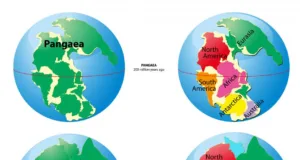
The Geological Evolution of Continents
Continents are large, continuous landmasses that make up the Earth's surface. They are primarily composed of continental crust, which is distinct from oceanic crust....

Earth’s Early Atmosphere and Oceans
The Earth's early atmosphere and oceans play a crucial role in shaping the planet's evolutionary history and creating the conditions necessary for life to...

Gravity Surveys
Gravity surveys are geophysical techniques used to measure the variations in the Earth's gravitational field at different locations. These surveys involve the measurement of...

Banded Iron Formations (BIFs)
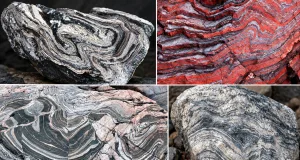
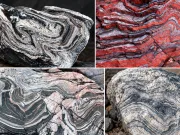
Banded Iron Formations (BIFs) are distinctive units of sedimentary rocks composed of alternating layers of iron-rich minerals, mainly hematite and magnetite, and silica-rich minerals...

Full List of Index Fossils
Index fossils are specific fossils that are used to define and identify particular time periods in Earth's geologic history. These fossils are typically widespread...
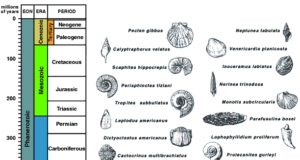
Index Fossils
Index fossils play a crucial role in the field of geology, aiding scientists in dating and correlating rocks. These fossils are valuable indicators of...

Greenhouse Gases in Geological History
Greenhouse gases are gases in Earth's atmosphere that trap heat. They allow sunlight to enter the atmosphere freely but prevent some of the heat...
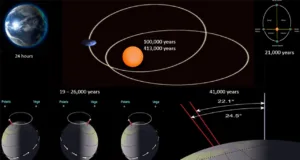
Milankovitch Cycles
Milankovitch cycles, also known as orbital or astronomical cycles, refer to the variations in Earth's orbit and axial tilt that occur over long periods...

Paleoclimate Indicators
Paleoclimate indicators are various pieces of evidence from the past that scientists use to reconstruct past climatic conditions. These indicators help researchers understand natural...
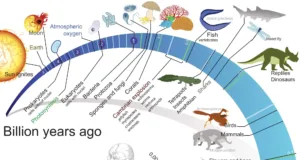
Evolution of Life
Evolution is a fundamental process that describes the changes in heritable traits of populations over successive generations. It is the mechanism by which life...

Formation of The Moon
The Moon, Earth's only natural satellite, has captivated human fascination for centuries and plays a crucial role in shaping our planet's dynamics.Characteristics of...
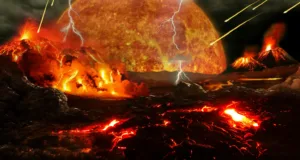
Formation of The Earth
In the vast expanse of the cosmos, our home, Earth, emerges as a remarkable celestial body, bearing the signature of a complex and awe-inspiring...