







Geology Fundamentals

Home Geology Fundamentals Page 3
Geology is the science that explores how the Earth was formed, how it changes, and what its physical materials reveal about the planet’s long and complex history. From the deep interior of the Earth to the landscapes we see on the surface, geology connects every process that shapes our environment. It explains earthquakes, volcanoes, mountain building, erosion, sedimentation, and the formation of rocks and minerals, giving us a complete picture of how our world works.
Bowen’s Reaction Series

When magma cools, it doesn’t solidify all at once. Instead, minerals form in a precise and predictable order, depending on temperature, composition, and chemical...

The Rock Cycle

The rock cycle basic definiton is transitions among the three main rock types, which are metamorphic, igneous and sedimentary rocks. Each of the rocks can be altered when they are force out equilibrium conditions.The rock cycle describes how the three rock types are interrelated and how processes change from one to another over time.The rock cycle

Unconformities

An unconformity is contact between two rock units.Unconformities are typically buried erosional surfaces that can represent a break in the geologic record of hundreds of millions of years or more. It it called an unconformity because the ages of the layers of rock that are abutting each other are discontinuous at the unconformity. An expected age of layer or layers of rock is/are missing due to the erosion; and, some period in geologic time is not represented.

Plate Tectonics: How Earth’s Moving Plates Shape Continents, Mountains, and Oceans

The theory of plate tectonics is the unifying framework of modern geology.It explains how the Earth’s rigid outer shell — the lithosphere — is...

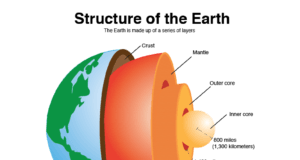
Structure of Earth

Our planet may look peaceful from space, but beneath its surface lies a restless interior filled with heat, motion, and complexity. The structure of...