
















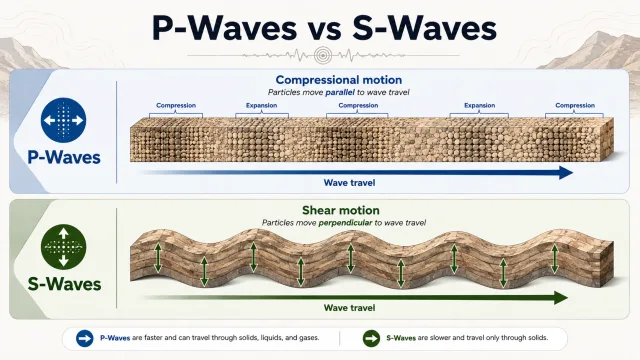
When an earthquake occurs, the ground does not shake in just one way. The energy released at the earthquake source travels through and along the Earth as different types of waves. Two of the most important are P-waves and S-waves.
When a seismometer begins recording an earthquake, the first signal to arrive is usually the P-wave. A little later, the slower-moving S-wave arrives. If you are far enough from the earthquake source, this difference can sometimes even be felt by people: first a light, short vibration, followed by stronger shaking.
But the difference between P- and S-waves is not only about which one arrives first.
P-waves can travel through solids as well as liquids, while S-waves cannot travel through liquids. This apparently simple property provided one of the most important pieces of evidence that helped scientists understand that Earth’s outer core, thousands of kilometers beneath our feet, is liquid.
The same waves are still used today to locate earthquakes, study the internal structure of Earth, and operate earthquake early warning systems.
So what exactly are P- and S-waves? Which one is faster? Which one causes more damage? And why can’t S-waves travel through liquids?
What Are P-Waves and S-Waves?
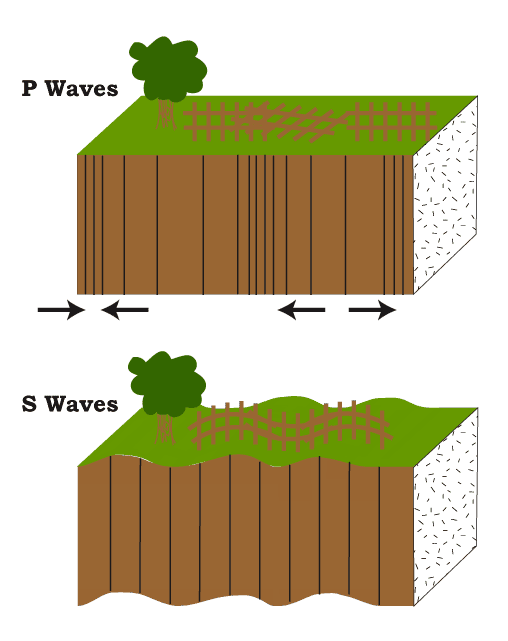
P- and S-waves are classified as body waves, meaning seismic waves that travel through the interior of the Earth.
This means they do not move only along Earth’s surface. They can pass through rock and travel deep into the planet.
When a fault suddenly ruptures during an earthquake, a large amount of stored elastic energy is released. This energy is transferred into the surrounding rocks and produces different types of seismic waves.
The P in P-wave stands for Primary.
The S in S-wave stands for Secondary.
The reason for these names is simple:
P-waves reach a seismic station first.
S-waves arrive later.
However, the way they move through material is completely different.
P-Waves vs S-Waves: Key Differences
| Feature | P-Waves | S-Waves |
|---|---|---|
| Full name | Primary Waves | Secondary Waves |
| Arrival at seismic station | First | After P-waves |
| Speed | Faster | Slower |
| Particle motion | Compression and expansion | Shearing motion |
| Travel through solids | Yes | Yes |
| Travel through liquids | Yes | No |
| Travel through gases | Yes | No |
| Wave type | Longitudinal / compressional | Transverse / shear |
| Typical shaking | Usually weaker | Often stronger |
| Importance for studying Earth’s interior | Very high | Very high |
The table shows the basic differences between the two waves, but the most interesting part is understanding why these differences exist.
What Are P-Waves?
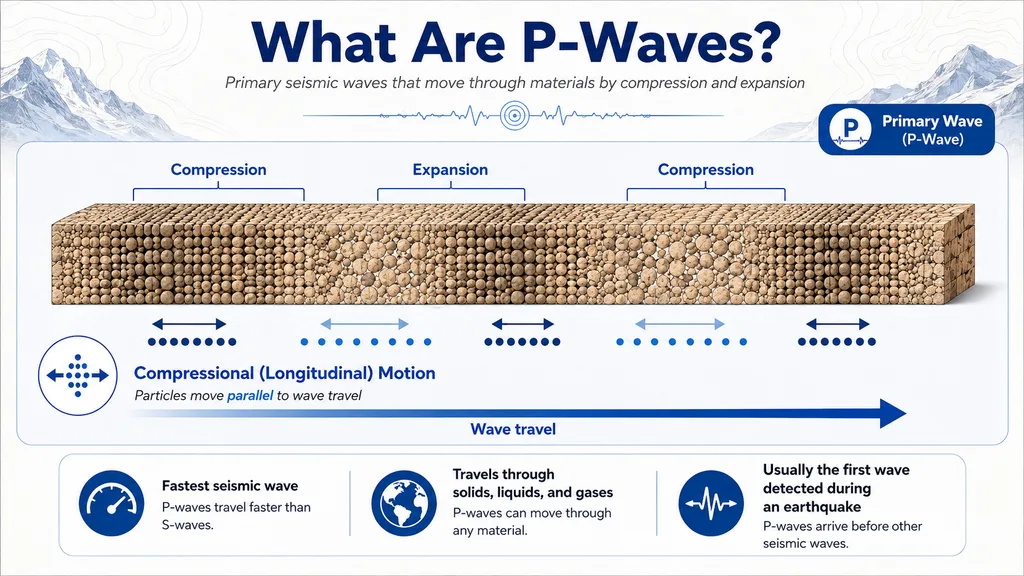
P-wave diagram showing compression and expansion as particles move parallel to the direction of wave travelP-waves are the fastest seismic waves produced during an earthquake.
For this reason, they are usually the first seismic waves detected by a seismometer.
As P-waves travel, they move rock particles backward and forward in the same direction that the wave itself is traveling.
You can imagine this by thinking about a spring.
If you compress one end of a spring and release it, the compressed section travels through the spring. The entire spring does not move from one end to the other; instead, energy moves through repeated compression and expansion.
P-waves behave in a similar way.
The rock is briefly:
compressed → expanded → compressed again.
For this reason, P-waves are also called compressional waves.
The way sound waves travel through air is based on a similar principle.
How Fast Do P-Waves Travel?
P-waves do not have one fixed speed.
Their velocity depends on the material they are traveling through, including its:
- density,
- elastic properties,
- pressure,
- temperature,
- mineral composition.
Within Earth’s crust, P-waves commonly travel through rock at approximately 5–8 kilometers per second.
Their speed can increase in the deeper and denser parts of the mantle.
That is extremely fast.
A P-wave traveling at 6 kilometers per second can cover about 60 kilometers in only 10 seconds.
However, P-wave velocity does not remain constant throughout Earth. As the waves pass between layers with different densities and compositions, they can refract, reflect, and change speed.
This is one of the reasons scientists can use seismic waves to investigate Earth’s internal structure.
What Does a P-Wave Feel Like During an Earthquake?
Depending on the distance from the earthquake source and the local geology, a P-wave may feel like a short jolt or a light vibration.
Some people describe large earthquakes by saying:
“First there was a small shake, then a few seconds later the strong shaking started.”
This does not always mean that the person distinctly felt the P- and S-waves. Local geology, building response, and other seismic waves can change how an earthquake feels.
However, when a person is far enough from the earthquake source, the difference between P- and S-wave arrival times can become noticeable.
This time difference is also one of the principles behind earthquake early warning systems.
What Are S-Waves?
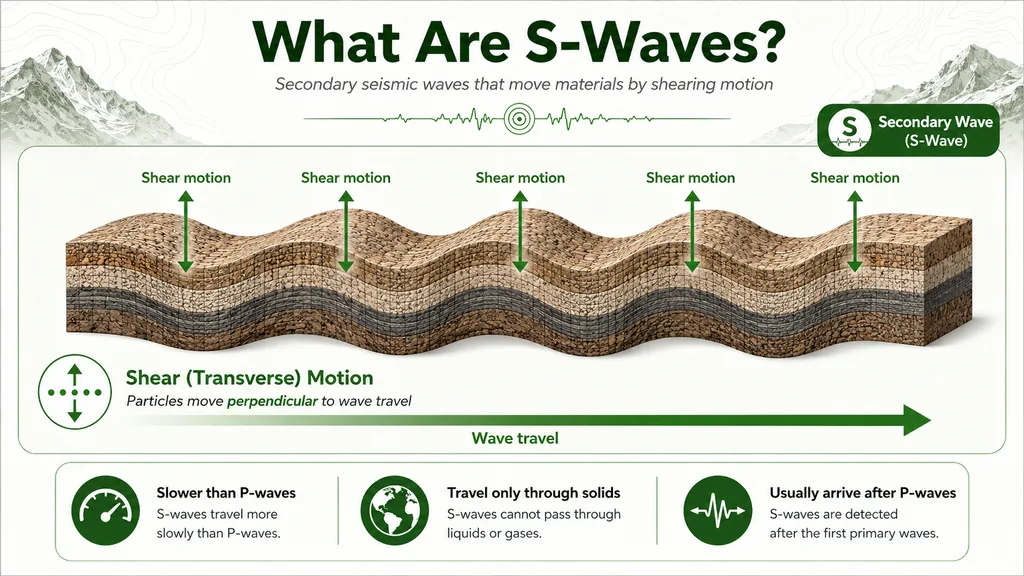
S-wave diagram showing shear motion as particles move perpendicular to the direction of wave travelS-waves are the second major type of body wave and travel more slowly than P-waves.
Their movement, however, is completely different.
While P-waves compress and expand the material in the direction they travel, S-waves move particles perpendicular to the direction of wave travel.
For example, if the wave is moving eastward, the rock particles may move upward and downward or from side to side.
For this reason, S-waves are also called shear waves.
S-waves can often produce stronger ground motion than P-waves. However, it would be incorrect to say that S-waves always cause the greatest earthquake damage. Surface waves, especially Love and Rayleigh waves, can create stronger and longer-lasting motion during large earthquakes.
Why Can’t S-Waves Travel Through Liquids?
This is probably the most important difference between P- and S-waves.
P-waves can travel through:
solids + liquids + gases
S-waves, however, can only travel through materials capable of supporting shear stress.
The reason is that an S-wave requires the material to resist sideways deformation.
If you push part of a solid rock sideways, the rock resists the deformation and can transfer the force to neighboring material.
A liquid does not behave in the same way.
When one part of a liquid is pushed sideways, the liquid flows and changes shape. It cannot maintain shear stress in the way a solid can.
For this reason, liquids have essentially no shear rigidity for seismic-wave propagation, and S-waves cannot travel through them.
This property became extremely important for understanding the structure of Earth.
Which Is Faster: P-Waves or S-Waves?
P-waves are faster.
That is why they are called “Primary Waves.”
Within the same rock, a P-wave always travels faster than an S-wave.
For example, in a material where a P-wave travels at around 6 kilometers per second, an S-wave might travel at roughly 3–4 kilometers per second.
As the distance from the earthquake source increases, the difference between their arrival times becomes larger.
Close to the earthquake source, the P- and S-waves may arrive only a few seconds apart.
Hundreds of kilometers away, the difference can become much larger.
Seismologists use this difference to estimate how far an earthquake source is from a seismic station.
What Is the S–P Time Interval?
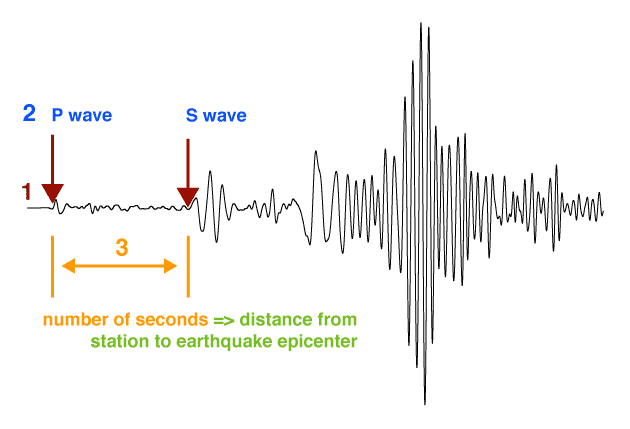
On a seismogram, the P-wave arrives first.
The S-wave follows later.
The difference between these arrival times is known as the S–P interval.
For example:
If the P-wave arrives at 10:00:00,
and the S-wave arrives at 10:00:20,
the S–P interval is about 20 seconds.
In general, the larger this interval is, the farther the earthquake source is from the station.
A single station cannot precisely determine the direction of the earthquake source. But when data from seismic stations in different locations are combined, the earthquake location can be calculated with high accuracy.
This is often explained using simple examples with three stations and geometric triangulation.
Modern seismology, however, uses data from many more stations and combines P- and S-wave arrival times with computer models and inverse methods.
Which Causes More Damage: P-Waves or S-Waves?
In general, S-waves can produce stronger shaking than P-waves.
This is partly because their shearing movement can force structures through stronger horizontal or vertical motions.
However, the statement:
“S-waves cause the most earthquake damage”
is not always correct.
Surface waves can become much more important during large earthquakes.
In particular:
Love waves
and
Rayleigh waves
travel near Earth’s surface and can create large-amplitude ground motion.
Rayleigh waves can move the ground in an elliptical rolling motion, somewhat similar to ocean waves.
Love waves create strong horizontal side-to-side motion.
For this reason, surface waves may be responsible for a significant part of the structural damage during major earthquakes.
P-Waves vs S-Waves vs Surface Waves
It is useful to divide the main seismic waves into three basic groups.
P-Waves
They are the fastest.
They travel through Earth’s interior.
They can pass through solids, liquids, and gases.
S-Waves
They are slower than P-waves.
They also travel through Earth’s interior.
They can only travel through solids.
Surface Waves
They travel close to Earth’s surface.
They are generally slower than P- and S-waves.
However, they can have large amplitudes and may cause severe damage in populated areas.
A simplified arrival order during an earthquake can therefore be written as:
P → S → surface waves
Real seismograms are more complicated. As seismic waves interact with boundaries inside Earth, they can reflect, refract, and produce many different seismic phases.
How Did P- and S-Waves Reveal Earth’s Internal Structure?
One of the most impressive uses of seismic waves is that they allow us to investigate parts of Earth that humans have never physically reached.
The deepest boreholes ever drilled are tiny compared with Earth’s radius.
The distance from Earth’s surface to its center is about 6,371 kilometers.
Yet scientists know a great deal about:
- the crust,
- the mantle,
- the outer core,
- the inner core.
One of the main reasons is seismic waves.
In a sense, large earthquakes create a natural ultrasound of the planet.
Scientists study which seismic waves reach different stations, where they disappear, where their speeds change, and how they bend as they travel through Earth.
From these observations, they can infer what exists deep beneath the surface.
How Did S-Waves Show That Earth’s Outer Core Is Liquid?
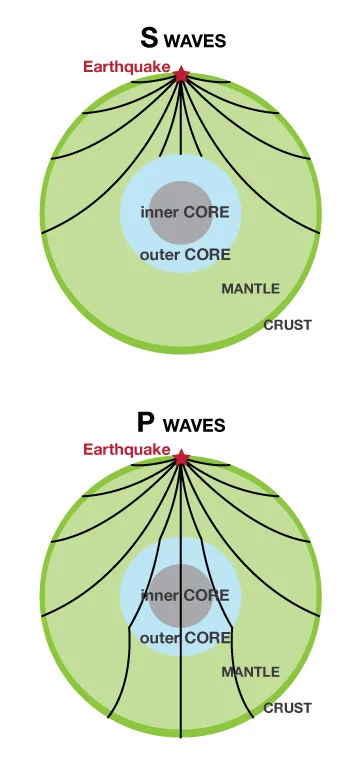
When a large earthquake occurs, S-waves can travel through Earth’s mantle.
But when they reach the boundary of the outer core, something changes.
The outer core is liquid.
Because S-waves cannot travel through liquids, they do not pass through the outer core.
As a result, there are regions on the opposite side of Earth where direct S-waves are not recorded.
This region is known as the S-wave shadow zone.
This observation led scientists to an important conclusion.
If the entire Earth were solid, S-waves should have been able to continue through the core.
But they did not.
This became one of the strongest seismic pieces of evidence that Earth’s outer core is liquid.
What Is the P-Wave Shadow Zone?
The situation with P-waves is different.
P-waves can travel through liquids.
So when they reach the outer core, they do not disappear completely.
However, when P-waves pass from the solid mantle into the liquid outer core, their speed and direction change significantly.
They are strongly refracted.
Because of this refraction, there is a region of Earth’s surface where direct P-waves are absent or greatly reduced.
This region is called the P-wave shadow zone.
By studying P- and S-wave shadow zones together, scientists learned a great deal about the structure of Earth’s core.
Later analysis of different P-wave phases also helped scientists determine that a solid inner core exists at the center of the planet.
How Do Earthquake Early Warning Systems Use P-Waves?
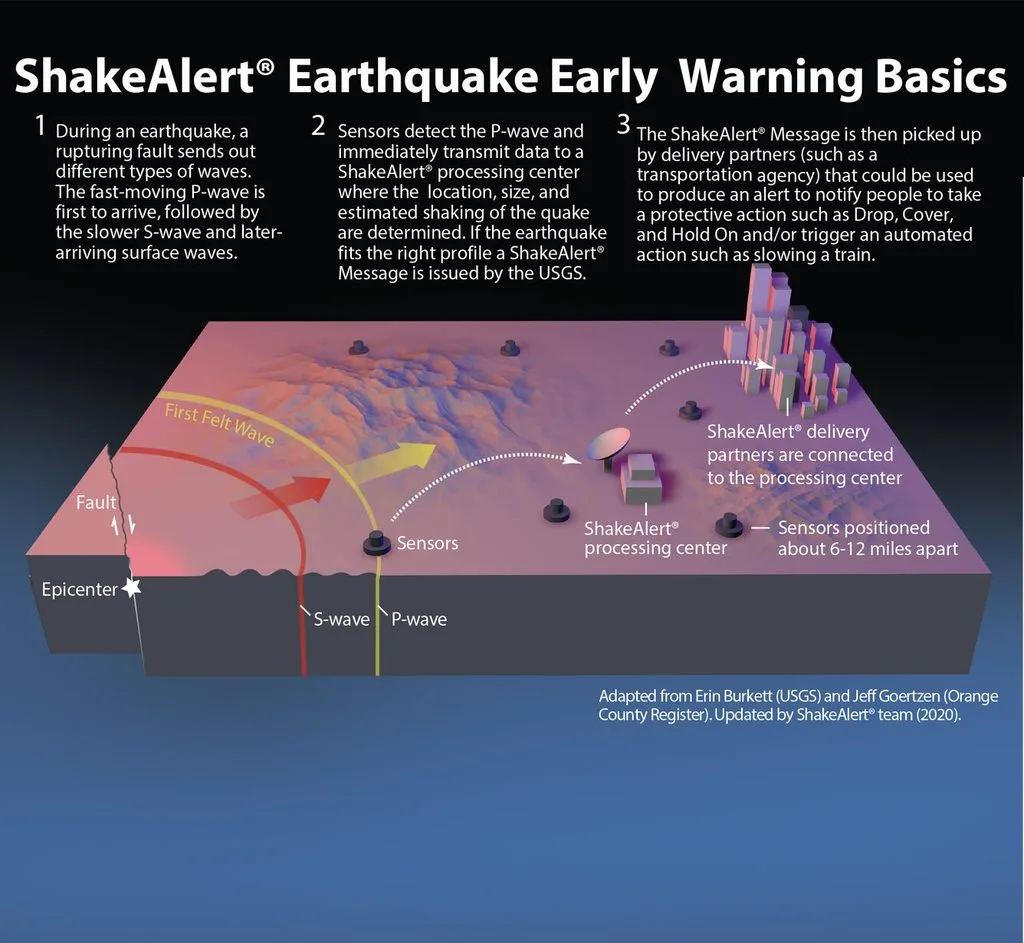
The high speed of P-waves is not just an academic fact.
It can provide a life-saving advantage.
When an earthquake begins, P-waves quickly travel away from the source.
S-waves and much of the stronger shaking travel more slowly.
Earthquake early warning systems use fast sensors to detect the first P-waves.
The system can then:
- Detect the first P-wave.
- Begin estimating the earthquake’s location and magnitude.
- Send alerts to areas where stronger shaking is expected to arrive.
These systems do not predict earthquakes.
The earthquake has already started.
But communication signals travel far faster than seismic waves, so people some distance from the earthquake source may receive several seconds—and in some situations tens of seconds—of warning.
Very close to the epicentral area, however, the warning time may be extremely short or nonexistent.
Can We See P- and S-Waves?
Not directly.
A seismic wave traveling through a mass of rock cannot normally be seen with the human eye.
But its effects can be measured.
Highly sensitive instruments called seismometers record ground motion.
The resulting record is called a seismogram.
On a seismogram, the first smaller movement often marks the arrival of the P-wave, followed by stronger S-wave motion and later surface-wave energy.
These recordings allow large earthquakes to be detected even by stations thousands of kilometers away.
Why Can P-Waves Travel Through Liquids but S-Waves Cannot?
This question provides one of the easiest ways to understand the difference between the two waves.
A P-wave travels by compressing and expanding material.
Liquids can be compressed and can transmit pressure changes.
Therefore, P-waves can move through liquids.
An S-wave attempts to shear the material sideways.
Liquids cannot sustain this type of shear stress.
Therefore, the S-wave cannot propagate through them.
This single physical difference helped scientists determine that Earth’s outer core is liquid.
Frequently Asked Questions
Which seismic wave arrives first?
The P-wave.
P-waves travel faster than S-waves.
Are P-waves longitudinal or transverse?
P-waves are primarily longitudinal compressional waves. Particle motion is parallel to the direction in which the wave travels.
Are S-waves transverse?
Yes. In S-waves, particle motion is perpendicular to the direction of wave travel.
Can P-waves travel through water?
Yes.
P-waves can travel through liquids.
Can S-waves travel through water?
No.
S-waves cannot propagate through liquids.
Which seismic wave is the fastest?
The P-wave.
Which seismic wave causes more damage?
S-waves can produce stronger ground motion than P-waves, but during large earthquakes, surface waves may be responsible for some of the most damaging shaking.
Are P- and S-waves produced only by earthquakes?
No.
Explosions, volcanic activity, and some large human-made energy releases can also generate seismic waves.
Final Thoughts
At first, P- and S-waves may seem like nothing more than two different types of vibrations created by an earthquake.
In reality, they form part of the foundation of modern seismology.
P-waves are faster and can travel through solids, liquids, and gases. They move material through alternating compression and expansion in the same general direction as wave propagation.
S-waves are slower and can travel only through solids. They move material perpendicular to the direction in which the wave travels.
The difference in their speeds allows scientists to help determine earthquake locations.
The early arrival of P-waves gives earthquake early warning systems precious seconds.
And the inability of S-waves to cross the liquid outer core helped scientists understand what exists deep inside our planet.
Humans have never reached Earth’s core.
We have never brought back a rock sample from it.
Yet we know that the outer core is liquid and the inner core is solid.
One of the biggest reasons is that we can listen to the P- and S-waves sent through the planet by powerful earthquakes.