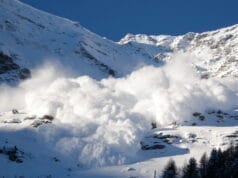


























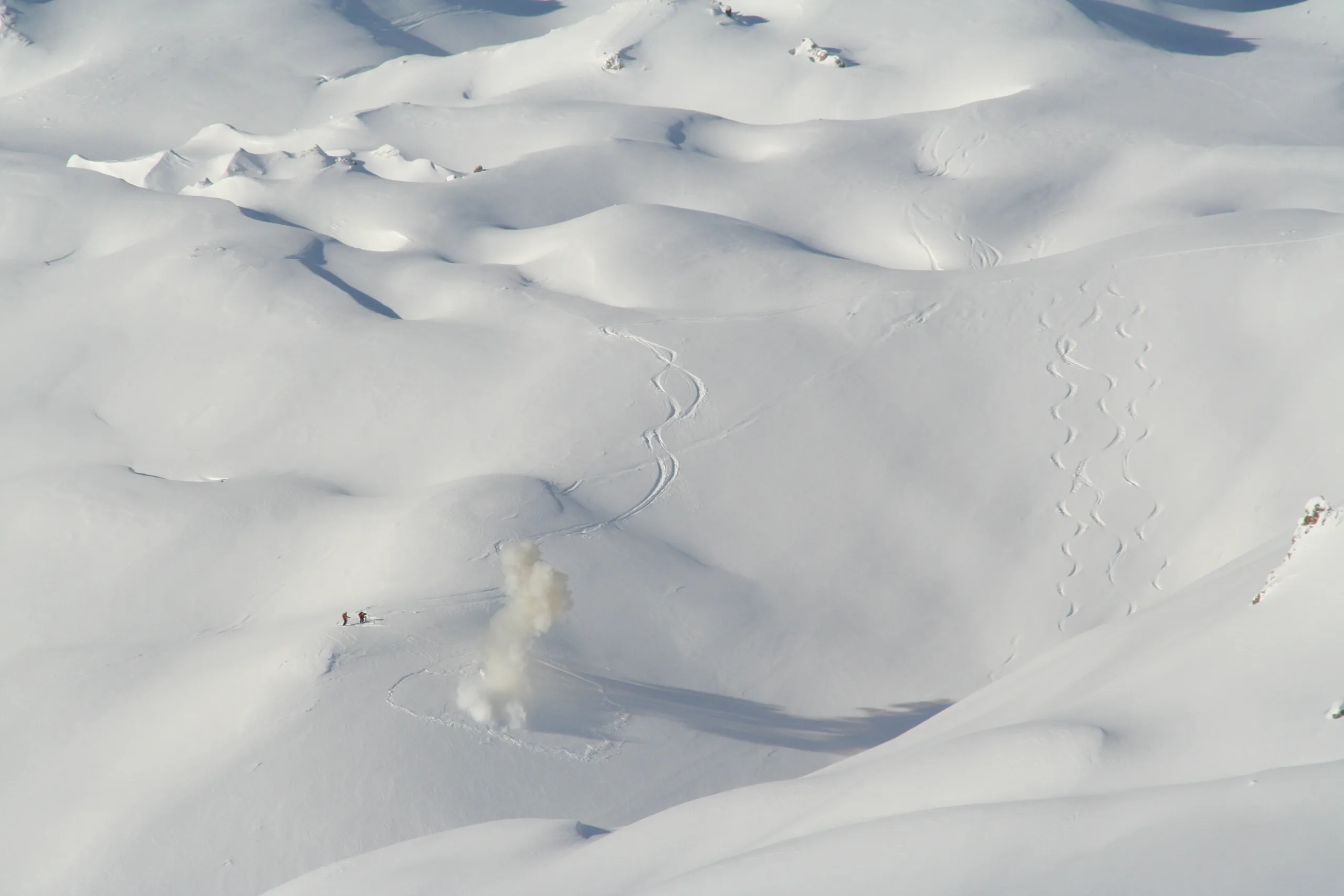
An avalanche is a rapid downslope movement of snow driven by gravity. It begins when snow loses mechanical stability and can grow by entraining additional snow along its path. Avalanches are a form of mass movement in mountain environments, capable of reshaping vegetation, transporting sediment and damaging infrastructure. Snow avalanches differ from rock avalanches and volcanic debris flows in their dominant material and release mechanisms.
How avalanches form
Seasonal snow accumulates in layers with different grain shapes, densities and bonding strengths. Burial of weak layers beneath cohesive snow creates a mechanically unstable structure. Temperature gradients can promote the growth of angular, poorly bonded crystals, while wind can redistribute snow into dense slabs. A buried layer of surface hoar may remain weak for weeks or months. Failure can propagate through a weak layer far beyond the initial disturbance, releasing a broad slab.
For a simplified uniform snow layer of density ρ and thickness h measured perpendicular to the slope, gravitational shear stress is approximately τ = ρgh sin θ, where g is gravitational acceleration and θ is slope angle. A 0.5 m layer with density 250 kg/m³ on a 35° slope produces about 703 Pa of shear stress. This calculation illustrates loading, not a stability test: fracture propagation, bonding, spatial variability and snow structure also matter.
Types of avalanches
Release mechanisms and flow behavior describe different aspects of an avalanche. A dry slab can develop a powder cloud, whereas a wet slab may travel as a dense granular flow. The categories therefore overlap.
| Type | Mechanism | Field evidence |
|---|---|---|
| Slab | Failure beneath cohesive snow | Distinct crown fracture |
| Loose snow | Progressive entrainment from a point | Fan-shaped track |
| Glide snow | Entire snowpack slides over ground | Ground exposed in release area |
| Wet snow | Liquid water alters snow strength | Dense, irregular deposits |
| Powder snow | Suspension of fine snow in air | Expanding turbulent cloud |
Terrain and avalanche paths
An avalanche path includes a release zone, a transport track and a deposition or runout zone. Slab releases commonly occur on slopes around 30–50 degrees, but debris can travel across much gentler terrain. Gullies concentrate moving snow and increase burial depth; cliffs increase trauma risk. Aspect, elevation, wind exposure and shading influence snow accumulation and metamorphism. A low-angle location is not necessarily safe if it lies beneath a steep connected slope.
Weather and triggers
Rapid snowfall adds weight, wind deposits snow unevenly, and rain or prolonged warming can introduce liquid water into the snowpack. Cornice collapse and human loading may initiate failure. Ordinary shouting is not a meaningful avalanche trigger. A collapsing weak layer may produce an audible whumpf, which is a warning of instability rather than a cause of the collapse. Remote triggering is possible where weak layers extend into adjacent terrain.
Avalanche size and danger
European warning services distinguish five destructive size classes, from small releases to events capable of altering entire landscapes. Size describes the event and its potential consequences; danger level describes regional conditions, including the likelihood and expected distribution of avalanches. These are not interchangeable. Even a relatively small release can be fatal in a terrain trap.
The released volume can be approximated from slab area multiplied by mean thickness. A hypothetical 40 m by 60 m slab with a thickness of 0.4 m contains 960 m³ of snow. At 250 kg/m³ its initial mass is approximately 240 tonnes. Entrainment and compaction change the volume and density during motion.
Geological and environmental effects
Repeated avalanches create recognizable corridors through forests, break trees, scour shallow soils and redistribute rock fragments. Deposits may contain angular debris mixed with organic material. After melting, sediment can remain on fans or valley floors. These features must be distinguished from debris-flow deposits using sedimentology, vegetation patterns and historical records. Tree-ring damage can help reconstruct past avalanche activity, although preservation and sampling introduce uncertainty.
Monitoring and hazard mapping
Specialists combine weather stations, snow profiles, stability observations, historical inventories and terrain models. Snow pits document grain form, hardness, temperature and layer thickness; tests assess local failure and propagation behavior. No single test establishes safety across a mountain slope. Remote sensing, aerial surveys and numerical runout models help map exposure of roads, settlements and ski areas. Model results depend on release assumptions, topography and snow properties.
Prevention and risk reduction
Permanent protection may include snow-support structures in release zones, deflection barriers, catchment dams and protective road galleries. Land-use planning avoids construction in mapped high-hazard corridors. Controlled releases are performed by trained professionals under regulated procedures. For backcountry travel, consult the current local avalanche bulletin, obtain practical training, select terrain conservatively and carry a transceiver, probe and shovel with trained companions. Equipment does not prevent burial or guarantee survival.
Frequently asked questions
Can avalanches occur without fresh snowfall?
Yes. Persistent weak layers, wind redistribution and warming can destabilize an older snowpack.
Are avalanches the same as landslides?
Both are gravity-driven mass movements, but snow avalanches primarily transport snow, whereas landslides primarily involve soil or rock.
Does a low danger rating mean a slope is safe?
No. Regional forecasts cannot guarantee stability at a particular location. Local terrain and snow conditions remain important.
Scientific references
WSL Institute for Snow and Avalanche Research SLF — Avalanche types; SLF — Avalanche sizes; Avalanche.org — Snowpack collapse. Featured photograph: Alexander Joss, public domain, Wikimedia Commons.