



























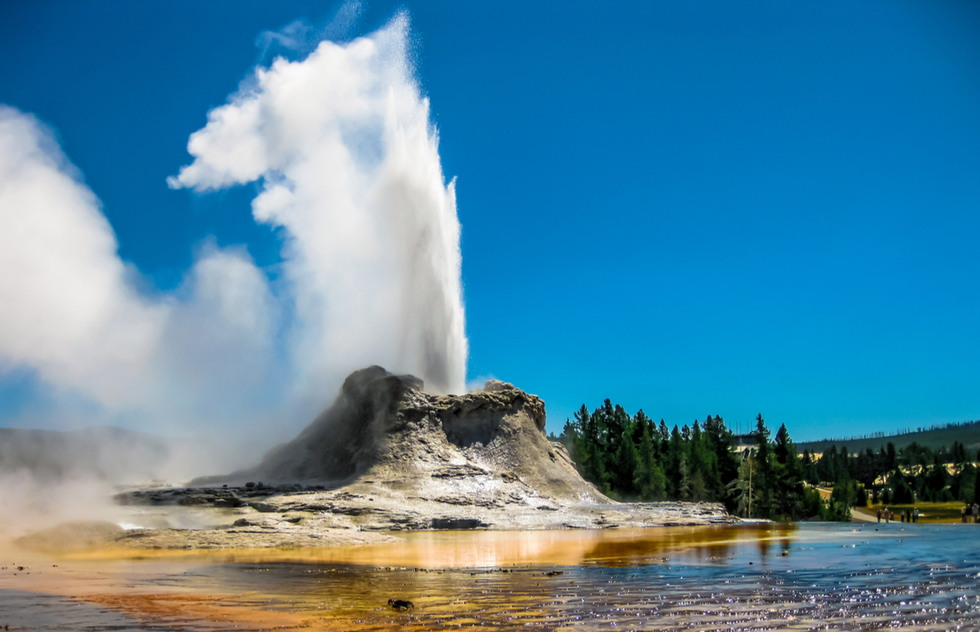
A geyser is a hot spring that intermittently ejects liquid water and steam when boiling within its underground plumbing system drives rapid fluid expansion. Unlike continuously flowing hot springs, geysers require a combination of geothermal heat, water recharge and a conduit geometry that allows heat and pressure to accumulate between eruptions.
Geological conditions for geyser formation
Most geyser fields occur in volcanic regions where shallow heat sources warm groundwater. Rain and snowmelt infiltrate fractured rock, circulate at depth and return toward the surface. Restricted conduits, cavities and changes in permeability can trap hot water and steam, making an intermittent eruption possible. A conventional confined aquifer is not a universal requirement.
Silica-rich waters can precipitate opaline silica along vents and fractures. These deposits may gradually modify the plumbing and reduce leakage. A stable heat source alone is insufficient: many volcanic areas have hot springs but no active geysers.
Why geysers erupt
During recharge, water entering the conduit is heated from below. The weight of overlying water increases pressure at depth and raises the local boiling temperature. Water can therefore remain liquid at temperatures above the boiling point at the surface.
Steam bubbles may accumulate in cavities or rise through the conduit. When hot water spills or is displaced from the vent, the pressure on deeper water decreases. Some of the liquid flashes into steam, further reducing the weight of the water column. This positive feedback can expel a mixture of water and steam. The details vary with the geometry of the system.
After an eruption, the conduit contains less hot water and may cool. Groundwater refills the system and heat builds again. The rate of recharge, heat supply and steam loss determine whether the next eruption follows minutes, hours or much longer afterward.
Pressure and boiling temperature
The approximate pressure in a static water column is P = P₀ + ρgh, where P₀ is atmospheric pressure, ρ is water density, g is gravitational acceleration and h is depth. At 10 m depth, assuming a density of 1,000 kg/m³ and sea-level atmospheric pressure, the absolute pressure is about 199 kPa. Pure water boils near 120 °C at this pressure, compared with 100 °C at sea level. Actual geyser systems contain moving fluids and steam, so this calculation is illustrative rather than an eruption forecast.
Cone and fountain geysers
| Type | Vent and eruption | Example |
|---|---|---|
| Cone geyser | Relatively narrow vent through a mineral mound; often a concentrated jet | Old Faithful, Yellowstone |
| Fountain geyser | Open pool; often bursts of water in several directions | Great Fountain, Yellowstone |
This distinction describes vent morphology and eruption style, not a universal rule about eruption frequency. Mudpots and fumaroles are separate hydrothermal features: mudpots contain acidic water and altered sediment, while fumaroles mainly discharge steam and gases.
Where geysers occur
Major geyser fields include Yellowstone in the United States, Haukadalur in Iceland, the Taupō Volcanic Zone in New Zealand, El Tatio in Chile and the Valley of Geysers in Kamchatka. Each field has its own water chemistry, geological framework and heat supply. Yellowstone contains the largest concentration of active geysers.
Old Faithful is notable for its comparatively predictable eruptions, although intervals vary. Strokkur in Iceland is another frequently erupting geyser. Steamboat Geyser in Yellowstone produces exceptionally tall water eruptions, but its major eruptions are irregular.
Geyserite and mineral deposits
Cooling and evaporation of silica-rich geothermal water can produce siliceous sinter, including finely laminated geyserite around vents. Deposit textures record variations in discharge, temperature and microbial activity. Carbonate-rich hot springs can instead build travertine; carbonate deposits and siliceous geyserite should not be treated as the same material.
Scientific monitoring and geothermal energy
Researchers use temperature sensors, pressure measurements, seismic records, water chemistry and eruption observations to investigate geyser plumbing. Changes in intervals may reflect changing water availability, mineral deposition, earthquakes or other disturbances; they do not by themselves establish that magma is rising or that a volcanic eruption is imminent.
Geysers indicate an active hydrothermal system, but natural geyser vents are not generally used as commercial power sources. Geothermal plants obtain heat or steam through wells in suitable reservoirs. Such extraction can reduce reservoir pressure and disrupt nearby thermal features. Yellowstone’s hydrothermal resources are protected from geothermal exploitation.
Safety and conservation
Thermal waters can cause severe burns, and thin mineral crusts may conceal boiling water. Visitors should remain on designated paths and boardwalks, obey closures and never enter unapproved thermal pools. Disturbing vents or depositing objects can damage the plumbing and permanently alter eruption behavior.
Frequently asked questions
Why are geysers rare? Few locations combine sustained heating, groundwater recharge and suitable underground plumbing.
Are geysers volcanoes? No. Geysers discharge heated groundwater and steam, not magma, although many occur in volcanic regions.
Do geysers erupt at fixed intervals? No. Some have predictable ranges, while others remain irregular or dormant for years.
Can a geyser stop erupting? Yes. Changes in recharge, permeability, heat supply or human extraction can alter or terminate activity.
Scientific references
National Park Service – How geysers work
National Park Service – Hydrothermal features
USGS – Yellowstone’s active hydrothermal system
National Park Service – Hydrothermal systems