
























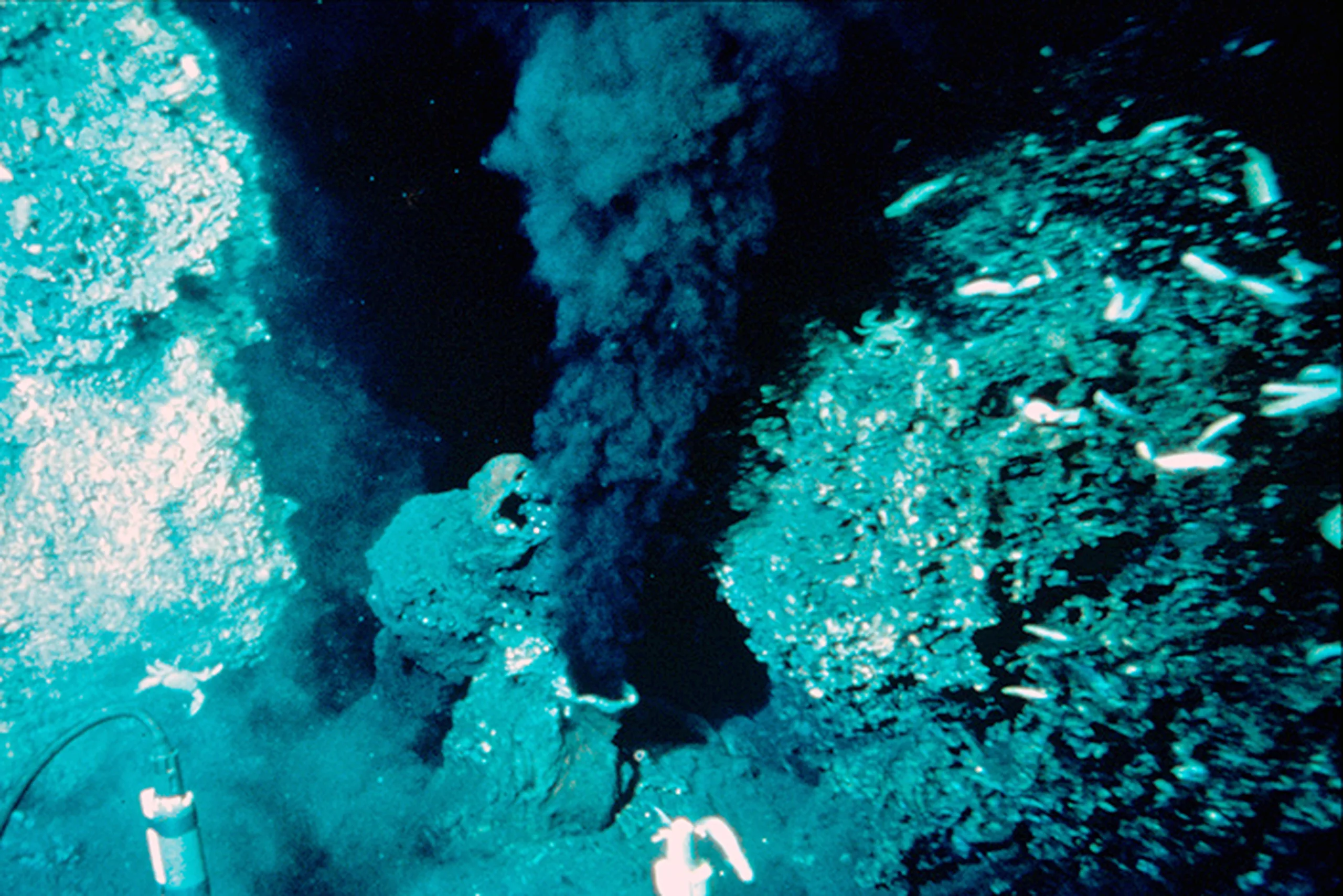
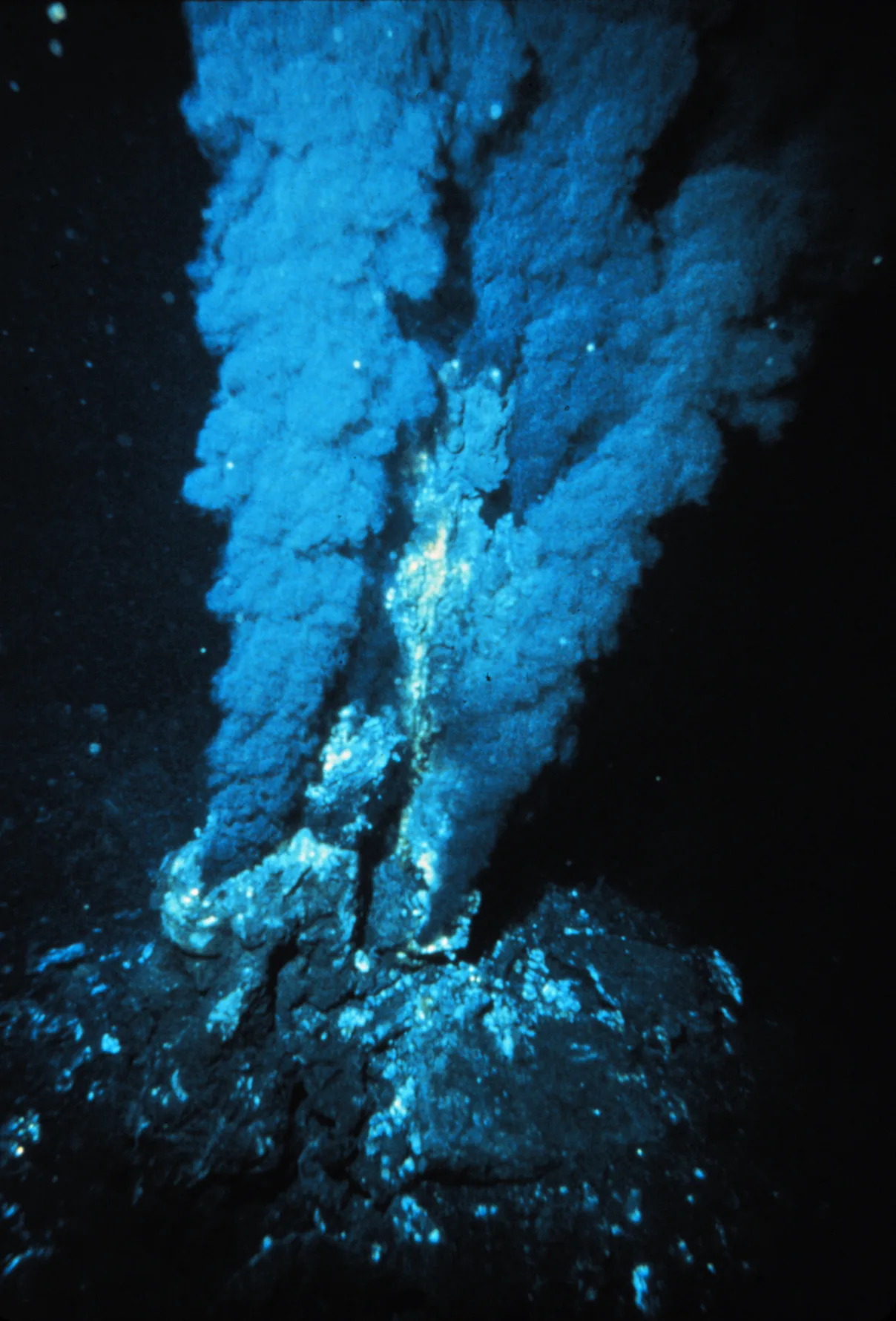
Black smokers are high-temperature hydrothermal vents on the seafloor that discharge chemically altered water carrying dissolved metals and sulfur. When the fluid mixes with cold seawater, microscopic metal sulfide particles form a dark plume, while minerals deposited around the outlet build a chimney. These systems connect oceanic crust, seawater chemistry, mineral deposits and deep-sea ecosystems.
Where Black Smokers Form
Most occur along divergent plate boundaries, where magma supplies heat and faulting creates pathways for water. Fast-spreading ridges such as the East Pacific Rise and slow-spreading ridges such as the Mid-Atlantic Ridge both host active fields. Submarine volcanic arcs and back-arc basins also support high-temperature circulation. Vent distribution depends on permeability, heat supply and the geometry of faults rather than spreading rate alone.
Basalt-hosted systems are common, but some vents circulate through exposed mantle peridotite or sediment-covered crust. These contrasting host rocks influence acidity, dissolved gases and metal concentrations.
Hydrothermal Circulation and Chimney Growth
Cold seawater enters permeable fractures and descends into hot crust. During heating, reactions with rock remove much of its magnesium and modify its sulfate content. The resulting fluid may become acidic and acquire dissolved iron, copper, zinc, silica and reduced sulfur. Buoyancy and pressure gradients drive the fluid upward through connected fractures.
At the outlet, rapid cooling and chemical mixing produce supersaturation with respect to sulfide minerals. Fine particles remain suspended in the plume, while others accumulate along the walls of the conduit. Anhydrite can form where seawater is heated against the chimney wall; later sulfide deposition reinforces or replaces this material. Repeated precipitation, cracking and collapse produce branching chimneys and rubble mounds.
Temperature, Pressure and Fluid Chemistry
Focused black smoker discharge commonly reaches approximately 300–400°C, although temperatures vary between fields. Ambient deep seawater is typically only a few degrees above freezing. The high pressure at depth changes the boiling behavior of water, so temperatures well above 100°C are possible without ordinary surface boiling. Depending on pressure, temperature and salinity, hydrothermal fluids may separate into vapor-rich and brine-rich phases, which can carry different concentrations of metals.
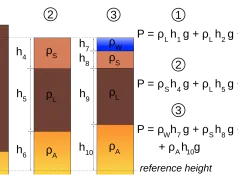
For example, at 2,500 m depth, a simple hydrostatic estimate using seawater density of 1,025 kg/m³ gives a gauge pressure of ρgh ≈ 25.1 MPa (about 251 bar). This is an approximation; actual fluid phase behavior requires the pressure-temperature-composition relationship of the saline fluid.
Mineralogy of Black Smoker Chimneys
Mineral assemblages vary across a chimney because temperature, mixing and chemical gradients change over distances of centimeters. Copper-rich sulfides can occur near hotter conduits, whereas zinc-rich minerals may dominate cooler zones. This pattern is not universal and depends on fluid composition and growth history.
| Mineral | Formula | Geological significance |
|---|---|---|
| Pyrite | FeS₂ | Common iron sulfide in chimneys and mounds |
| Chalcopyrite | CuFeS₂ | Important copper-bearing sulfide |
| Sphalerite | ZnS | Principal zinc-bearing sulfide |
| Pyrrhotite | Fe₁₋ₓS | Iron sulfide favored by certain reduced conditions |
| Anhydrite | CaSO₄ | May form in heated seawater along chimney walls |
| Barite | BaSO₄ | Forms where barium-bearing fluids meet sulfate |
Black Smokers, White Smokers and Diffuse Vents
Black smokers emit abundant dark sulfide particles. White smokers produce paler mineral suspensions, often containing sulfate or silica phases, and may discharge cooler fluids. Diffuse vents release fluid through broad permeable areas rather than a single focused outlet. These are related expressions of hydrothermal circulation, not interchangeable names. Alkaline carbonate-rich systems such as Lost City represent a distinct style of water-rock interaction and should not be classified as typical black smokers.
Seafloor Massive Sulfide Deposits
Long-lived circulation can accumulate sulfide minerals at and below the seabed. Chimney fragments, mineralized breccias, replacement bodies and networks of feeder veins may form a larger deposit. Modern seafloor massive sulfides provide analogues for ancient volcanogenic massive sulfide (VMS) deposits exposed on land. Copper and zinc are common commodities in these ancient ores; lead, silver and gold may also be economically significant.
An active chimney is not automatically an economic ore deposit. Tonnage, grade, mineral processing behavior, access and environmental constraints all affect resource potential. Hydrothermal activity also redistributes elements between crust and ocean, and some dissolved or particulate material is transported far beyond the vent field.
Life Around Hydrothermal Vents
Microorganisms use chemical energy from reactions involving reduced sulfur, hydrogen or methane to support primary production without sunlight. Some animals obtain nutrition through symbiotic microbes; others graze or prey on organisms supported by this food web. Giant tubeworms occur at eastern Pacific vents, while certain Atlantic fields support dense shrimp populations. Animals generally occupy cooler mixing zones rather than the hottest discharge itself.
Vent communities are patchy and change as fluid pathways shift. Their dependence on local chemistry makes active vents particularly sensitive to physical disturbance. Mining impacts, including habitat removal and sediment plumes, require careful site-specific assessment. Hydrothermal systems are also studied as possible environments relevant to early life, but their role in life’s origin remains a hypothesis.
Discovery and Field Observations
The 1977 Galápagos Rift expedition documented hydrothermal vent communities, and high-temperature black smokers were observed on the East Pacific Rise in 1979. Modern exploration uses bathymetry, water-column turbidity and chemical sensors to locate plumes, followed by remotely operated vehicles or submersibles to map outlets and sample fluids and minerals.
At an East Pacific Rise site near 9°39′N, USGS documented discharge at 329°C at a depth of 2,550 m in 1991. The surrounding bottom water was about 1.4°C. This contrast illustrates why mineral precipitation is so rapid at the vent boundary. At the Juan de Fuca Ridge, drilling has also documented copper-rich mineralization beneath a seafloor sulfide deposit, showing that mineral accumulation is not limited to visible chimneys.
Frequently Asked Questions
Is the black smoke actually smoke?
No. It consists mainly of tiny mineral particles suspended in water, not combustion products.
Are all hydrothermal vents black smokers?
No. Hydrothermal vents include focused black and white smokers, diffuse discharge and other chemically distinct systems.
Can organisms live in the hottest vent fluid?
Known organisms cannot grow at typical black smoker outlet temperatures. Most vent life occupies cooler regions where hot fluid mixes with seawater.
Scientific Sources
NOAA — Hydrothermal vents; Woods Hole Oceanographic Institution — Hydrothermal fluid chemistry; USGS — Volcanogenic massive sulfide occurrence model; USGS — East Pacific Rise field observation; Zierenberg et al. (1998), Nature — Subsurface mineralization.