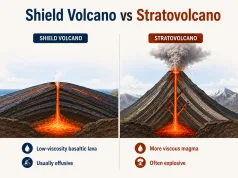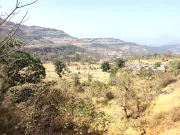
























The Deccan Traps are a large igneous province in western and central India, dominated by thick sequences of basaltic lava flows. Their main eruptive phase occurred near the Cretaceous–Paleogene (K–Pg) boundary approximately 66 million years ago. The province records one of the largest episodes of continental flood basalt volcanism in Earth’s recent geological history.
Location and Geological Setting
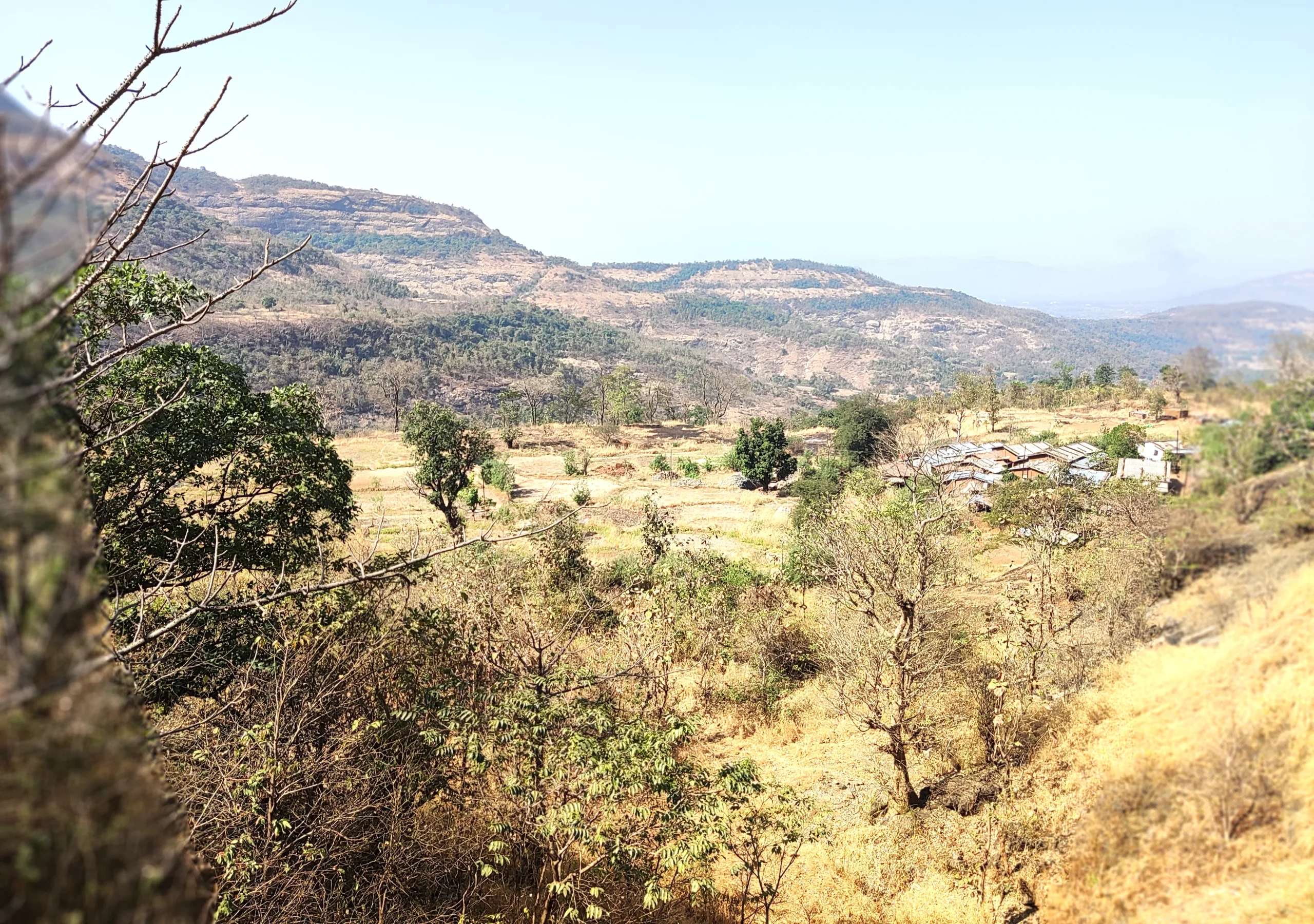
The preserved lava succession extends across large parts of Maharashtra and neighboring regions, with additional exposures farther east and north. Erosion and burial obscure the original extent of the province. The Western Ghats expose many thick lava sequences, where differences in flow resistance help produce the distinctive stepped terrain. The word traps is derived from a term for stairs and refers to this appearance.
Formation of the Deccan Flood Basalts
Large volumes of magma reached the surface through fractures, dikes and eruptive systems. Repeated eruptions built overlapping sheets of basalt rather than a single volcanic cone. The formation of the province is commonly linked to the Réunion mantle plume and the tectonic evolution of the Indian plate, although the details of melt generation, magma pathways and plume–lithosphere interactions remain subjects of research.
The dominant rock is tholeiitic basalt, typically containing plagioclase and pyroxene with variable olivine and iron–titanium oxides. Lava cooling produces fine-grained textures; gas-rich flow tops may contain vesicles subsequently filled by secondary minerals. Intrusive equivalents include dolerite.
Age and Duration of Volcanism
High-precision uranium–lead zircon dating constrains the timing of the major volcanic episode. Research published in 2015 estimated that its principal phase began roughly 250,000 years before the K–Pg boundary and lasted approximately 750,000 years. Later studies resolved pulses of eruption and refined eruption-rate estimates. The results depend on stratigraphic correlation, sampling and assumptions used to estimate volumes.
Although published volume estimates vary, the original lava volume was of the order of a million cubic kilometres. This figure is a reconstruction, not a direct measurement of the present-day exposed rock volume.
Lava Flow Architecture and Field Features
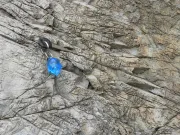
Individual flows can contain a dense interior, a vesicular or rubbly upper zone and chilled margins. Columnar joints develop as lava contracts during cooling. Weathered horizons and sedimentary interbeds can record intervals between eruptions, while intrusive dikes cut earlier rocks and preserve evidence of magma transport. Mapping these relationships helps geologists reconstruct the sequence of eruptions.
Deccan Traps and the Mass Extinction
The Deccan eruptions overlapped the end-Cretaceous environmental crisis and the Chicxulub impact. Volcanic carbon dioxide can contribute to warming over extended timescales; sulfur emissions can generate sulfate aerosols that cause shorter-lived cooling. The amount, timing and atmospheric effects of these emissions are not determined by lava volume alone.
The Chicxulub impact is widely regarded as the principal immediate cause of the abrupt K–Pg extinction. The Deccan eruptions may have contributed to environmental stress before the boundary or influenced subsequent recovery. Researchers continue to evaluate the relative roles of volcanism, the impact and feedbacks in the climate system.
Why the Deccan Traps Matter
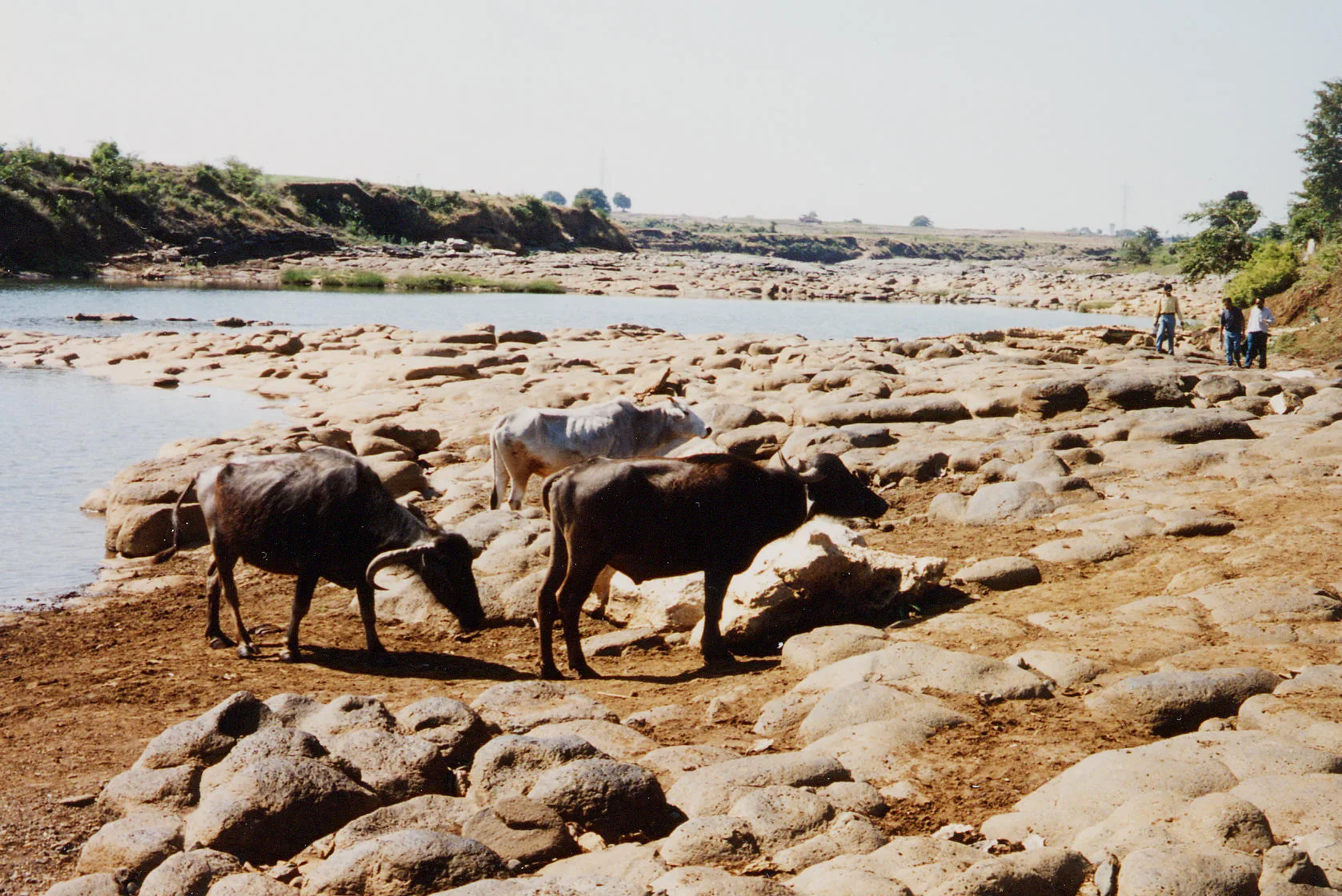
The province provides evidence of large-scale mantle melting, continental volcanism and interactions between geology and climate. Its fractured and weathered basalt layers also influence regional groundwater storage. Flow boundaries, joints and secondary mineral assemblages can produce pronounced variations in permeability and rock strength.
Frequently Asked Questions
Are the Deccan Traps a single volcano?
No. They are a vast province of overlapping lava flows and related intrusions.
How old are the Deccan Traps?
The main eruptive phase occurred around 66 million years ago, with volcanic activity extending across the K–Pg boundary.
Did the Deccan Traps kill the dinosaurs?
Volcanism may have influenced environmental stress, but the Chicxulub impact is strongly supported as the immediate driver of the end-Cretaceous extinction.
Scientific References
Schoene et al. (2019) — U-Pb constraints on pulsed eruption of the Deccan Traps
Featured photograph: Shyamal L., Wikimedia Commons, CC0 1.0; converted to WebP.