
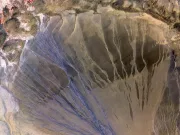
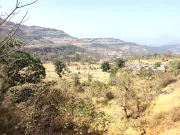
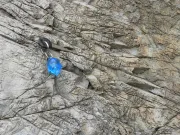




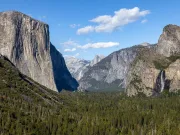



















Orogeny is the set of geological processes that builds a mountain belt through tectonic deformation, crustal thickening and associated metamorphism, magmatism and uplift. An orogen is the resulting belt of deformed rocks. Mountain building commonly occurs at convergent plate boundaries, but the evolution of a mountain range also depends on erosion and later tectonic processes.
How Orogeny Works
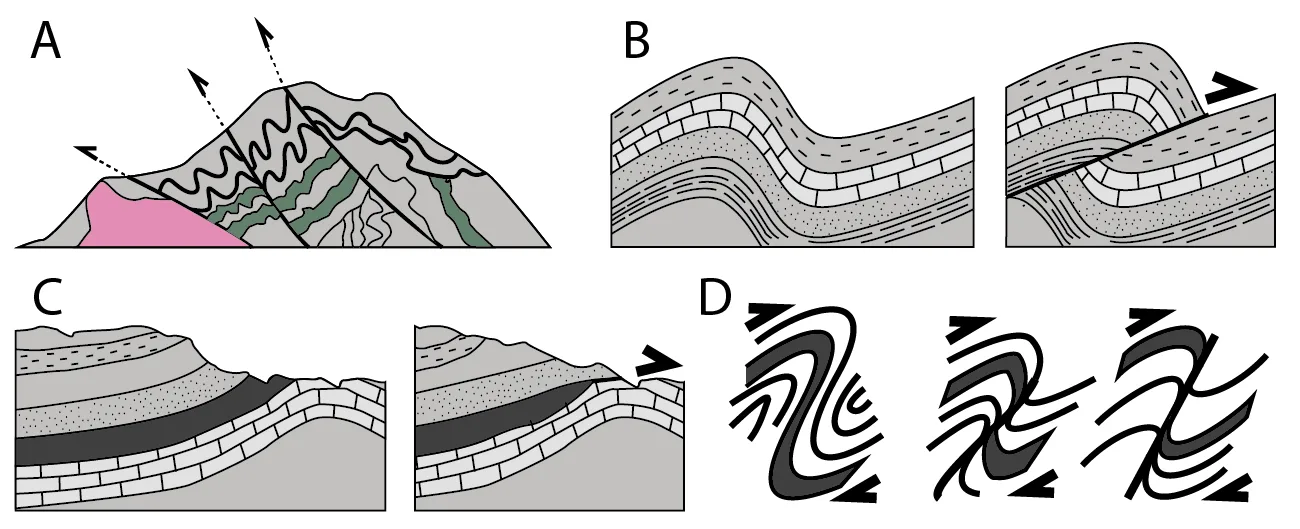
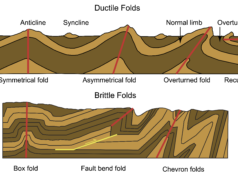
When tectonic plates converge, stresses can shorten the continental crust. Rock layers fold, thrust faults stack slices of crust, and deeper rocks may deform ductilely. Thickened crust can develop a deep root, while uplift and erosion expose rocks that originally formed at depth.
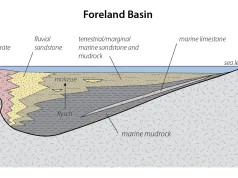
The weight of the growing mountain belt may bend adjacent lithosphere, creating a basin that receives sediment eroded from the mountains. These processes connect the internal orogenic belt to its external sedimentary basins. See hinterland and foreland in geology.
Major Tectonic Settings
Continental collision: when continental masses converge after an intervening ocean closes, extensive shortening can form thick crust and large mountain belts. The Himalayas and Alps are examples.
Ocean–continent convergence: subduction of oceanic lithosphere beneath a continental margin may produce a volcanic arc, accretionary complexes and a deformed continental margin. The Andes illustrate this setting.
Terrane accretion: fragments of crust, island arcs and oceanic plateaus may be incorporated into a continental margin, contributing to a composite mountain belt.
Evidence of Ancient Orogenies
Geologists reconstruct mountain-building events using folded and faulted strata, metamorphic mineral assemblages, intrusive igneous rocks, sedimentary basin records and radiometric ages. Different rock samples may record different stages of the same prolonged event.
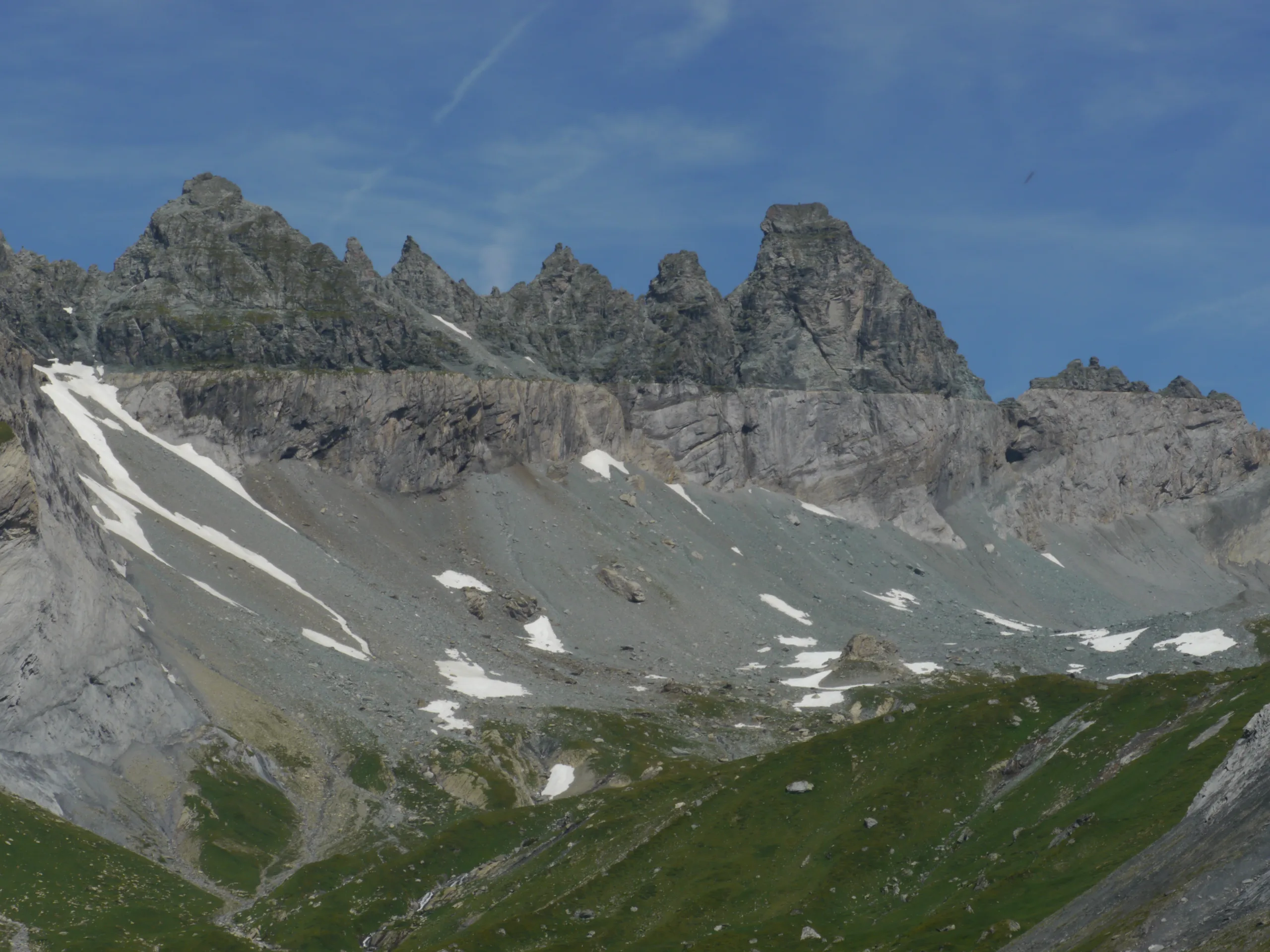
A thrust fault can place older rocks above younger strata, as seen at the Glarus Thrust in Switzerland. Such relationships preserve evidence of horizontal crustal shortening even after substantial erosion. Related structures are discussed in faults and folds.
Examples of Orogenies
The Alpine orogeny reflects convergence between African-related and Eurasian plates. The Himalayan orogen developed through India–Eurasia convergence and remains tectonically active. The Paleozoic Alleghenian orogeny contributed to the Appalachian mountain belt during the assembly of Pangaea. These examples differ in age, tectonic history and present-day activity.
Orogeny, Uplift and Erosion
Orogeny is not synonymous with uplift. A rock body may rise toward the surface while erosion lowers the land surface; surface elevation reflects the balance between deformation, uplift and denudation. Crustal extension can also create fault-block mountains, as described in horst and graben structures, without the same shortening mechanisms as a collisional orogen.
Frequently Asked Questions
What is the difference between orogeny and an orogen?
Orogeny refers to the mountain-building processes or event. An orogen is the mountain belt and its associated geological structures.
How long does an orogeny last?
Major mountain-building episodes may span tens of millions of years or more, with several phases of deformation, metamorphism and erosion.
Can an orogen exist without high mountains?
Yes. Ancient orogens may be deeply eroded, leaving deformed rocks and structures as evidence of their mountain-building history.
References
Physical Geology — Mountain Building
Physical Geology — Fractures, Joints and Faults
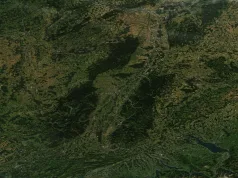
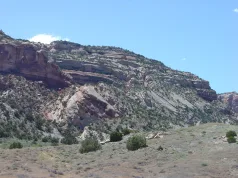
Featured photograph: Christian Heine / EGU Imaggeo, Wikimedia Commons, CC BY-SA 3.0, converted to WebP.