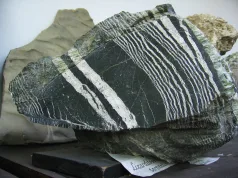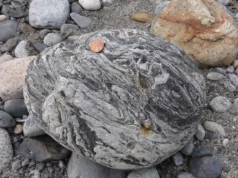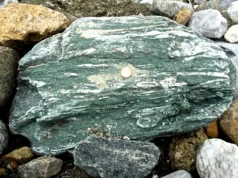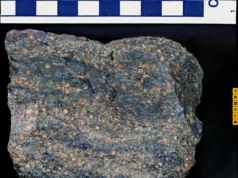


















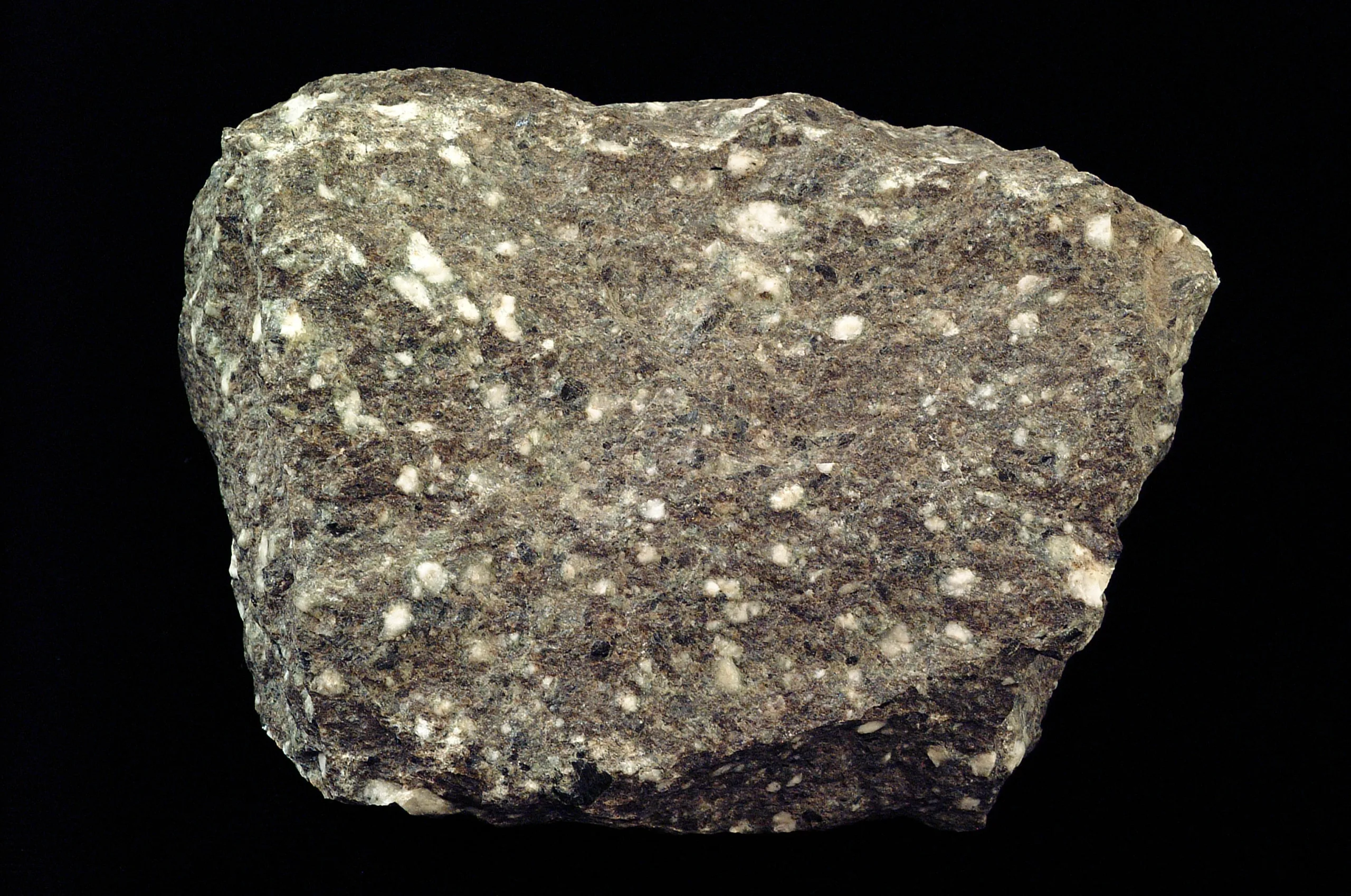
Mylonite is a fine-grained, strongly foliated fault-zone rock produced mainly by crystal-plastic deformation and dynamic recrystallization during concentrated ductile shear. Its defining features are deformation-related grain-size reduction and a penetrative shear fabric, not a particular chemical composition. Mylonites may originate from granite, gneiss, quartzite, mafic rocks, or even peridotite.
What Does Mylonite Look Like?
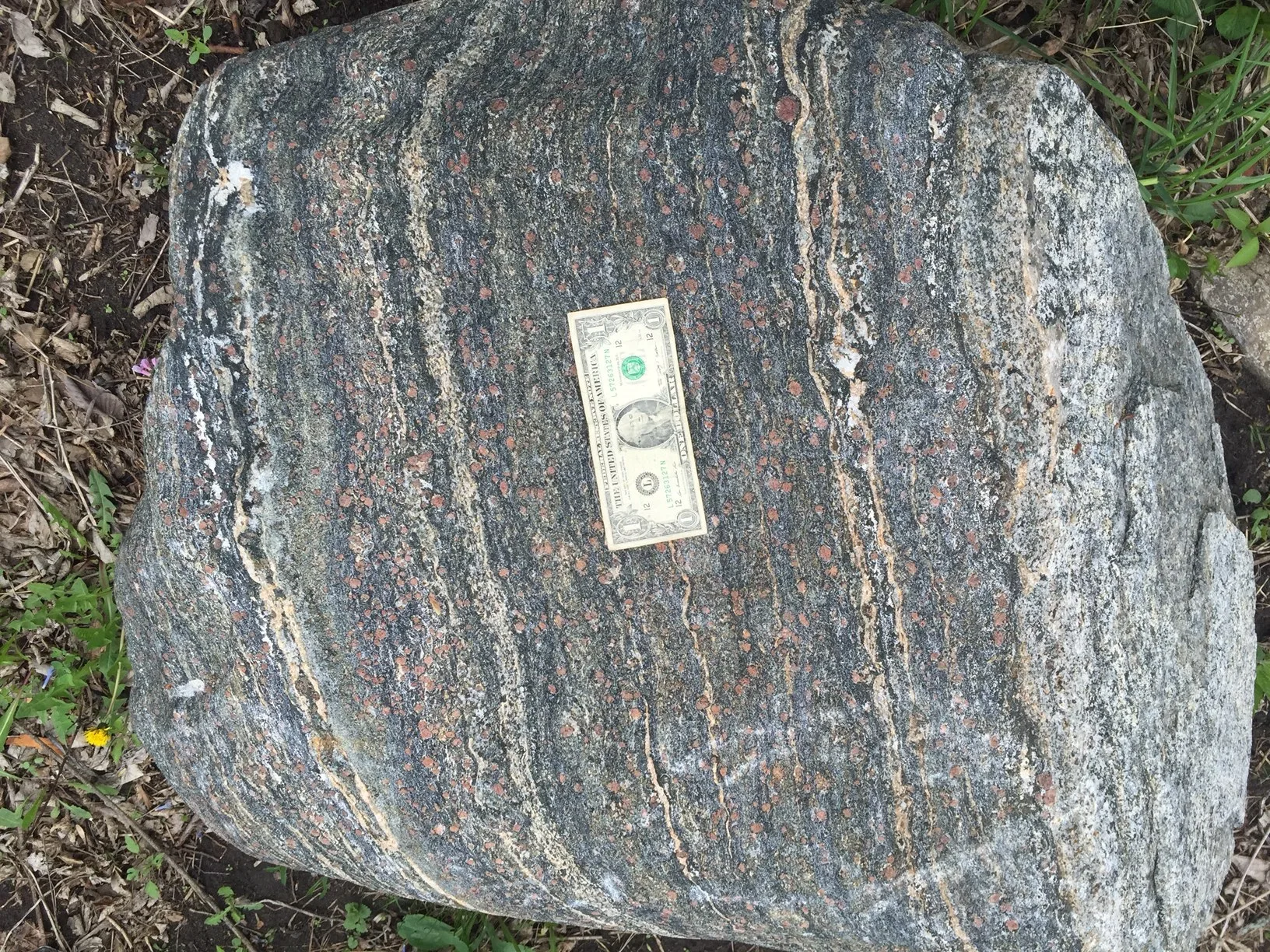
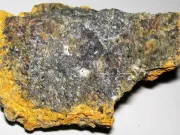
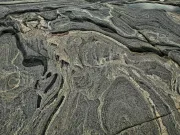
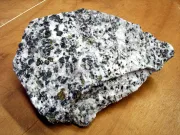
Typical hand specimens display narrow, continuous streaks, flattened mineral aggregates, and pale quartz or feldspar ribbons in a finer, darker matrix. Some are distinctly banded; others look almost homogeneous without magnification. Foliation may be planar, wavy, or locally folded, and a linear stretching fabric can be visible on a surface parallel to lineation. Color reflects the parent rock: gray and white in quartzofeldspathic examples, darker in mafic varieties, and greenish in some ultramafic rocks.
How Mylonite Forms
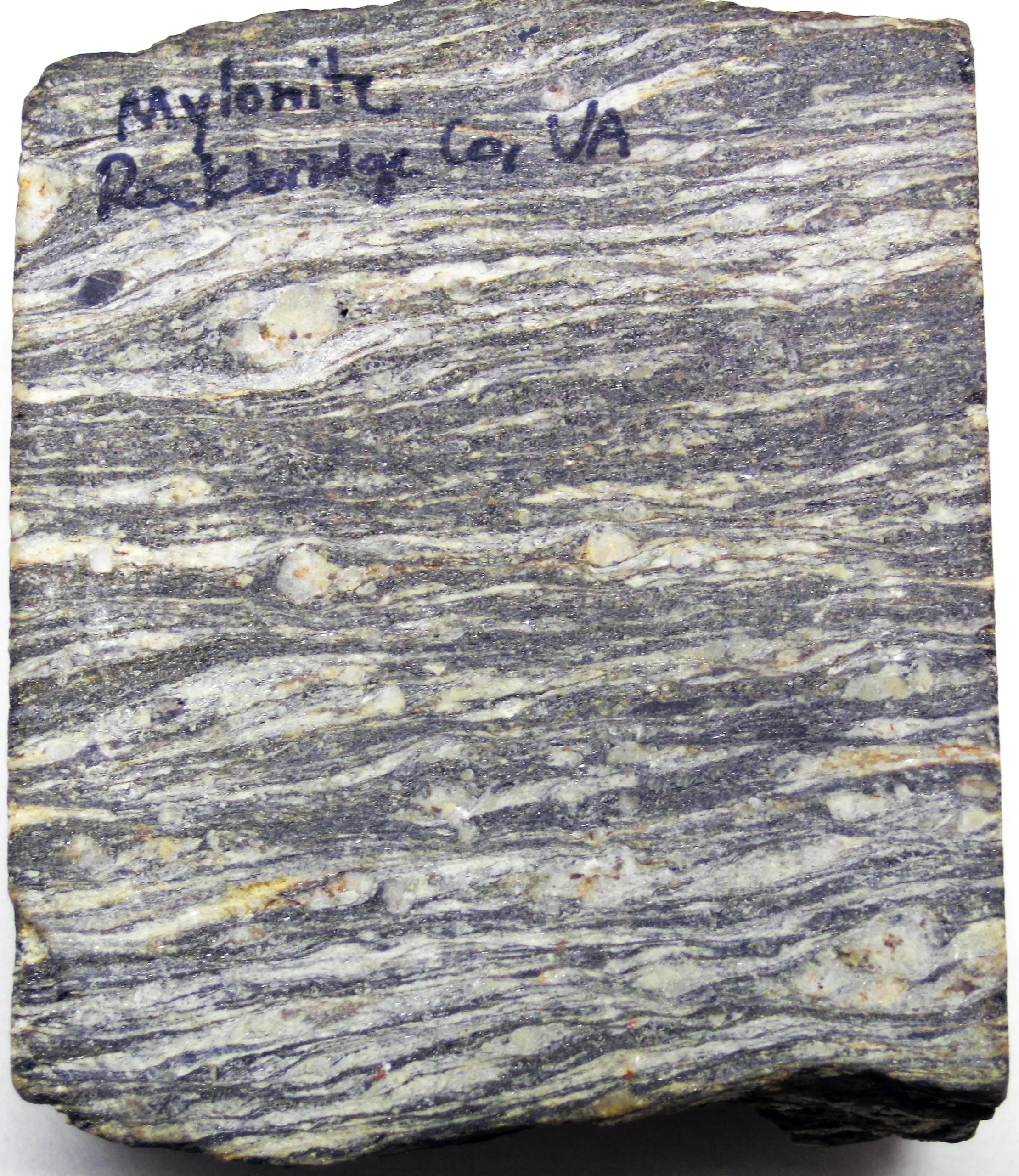
Mylonitization develops where deformation becomes concentrated into a ductile shear zone. At elevated temperature and/or suitable pressure and strain rate, minerals deform by dislocation creep, diffusion-assisted processes and grain-boundary mechanisms rather than simply breaking into angular fragments. Dynamic recrystallization creates new, often smaller grains while the rock is deforming; elongated relic crystals and ribbons can survive inside the finer matrix. Fluids, mineral reactions, inherited fabrics and contrasts in mineral strength all affect the resulting texture. There is no single universal depth or temperature threshold for all mylonites.
Mineral Composition and Parent Rocks
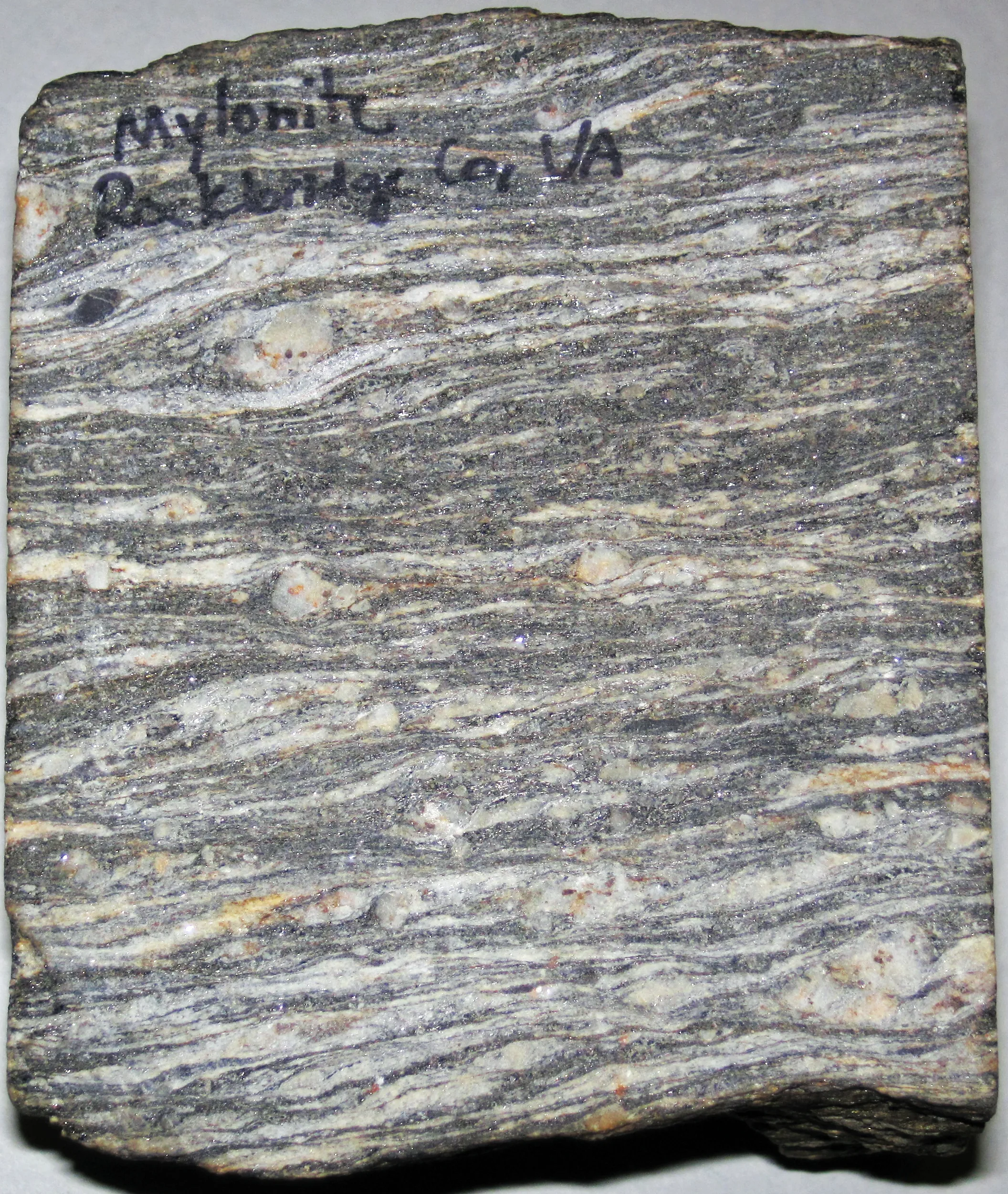
Mylonite is a structural-textural term, not a compositional rock name. A granitic protolith may yield quartz ribbons, feldspar porphyroclasts, mica-rich seams and recrystallized quartz; a mafic protolith can produce amphibole-, plagioclase- or chlorite-bearing fabrics; peridotitic mylonite may preserve olivine and pyroxene deformation microstructures. Chemical alteration can accompany shear, but is not required to define mylonite.
Mylonitic Textures and Microstructures
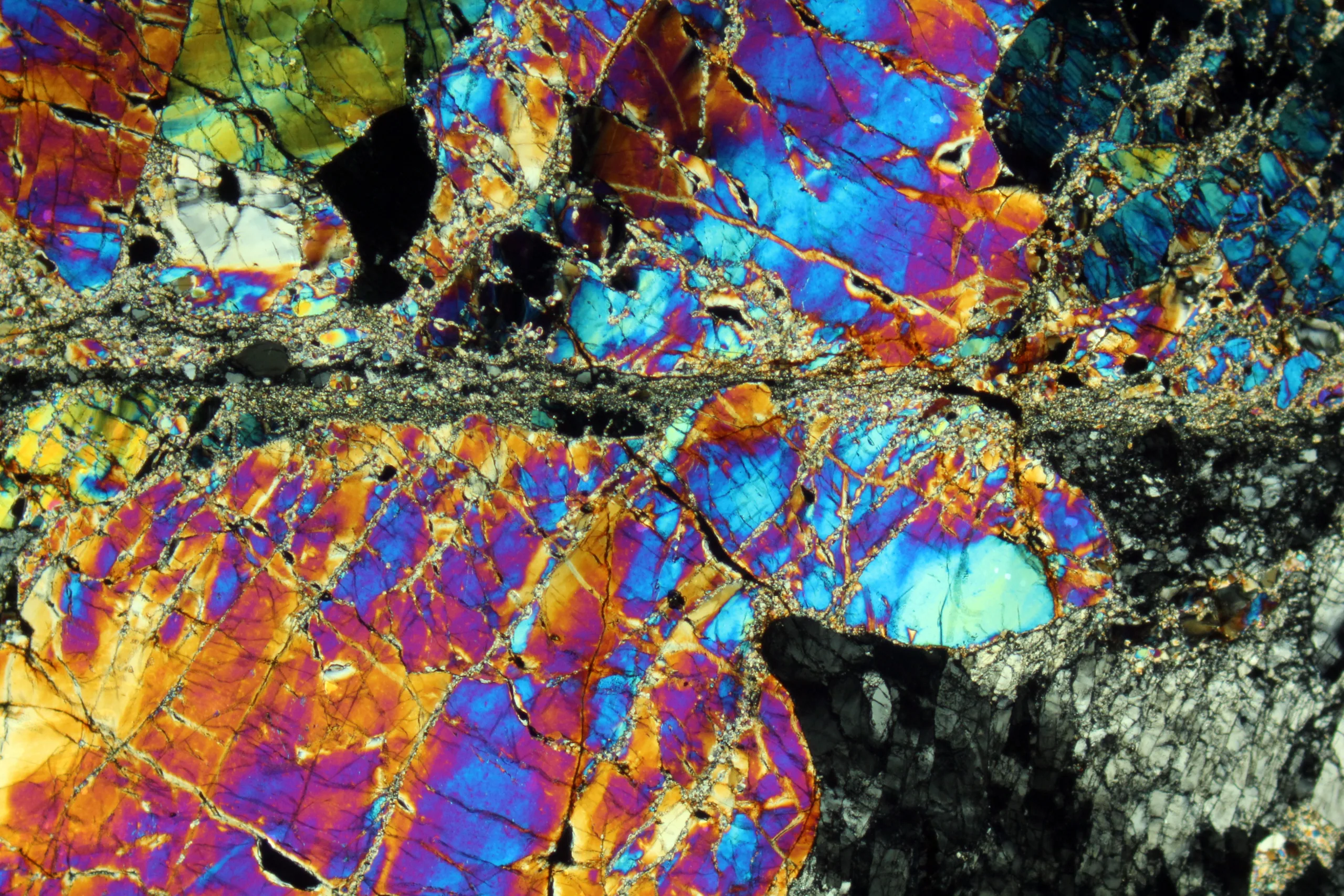
The most diagnostic evidence is microscopic. Common features include dynamically recrystallized grain aggregates, undulose extinction in quartz, subgrains, serrated or migrating grain boundaries, deformation twins in some feldspars, and asymmetric porphyroclast tails. Quartz ribbons can record stretching; mica fish, S–C fabrics and oblique grain-shape fabrics may help infer shear sense. No single indicator is infallible: interpretation requires the correct viewing plane and an understanding of overprinting.
| Feature | Interpretation | Caution |
|---|---|---|
| Quartz ribbons | Strong finite stretching and recrystallization | May be folded or transposed later |
| Fine recrystallized matrix | Grain-size reduction during deformation | Fine grain size alone is not diagnostic |
| Feldspar porphyroclasts | Relics of coarser parent rock | Some tails can be ambiguous |
| S–C fabric | Potential shear-sense marker | Requires correct orientation and context |
Protomylonite, Mylonite and Ultramylonite
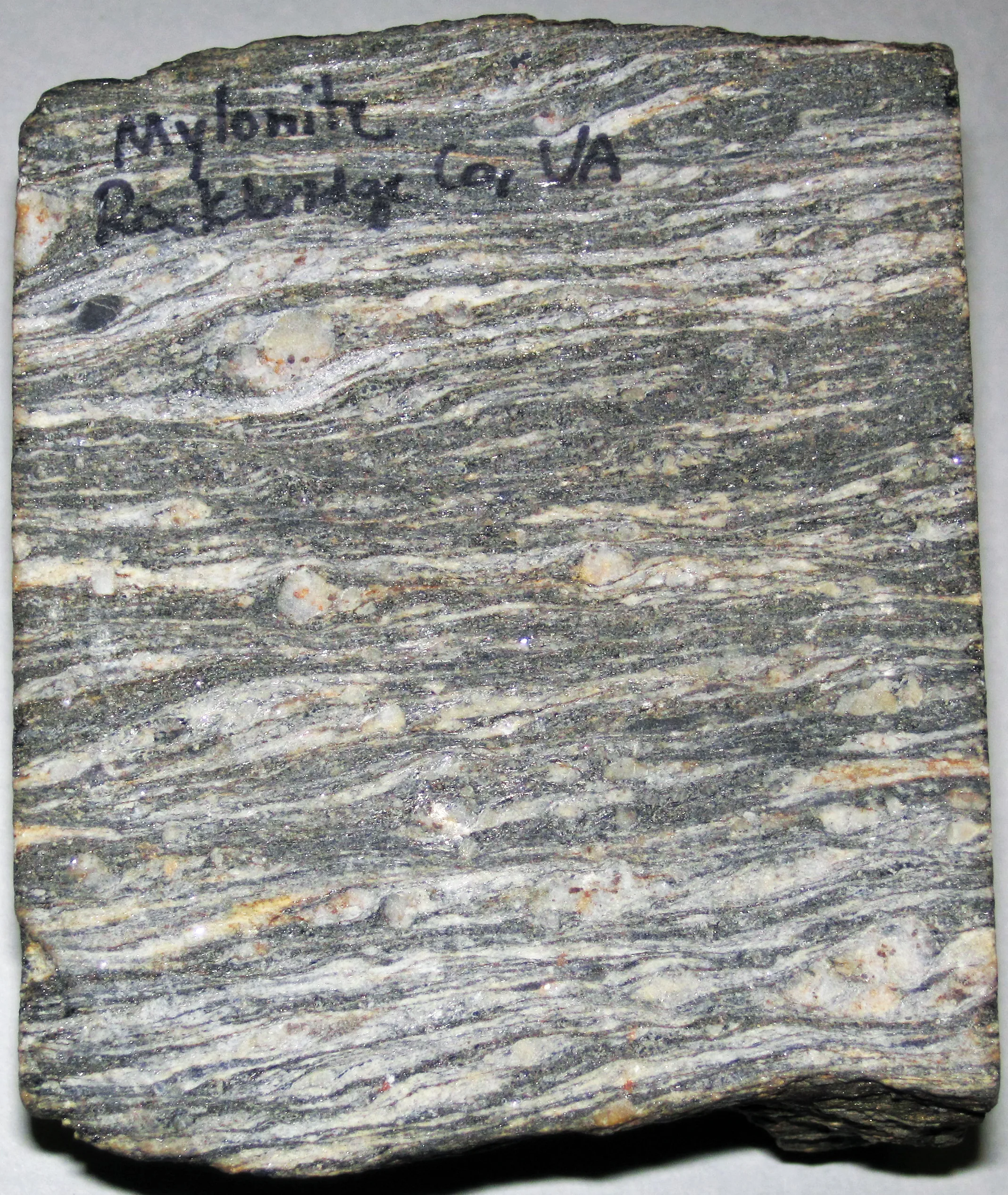
A commonly used descriptive classification considers the proportion of fine-grained matrix generated by deformation. In many schemes, protomylonite contains roughly 10–50% matrix, mylonite 50–90%, and ultramylonite more than 90%. These boundaries are conventions rather than universal mineralogical laws; individual studies may define or measure matrix differently. Blastomylonite describes strongly recrystallized mylonitic material in some historical and regional usages, while phyllonite denotes a mica-rich, phyllitic-looking shear rock.
Where Mylonite Occurs
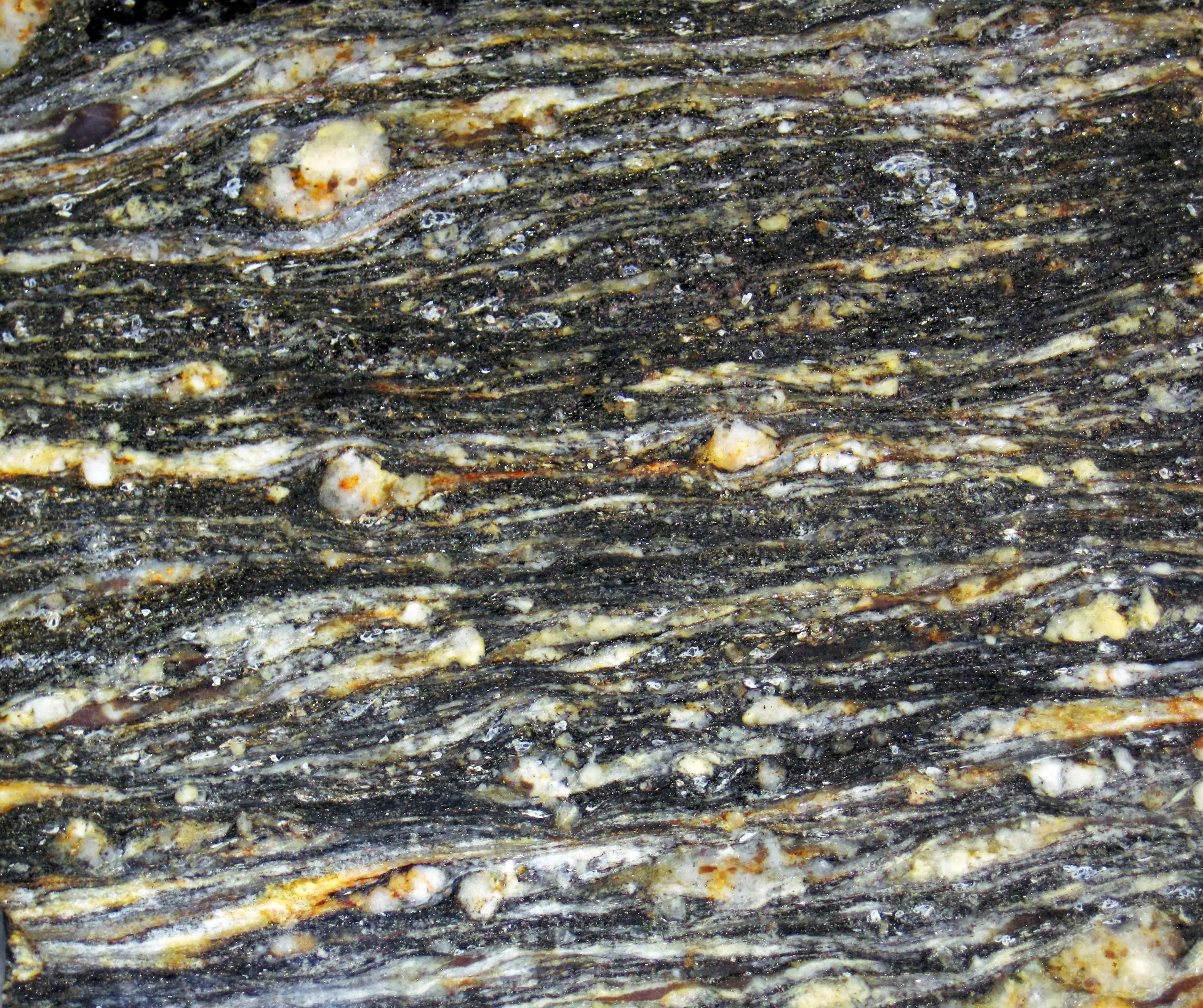
Mylonites occur in localized high-strain zones in continental crust, metamorphic terranes, exhumed fault systems, detachment zones and some mantle shear zones. They commonly form belts ranging from centimeters to kilometers in width. Field geologists map the change from relatively undeformed host rock through progressively stronger foliation into a high-strain core. Such gradients are often more informative than an isolated hand sample.
How to Identify Mylonite in the Field
1. Look for a persistent planar fabric and aligned, stretched mineral bands rather than random layering. 2. Examine quartz or feldspar ribbons and asymmetric larger grains with a hand lens. 3. Compare the specimen with nearby less-deformed host rock. 4. Record foliation and lineation orientation, outcrop context and cross-cutting relationships. 5. Use thin-section petrography to verify crystal-plastic deformation and dynamic recrystallization. A banded hand specimen alone cannot prove a mylonitic origin.
Mylonite vs. Cataclasite, Gneiss and Fault Gouge
| Rock | Dominant diagnostic process | Typical fabric |
|---|---|---|
| Mylonite | Crystal-plastic shear and dynamic recrystallization | Penetrative foliation, ribbons, recrystallized matrix |
| Cataclasite | Brittle fracturing and frictional fragmentation | Angular clasts in crushed matrix |
| Fault gouge | Intense brittle comminution and alteration | Very fine, commonly weak or clay-rich fault material |
| Gneiss | Metamorphic differentiation and deformation | Compositional banding, not necessarily a localized shear-zone fabric |
Natural faults can preserve both brittle and ductile overprints. A mylonite may later be fractured into cataclasite, and a banded gneiss may become mylonitized. Distinguish the processes using textures and cross-cutting relationships rather than color alone.
Why Mylonite Matters
Mylonite documents how rocks accommodate long-lived deformation at depth. Shear-sense indicators, mineral assemblages, recrystallized grain size, crystallographic preferred orientations and geochronology can constrain fault kinematics, pressure–temperature conditions and tectonic history. However, grain-size-based stress estimates require mineral-specific calibrations and assumptions; they should not be inferred from a photograph.
Frequently Asked Questions
Is mylonite an igneous or metamorphic rock?
It is a tectonically deformed metamorphic rock classified primarily by its ductile shear fabric, regardless of whether its original rock was igneous, sedimentary or metamorphic.
Does mylonite form by grinding rocks into powder?
The historical name suggests milling, but most mylonite forms through crystal-plastic deformation and dynamic recrystallization rather than simple brittle grinding.
Can mylonite form from granite?
Yes. Granitic mylonites commonly preserve feldspar porphyroclasts, recrystallized quartz ribbons and mica-rich foliation.
Can a photograph establish shear direction?
Usually not reliably. Shear-sense interpretation depends on sample orientation, viewing plane and multiple microstructural criteria.
Scientific References and Further Reading
Tullis, J. & Yund, R. A. (1985). Dynamic recrystallization of feldspar: A mechanism for ductile shear zone formation. Geology. See also Metamorphic Textures & Fabrics, Metamorphic Petrology, and Faults. Photo credits and individual reuse licenses appear beneath each image.