










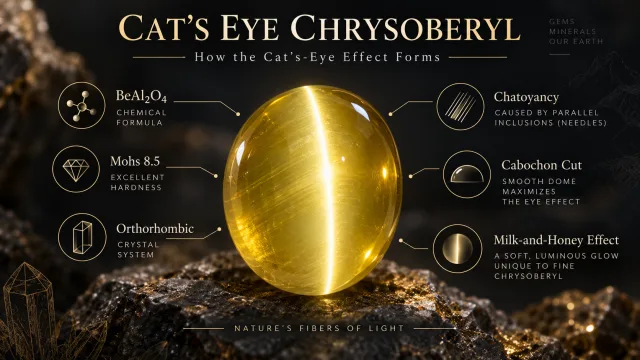
Cat’s eye chrysoberyl is one of the most distinctive phenomenal gemstones in the mineral world.
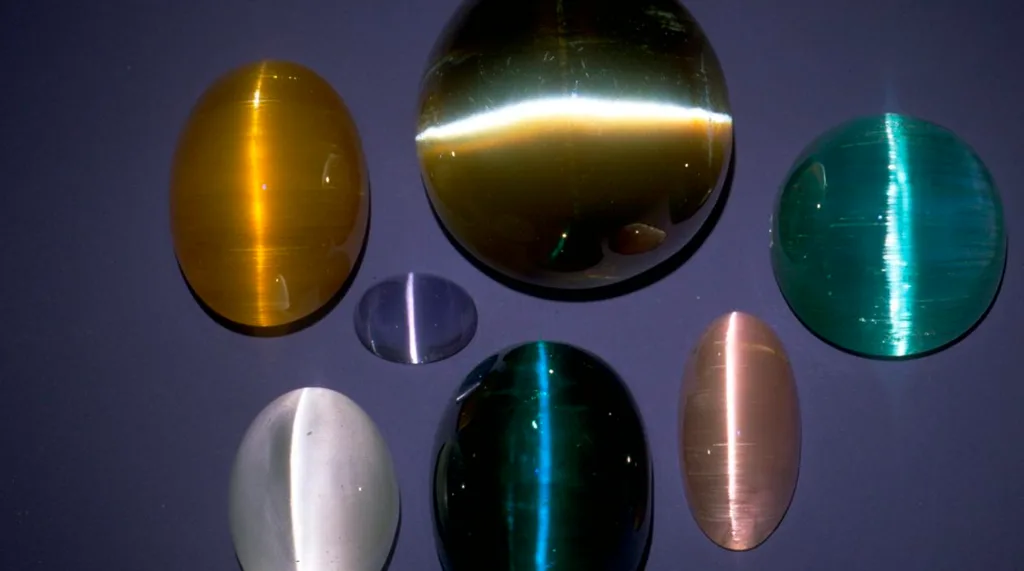
At first glance, the stone may appear yellow, greenish yellow, brownish yellow, or honey-colored. But when a focused light moves across its polished surface, a narrow bright band appears to glide from side to side.
This optical phenomenon is called chatoyancy.
The effect resembles the slit-shaped pupil of a cat, which is why the stone became known as cat’s eye chrysoberyl.
Unlike many gemstone names that describe only color or composition, cat’s eye chrysoberyl owes its identity to a combination of:
- Mineral chemistry
- Internal inclusions
- Crystal orientation
- Cutting style
- Light reflection
The mineral itself is chrysoberyl, with the chemical formula:
BeAl₂O₄
But only chrysoberyl containing the right type and orientation of microscopic inclusions can produce a strong cat’s-eye effect.
Gemologists commonly regard chrysoberyl as producing one of the sharpest and most desirable examples of chatoyancy found in any gemstone.
In gemological usage, chrysoberyl is also the one gem that may traditionally be called simply “cat’s eye” without adding the mineral name. Other chatoyant stones are normally described as quartz cat’s eye, tourmaline cat’s eye, and so on.
What Is Cat’s Eye Chrysoberyl?
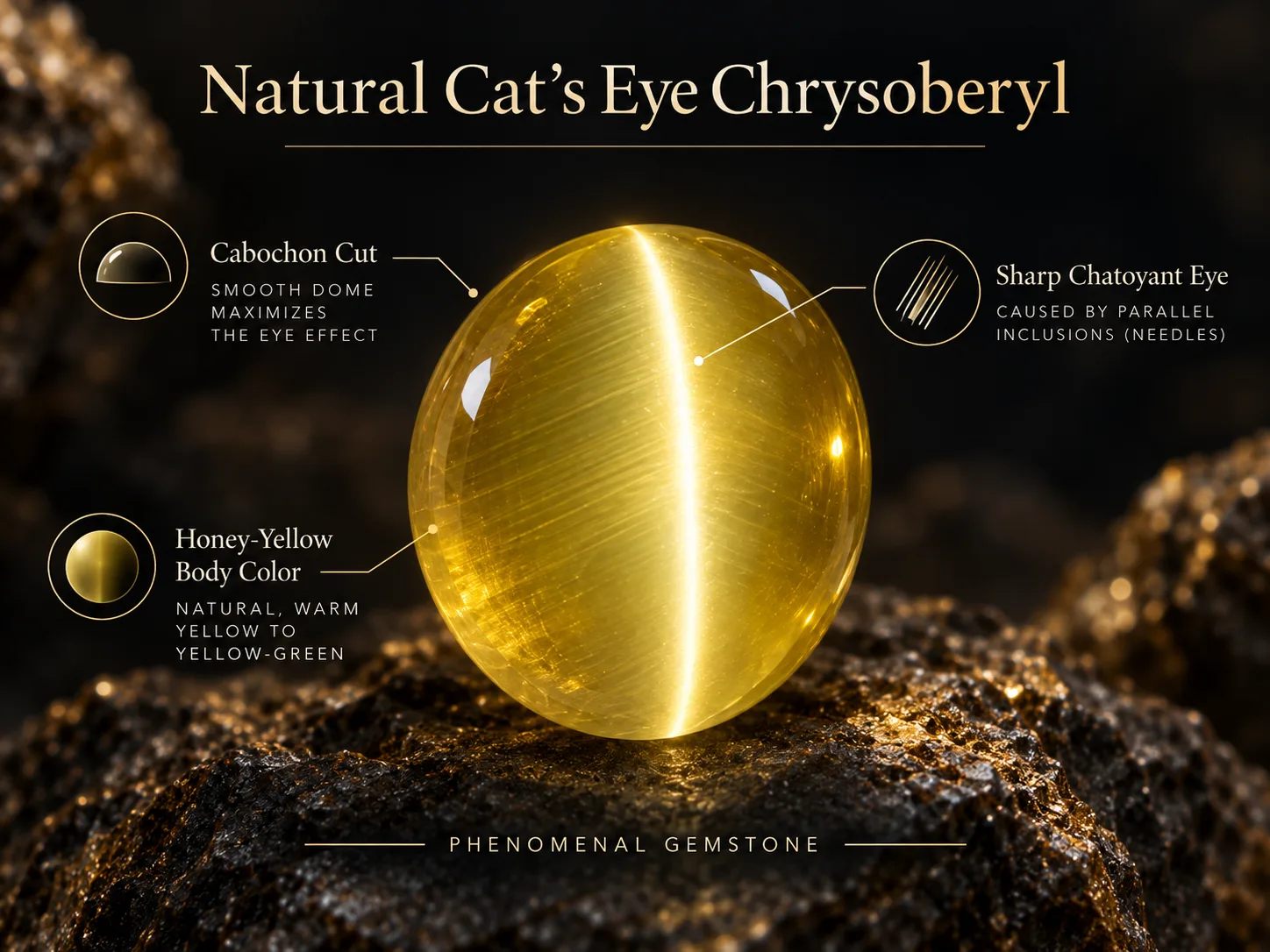
Cat’s eye chrysoberyl is a chatoyant variety of the mineral chrysoberyl.
Chrysoberyl is a beryllium aluminum oxide mineral that crystallizes in the orthorhombic crystal system.
Its ideal chemical formula is:
BeAl₂O₄
It is a remarkably hard gemstone, reaching about 8.5 on the Mohs scale, making it harder than quartz, topaz, and most common gem minerals.
Its specific gravity is around 3.7–3.8.
Typical chrysoberyl can occur in colors including:
- Yellow
- Greenish yellow
- Brownish yellow
- Green
- Brown
- Pale yellow-green
Three gem varieties are especially important:
- Ordinary transparent chrysoberyl
- Alexandrite
- Cat’s eye chrysoberyl
Alexandrite is famous for its color-change effect.
Cat’s eye chrysoberyl is famous for chatoyancy.
What Is Cymophane?
Cat’s eye chrysoberyl is also commonly called cymophane.
The name comes from Greek words associated with a wave-like or floating appearance, referring to the hazy or moving optical effect visible in some specimens.
Cymophane is generally treated as a variety of chrysoberyl showing opalescent or chatoyant behavior.
In modern gemological usage, however, cat’s eye chrysoberyl is usually the clearer and more immediately understandable term.
The mineral composition remains the same:
BeAl₂O₄
The difference lies in the internal structure and inclusions that interact with light.
What Causes the Cat’s-Eye Effect?
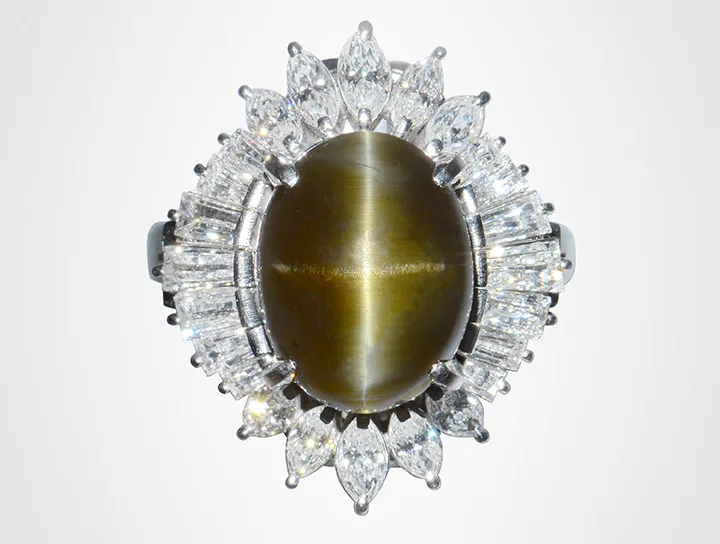
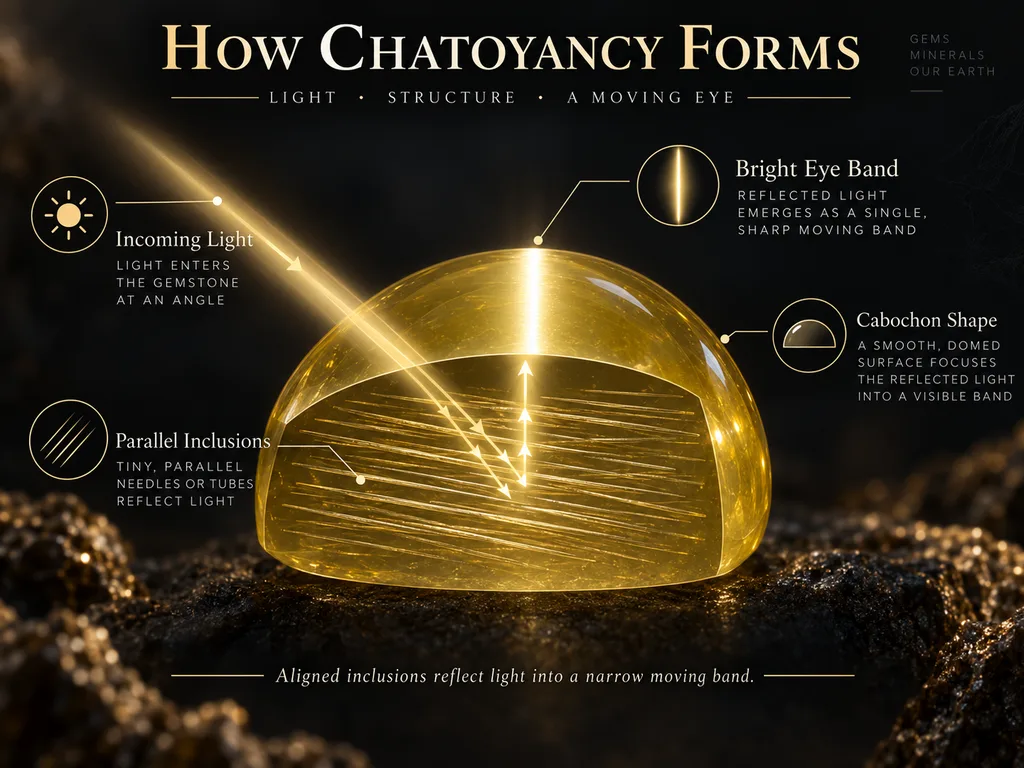
The cat’s-eye effect is caused by chatoyancy.
Chatoyancy occurs when light reflects from large numbers of microscopic inclusions or internal features that are aligned in nearly the same direction.
These can include:
- Fine needle-like inclusions
- Fibrous inclusions
- Microscopic tubes
- Elongated cavities
When these structures are oriented parallel to one another, reflected light becomes concentrated into a narrow bright band.
As either the light source or the gemstone moves, the bright band appears to travel across the surface.
This moving line creates the impression of a cat’s eye.
What Are the Inclusions Inside Cat’s Eye Chrysoberyl?
For many years, the inclusions responsible for chatoyancy in chrysoberyl were broadly described as silk.
Modern microscopic and analytical studies indicate that many fine needle inclusions in natural chrysoberyl are rutile, although other mineral inclusions and microscopic cavities can also contribute.
The important factor is not simply the presence of inclusions.
They must also be:
- Numerous enough
- Very fine
- Closely aligned
- Correctly oriented relative to the cut
Without this alignment, the stone may simply appear cloudy or silky instead of producing a sharp eye.
Why Is Cat’s Eye Chrysoberyl Cut as a Cabochon?
Chatoyant gemstones are generally cut as cabochons rather than faceted stones.
A cabochon has a smooth, rounded, polished upper surface.
This curved surface allows reflected light from the parallel inclusions inside the gemstone to concentrate into a visible line.
For the strongest cat’s-eye effect, the lapidary must orient the stone correctly.
The aligned inclusions must be positioned so that the resulting light band crosses the top of the cabochon clearly.
If the stone is cut at the wrong angle, the eye may become:
- Weak
- Off-center
- Blurred
- Broad
- Nearly invisible
The quality of a cat’s eye therefore depends not only on the original rough stone but also on how accurately it is oriented and cut.
What Makes a Good Cat’s Eye?
The finest cat’s eye chrysoberyl displays a light band that is:
- Sharp
- Narrow
- Bright
- Straight
- Well centered
- Clearly visible under a single light source
As the stone is rotated, the eye should move smoothly across the cabochon.
A weak specimen may show only a diffuse band or broad patch of light.
This difference is important because chatoyancy varies dramatically in strength.
Two stones can have essentially the same mineral composition but very different visual quality depending on the density and orientation of their inclusions.
What Is the Milk-and-Honey Effect?
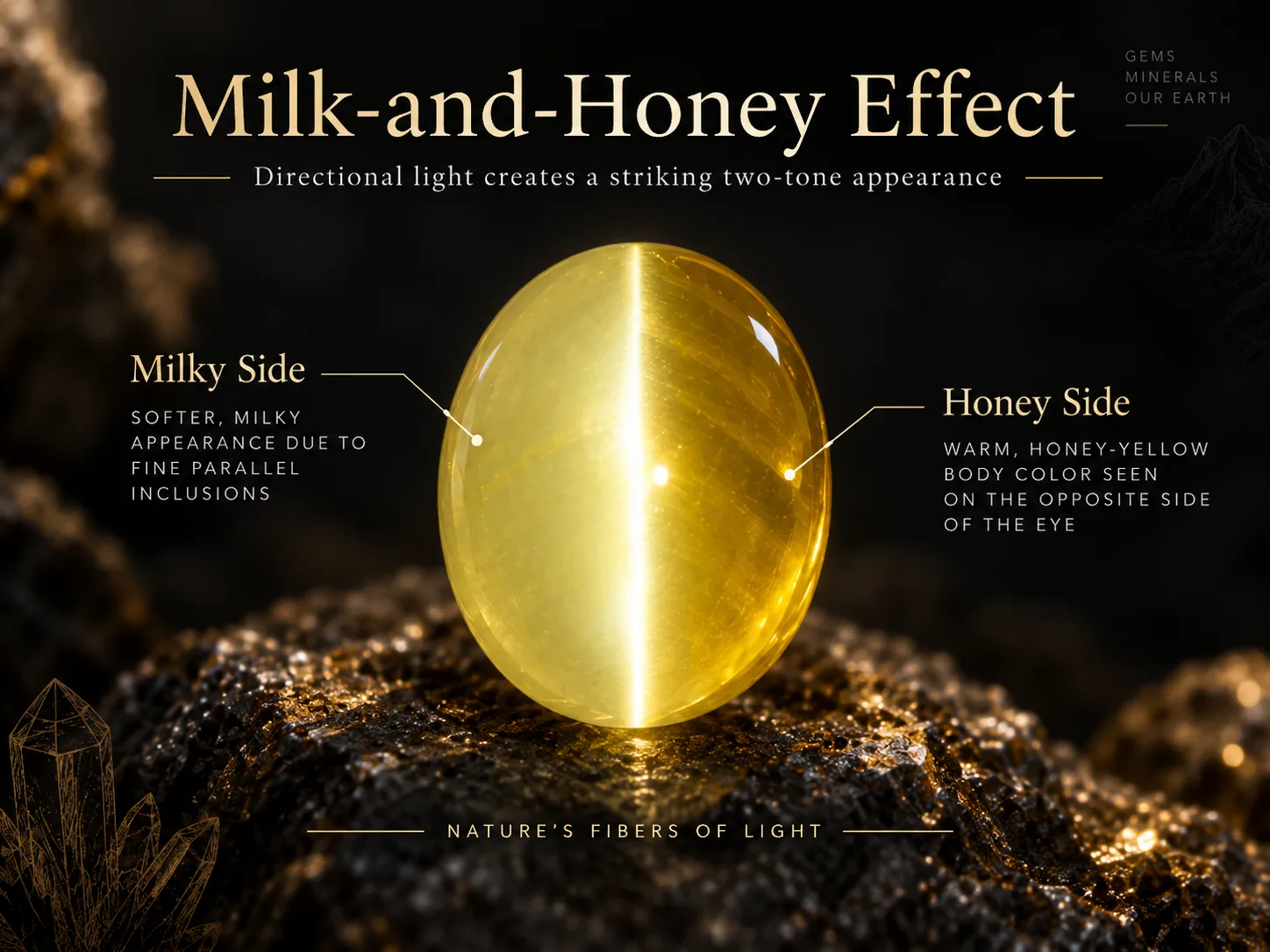
One of the most famous features of fine cat’s eye chrysoberyl is the milk-and-honey effect.
Under directional lighting, the bright eye can divide the gemstone visually into two contrasting halves.
One side may appear:
milky or pale
while the other appears:
warm honey-yellow or brownish yellow
When the stone or light source moves, these contrasting sides may reverse.
This effect is especially prized because it strengthens the visual impression of a living, moving eye.
The milk-and-honey phenomenon is considered one of the classic quality features of fine chrysoberyl cat’s eye.
Cat’s Eye Chrysoberyl Physical Properties
| Property | Cat’s Eye Chrysoberyl |
|---|---|
| Mineral | Chrysoberyl |
| Chemical formula | BeAl₂O₄ |
| Crystal system | Orthorhombic |
| Mohs hardness | About 8.5 |
| Specific gravity | Around 3.7–3.8 |
| Luster | Vitreous |
| Transparency | Transparent to translucent |
| Typical colors | Yellow, greenish yellow, brownish yellow, honey |
| Optical effect | Chatoyancy |
| Typical cut | Cabochon |
| Tenacity | Brittle |
Chrysoberyl’s high hardness makes cat’s eye chrysoberyl more durable than many other phenomenal gemstones.
How Does Chrysoberyl Form?
The geology of chrysoberyl is especially interesting because it requires an unusual chemical combination.
Chrysoberyl contains both:
beryllium and aluminum
Beryllium is relatively uncommon in Earth’s crust and tends to become concentrated in chemically evolved igneous systems, particularly granitic pegmatites.
Chrysoberyl therefore commonly forms in geological environments connected with:
- Granitic pegmatites
- Pegmatite-related reaction zones
- High-grade metamorphic rocks
Two broad geological settings are especially important:
- Deposits related to pegmatitic activity
- Deposits associated with high-grade metamorphism
Chrysoberyl may crystallize directly in pegmatitic systems or form where Be-bearing material reacts with aluminum-rich surrounding rocks.
Chrysoberyl in Pegmatites
Pegmatites are extremely coarse-grained igneous rocks commonly associated with evolved granitic magmas.
During the late evolution of some granitic systems, elements that do not fit easily into early-forming minerals can become concentrated in the remaining melt or associated fluids.
Beryllium is one of these elements.
Under suitable conditions, it can form minerals such as:
- Beryl
- Chrysoberyl
- Phenakite
Chrysoberyl can occur within pegmatites themselves or in reaction zones between pegmatitic material and surrounding rocks.
The exact origin is not identical in every chrysoberyl deposit.
Some occurrences appear strongly magmatic, while others record later metamorphic reactions involving pre-existing beryllium minerals.
Chrysoberyl and Metamorphism
Chrysoberyl can also form during high-grade metamorphism.
It occurs in some amphibolite- and granulite-facies metamorphic environments, where rocks have experienced high temperatures and substantial pressure.
In some metamorphosed pegmatites, chrysoberyl can form through reactions involving minerals such as:
- Beryl
- Feldspar
- Muscovite
- Quartz
This means that chrysoberyl does not always represent simple direct crystallization from magma.
In some cases, it records a more complicated history involving:
- Pegmatite formation
- Beryllium concentration
- Later metamorphism
- Mineral reactions
- Recrystallization
This makes chrysoberyl useful not only as a gemstone but also as evidence of the geological evolution of its host rock.
Why Is Chrysoberyl Often Found in Placer Deposits?
Many gem-quality chrysoberyls are recovered not directly from their original host rocks but from secondary placer deposits.
This happens because chrysoberyl has several properties that help it survive erosion:
- High hardness
- Relatively high density
- Good resistance to chemical weathering
When chrysoberyl-bearing rocks weather, crystals can be released.
Streams and rivers transport the surrounding sediment.
Over time, dense and durable gem minerals can accumulate in gravel layers.
Chrysoberyl may therefore occur in placer deposits alongside minerals such as:
- Sapphire
- Ruby
- Spinel
- Garnet
- Zircon
- Tourmaline
Sri Lanka is especially famous for secondary gem gravels containing chrysoberyl and numerous other gem minerals.
Where Is Cat’s Eye Chrysoberyl Found?
Important chrysoberyl-producing regions include parts of:
- Sri Lanka
- Brazil
- India
- Madagascar
- Tanzania
- Russia
- Australia
Both primary and secondary deposits occur.
Brazil has long been an important source of chrysoberyl, including cat’s-eye material associated with pegmatitic districts.
Sri Lanka is famous for gem-quality chrysoberyl recovered from alluvial gravels derived from high-grade metamorphic terrains.
The geology can therefore differ considerably between deposits.
Cat’s Eye Chrysoberyl vs Ordinary Chrysoberyl
Ordinary chrysoberyl and cat’s eye chrysoberyl have essentially the same basic chemical composition.
The key difference is optical structure.
| Feature | Ordinary Chrysoberyl | Cat’s Eye Chrysoberyl |
|---|---|---|
| Composition | BeAl₂O₄ | BeAl₂O₄ |
| Hardness | ~8.5 | ~8.5 |
| Crystal system | Orthorhombic | Orthorhombic |
| Typical cut | Often faceted | Usually cabochon |
| Parallel inclusions | May be absent or weak | Abundant and aligned |
| Chatoyancy | Usually absent | Strong |
| Appearance | Transparent gem | Moving light band |
The cat’s-eye effect is therefore not caused by a different mineral species.
It is caused by the internal arrangement of inclusions and the way the stone is cut.
Cat’s Eye Chrysoberyl vs Alexandrite
Both gemstones belong to chrysoberyl, but they are known for completely different optical effects.
Cat’s eye chrysoberyl is defined by chatoyancy.
Alexandrite is famous for color change.
Alexandrite contains chromium that produces different perceived colors under different light sources.
Some exceptionally unusual chrysoberyl specimens can show both color change and chatoyancy and may be described as cat’s-eye alexandrite.
These stones combine two phenomenal optical effects in a single gemstone and are exceptionally uncommon.
Why Is Chrysoberyl Cat’s Eye Sharper Than Many Other Cat’s-Eye Gems?
Many gemstones can display chatoyancy.
Examples include:
- Quartz
- Tourmaline
- Apatite
- Scapolite
- Beryl
- Corundum
But chrysoberyl is particularly famous because its fine, dense, strongly oriented inclusions can produce an exceptionally narrow and sharp band of reflected light.
This is why the unqualified term “cat’s eye” traditionally refers to chrysoberyl in gemological usage.
Chatoyancy vs Asterism
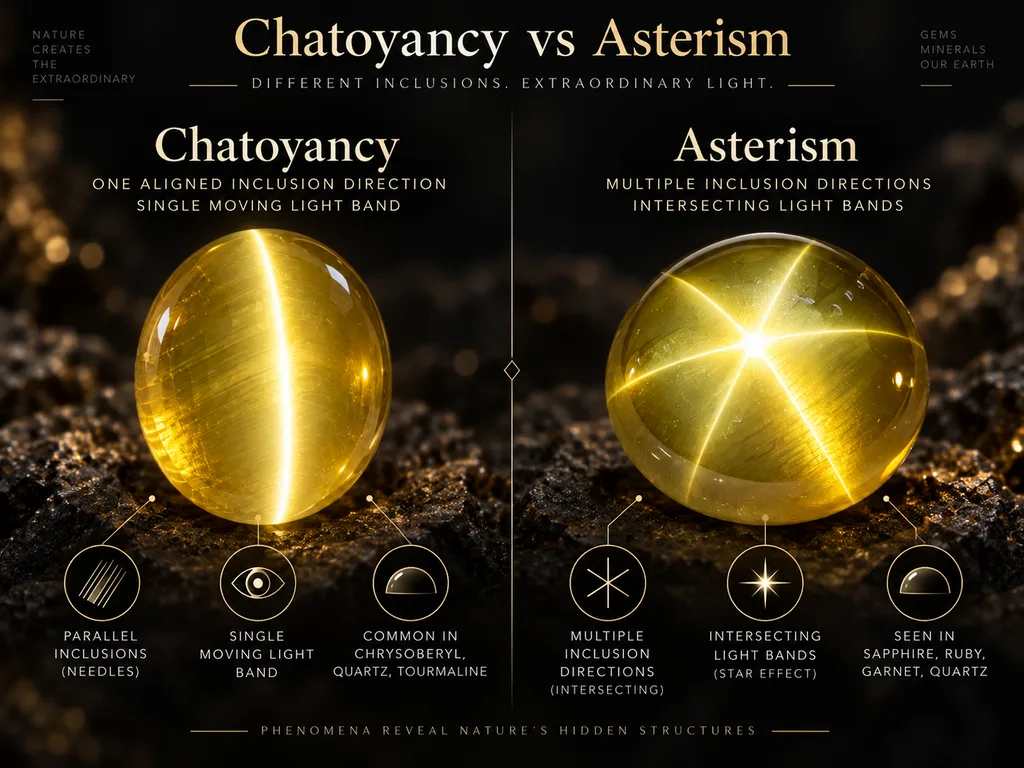
Chatoyancy should not be confused with asterism.
Both effects are produced by oriented internal structures interacting with light.
But their geometry is different.
Chatoyancy
Produces:
one moving band of light
This creates the cat’s-eye effect.
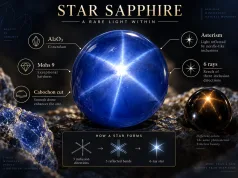
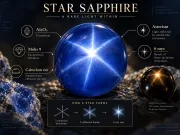
Asterism
Produces:
multiple intersecting bands
These create a star.
Star sapphire and star ruby are famous examples.
Rare chrysoberyl specimens can also display star-like optical effects when inclusions occur in multiple suitable orientations.
Is Cat’s Eye Chrysoberyl Rare?
Fine-quality material is relatively uncommon.
Ordinary chrysoberyl itself is not among the rarest minerals on Earth, but several conditions must occur together to create an exceptional cat’s-eye gemstone.
The crystal must contain:
- A dense population of suitable inclusions
- Strong parallel orientation
- Suitable body color
- Enough transparency or translucency
- Sufficient clean material for cutting
- Correct orientation for a cabochon
A stone with only one of these features may not produce an attractive eye.
The rarity therefore comes from the combination of mineral formation, inclusion development, preservation, and lapidary orientation.
What Determines Cat’s Eye Chrysoberyl Quality?
Several factors influence the visual quality of the gemstone.
Sharpness of the Eye
A narrow, clearly defined line is generally preferred over a broad, blurry band.
Centering
The eye should ideally pass near the center of the cabochon.
Movement
A strong eye should move cleanly as the stone is rotated.
Body Color
Honey-yellow, golden, yellow-green, and related colors can be especially attractive.
Milk-and-Honey Effect
A strong contrasting light and dark division can greatly enhance the appearance.
Transparency
The stone needs enough transparency or translucency for light to interact effectively with its inclusions.
Too many random inclusions can make the gem simply opaque or cloudy.
Is Cat’s Eye Chrysoberyl Durable?
Yes.
With a Mohs hardness of approximately 8.5, chrysoberyl is one of the harder common gemstones.
Only minerals such as:
- Corundum
- Diamond
are significantly harder among widely used gems.
That hardness gives chrysoberyl good resistance to scratching.
However, hardness does not mean indestructibility.
Chrysoberyl is brittle and can still chip or fracture under a strong impact.
Why Is Cat’s Eye Chrysoberyl Geologically Interesting?
The gemstone combines several geological processes in a single object.
Its chrysoberyl crystal records the concentration of unusual elements such as beryllium in igneous or metamorphic systems.
Its inclusions preserve microscopic evidence of conditions during or after crystal growth.
Its placer occurrence can record erosion, transport, and sedimentary concentration.
Its chatoyancy reveals how crystal-scale structures interact with visible light.
So the moving eye is not merely a decorative feature.
It is the visible result of a geological history preserved at microscopic scale.
Frequently Asked Questions
Is cat’s eye chrysoberyl the same as chrysoberyl?
Cat’s eye chrysoberyl is a variety of chrysoberyl. It has the same basic composition, BeAl₂O₄, but contains suitably oriented microscopic inclusions that create chatoyancy.
What causes the cat’s-eye effect?
The effect is caused by reflection from large numbers of parallel microscopic inclusions, fibers, needles, or tubes inside the gemstone.
Is cymophane the same as cat’s eye chrysoberyl?
Cymophane is a traditional name used for opalescent or chatoyant chrysoberyl and is commonly applied to cat’s eye chrysoberyl.
Why is the stone cut as a cabochon?
The curved cabochon surface concentrates reflections from the aligned inclusions into a narrow band of light.
What is the milk-and-honey effect?
It is an optical appearance in fine cat’s eye chrysoberyl where directional light makes one side of the gemstone appear pale or milky and the other side honey-colored.
How hard is cat’s eye chrysoberyl?
About 8.5 on the Mohs scale.
Can other gemstones show a cat’s-eye effect?
Yes. Quartz, tourmaline, apatite, scapolite, beryl, and several other gems can show chatoyancy, but they are normally identified with the mineral name, such as cat’s eye quartz.
Can chrysoberyl show both a cat’s eye and a color change?
Yes. Rare cat’s-eye alexandrite can display both chatoyancy and the alexandrite color-change effect.
Conclusion
Cat’s eye chrysoberyl is an excellent example of how mineralogy, geology, and optics can combine to produce an extraordinary gemstone.
Chemically, it is chrysoberyl:
BeAl₂O₄
Geologically, it can form in pegmatitic and high-grade metamorphic environments where beryllium and aluminum become concentrated under suitable conditions.
Later weathering can release durable chrysoberyl crystals from their host rocks and concentrate them in placer deposits.
But the defining feature of cat’s eye chrysoberyl lies inside the crystal.
Dense, parallel microscopic inclusions interact with light and create a bright moving band known as chatoyancy.
When the gemstone is correctly oriented and cut as a cabochon, that band can become remarkably sharp.
In the finest stones, the effect may be accompanied by the famous milk-and-honey appearance, creating a dramatic contrast across the gem.
So a cat’s eye chrysoberyl is not simply a yellow gemstone with a bright line.
It is the product of several stages of geological and optical history:
mineral formation, inclusion growth, erosion, preservation, cutting, and finally the interaction of light with microscopic structures inside the crystal.
That is what makes the stone scientifically interesting as well as visually unusual.