



Quartz and calcite are two of the most common minerals on Earth, and in some specimens they can be surprisingly easy to confuse.
A colorless crystal growing inside a rock fracture, a white mineral filling a hydrothermal vein, or a transparent specimen in a collection could be quartz, calcite, or sometimes something else entirely.
Mineralogically, however, quartz and calcite are very different.
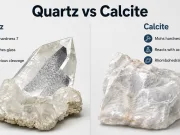
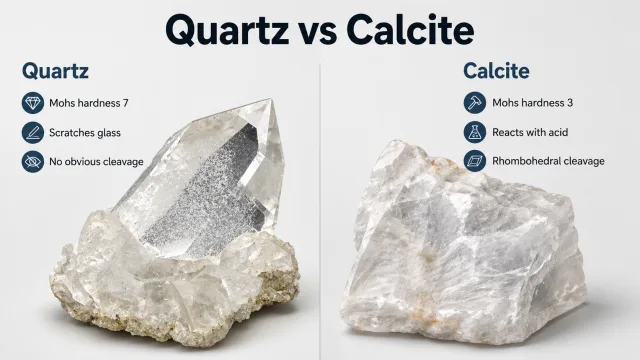
Quartz is made of silicon dioxide (SiO₂) and has a Mohs hardness of 7. Calcite is calcium carbonate (CaCO₃) and has a hardness of only 3.
Three properties are especially useful when trying to tell them apart:
Quartz is much harder.
Calcite reacts strongly with dilute acid.
Calcite has excellent rhombohedral cleavage, while quartz normally breaks with conchoidal fracture rather than showing obvious cleavage.
Once you know what to look for, most typical specimens are not very difficult to separate.
So how can you tell quartz from calcite? Which one scratches glass? Why does calcite fizz in acid? What does cleavage actually look like? And can both minerals occur in the same rock?
What Is Quartz?
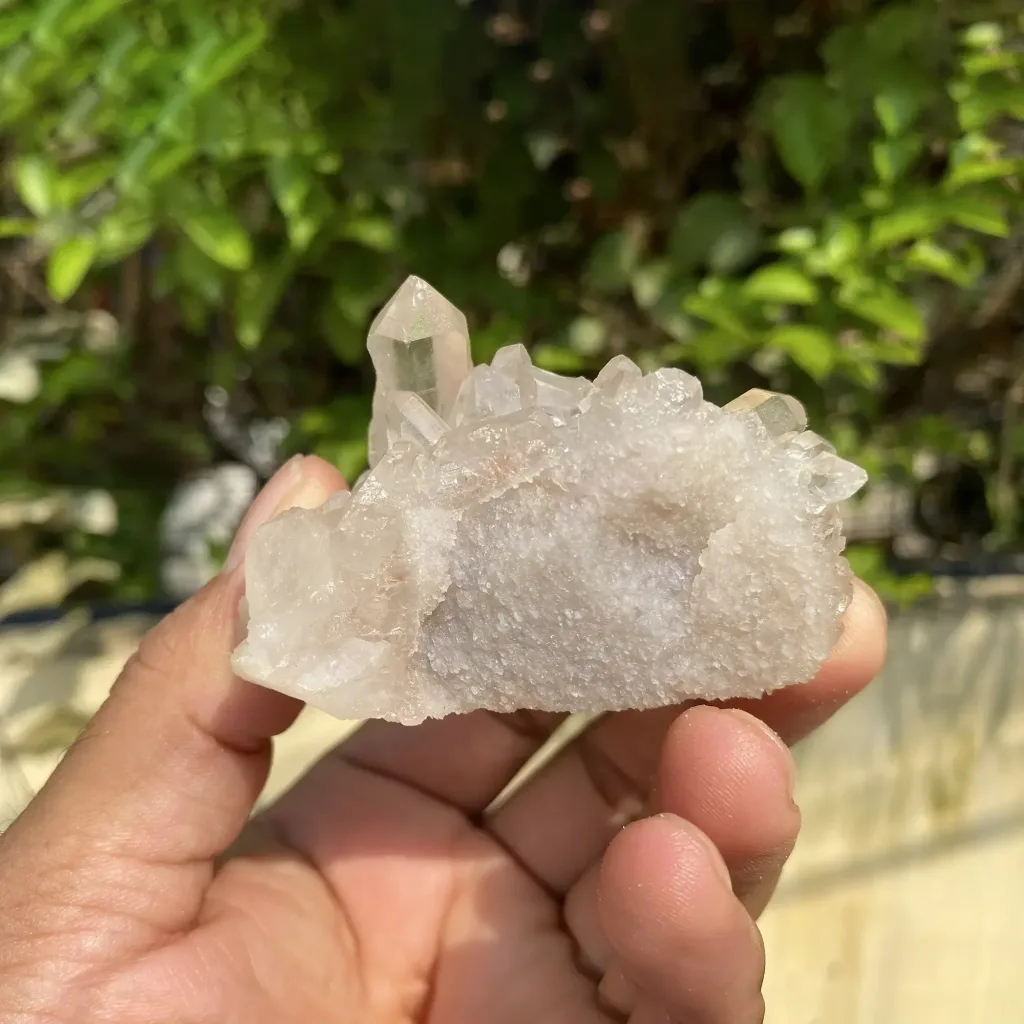
Quartz is one of the most abundant minerals in Earth’s continental crust.
Its chemical formula is:
SiO₂
meaning that its structure is built from silicon and oxygen.
Quartz forms in a very wide range of geological environments. It occurs in:
- granitic and other silica-rich igneous rocks,
- metamorphic rocks,
- hydrothermal veins,
- pegmatites,
- sedimentary rocks,
- sand and sandstone.
Quartz is also very resistant to weathering.
When granite breaks down, feldspar and some other minerals may eventually alter into clay minerals, while quartz grains can survive much longer.
This is one reason quartz is so common in beach sand, river sediment, and sandstone.
When quartz has enough open space to grow freely, it often develops characteristic prismatic crystals. Well-formed crystals commonly have a six-sided appearance with pointed terminations.
Quartz is not always colorless.
Many familiar mineral and gemstone varieties belong to the quartz family, including:
- amethyst,
- citrine,
- rose quartz,
- smoky quartz,
- rock crystal.
Although their appearance may be very different, their main mineral composition is still SiO₂.
What Is Calcite?
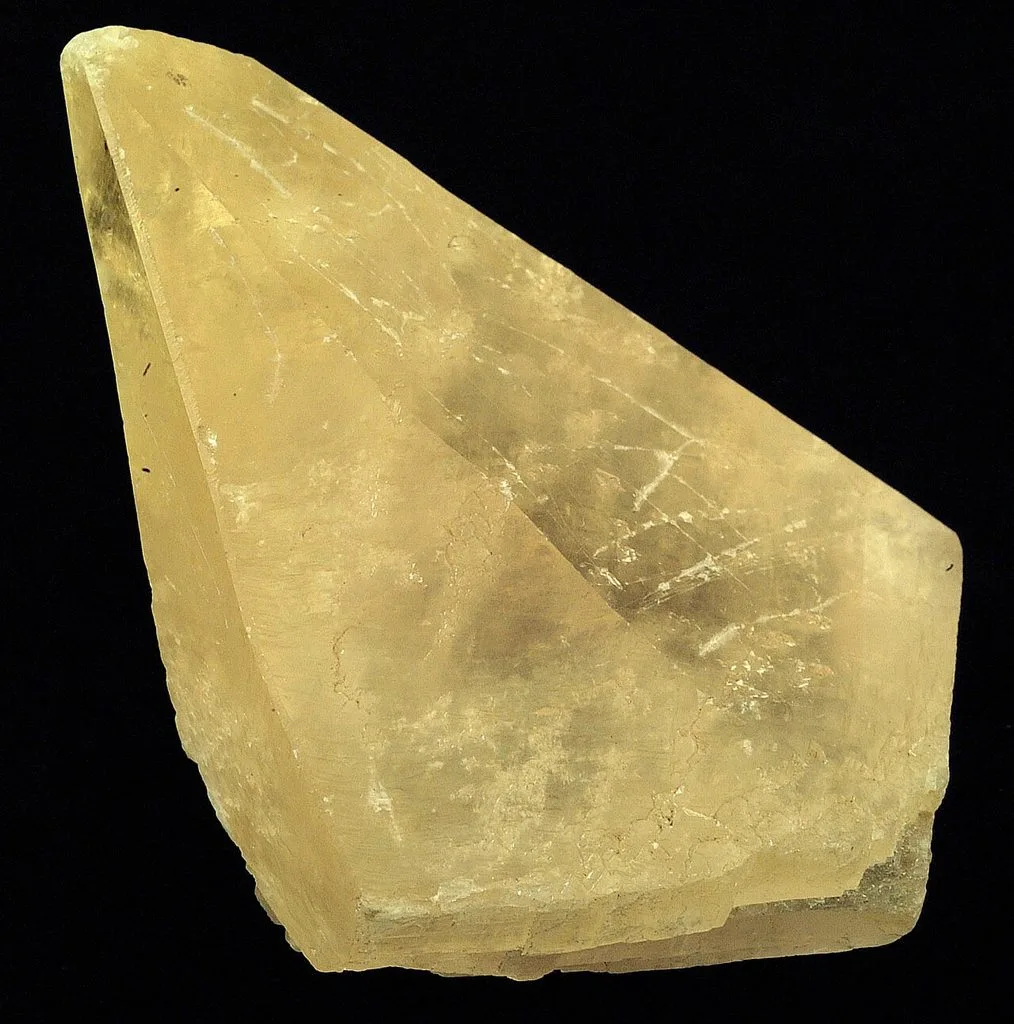
Natural calcite crystal showing characteristic cleavage and crystal formCalcite is a calcium carbonate mineral with the chemical formula:
CaCO₃
It is one of the most important carbonate minerals on Earth and is the main mineral in many limestones.
When limestone undergoes metamorphism and recrystallizes into marble, calcite commonly remains a major component.
Calcite can also occur in:
- hydrothermal veins,
- caves,
- hot spring deposits,
- marine sediments,
- biological shells and skeletal material.
Many classic cave formations, including stalactites and stalagmites, are made largely of calcite.
Calcite can form an unusually wide variety of crystal shapes. One of its most useful identification features, however, is its excellent rhombohedral cleavage.
When calcite breaks along its cleavage planes, it can produce fragments shaped like tilted boxes, or rhombohedrons, rather than cubes.
This makes it quite different from quartz.
A particularly clear variety of calcite known as Iceland spar is also famous for strong double refraction.
Quartz vs Calcite: Key Differences
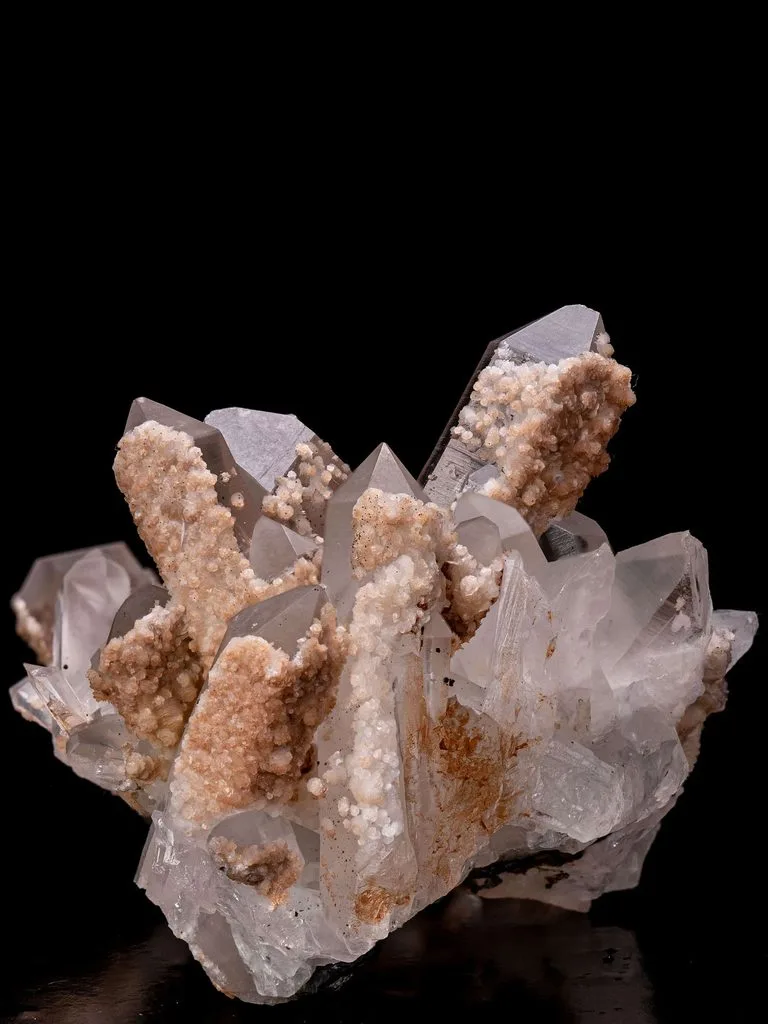
| Feature | Quartz | Calcite |
|---|---|---|
| Chemical formula | SiO₂ | CaCO₃ |
| Main mineral family | Silica mineral | Carbonate mineral |
| Mohs hardness | 7 | 3 |
| Scratches ordinary glass? | Usually yes | No |
| Cleavage | No prominent cleavage used in hand identification | Perfect rhombohedral cleavage |
| Typical breakage | Commonly conchoidal fracture | Commonly breaks along cleavage planes |
| Reaction with dilute HCl | No visible fizzing | Strong effervescence |
| Common crystal form | Prismatic, commonly six-sided | Rhombohedral, scalenohedral, and other forms |
| Strong visible double refraction | Usually not obvious by eye | Common in clear calcite |
| Common rock associations | Granite, quartzite, sandstone, veins | Limestone, marble, caves, veins |
Notice that color is not one of the best differences.
Both minerals can be:
- colorless,
- white,
- yellowish,
- brownish,
- transparent,
- translucent.
Color alone is often a poor way to identify minerals.
How Can You Tell Quartz from Calcite?
Instead of depending on a single property, it is better to check several features together.
A useful order is:
hardness → cleavage or fracture → crystal form → acid reaction if needed
This also helps avoid unnecessary damage to a good specimen.
1. Hardness: Quartz Is Much Harder Than Calcite
One of the clearest physical differences is hardness.
On the Mohs scale:
Calcite = 3
Quartz = 7
That is a large difference.
Quartz is harder than ordinary window glass, which is usually around 5 to 5.5 on the Mohs scale. A quartz point or fresh edge can therefore leave a real scratch on glass.
Calcite is much softer.
It normally cannot scratch glass and can itself be scratched much more easily than quartz.
This makes hardness one of the most useful field tests when crystal shape is unclear.
There is one small problem, though.
A mineral may leave powder on the glass that looks like a scratch.
A real scratch is a physical groove in the glass. If the mark can simply be wiped away with your finger, it was probably only mineral powder.
Also remember that a rock may contain more than one mineral.
If a piece of limestone contains a small quartz grain, that grain may scratch the glass even though most of the specimen is calcite.
2. Why Does Calcite Fizz in Acid?
One of calcite’s most characteristic properties is its reaction with dilute acid.
Calcite contains calcium carbonate.
When dilute hydrochloric acid contacts a fresh calcite surface, a chemical reaction releases carbon dioxide gas.
The escaping gas appears as visible bubbles.
This reaction is called effervescence.
On fresh calcite, the reaction with dilute hydrochloric acid is usually immediate and obvious.
Quartz does not behave this way under the same field-test conditions because it is composed of SiO₂ rather than calcium carbonate.
This is why geologists commonly carry dilute hydrochloric acid when identifying carbonate rocks and minerals.
Weak household acids such as vinegar can sometimes produce a reaction with calcite, but it may be much slower and harder to see.
So:
“It did not fizz with vinegar, therefore it must be quartz”
is not a very reliable conclusion.
A properly performed dilute HCl test gives a much clearer result.
3. Cleavage: One of the Best Visual Clues
Quartz and calcite also break differently.
Calcite
Calcite has excellent cleavage in three directions.
These directions do not meet at 90-degree angles.
As a result, broken calcite often produces characteristic rhombohedral fragments.
If a specimen repeatedly breaks into pieces with smooth, flat surfaces meeting at similar sloping angles, calcite should be considered.
Quartz
Quartz does not show the strong, obvious cleavage seen in calcite.
Instead, it commonly breaks with conchoidal fracture.
A fresh quartz fracture can look curved and shell-like, somewhat similar to broken glass.
This is especially obvious in clear or massive quartz.
So while both minerals may show shiny flat-looking surfaces, the reason for those surfaces can be very different.
Cleavage and Crystal Faces Are Not the Same Thing
This is an easy mistake to make.
A mineral having flat surfaces does not automatically mean those surfaces are cleavage planes.
Crystals naturally grow with flat crystal faces.
A well-formed quartz crystal, for example, has many smooth external faces.
That does not mean quartz has good cleavage.
Cleavage describes the tendency of a mineral to repeatedly break along particular planes controlled by its internal atomic structure.
Calcite shows this extremely well.
Quartz generally does not.
4. Can Crystal Shape Help?
Yes, especially when the crystals are well developed.
Quartz commonly forms elongated prismatic crystals.
Typical features include:
- a roughly six-sided prism,
- pointed terminations,
- a relatively long crystal body.
Calcite is much more variable.
It may form:
- rhombohedral crystals,
- scalenohedral crystals,
- tabular crystals,
- many complex combinations.
The sharp, pointed calcite habit commonly called dogtooth calcite can look very different from ordinary quartz.
Still, crystal shape should not be used alone.
Natural crystals may be:
- broken,
- weathered,
- coated with other minerals,
- poorly formed because they had little room to grow.
Hardness and cleavage are usually more dependable.
Why Can Clear Calcite Make an Image Look Double?
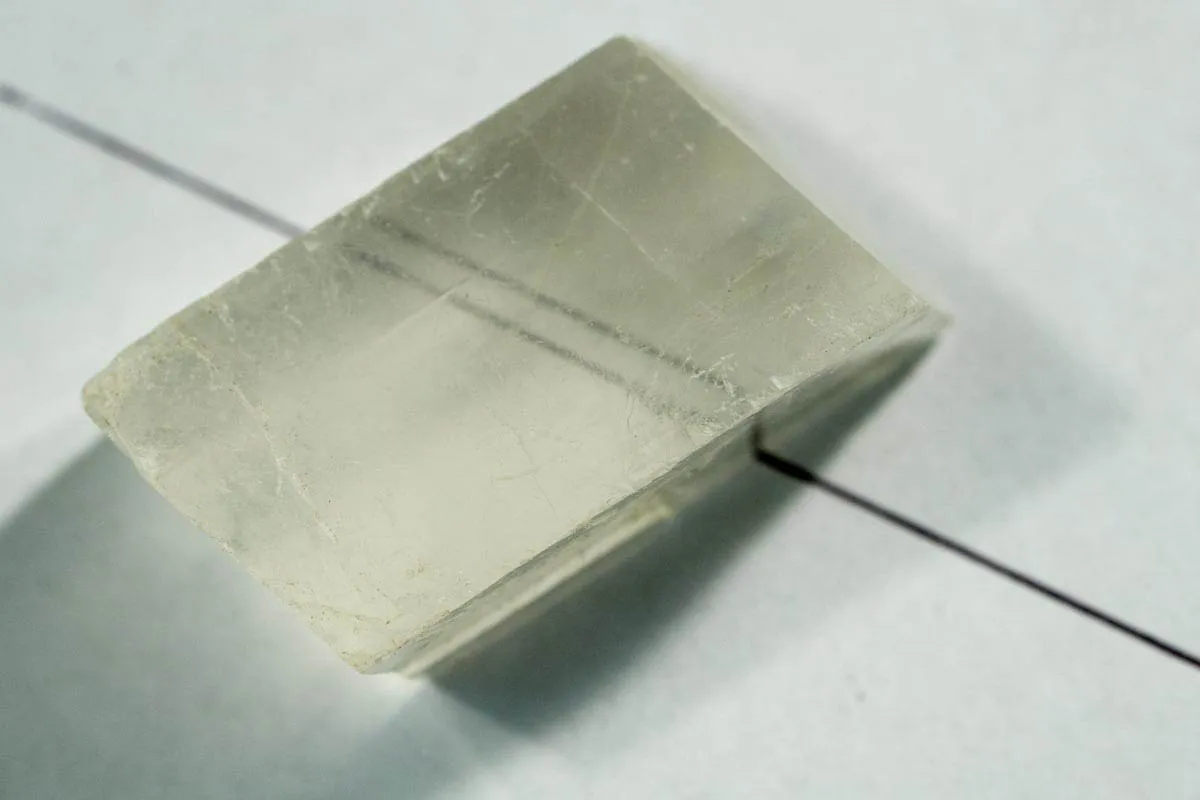
One of the most interesting properties of clear calcite is double refraction.
If you place a transparent piece of Iceland spar over a printed line or text, you may see two images instead of one.
This happens because light traveling through the calcite crystal can split into two rays that travel differently through the crystal.
The optical property responsible for this is called birefringence.
Calcite has exceptionally strong birefringence.
Quartz is also birefringent, but its effect is much weaker. In an ordinary hand specimen, it normally does not create the dramatic double image that clear calcite can show.
So if a transparent crystal clearly doubles the image beneath it, calcite becomes a very strong possibility.
Does Calcite Scratch Glass?
Normally, no.
Calcite has a Mohs hardness of 3, while ordinary glass is much harder.
If a mineral thought to be calcite easily produces a real scratch in glass, its identification should be questioned.
Quartz is one possible alternative.
But again, mixed specimens can cause confusion.
A calcite vein may contain small quartz crystals, and one of those harder grains could be responsible for the scratch.
This is why testing a clean, known part of the specimen matters.
Why Can Quartz Scratch Glass?
Quartz has a Mohs hardness of 7.
That makes it harder than ordinary glass.
A fresh quartz edge can therefore cut a genuine groove into a glass surface.
This property is useful in field identification and also tells us something about why quartz grains survive weathering so well.
But hardness should not be confused with toughness.
Quartz is hard, meaning it resists scratching.
It is still brittle and can break if struck.
A hard mineral is not necessarily an unbreakable mineral.
Does Quartz React with Acid?
Under ordinary mineral-identification conditions, quartz does not fizz with dilute hydrochloric acid the way calcite does.
That makes the acid test very useful when comparing these two minerals.
However, acid reaction alone does not identify every white mineral.
Other carbonate minerals can also react with acid.
Dolomite, for example, can react more weakly, particularly when powdered.
So mineral identification is stronger when several properties agree:
- hardness,
- cleavage,
- crystal habit,
- acid reaction.
A single test should rarely be treated as the whole answer.
Can Quartz and Calcite Occur in the Same Rock?
Yes.
They can even occur together in the same mineral vein.
This is especially common in hydrothermal systems.
Hot, mineral-rich fluids move through fractures in rock. As temperature, pressure, and chemistry change, different minerals can precipitate at different stages.
A hydrothermal vein may contain combinations of:
- quartz,
- calcite,
- sulfide minerals,
- fluorite,
- barite.
So when looking at a white vein, it is not safe to assume the entire vein is one mineral.
One section may be quartz while another is calcite.
Sometimes the two grow directly against each other.
Where Are Quartz and Calcite Commonly Found?
Their geological settings overlap in some places, but each mineral also has environments where it is especially common.
Where Is Quartz Common?
Quartz occurs frequently in:
- granite,
- rhyolite,
- pegmatite,
- quartzite,
- sandstone,
- hydrothermal veins.
Quartz-rich sandstone can consist mainly of quartz grains, while quartzite may be composed almost entirely of recrystallized quartz.
Where Is Calcite Common?
Calcite is especially common in:
- limestone,
- marble,
- travertine,
- cave deposits,
- carbonate veins,
- some hydrothermal systems.
Knowing the host rock can therefore provide a useful clue.
White crystals filling a fracture in limestone are often calcite.
Well-formed prismatic crystals inside a granitic pegmatite are more likely to be quartz.
These are useful clues, not absolute rules.
Is a White Vein in Limestone Quartz or Calcite?
It can be either.
Fractures in limestone can be filled by mineral-rich fluids.
Calcite is extremely common because limestone itself is rich in calcium carbonate.
But silica-rich fluids can also deposit quartz in fractures within carbonate rocks.
The safest approach is still to examine the mineral itself.
Calcite is:
- softer,
- strongly cleavable,
- reactive with dilute acid.
Quartz is:
- harder,
- normally lacks obvious cleavage,
- does not fizz with dilute HCl.
Color alone does not solve the problem.
The Fastest Way to Identify Quartz vs Calcite in the Field
If you find an unknown pale or transparent mineral, a simple sequence works well.
1. Look at the crystal and broken surfaces
Repeated rhombohedral cleavage surfaces suggest calcite.
A well-formed six-sided prismatic crystal suggests quartz.
2. Test hardness
If it genuinely scratches glass, quartz is more likely.
If it is easily scratched and cannot scratch glass, calcite becomes more likely.
3. Use acid only if necessary
Strong bubbling on a fresh surface with dilute hydrochloric acid is excellent evidence for calcite.
No visible reaction makes quartz more likely, but other properties should still be checked.
In many ordinary hand specimens, these three steps are enough.
Why Are Quartz and Calcite So Often Confused?
Because color is less useful in mineral identification than people expect.
Both minerals can be:
- white,
- colorless,
- transparent,
- translucent,
- glassy.
Both can also fill fractures and veins.
If the crystals are small, broken, or poorly developed, their characteristic shapes may not be obvious at all.
But once physical properties are tested, the difference becomes much clearer.
Quartz and calcite are a good example of one of the basic rules of mineral identification:
Do not trust color alone.
Frequently Asked Questions
Which is harder, quartz or calcite?
Quartz is much harder. Quartz has a Mohs hardness of 7, while calcite has a hardness of 3.
Can calcite scratch glass?
Normally, no. Calcite is considerably softer than ordinary glass.
Can quartz scratch glass?
Yes. Quartz is harder than ordinary glass and can usually produce a genuine scratch.
Why does calcite fizz in acid?
Calcite contains calcium carbonate. When it reacts with acid, carbon dioxide gas is released, producing visible bubbles.
Does quartz fizz in acid?
Not under the dilute hydrochloric acid test normally used for mineral identification.
Can quartz and calcite occur in the same vein?
Yes. Both minerals can precipitate from hydrothermal fluids and may occur together in the same vein.
Does quartz have cleavage?
Quartz does not show the prominent cleavage used to identify calcite. In hand specimens it usually breaks with conchoidal fracture.
Does calcite have cleavage?
Yes. Calcite has excellent rhombohedral cleavage in three directions.
Why does clear calcite show a double image?
Calcite has very strong birefringence. Light passing through the crystal splits into two rays, which can make an object beneath it appear doubled.
Can quartz and calcite be identified from a photo?
Sometimes crystal shape gives a useful clue, but a photograph alone is not always enough. Hardness, cleavage, and acid reaction are much more reliable for identification.
Final Thoughts
Quartz and calcite can look surprisingly similar, but their physical and chemical properties are very different.
Quartz is a hard SiO₂ mineral with a Mohs hardness of 7. It can scratch glass and commonly breaks with conchoidal fracture.
Calcite is CaCO₃, has a hardness of 3, shows excellent rhombohedral cleavage, and reacts readily with dilute acid.
So when you find a white or transparent crystal, color is not the best place to start.
Ask instead:
Can it scratch glass?
Does it break along repeated flat cleavage surfaces?
Does it fizz when tested with dilute acid?
When those properties are considered together, the difference between quartz and calcite is usually much easier to see.
And that leads to one of the most useful habits in mineral identification:
Pay less attention to what a mineral looks like at first glance, and more attention to how it behaves.
References
- Mindat.org — Quartz: Mineral Information, Data and Localities. Formula SiO₂, Mohs hardness 7, vitreous luster, characteristic conchoidal fracture, and common crystal habits.
- Mindat.org — Calcite: Mineral Information, Data and Localities. Formula CaCO₃, Mohs hardness 3, rhombohedral cleavage, acid reactivity, and optical properties.
- MIT OpenCourseWare — 12.001 Introduction to Geology: Mineral Identification Guide. Laboratory identification criteria including calcite reaction with hydrochloric acid, rhombohedral cleavage, double refraction, and quartz conchoidal fracture.