























Water is a geological agent that transfers heat, transports sediment and dissolved substances, reacts with minerals and changes the mechanical behavior of rocks and soils. From surface erosion to mineral deposits and deep mantle melting, water connects the hydrologic cycle with the rock cycle. Its effects depend on temperature, pressure, chemistry, flow and the properties of the surrounding geological materials.
Weathering and landscape evolution
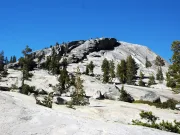
Water is a polar solvent and a physical agent of rock breakdown. Rainwater absorbs carbon dioxide from the atmosphere and soil, producing weak carbonic acid. Hydrolysis alters feldspars to clay minerals, while dissolution removes soluble minerals such as calcite and halite. Repeated freezing and thawing can widen water-filled fractures where conditions permit ice growth. Weathering breaks down material in place; erosion removes and transports it.
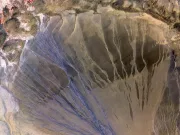
Rivers entrain sediment when flow exerts sufficient force on the bed. Sand and gravel abrade bedrock, while dissolved ions and suspended particles travel downstream. Changes in discharge, slope and sediment supply determine whether a reach erodes or accumulates sediment. The Colorado River and its tributaries illustrate how incision, uplift and rock resistance interact to produce deep canyons.
Karst and carbonate dissolution
In limestone, carbon dioxide-rich water dissolves calcium carbonate through the reversible reaction CaCO₃ + CO₂ + H₂O ⇌ Ca²⁺ + 2HCO₃⁻. Enlargement of fractures can create caves, sinkholes and underground drainage networks. When cave water loses carbon dioxide, calcite may precipitate as stalactites and stalagmites. The same water-rock system can therefore both remove and deposit rock.
Groundwater and the hydrologic cycle
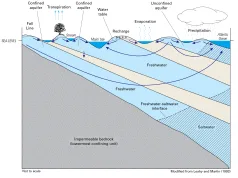
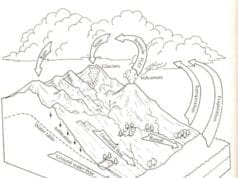
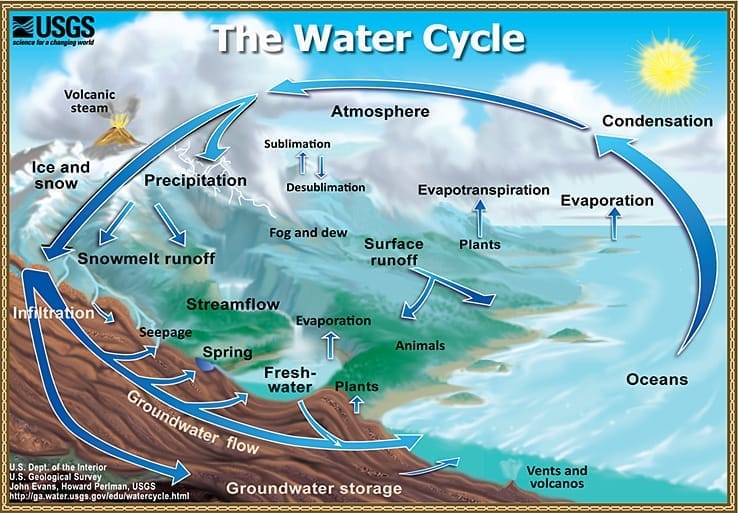
Solar energy drives evaporation and gravity drives runoff and much subsurface flow. Precipitation may return to the atmosphere through evapotranspiration, enter streams or infiltrate soil. Some infiltrating water reaches the saturated zone and recharges aquifers. Groundwater eventually discharges to springs, streams or the ocean, although residence times vary enormously.
Porosity describes the fraction of rock occupied by voids; permeability describes how readily connected openings transmit fluids. Clay can have high porosity but low permeability, whereas fractured limestone may transmit water rapidly through a small volume of connected openings. Hydraulic gradients drive groundwater movement. For saturated porous media under laminar flow, Darcy’s law gives Q = KAi, where Q is discharge (m³/s), K is hydraulic conductivity (m/s), A is cross-sectional area (m²), and i is the dimensionless hydraulic gradient. For example, K = 0.0001 m/s, A = 20 m² and i = 0.01 give Q = 0.00002 m³/s, or 1.728 m³/day.
Sedimentary rocks and the rock cycle
Water transports sediment to floodplains, deltas, lakes and marine basins. Declining flow competence allows particles to settle; subsequent burial compacts sediments and groundwater can precipitate calcite or silica cement between grains. Evaporation of concentrated brines can produce gypsum and halite. Water thus participates in both clastic and chemical sedimentary rock formation.
Glaciers are another part of the water-driven rock cycle. Moving ice abrades and plucks bedrock, transports debris and deposits till. Meltwater sorts sediment into sand and gravel deposits. U-shaped valleys and moraines preserve evidence of former glaciation.
Hydrothermal mineral deposits and metamorphism
Hot aqueous fluids circulate through permeable rocks and fractures. Dissolved metal complexes can become unstable as fluids cool, react with host rocks, mix with other fluids or undergo pressure changes. Quartz veins and sulfide deposits may form as a result. At mid-ocean ridges, seawater heated by underlying magmatic systems reacts with oceanic crust and can precipitate metal sulfides at seafloor vents.
During metamorphism, aqueous fluids promote mineral reactions and chemical transport. Hydration can produce minerals such as serpentine, whereas dehydration reactions release water from hydrous minerals as pressure and temperature change. Fluid availability influences reaction rates and mineral assemblages; not every metamorphic reaction requires an external fluid.
Water in subduction zones and volcanism
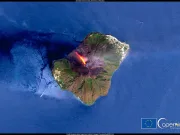
Oceanic crust and sediments carry water into subduction zones, both in pores and bound within minerals. As the descending plate heats, mineral reactions can release water into the mantle wedge. Water lowers the solidus of mantle rocks, promoting partial melting under suitable pressure and temperature conditions. This helps generate magma beneath many volcanic arcs. Water dissolved in ascending magma may exsolve as pressure falls, contributing to explosive behavior, depending on magma viscosity, gas escape and ascent rate. Water is not the primary driving force of plate motion.
Pore pressure, landslides and earthquakes
Water pressure in pores and fractures reduces effective normal stress. In the simple saturated soil case, effective stress is σ′ = σ − u, where σ is total normal stress and u is pore-water pressure. Increasing u can reduce frictional resistance even when total stress stays constant. In a slope with total normal stress of 100 kPa, raising pore pressure from 20 to 60 kPa reduces effective normal stress from 80 to 40 kPa. This is an illustrative calculation, not a slope stability assessment.
Heavy rainfall, rapid snowmelt and changes in groundwater levels can contribute to slope failure. Elevated fluid pressure on a suitably stressed fault can also facilitate slip, including some induced earthquakes. Neither rain nor groundwater alone explains most tectonic earthquakes; fault geometry, stress history and rock properties matter.
Why water matters in applied geology
Hydrogeologists use well logs, pumping tests, water chemistry and monitoring to locate aquifers and evaluate recharge, contamination and sustainable abstraction. Engineering geologists assess groundwater during foundation, tunnel and slope investigations because seepage, uplift and pore pressure affect stability. Groundwater extraction can also cause compaction and land subsidence in susceptible sedimentary basins. Geothermal exploration and mining similarly depend on understanding fluid pathways and water-rock reactions.
Geological processes controlled or influenced by water
| Process | Role of water | Geological result |
|---|---|---|
| Weathering | Dissolution and hydrolysis | Clay, regolith and karst |
| Erosion | Sediment transport and abrasion | Valleys and canyons |
| Sedimentation | Deposition and cement transport | Sedimentary rocks |
| Hydrothermal circulation | Heat and solute transport | Mineral veins and ore deposits |
| Subduction | Lowering of rock melting temperature | Arc magmatism |
| Slope deformation | Pore-pressure changes | Potential instability |
Frequently asked questions
Can water dissolve all rocks?
No. Solubility varies with mineral composition and water chemistry. Halite dissolves readily, carbonate rocks dissolve in mildly acidic water, and quartz is comparatively resistant under ordinary surface conditions.
Is groundwater an underground river?
Usually not. Most groundwater moves through connected pores and fractures. Underground streams do occur in some karst systems.
Can water cause volcanic activity?
Water can facilitate mantle melting in subduction zones and influence eruption dynamics, but it is only one factor in magma generation and volcanic behavior.
Scientific references
USGS — Groundwater; Distribution, cycling and impact of water in the Earth’s interior; Mase and Smith — The role of pore fluids in tectonic processes.