






























November 28, 2026. Two Antarctic geological landmarks—an ice field that has yielded roughly 14,000 meteorites and a region preserving evidence of extreme metamorphic temperatures—have joined the Third 100 IUGS Geological Heritage Sites. The International Union of Geological Sciences (IUGS) designated the Yamato Mountains Blue-Ice Meteorite Field and Archean Ultrahigh-Temperature Metamorphism in the Napier Complex. Japan’s National Institute of Polar Research (NIPR) described their inclusion in a November 24 announcement.
The IUGS third selection was initially announced on November 6, 2026; the November 24 NIPR communication gave specific details about the two Antarctic locations. They are recognised scientific heritage sites, not newly discovered geological formations, and IUGS designation should not be confused with UNESCO World Heritage inscription.
Two Antarctic Sites Added to the IUGS Heritage List
The newly recognised areas have official site numbers in the IUGS publication The Third 100 IUGS Geological Heritage Sites: the Napier Complex is Site 243, and the Yamato Mountains blue-ice meteorite field is Site 292. Both are located in East Antarctica, but they preserve very different types of scientific evidence.
The Yamato area illustrates how the movement and surface loss of Antarctic ice can concentrate meteorites, making rare extraterrestrial rock samples recoverable. The Napier Complex, in Enderby Land, preserves ancient lower-crustal rocks that endured some of the highest metamorphic temperatures recognised in the geological record.
Before these two additions, the Antarctic entry on the IUGS heritage list was the Cretaceous–Paleogene boundary on Seymour (Marambio) Island. Antarctica therefore has three designated sites across the collections described by NIPR.
Yamato Mountains: Around 14,000 Meteorites Recovered
Blue-ice terrain around the Yamato Mountains is among the most productive meteorite-collecting regions on Earth. NIPR reports that approximately 14,000 meteorites have been recovered there. This figure refers to the Yamato Mountains field; it should not be confused with the larger collection of approximately 17,400 Antarctic meteorites held by the Japanese Antarctic Meteorite Research Center, which includes finds from other regions.
Members of the 10th Japanese Antarctic Research Expedition identified meteorites around the Yamato Mountains in 1969. Subsequent expeditions demonstrated that Antarctic ice fields can preserve and concentrate specimens that originally fell across much larger areas and at different times. Meteorite classification and geochemical analysis have since provided evidence about asteroids, impacts, planetary differentiation and the history of the Solar System.
Why Meteorites Accumulate on Antarctic Blue Ice
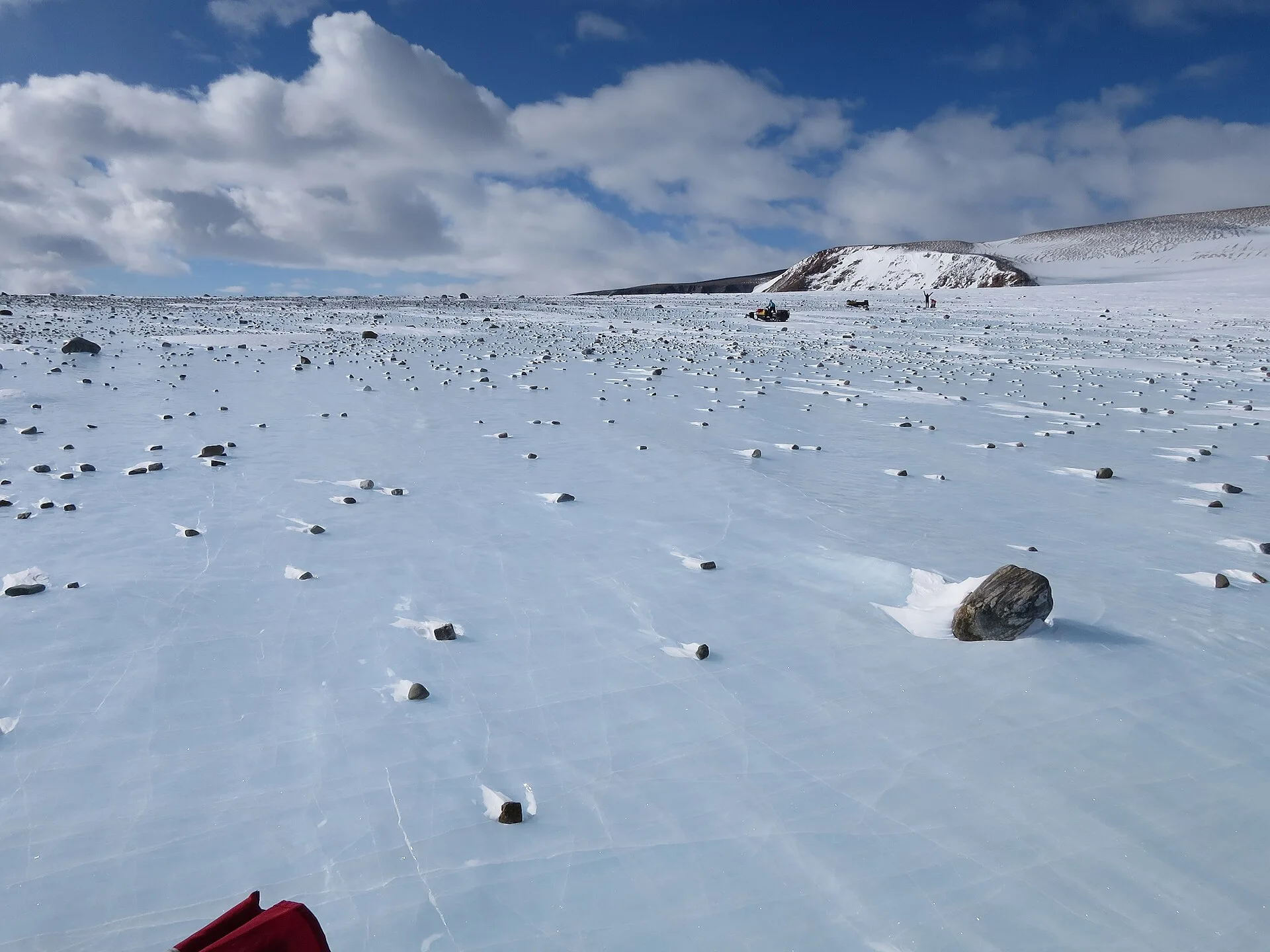
Many meteorites fall onto snow and become buried as snowfall gradually adds new layers. Over long periods, the ice sheet flows. In certain places, rock barriers or changes in topography slow ice movement and divert it upward. Persistent katabatic winds can also remove surface ice through sublimation and wind abrasion, exposing dark meteorites that have been carried within the ice.
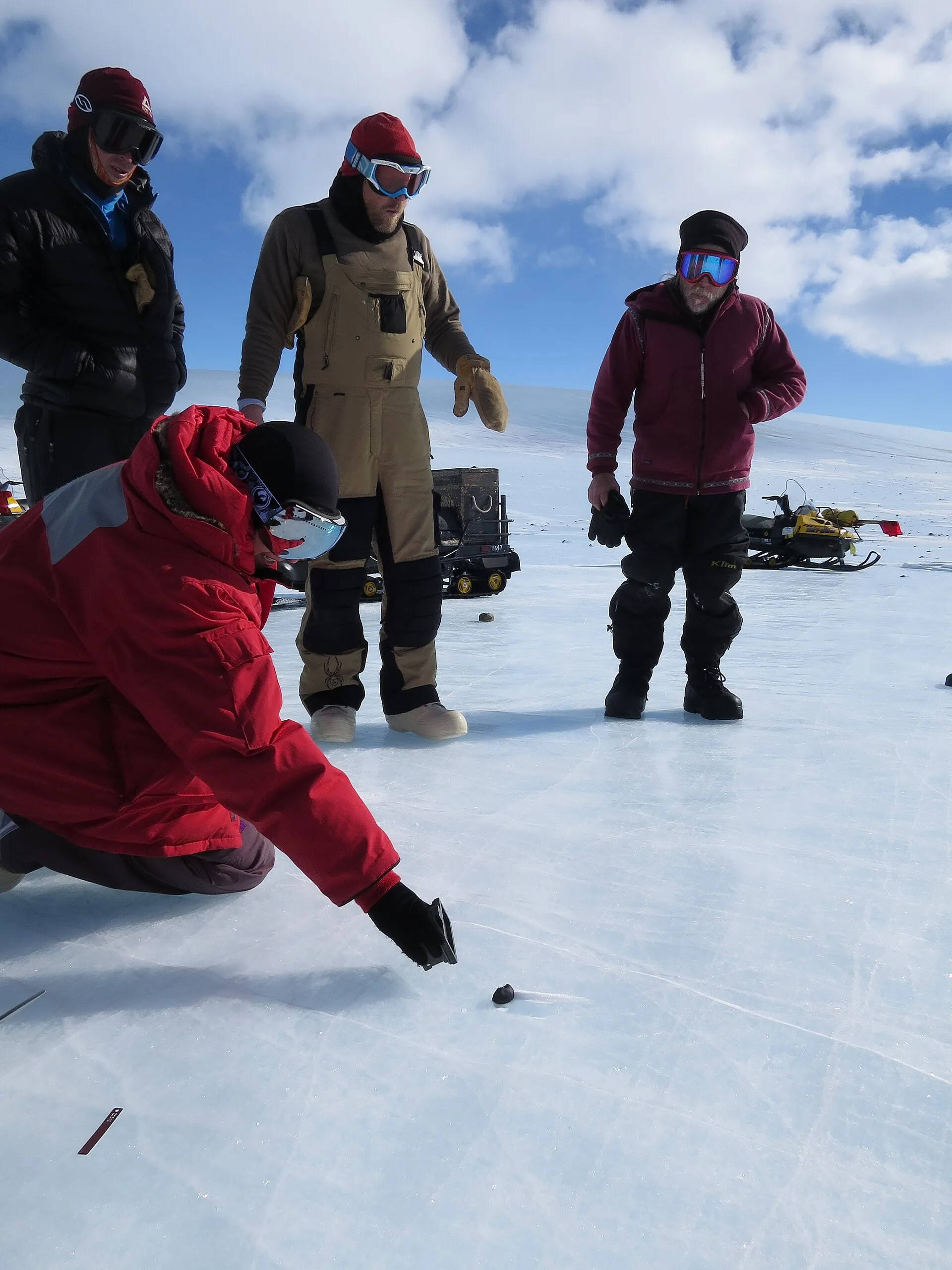
Because exposed meteorites contrast sharply with pale blue ice, field teams can locate specimens that would be difficult to recognise among ordinary rocks elsewhere. That does not mean all dark stones on Antarctic ice are meteorites: researchers use geological context, mineralogy and laboratory analysis to confirm their origin. GeologyScience’s meteorite identification guide describes several basic diagnostic features.
A Martian Meteorite From the Yamato Field
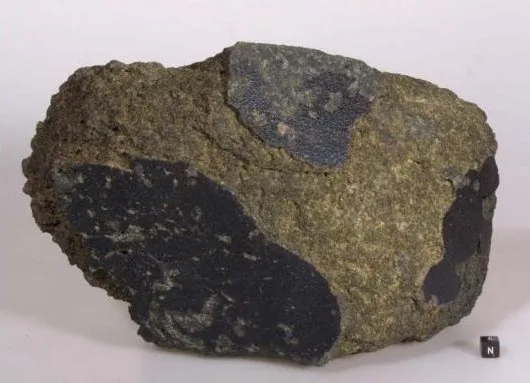
One notable specimen recovered near the Yamato Mountains is Yamato 000593, a roughly 13.7-kilogram Martian meteorite found during Japan’s Antarctic research programme in 2000. Because it came from Mars, it provides a direct physical sample of igneous and alteration processes on another planet. Its inclusion in the record demonstrates the planetary science value of Antarctic meteorite surveys.
The new heritage designation does not mean that Yamato 000593 itself was found in November 2026. Meteorites of many different ages and types are stored and studied long after their discovery, and the recognition honours the field area and its long-term research significance.
Napier Complex: Evidence of Ultrahigh-Temperature Metamorphism
The Napier Complex occupies part of Enderby Land in East Antarctica. Important outcrops include Tonagh Island and Mount Riiser-Larsen. The region exposes Archean continental crust transformed under exceptional temperatures. Its geology has been studied for decades by Australian and Japanese Antarctic research expeditions and is widely regarded as a reference area for ultrahigh-temperature (UHT) metamorphism.
UHT metamorphism involves unusually high temperatures in continental crust, typically above approximately 900°C. Mineral assemblages such as sapphirine with quartz, and other high-grade silicate minerals, can help geologists constrain temperature and pressure histories. Such mineral evidence must be interpreted alongside petrography, geochronology and the chemical composition of the parent rock.
In the Napier Complex, these rock records are especially valuable because they help scientists investigate how exceptionally hot conditions developed within ancient continental crust. The exact timing and pathways of crustal heating and subsequent cooling have been subjects of long-running research, so the rocks preserve a complex history rather than evidence of a single simple thermal event.
What These Ancient Rocks Tell Us About Early Earth
High-grade metamorphic rocks preserve information about deep crustal conditions, crustal thickening, the movement of heat and the transfer of chemical elements between minerals. In ancient terranes, minerals and isotopic systems can constrain the age of the original rock and later metamorphic events. The Napier Complex therefore provides a natural laboratory for testing models of the early continental lithosphere.
Its distinctive geology is related to broader questions about why some Archean crustal regions were so hot and how their tectonic settings differed from today. A heritage designation recognises the scientific importance of the site; it does not settle those ongoing debates. Related background is available in our Granulite and Index Minerals and Metamorphic Grades articles.
What the IUGS Heritage Designation Means
The International Union of Geological Sciences identifies geological heritage sites for their exceptional scientific importance, reference value and contributions to understanding Earth history. The selection highlights locations that illuminate significant geological phenomena and research milestones. It is an IUGS scientific recognition, not automatic UNESCO World Heritage status, a new national park designation or permission for unrestricted tourism. Antarctica remains subject to stringent environmental and scientific access controls.
For the Yamato field, recognition reflects its extraordinary meteorite abundance, diversity and the discoveries made through Japanese polar research. For the Napier Complex, it reflects its importance as a global reference locality for ultrahigh-temperature metamorphism. Together, the sites connect planetary materials delivered from space with deep processes inside Earth’s earliest continental crust.
Primary Scientific Sources and Image Credits
National Institute of Polar Research (NIPR), November 24, 2026: two Antarctic IUGS sites; University of Edinburgh, November 9: Napier Complex designation; IUGS: The Third 100 Geological Heritage Sites (official catalogue); NIPR Antarctic Meteorite Research Center.
Featured photo: scientists examining a meteorite in Antarctica’s Miller Range (NASA/Cindy Evans, December 2015, public domain). This is a representative Antarctic fieldwork photograph not taken at either newly designated site. Source and image credit. Cropped/resized for web.