



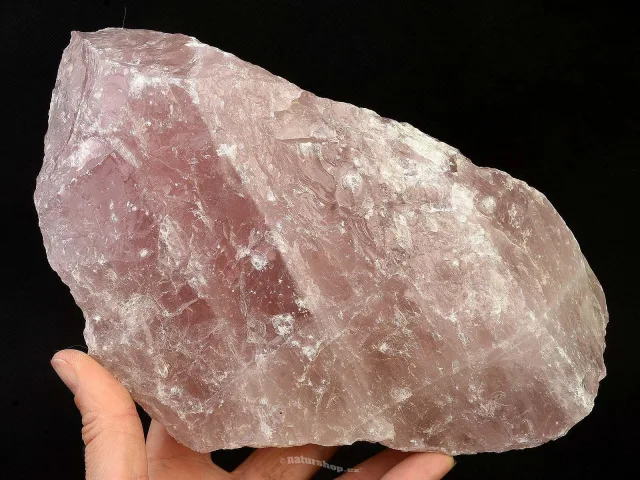
Rose quartz is a pink variety of the mineral quartz, known for its delicate color, cloudy translucence, and widespread use in jewelry and ornamental objects. Its appearance ranges from very pale pink to deeper rose-colored shades, making it one of the most recognizable varieties of quartz.
Although quartz is one of Earth’s most abundant minerals, rose quartz is distinguished by a fascinating microscopic feature: its pink color is commonly associated with extremely fine, fibrous inclusions of a mineral closely related to dumortierite.
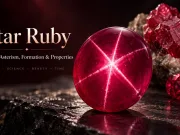
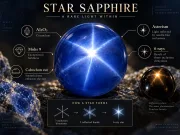
These inclusions are often too small to see with an ordinary microscope, yet they influence both the color and transparency of the stone. In certain specimens, their orientation also produces a remarkable six-rayed star when the gemstone is polished into a cabochon.
Rose quartz typically forms as massive mineral aggregates in granitic pegmatites and hydrothermal veins. It occurs in several regions worldwide, including Brazil, Madagascar, Namibia, India, and the United States.
Beyond its popularity as a gemstone, rose quartz provides an interesting example of how microscopic mineral structures can influence the optical properties of a familiar geological material.
What Is Rose Quartz?
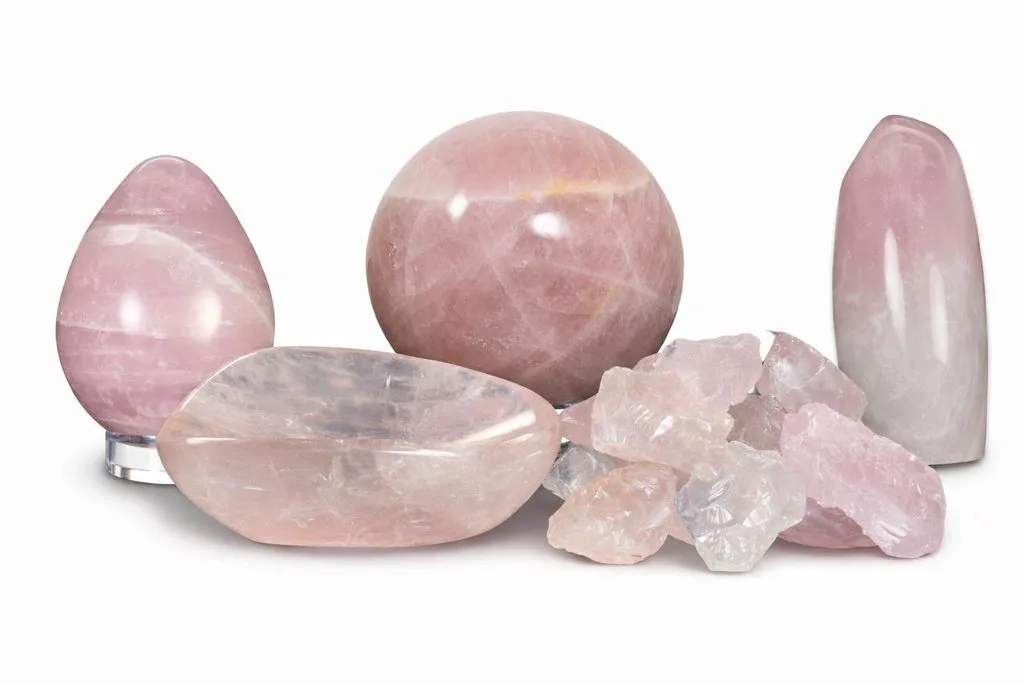
Rose quartz is the pink-colored variety of quartz, a crystalline silicate mineral composed of silicon dioxide (SiO₂).
It belongs to the trigonal crystal system and shares the fundamental physical properties of other crystalline quartz varieties, including amethyst, citrine, and smoky quartz.
The term rose quartz most commonly refers to translucent, massive pink quartz rather than well-formed individual crystals.
Unlike clear quartz, which frequently develops recognizable six-sided prisms terminated by pyramidal faces, typical rose quartz occurs as irregular, intergrown crystal masses without prominent external crystal faces.
Its most recognizable characteristics include:
- Pale pink to medium-dark pink coloration
- Massive crystalline growth habit
- Cloudy or milky translucence
- Vitreous luster on fresh or polished surfaces
- Mohs hardness of 7
- Occasional six-rayed asterism
- Common occurrence in granitic pegmatites
Rare, well-formed pink quartz crystals also exist, but their coloration can arise through a different mechanism from that of common massive rose quartz.
This distinction is important when studying the mineral’s formation and optical properties.
Chemical Composition and Mineral Properties
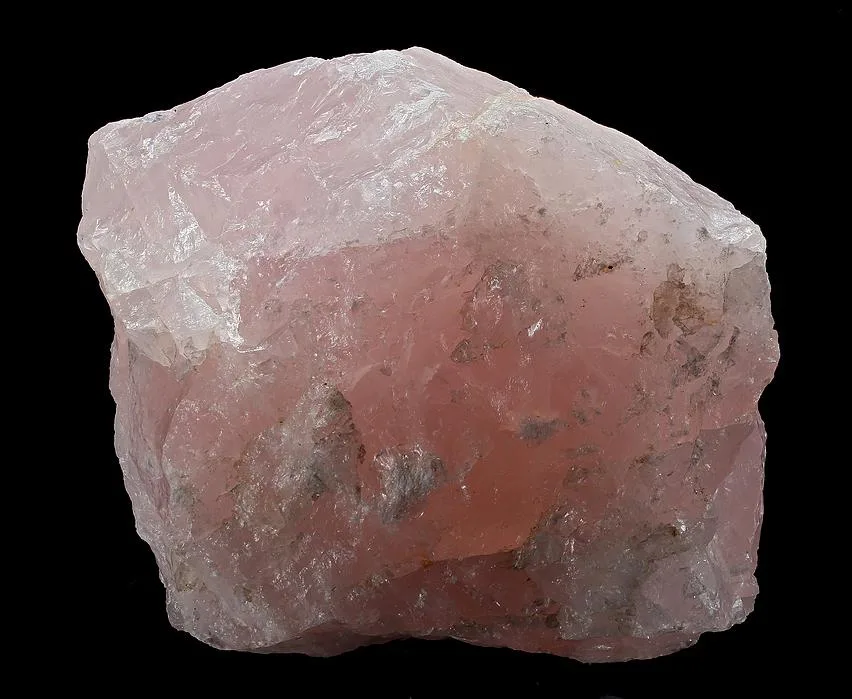
Rose quartz is composed of silicon dioxide, the same chemical compound found in other varieties of quartz.
Chemical formula: SiO₂
Its pink appearance does not indicate that it is a separate mineral species. Instead, it results from features associated with trace constituents and microscopic inclusions.
Physical and Optical Properties
| Property | Description |
|---|---|
| Mineral name | Quartz |
| Variety | Rose quartz |
| Chemical formula | SiO₂ |
| Mineral classification | Tectosilicate |
| Crystal system | Trigonal |
| Color | Very pale pink to medium-dark pink |
| Mohs hardness | 7 |
| Luster | Vitreous |
| Transparency | Commonly translucent; transparent material is less common |
| Streak | White |
| Cleavage | No distinct cleavage |
| Fracture | Conchoidal |
| Refractive indices | Approximately 1.544–1.553 |
| Birefringence | Approximately 0.009 |
| Specific gravity | Approximately 2.65–2.66 |
| Optical character | Uniaxial positive |
| Common growth habit | Massive, intergrown crystals |
| Special optical effect | Asterism in some specimens |
These properties make rose quartz a useful material for mineral identification.
Its hardness, refractive indices, and crystal structure are characteristic of quartz, while the pink coloration distinguishes it from colorless and other colored varieties.
Why Is Rose Quartz Pink?
The origin of rose quartz’s pink color has been studied for decades.
Earlier explanations proposed that its coloration resulted directly from trace elements such as titanium or manganese within the quartz crystal lattice.
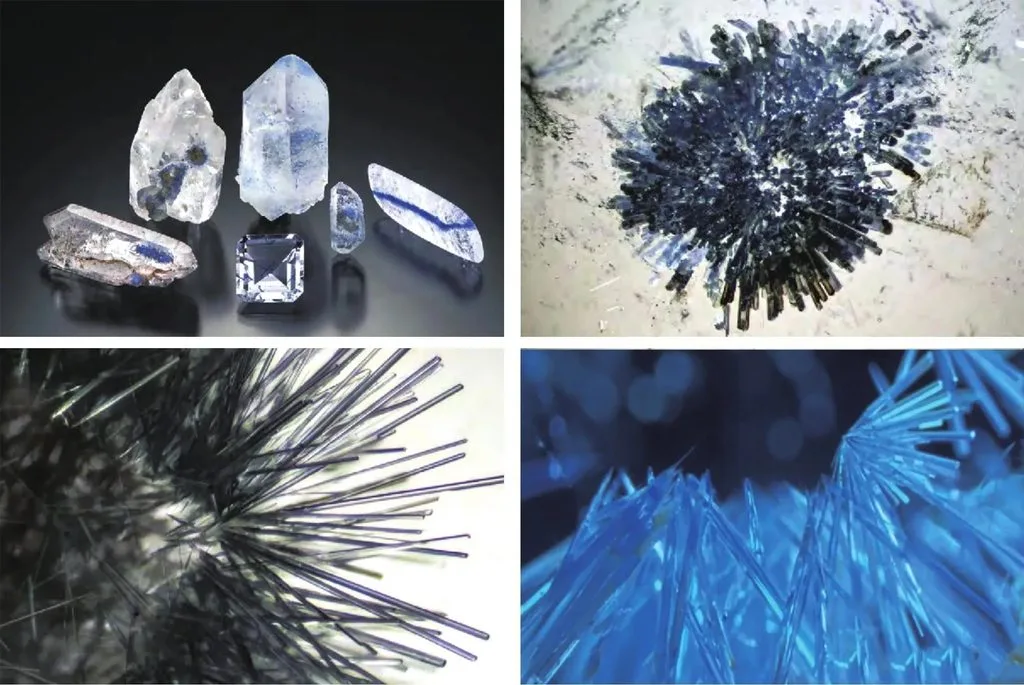
However, detailed mineralogical investigations have demonstrated that the pink color of common massive rose quartz is associated with extremely fine fibrous inclusions.
Dumortierite-Related Nanofibers
Research by Goreva, Ma, and Rossman (2001), followed by Ma, Goreva, and Rossman (2002), investigated microscopic fibers extracted from massive rose quartz.
The researchers found that the fibers possess structural and chemical similarities to dumortierite, a borosilicate mineral.
However, their structure is not completely identical to ordinary dumortierite.
The most accurate description is therefore dumortierite-related fibrous nanoinclusions, rather than assuming that every fiber is ordinary dumortierite.
The fibers are exceptionally small, with dimensions measured in fractions of a micrometer.
Their presence influences the way visible light passes through the quartz.
The Role of Iron and Titanium
The pink coloration of these fibrous inclusions is associated with electronic interactions involving iron and titanium.
A process known as intervalence charge transfer produces characteristic absorption of visible light.
Because the quartz contains numerous fine fibers, the overall stone displays a pink appearance.
The inclusions also scatter light, contributing to the cloudy translucence commonly observed in rose quartz.
Why Are Some Rose Quartz Specimens More Pink Than Others?
Rose quartz varies in color intensity.
Some specimens appear nearly white with a faint pink tint, while others exhibit a noticeably deeper rose color.
Differences in the abundance, distribution, and optical characteristics of the inclusions can influence the appearance.
The thickness of the specimen and lighting conditions also affect how strongly the color is perceived.
This helps explain why a large piece of rose quartz may show a more noticeable pink color than a small stone cut from similar material.
How Does Rose Quartz Form?
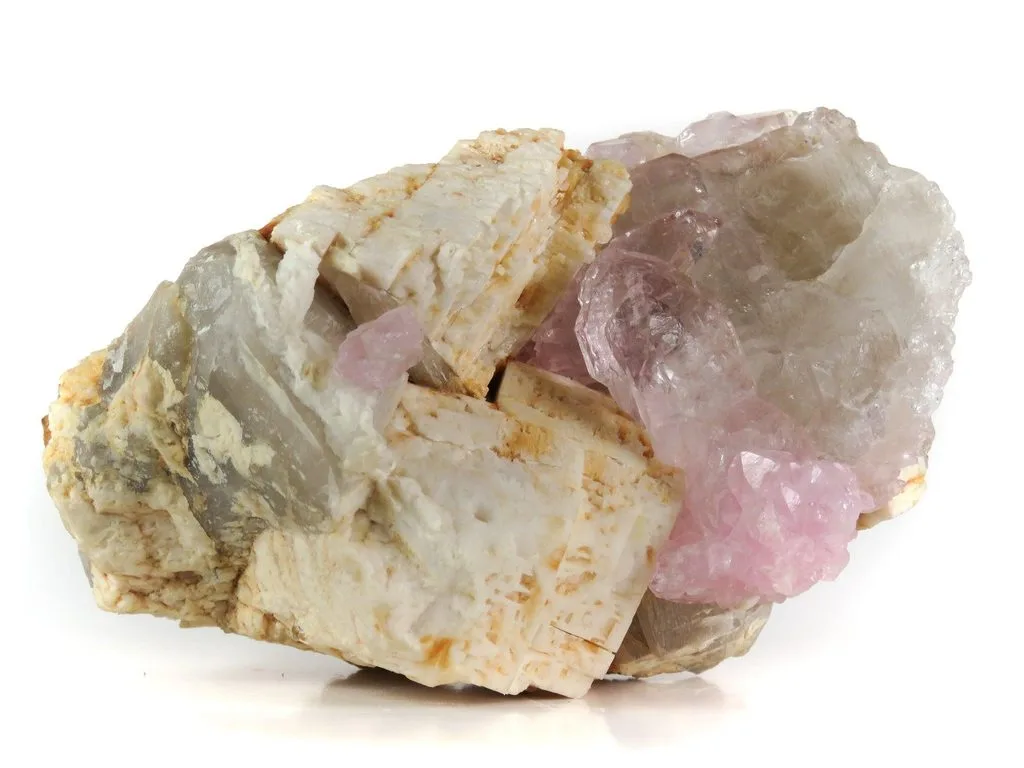
Rose quartz forms in geological environments where silica-rich material crystallizes under suitable conditions.
Its occurrence is especially associated with granitic pegmatites and some hydrothermal veins.
Formation in Granitic Pegmatites
Granitic pegmatites are coarse-grained igneous rocks commonly associated with the late stages of granitic magmatic evolution.
They can contain exceptionally large crystals of minerals such as quartz, feldspar, and mica.
During pegmatite crystallization, quartz may develop as large masses within the rock.
Where the appropriate chemical components and microscopic inclusion-forming processes occur, pink quartz can develop.
Many well-known rose quartz deposits are associated with such pegmatitic environments.
Hydrothermal Vein Formation
Rose quartz also occurs in some hydrothermal veins.
Hydrothermal fluids are hot, mineral-bearing fluids that circulate through fractures and openings in rocks.
Under suitable conditions, silica dissolved in these fluids can precipitate as quartz.
The development of pink material depends on the geological and chemical history of the deposit.
Formation of Microscopic Inclusions
In common massive rose quartz, the dumortierite-related fibrous inclusions are believed to develop during the mineral’s cooling and subsequent evolution.
These microscopic features are associated with the characteristic pink color.
Their orientation can also influence optical effects in polished gemstones.
Weathering and Exposure
After formation, rose quartz-bearing rocks may become exposed through tectonic uplift, erosion, and weathering.
Weathering can release pieces of rose quartz from their original host rocks.
These fragments may remain near their source or be transported into sedimentary environments.
Because quartz is relatively resistant to many weathering processes, rose quartz fragments can survive as pebbles or larger pieces.
Massive Rose Quartz vs. Crystalline Pink Quartz
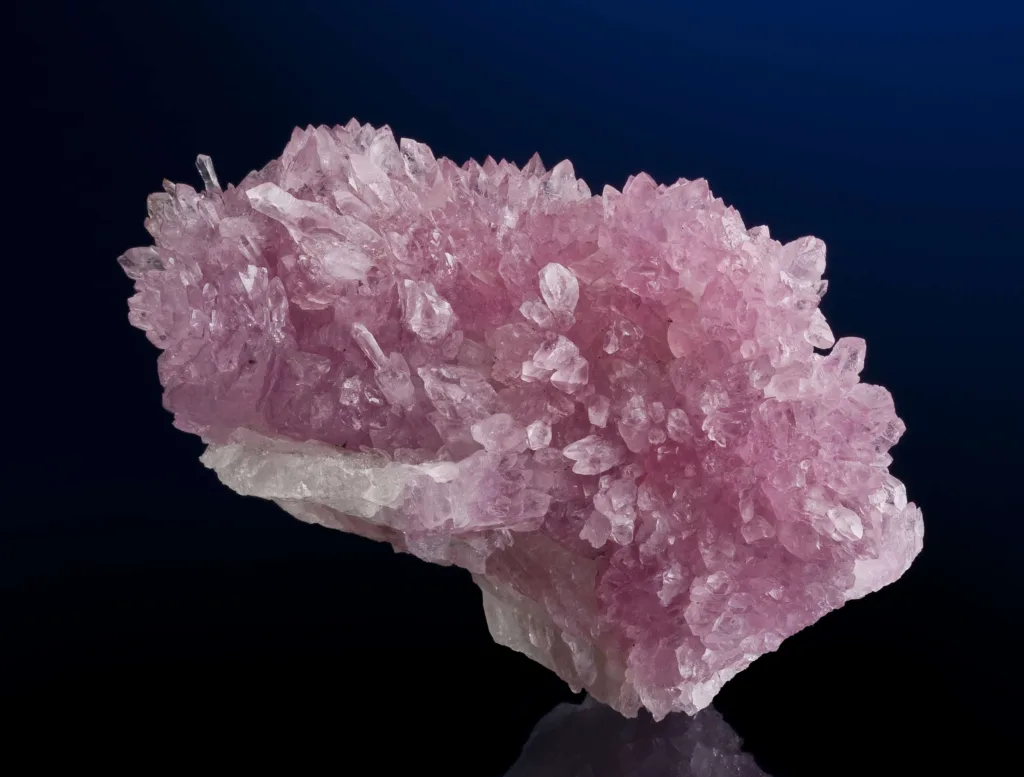
Not all naturally pink quartz has the same appearance or coloring mechanism.
Mineralogical studies distinguish the common massive variety from rare pink quartz occurring as well-formed crystals.
Massive Rose Quartz
This is the familiar material used for most rose quartz carvings, cabochons, spheres, and decorative objects.
It commonly displays:
- Irregular, massive growth
- Cloudy or milky translucence
- Pale to medium pink coloration
- Dumortierite-related fibrous inclusions
- Occasional asterism
Its color mechanism has been investigated through microscopy, spectroscopy, and mineralogical analysis.
Crystalline Pink Quartz
Rare pink quartz specimens occur as recognizable individual crystals with well-developed crystal faces.
Scientific studies indicate that some of these crystals derive their pink coloration from radiation-related color centers involving structural defects and trace elements.
This mechanism differs from the fibrous-inclusion mechanism responsible for the color of common massive rose quartz.
Crystalline pink quartz may also exhibit different color stability under exposure to light or heat.
For this reason, the two materials should not automatically be treated as having identical geological and optical properties.
Star Rose Quartz and Asterism
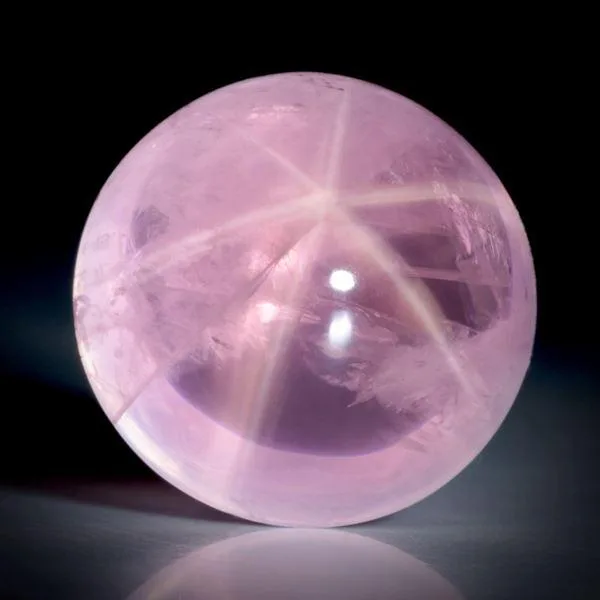
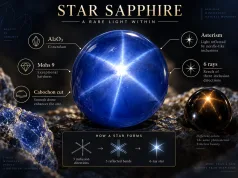
Some rose quartz gemstones display a luminous, star-shaped optical effect when illuminated by a concentrated light source.
This phenomenon is called asterism.
What Causes the Star Effect?
Asterism results from the interaction of light with numerous fine, oriented inclusions inside the gemstone.
When suitable inclusions are arranged in particular crystallographic directions, they can scatter or reflect light in ways that produce intersecting bright bands.
In rose quartz, this commonly creates a six-rayed star.
The effect is most clearly visible when the gemstone is cut into a properly oriented, rounded cabochon.
Why Are Star Rose Quartz Gemstones Unusual?
Not every specimen contains inclusions with the necessary orientation and distribution.
Even when suitable inclusions exist, the gemstone must be cut correctly to display the star.
Well-defined stars on an attractive, evenly colored background are particularly desirable.
The intensity and sharpness of the effect depend on the internal structure of the stone, the cut, and the lighting conditions.
Colors and Appearance of Rose Quartz
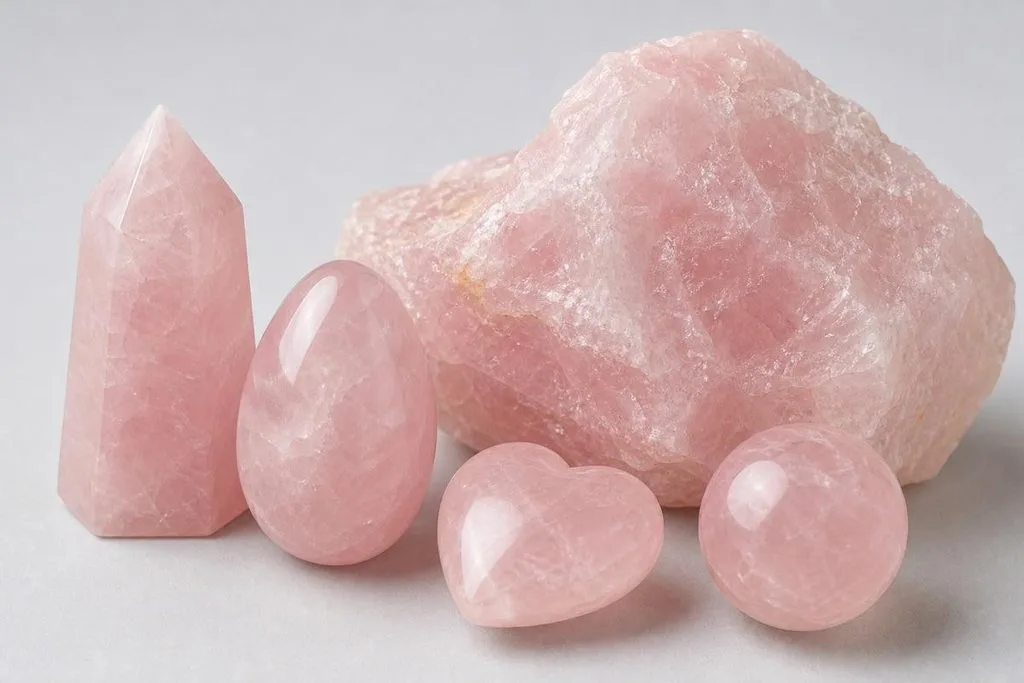
Rose quartz is best known for its soft pink color, but its appearance varies considerably.
Pale Pink Rose Quartz
Pale pink material may appear nearly colorless under some lighting conditions.
The color is often more noticeable in thicker specimens.
Medium Pink Rose Quartz
Medium pink specimens display the familiar rose coloration associated with the mineral.
These stones are widely used in polished cabochons, carvings, and decorative objects.
Deep Pink Rose Quartz
More strongly colored specimens may show a richer rose or reddish-pink appearance.
Color quality is one of the factors considered when selecting rose quartz for gem cutting.
Cloudy and Milky Rose Quartz
Many specimens exhibit a cloudy appearance caused by microscopic inclusions and light scattering.
This translucence is a characteristic feature of common massive rose quartz.
Where Is Rose Quartz Found?
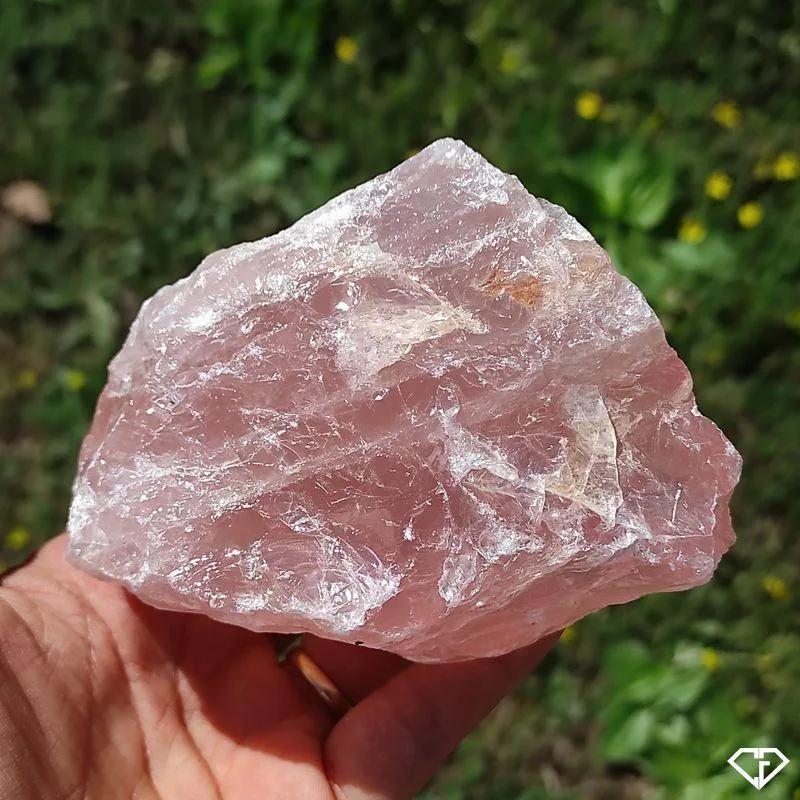
Rose quartz occurs in several countries where suitable geological environments are present.
The mineral is especially associated with pegmatite deposits.
Brazil
Brazil is an important source of quartz varieties, including rose quartz.
Rose quartz occurs in pegmatitic regions, particularly within Minas Gerais and other mineral-producing areas.
Some Brazilian localities are also known for rare pink quartz crystals with recognizable crystal faces.
Madagascar
Madagascar is a well-known source of rose quartz, including large masses suitable for carving and gem cutting.
The country has also supplied relatively transparent material used for faceted gemstones.
United States
Rose quartz occurs in several parts of the United States.
South Dakota is particularly well known for rose quartz-bearing pegmatites in the Black Hills region.
Other occurrences are documented in states with suitable pegmatitic geological environments.
Namibia
Namibia is another documented source of rose quartz.
Specimens occur in pegmatitic geological settings and are collected as rough mineral material.
India
India produces rose quartz and other quartz varieties from suitable geological deposits.
The material is used in decorative carvings and gemstone products.
The quality, color, and transparency of specimens vary between deposits.
How to Identify Rose Quartz
Rose quartz is often recognized by its pink color, but reliable identification requires considering its mineral properties.
1. Observe the Color and Transparency
Natural rose quartz commonly displays a soft pink color.
Most massive specimens are translucent rather than completely transparent.
However, visual appearance alone cannot establish authenticity.
2. Examine the Growth Habit
Typical rose quartz occurs in massive aggregates without prominent external crystal faces.
Well-formed pink quartz crystals are considerably less common and may have different color-related characteristics.
3. Consider Hardness
Quartz has a Mohs hardness of 7.
This characteristic helps distinguish it from softer pink minerals such as calcite.
However, scratch testing can damage specimens and should not be used casually on valuable or polished stones.
4. Check the Fracture and Luster
Quartz has no distinct cleavage and commonly displays conchoidal fracture.
Fresh surfaces may show a vitreous luster.
5. Use Gemological Testing
Professional identification can involve refractive index measurements, specific gravity, microscopic examination, and spectroscopy.
These methods help distinguish quartz from other pink gemstones or imitations.
Specific color-causing inclusions generally require specialized laboratory methods for definitive identification.
Rose Quartz vs. Other Pink Minerals
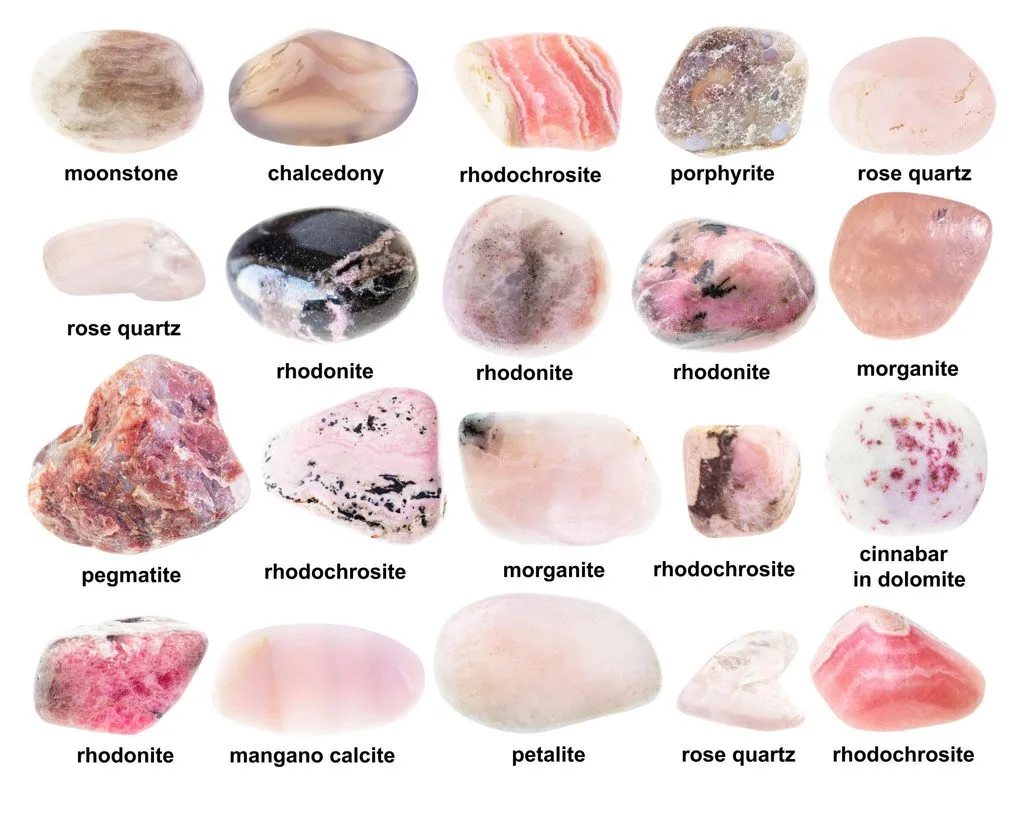
Rose quartz may resemble several other pink minerals and gemstones.
| Mineral | Main Difference |
|---|---|
| Rose quartz | Pink quartz, SiO₂; Mohs hardness 7 |
| Pink calcite | Softer carbonate mineral with distinct cleavage |
| Rhodonite | Manganese silicate, often with dark manganese-oxide markings |
| Rhodochrosite | Pink manganese carbonate, significantly softer than quartz |
| Pink opal | Hydrated silica with different optical and physical properties |
| Morganite | Pink beryl with a different crystal structure and gemological properties |
Color alone is not sufficient to separate these materials reliably.
Uses of Rose Quartz
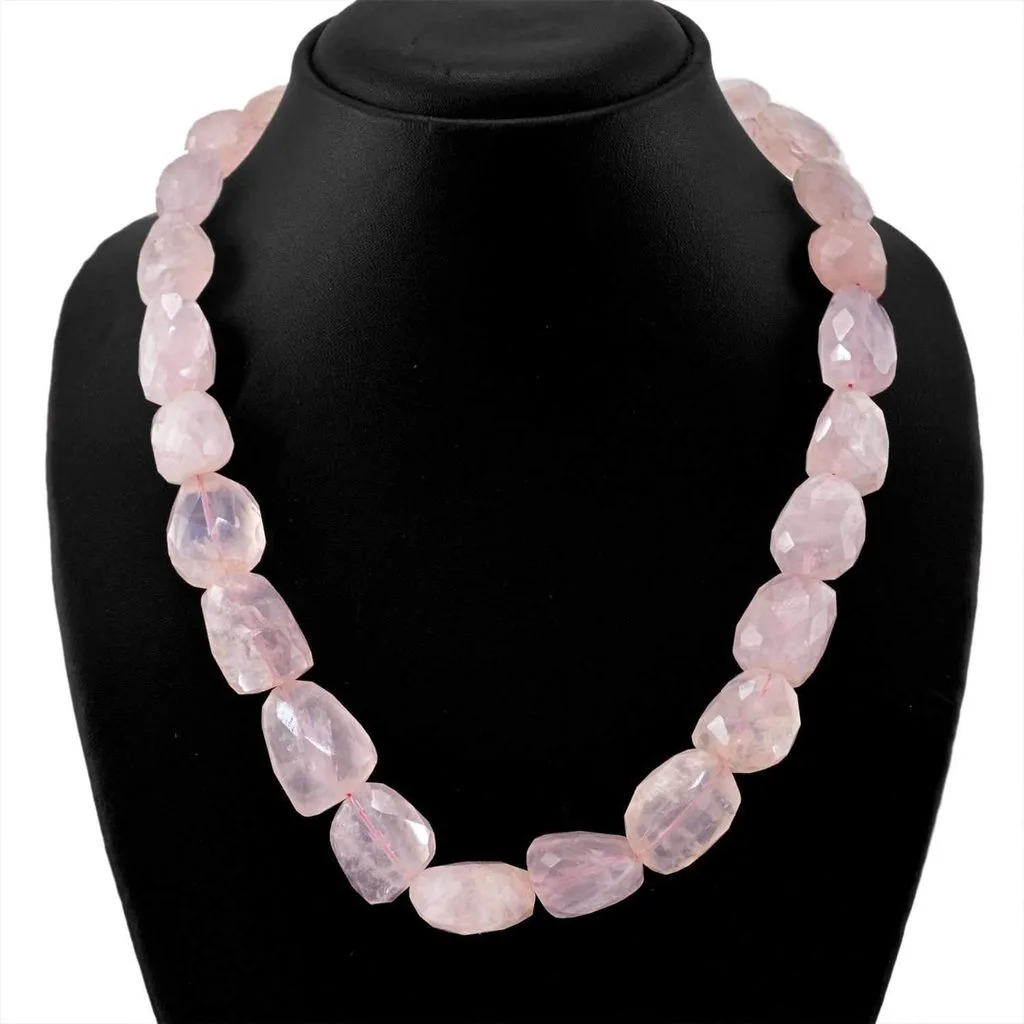
Rose quartz has been used for decorative and ornamental purposes for centuries.
Its color, relatively good durability, and availability in large masses make it suitable for many applications.
Jewelry
Rose quartz is commonly fashioned into cabochons, beads, pendants, bracelets, and earrings.
More transparent material can sometimes be faceted.
Its hardness of 7 provides useful scratch resistance, although the stone can still chip or fracture if struck.
Carvings and Decorative Objects
Large pieces of rose quartz are used to produce spheres, figurines, ornamental bowls, and other carved objects.
The mineral’s massive occurrence allows craftspeople to work with pieces larger than many individual gem crystals.
Mineral Collections
Rose quartz is valued by collectors for its color, geological occurrence, and occasional optical phenomena.
Rare well-formed pink quartz crystals and specimens showing strong asterism are of particular mineralogical and gemological interest.
What Determines Rose Quartz Value?
Rose quartz is generally more affordable than many rare gemstones, but quality and value vary.
Color
An attractive, even pink color is an important quality factor.
The desired depth of color may depend on the intended use and the size of the material.
Transparency and Clarity
Most rose quartz is cloudy or translucent.
More transparent material suitable for faceting is less common.
Star Effect
Well-defined asterism can add interest to a cabochon.
The sharpness and visibility of the star are important quality considerations.
Size and Cutting Quality
Rose quartz occurs in large masses, so large specimens are not necessarily rare.
Nevertheless, well-cut stones with attractive color, good polish, and unusual optical features may be more desirable.
Natural vs. Treated Material
As with other gemstones, buyers should consider the possibility of treatments, coatings, or imitations.
A reputable seller should accurately disclose known enhancements.
How to Clean and Care for Rose Quartz
Rose quartz is a relatively durable gemstone, but proper care helps maintain its appearance.
- Clean with lukewarm water, mild soap, and a soft cloth.
- Avoid strong impacts that may cause chips or fractures.
- Do not expose the gemstone to sudden temperature changes.
- Keep it away from harsh cleaning chemicals.
- Store polished stones separately from harder materials.
- Avoid prolonged intense light or heat exposure when the specimen’s color stability is uncertain.
For ordinary jewelry cleaning, gentle hand washing is generally preferable to aggressive cleaning procedures.
Frequently Asked Questions
Is rose quartz a real mineral?
Rose quartz is a natural pink variety of the mineral quartz. It has the chemical formula SiO₂ and shares the fundamental crystal structure of other quartz varieties.
What causes the pink color of rose quartz?
The color of common massive rose quartz is associated with microscopic fibrous inclusions closely related to dumortierite. Their coloration involves iron–titanium electronic interactions.
Is rose quartz rare?
Common massive rose quartz is relatively widespread. However, strongly colored transparent material, exceptional star gemstones, and well-formed pink quartz crystals are less common.
Where does rose quartz form?
Rose quartz commonly forms in granitic pegmatites and may also occur in hydrothermal veins.
Is rose quartz the same as pink quartz?
The names are sometimes used interchangeably, but mineralogical studies distinguish common massive rose quartz from rare well-formed pink quartz crystals that can have a different color mechanism.
What is star rose quartz?
Star rose quartz displays asterism, an optical phenomenon in which oriented microscopic inclusions produce a star-shaped pattern under suitable lighting.
How hard is rose quartz?
Rose quartz has a Mohs hardness of 7, the same as other varieties of quartz.
Can rose quartz fade in sunlight?
Color stability depends on the type of pink quartz and its coloring mechanism. Rare crystalline pink quartz can be light-sensitive, while common massive rose quartz generally has a different, more stable color mechanism. Avoiding prolonged intense light and heat is a reasonable precaution.
Is rose quartz suitable for jewelry?
Yes. Its hardness and lack of distinct cleavage make it suitable for many jewelry applications, although it should still be protected from strong impacts.
Conclusion
Rose quartz is one of the most recognizable varieties of quartz, distinguished by its soft pink color, massive crystal habit, and frequent cloudy translucence.
Scientific studies have revealed that the pink color of common massive rose quartz is closely associated with dumortierite-related fibrous nanoinclusions, demonstrating how microscopic mineral structures can affect the appearance of a much larger crystal aggregate.
Its geological occurrence in pegmatites and hydrothermal veins, together with occasional phenomena such as asterism, makes rose quartz an interesting subject for both mineralogy and gemology.
Whether examined as a geological specimen or fashioned into jewelry, rose quartz illustrates the diversity of physical and optical properties found within the quartz family.
References
- Gemological Institute of America (GIA). Rose Quartz: Gem Overview and Properties. Mineral properties, optical effects, appearance, and gem quality.
- Gemological Institute of America (GIA). Rose Quartz Description. Color-causing inclusions, geological occurrence, and gemstone characteristics.
- Goreva, J. S., Ma, C., & Rossman, G. R. (2001). Fibrous Nanoinclusions in Massive Rose Quartz: The Origin of Rose Coloration. American Mineralogist, 86, 466–472.
- Ma, C., Goreva, J. S., & Rossman, G. R. (2002). Fibrous Nanoinclusions in Massive Rose Quartz: HRTEM and AEM Investigations. American Mineralogist, 87, 269–276.
- GIA (2025). Structures Behind the Spectacle: A Review of Optical Effects in Phenomenal Gemstones and Their Underlying Nanotextures. Detailed discussion of star quartz and microscopic inclusion structures.
- Mindat.org. Rose Quartz – Mineral Information and Localities. Mineralogical classification and color mechanisms.
- International Gem Society (2024). Rose Quartz Value, Price, and Jewelry Information. Gem characteristics, durability, and uses.