



Paraíba tourmaline is one of the most distinctive and highly valued varieties of tourmaline, famous for its vivid electric-blue, turquoise, and green colors. Its extraordinary appearance is mainly associated with copper and manganese, elements that influence how the gemstone absorbs visible light.
First discovered in northeastern Brazil in the late 1980s, Paraíba tourmaline attracted worldwide attention because of its unusually intense coloration. The gemstones displayed brilliant blue-to-green hues that were rarely encountered in other tourmalines.
Although its name comes from Paraíba State in Brazil, the term Paraíba tourmaline is not restricted to Brazilian gemstones. Similar copper-bearing tourmalines have also been discovered in Nigeria and Mozambique. Under widely accepted gemological nomenclature, qualifying gemstones from these countries may also be described as Paraíba tourmaline.
Today, Paraíba tourmaline is admired not only for its beauty and rarity but also for its geological and gemological significance. Its formation involves unusual mineral chemistry, specialized geological environments, and trace elements capable of producing remarkable colors.
What Is Paraíba Tourmaline?
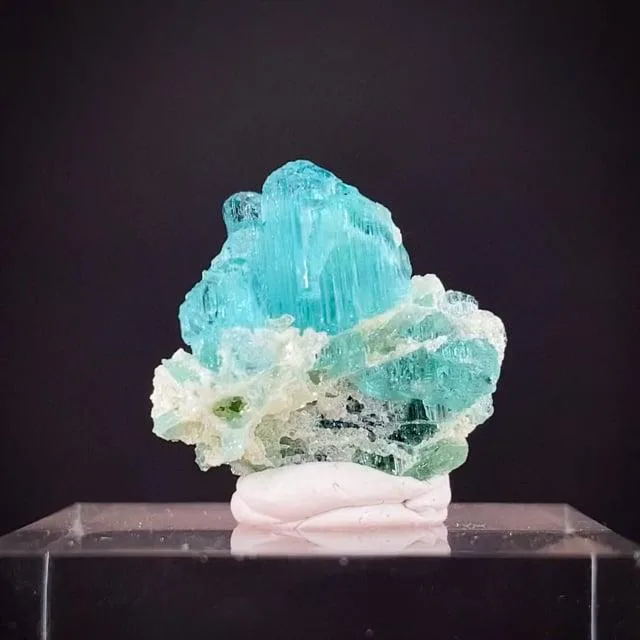
Paraíba tourmaline is a gemological variety of tourmaline characterized by vivid blue-to-green coloration associated primarily with copper and manganese.
It is not a separate mineral species. Most Paraíba tourmalines belong to elbaite, a member of the tourmaline supergroup. Copper-bearing examples belonging to the liddicoatite series have also been documented.
The name is used in the gemstone trade for tourmalines displaying the appropriate color and chemical characteristics, regardless of geographic origin.
The distinctive characteristics of Paraíba tourmaline include:
- Vivid electric-blue, turquoise, bluish-green, and green colors
- Copper-related absorption of visible light
- Transparent to translucent crystals
- A vitreous, or glass-like, luster
- A Mohs hardness of approximately 7–7.5
- Relatively scarce supplies of exceptional gem-quality material
Not every blue or green tourmaline qualifies as Paraíba tourmaline. Ordinary blue tourmaline, commonly called indicolite, may owe much of its color to iron rather than the copper-related coloration characteristic of Paraíba material.
The distinction is based on gemological characteristics and chemical evidence, not simply on visual appearance.
Discovery and History of Paraíba Tourmaline
The Original Discovery in Brazil
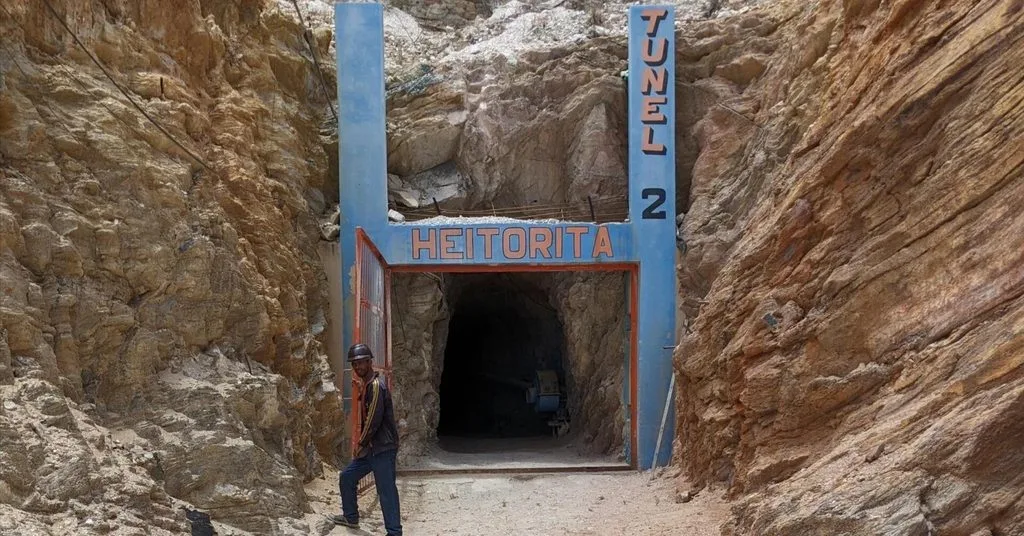
The discovery of Paraíba tourmaline is closely associated with Brazilian miner Heitor Dimas Barbosa, who began searching for unusual tourmalines in Paraíba State in the early 1980s.
According to historical research published by the Gemological Institute of America (GIA), Barbosa and his associates found distinctive electric-blue material at Mina da Batalha in August 1987. Facet-quality bright-blue tourmaline was subsequently recovered in 1989.
These discoveries introduced an extraordinary new variety of tourmaline to the international gemstone market.
The original Brazilian material became especially famous for its brilliant blue and blue-green colors. The vivid appearance was sufficiently unusual to distinguish these gemstones from most previously known blue tourmalines.
The gemstone was named after the Brazilian state where the original deposit was discovered.
Additional Discoveries in Brazil
Following the original discovery in Paraíba State, copper-bearing tourmaline was also identified in neighboring Rio Grande do Norte State.
These occurrences expanded the known distribution of Brazilian Paraíba tourmaline.
The deposits are associated with the mineral-rich pegmatite environments of northeastern Brazil.
The Discovery of African Sources
Copper-bearing tourmalines with colors resembling Brazilian Paraíba material later became available from Nigeria and Mozambique.
Nigerian material entered the international gem market around the beginning of the 2000s.
In Mozambique, copper-bearing tourmaline from the Mavuco area became an important source of blue-to-green gemstones during the early 2000s.
The discovery of these African sources demonstrated that similar gemstone colors and copper-bearing tourmaline compositions could occur in geographically distant regions.
It also created new challenges for gemologists attempting to determine the geographic origin of individual stones.
Chemical Composition and Mineral Properties
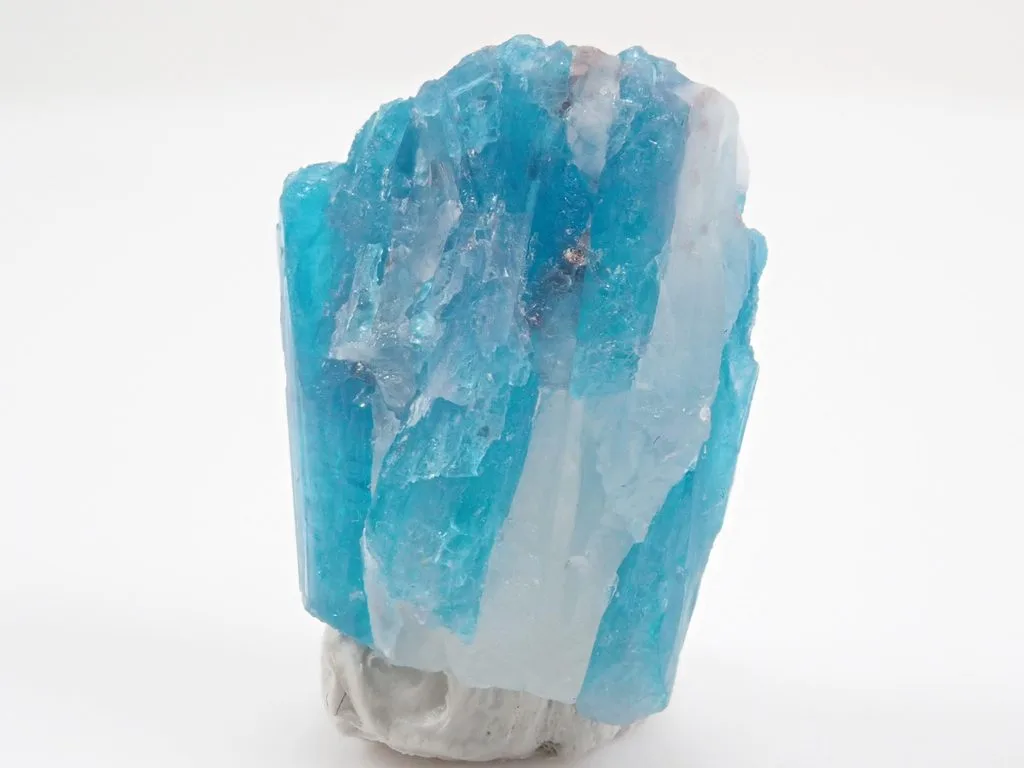
Paraíba tourmaline belongs to the tourmaline supergroup, a complex group of boron-bearing silicate minerals.
Tourmaline minerals contain several crystallographic sites that can accommodate different chemical elements. This chemical flexibility helps explain the wide variety of colors and compositions found throughout the group.
Mineral Chemistry
Most Paraíba tourmalines are varieties of elbaite, a lithium- and aluminum-rich tourmaline.
The idealized chemical formula of elbaite is:
Na(Li₁.₅Al₁.₅)Al₆(Si₆O₁₈)(BO₃)₃(OH)₄
This formula describes the ideal mineral composition rather than the exact chemistry of every natural specimen.
Copper and manganese occur in variable amounts and play important roles in the coloration of Paraíba tourmaline.
Some copper-bearing gemstones have been identified as belonging to the liddicoatite series rather than elbaite, demonstrating that the Paraíba designation is not limited to one mineral species.
Physical and Optical Properties
| Property | Paraíba Tourmaline |
|---|---|
| Mineral group | Tourmaline supergroup |
| Common mineral species | Elbaite |
| Other documented species | Members of the liddicoatite series |
| Crystal system | Trigonal |
| Typical colors | Blue, violet-blue, greenish blue, bluish green, green |
| Luster | Vitreous |
| Transparency | Transparent to translucent |
| Mohs hardness | 7–7.5 |
| Streak | White |
| Cleavage | No prominent cleavage |
| Fracture | Uneven to conchoidal |
| Optical character | Uniaxial negative in typical gem tourmaline |
| Pleochroism | Commonly present |
| Principal color-related elements | Copper and manganese |
| Geological occurrence | Pegmatitic environments and derived secondary deposits |
The physical and optical properties of individual specimens can vary with mineral composition.
Because Paraíba is a gemological variety rather than a single mineral species, one exact refractive index or specific gravity value should not be applied to every specimen.
What Causes the Neon Colors of Paraíba Tourmaline?
The remarkable colors of Paraíba tourmaline are among its most scientifically interesting features.
Unlike many ordinary blue tourmalines, Paraíba’s distinctive blue-to-green coloration is strongly associated with copper.
The Role of Copper
Copper ions, particularly Cu²⁺, absorb selected wavelengths of visible light within the tourmaline crystal.
This selective absorption contributes to the vivid blue and green colors associated with Paraíba tourmaline.
The precise appearance depends on the gemstone’s chemical composition, absorption characteristics, transparency, and interaction with light.
The Role of Manganese
Manganese also contributes to the colors of some copper-bearing tourmalines.
Different oxidation states of manganese absorb light differently.
In particular, Mn³⁺ can produce pink, red, or purple components. These may combine with copper-related absorption to create violet-blue and other complex colors.
Changes in manganese oxidation state during heat treatment can reduce certain pink or purple components, allowing a stronger blue-to-green appearance.
Why Does Paraíba Tourmaline Appear to Glow?
The expression neon Paraíba tourmaline describes the unusually vivid visual appearance of certain specimens.
It does not mean that the gemstone produces light like a neon lamp.
The effect is an appearance created by its absorption spectrum, color saturation, transparency, and interaction with the surrounding light.
Well-cut, highly saturated gemstones can display especially striking blue and turquoise colors.
The word neon is therefore best understood as a descriptive gemstone-trade term, not a separate mineralogical classification.
Geological Formation of Paraíba Tourmaline
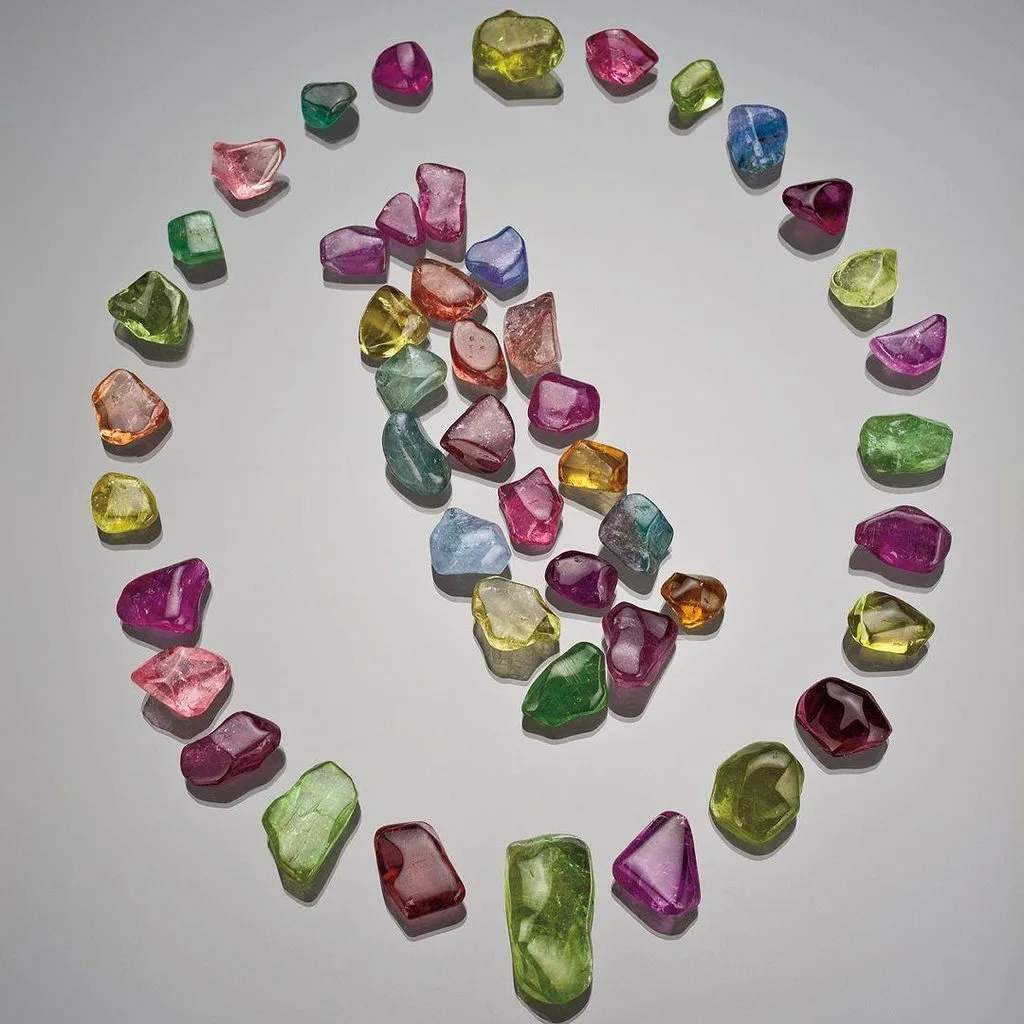
Paraíba tourmaline is associated with specialized geological environments capable of producing chemically unusual tourmaline crystals.
The best-understood primary occurrences are linked to granitic pegmatites.
Formation in Granitic Pegmatites
Pegmatites are igneous rocks commonly characterized by exceptionally large mineral crystals.
Many granitic pegmatites form from chemically evolved, volatile-rich melts during the later stages of granitic magmatic development.
These environments can become enriched in elements such as lithium and boron, which are important for the formation of certain tourmaline minerals.
As suitable melts crystallize, tourmaline may develop within the pegmatite.
For copper-bearing Paraíba tourmaline to form, copper must also be available and incorporated into the growing crystals.
The Brazilian occurrences are associated with lithium-rich granitic pegmatites.
Research has shown that Brazilian copper-bearing tourmaline can crystallize directly from a hydrous, boron- and lithium-rich melt during pegmatite development.
Where Does the Copper Come From?
The origin of copper in Paraíba-forming geological systems remains an important research question.
Although copper is responsible for much of the gemstone’s unusual coloration, its geological source has not been conclusively established for every deposit.
Researchers have investigated possible contributions from pegmatitic systems and interactions involving surrounding rocks or hydrothermal processes.
The available evidence does not justify assigning a single universal copper source to all Paraíba tourmaline deposits.
Primary and Secondary Deposits
Paraíba tourmaline can occur in primary geological deposits or be recovered from secondary accumulations.
Primary deposits contain tourmaline within its original host rock, such as pegmatite.
Secondary deposits form when weathering and erosion release crystals from their source rocks. The gemstones may subsequently accumulate in weathered material, stream sediments, or other sedimentary concentrations.
The original Brazilian deposits are associated with pegmatites.
An important source of Mozambican copper-bearing tourmaline near Mavuco occurs in secondary deposits, where gemstones have been recovered from sedimentary material.
This distinction is important because the location where a gemstone is mined may differ from the location of the original rock in which it crystallized.
Where Is Paraíba Tourmaline Found?
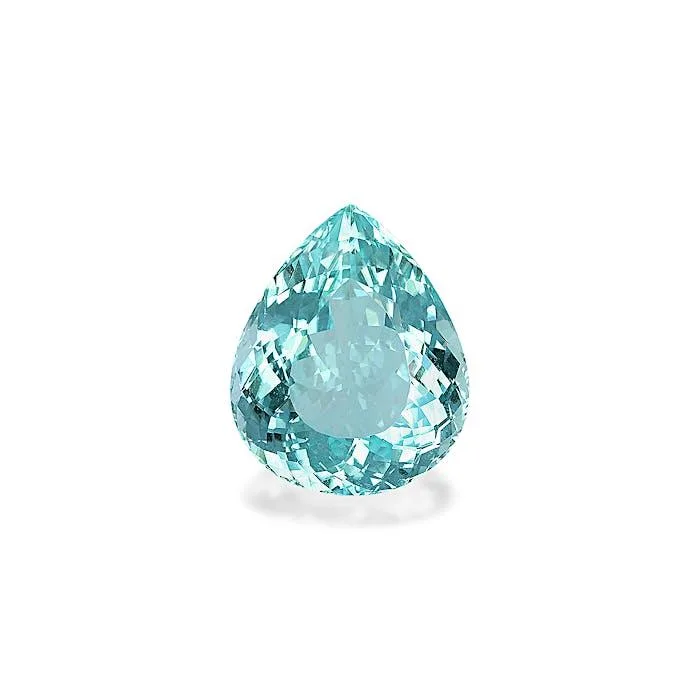
The three major countries associated with established Paraíba tourmaline production are Brazil, Nigeria, and Mozambique.
Brazil
Brazil is the original source of Paraíba tourmaline.
Important occurrences are found in the northeastern states of:
- Paraíba
- Rio Grande do Norte
The original Mina da Batalha occurrence in Paraíba State has particular historical importance.
Brazilian stones are celebrated for their vivid blue and blue-green coloration.
However, not every Brazilian specimen exhibits the same level of color saturation, transparency, or overall gem quality.
Mozambique
Mozambique is an important source of copper-bearing tourmaline.
The Mavuco mining area, in the Alto Ligonha pegmatite region, is especially well documented in gemological research.
The deposits have produced tourmalines with a broad range of colors, including purple, violet, blue, greenish blue, and green.
Some material responds to heat treatment by developing more prominent blue-to-green hues.
Mozambican gemstones may closely resemble Brazilian Paraíba tourmalines, making geographic origin determination a specialized laboratory task.
Nigeria
Nigeria has also produced copper-bearing tourmalines with vivid colors comparable to those found in Brazil and Mozambique.
Nigerian material became known internationally in the early 2000s.
As with stones from other sources, appearance alone does not provide a reliable basis for determining geographic origin.
Does Paraíba Tourmaline Have to Come from Brazil?
No.
The Paraíba name originated from a Brazilian geographic locality, but the widely accepted gemological definition encompasses qualifying copper-bearing tourmalines from different geographic origins.
The definition includes tourmalines in specified blue-to-green color ranges whose coloration is principally associated with copper and manganese.
This means that a gemstone sold as Paraíba tourmaline is not necessarily Brazilian.
For high-value purchases, geographic origin should be supported by a suitable report from a reputable gemological laboratory when origin is an important part of the seller’s claim.
Paraíba Tourmaline Colors
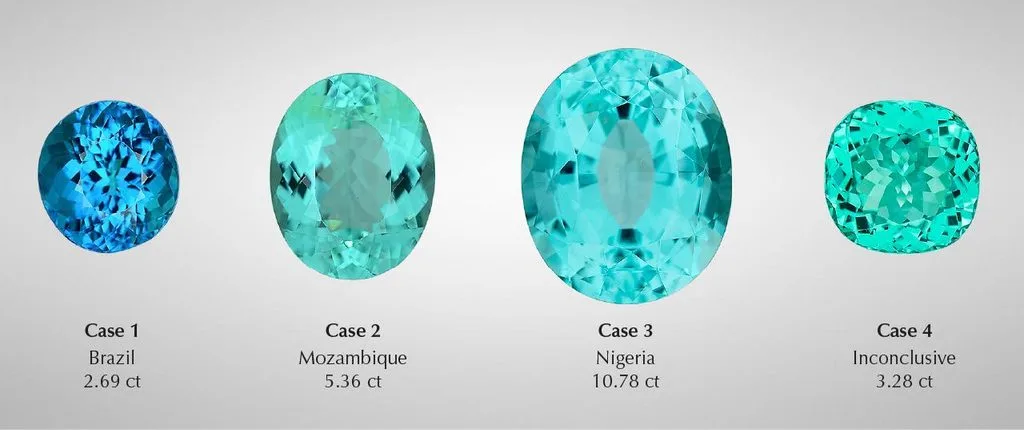
Paraíba tourmaline is best known for vivid blue-to-green hues. The accepted color range includes several related appearances rather than one precise shade.
Electric Blue
Electric-blue Paraíba tourmalines display intense blue coloration and are among the most recognizable examples of this gemstone variety.
The most visually striking specimens often combine high saturation with attractive transparency.
Turquoise Blue
Turquoise-blue stones display a mixture of blue and green components.
This vibrant appearance is strongly associated with Paraíba tourmaline in the gemstone market.
Greenish Blue and Bluish Green
Some specimens display intermediate colors between blue and green.
Their overall appearance depends on the relative contributions of the two hues and the gemstone’s tone and saturation.
Green and Yellowish Green
Qualifying Paraíba tourmalines may also show vivid green or yellowish-green coloration.
These colors fall within the broader recognized trade definition, provided the gemstone satisfies the relevant gemological characteristics.
Violet-Blue
Violet-blue is also part of the recognized Paraíba color range.
Manganese-related absorption may contribute to violet or purple components in copper-bearing tourmaline.
Purely pink or purple copper-bearing tourmalines should not automatically be classified as Paraíba tourmaline merely because copper is present.
The observed color and accepted nomenclature criteria must both be considered.
Heat Treatment of Paraíba Tourmaline
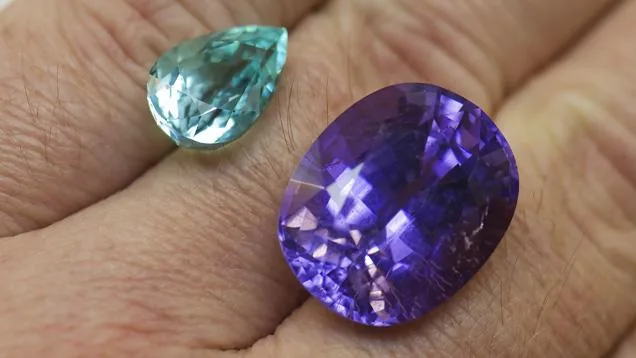
Heat treatment is an established practice for modifying the appearance of some copper-bearing tourmalines.
Certain stones naturally display strong violet or purple color components associated with manganese.
Controlled heating can change the oxidation state of manganese, reducing its contribution to visible-light absorption.
In suitable specimens, this can produce a more pronounced blue or green appearance.
Is Every Paraíba Tourmaline Heated?
No.
Some stones naturally display desirable blue or green colors and may not require heat treatment.
Other stones undergo heating to improve their appearance.
The presence or absence of treatment cannot always be established reliably from visual inspection.
Can Laboratories Detect Heat Treatment?
Heat treatment in copper-bearing tourmaline is not always detectable.
Some microscopic features may offer clues, but their presence or absence is not necessarily conclusive.
Consequently, treatment determinations can be limited by the nature of the gemstone and currently available testing methods.
Does Heating Make Paraíba Tourmaline Fake?
No.
A natural tourmaline remains a natural gemstone after heat treatment.
However, treatments should be disclosed appropriately in gemstone transactions.
A treated natural gemstone should not be confused with a synthetic gemstone or an imitation.
How to Identify Paraíba Tourmaline
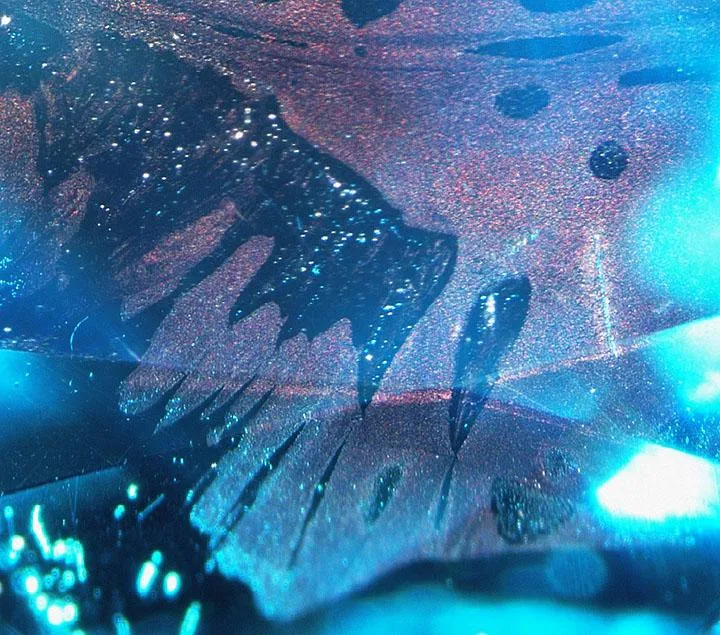
The identification of Paraíba tourmaline involves establishing the mineral identity and determining whether the gemstone meets the relevant color and chemical criteria.
Visual Examination
Color provides an initial indication, but it is not sufficient for positive identification.
Other tourmalines and unrelated gemstones can display similar blue or green colors.
Standard Gemological Testing
Gemologists use optical and physical measurements to identify tourmaline.
These can include:
- Refractive index
- Birefringence
- Pleochroism
- Specific gravity
- Microscopic characteristics
Such measurements help identify a gemstone as tourmaline but generally cannot establish that it is Paraíba tourmaline or determine its geographic origin by themselves.
Spectroscopic Analysis
Spectroscopy provides information about how a gemstone absorbs different wavelengths of light.
Copper-bearing tourmalines can exhibit absorption features associated with copper and manganese.
This information contributes to the identification of their color-causing elements.
Chemical Analysis
Advanced laboratory analysis can determine concentrations of chemical elements in the gemstone.
Techniques such as laser ablation inductively coupled plasma mass spectrometry (LA-ICP-MS) are used by specialized laboratories to characterize copper-bearing tourmalines.
Chemical analysis is especially important when determining geographic origin.
Determining Geographic Origin
Geographic origin determination is more difficult than identifying a gemstone as tourmaline.
Stones from Brazil, Mozambique, and Nigeria can overlap in appearance and conventional gemological properties.
GIA research has demonstrated that quantitative trace-element analysis provides useful chemical fingerprints.
Elements particularly important for origin discrimination include:
- Copper (Cu)
- Zinc (Zn)
- Gallium (Ga)
- Strontium (Sr)
- Tin (Sn)
- Lead (Pb)
By comparing analytical data with reference samples of known provenance, laboratories can identify the likely geographic origin of many specimens.
However, some gemstones have chemical characteristics that overlap between deposits or fall outside established reference ranges.
In these cases, the origin determination may be inconclusive.
Why Is Paraíba Tourmaline So Valuable?
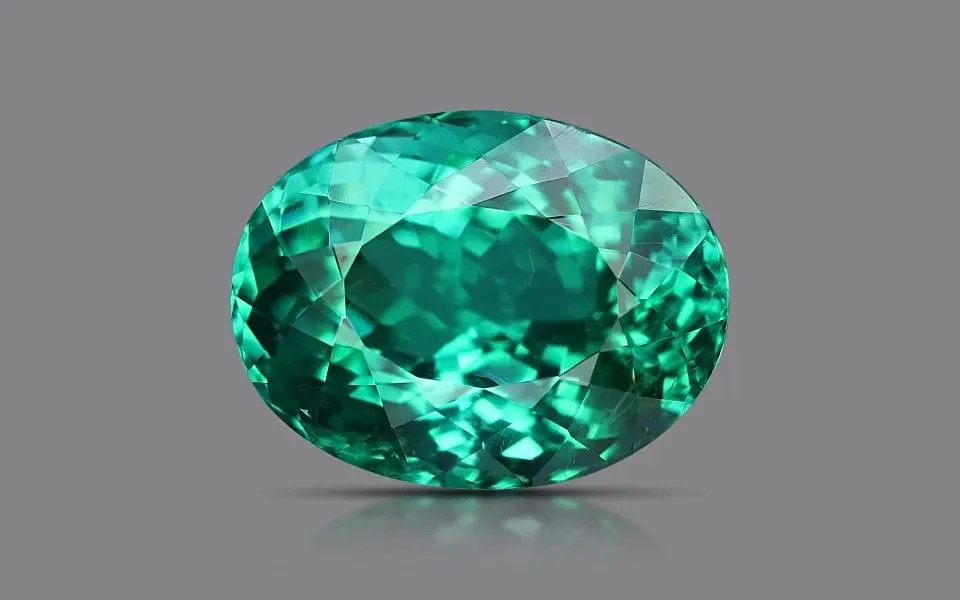
Paraíba tourmaline is valued for its unusual color, gemstone quality, rarity of exceptional specimens, and collector demand.
Although its name is strongly associated with expensive gemstones, the value of individual specimens varies considerably.
Color Quality
Color is a major consideration in Paraíba tourmaline valuation.
Stones displaying vivid, attractive blue or blue-green colors are highly sought after.
Hue, tone, and saturation all influence the overall appearance.
Clarity
Transparent stones with relatively few visually distracting inclusions are generally desirable.
However, natural inclusions are common in many tourmalines.
A gemstone with exceptional color may still be attractive despite visible inclusions.
Cut and Brilliance
A skilled cut enhances the gemstone’s appearance and helps display its color effectively.
Tourmaline’s optical properties, including pleochroism, can influence cutting orientation.
The proportions of the gemstone also affect its brightness and visual appeal.
Carat Weight
Large, fine-quality Paraíba tourmalines are relatively scarce.
Exceptional stones combining vivid color, good transparency, and larger size may command substantial premiums.
However, carat weight alone does not establish value.
Geographic Origin
Proven Brazilian origin can influence market value, particularly for high-quality gemstones.
The geographic source should nevertheless be considered alongside color, clarity, size, cut, and documentation.
Fine-quality stones also occur in African deposits.
Treatments and Documentation
Treatment history and laboratory documentation may affect buyer confidence and commercial value.
For valuable specimens, reputable gemological reports are particularly useful.
A laboratory identification or origin report should not automatically be treated as a monetary appraisal.
Paraíba Tourmaline vs. Indicolite
Paraíba tourmaline and indicolite are both associated with blue tourmaline, but the terms describe different characteristics.
| Feature | Paraíba Tourmaline | Indicolite |
|---|---|---|
| Classification | Recognized copper-related gemological variety | Trade name for blue tourmaline |
| Typical coloration | Vivid blue to green | Blue, often with variable greenish or darker tones |
| Color-causing elements | Primarily copper, with manganese also important | Commonly iron-related |
| Mineral group | Tourmaline | Tourmaline |
| Mohs hardness | Approximately 7–7.5 | Approximately 7–7.5 |
| Identification | Appropriate color and chemical characteristics | Blue color and tourmaline identity |
The distinction cannot always be made reliably from photographs or visual inspection alone.
Chemical testing may be necessary.
Paraíba Tourmaline in Jewelry
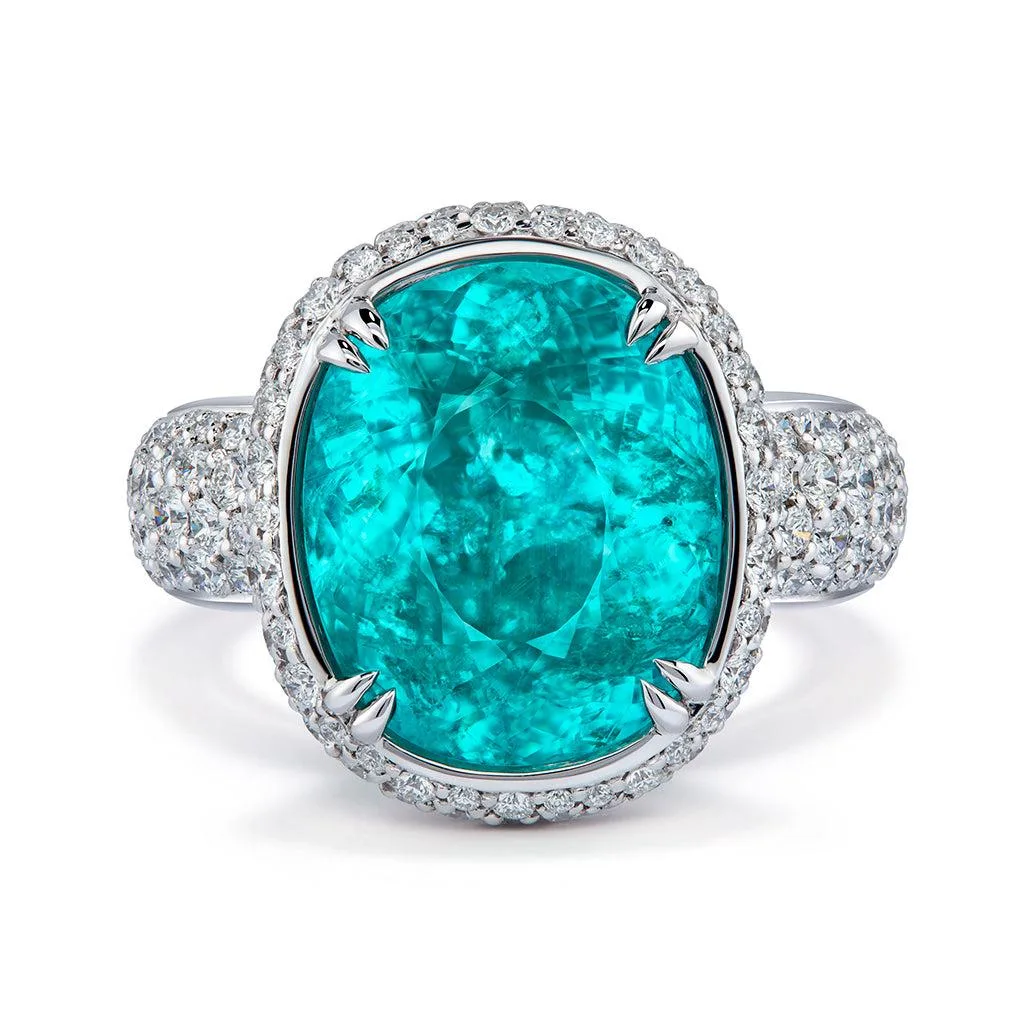
The striking colors of Paraíba tourmaline make it particularly attractive for fine jewelry.
Faceted stones are used in:
- Rings
- Pendants
- Earrings
- Necklaces
- Collector gemstones
Its vivid blue and turquoise shades can contrast beautifully with both white and yellow precious metals.
With a Mohs hardness of 7–7.5, tourmaline has reasonable resistance to scratching during normal wear.
However, it is not immune to impact damage.
Tourmaline’s toughness is generally considered fair, and gemstones containing significant fractures or inclusions may require additional protection.
Protective settings and careful handling are particularly important for rings.
How to Clean and Care for Paraíba Tourmaline
Paraíba tourmaline should be cleaned gently to protect the gemstone and any treatments or internal features.
Recommended care:
- Clean with warm, soapy water.
- Use a soft cloth or soft brush.
- Rinse carefully and dry with a clean cloth.
- Avoid sudden temperature changes.
- Protect the gemstone from strong impacts.
- Store jewelry separately from harder gemstones.
Avoid ultrasonic and steam cleaners. GIA recommends warm, soapy water as the preferred method for cleaning tourmaline.
High temperatures may damage tourmaline or alter its appearance, and thermal shock can cause fracturing.
Frequently Asked Questions
Is Paraíba tourmaline a real mineral?
Paraíba tourmaline is a recognized gemological variety of tourmaline, not a separate mineral species. Most specimens belong to elbaite, although other tourmaline species have also been documented.
What makes Paraíba tourmaline different from ordinary tourmaline?
Its distinctive blue-to-green coloration is primarily associated with copper, with manganese also playing an important role. This unusual chemical combination produces the vivid appearance for which the gemstone is known.
Is Paraíba tourmaline only found in Brazil?
No. Qualifying copper-bearing tourmalines are also found in Nigeria and Mozambique. The Paraíba trade designation is not restricted to Brazilian origin.
Why does Paraíba tourmaline look neon blue?
The apparent neon effect results from the gemstone’s color saturation and its interaction with visible light. It does not produce light independently.
Can Paraíba tourmaline be heat-treated?
Yes. Heating can modify manganese-related color components in some copper-bearing tourmalines, making blue-to-green colors more prominent.
How can Paraíba tourmaline be identified?
Identification requires appropriate gemological examination. Chemical and spectroscopic methods may be needed to confirm the characteristics associated with Paraíba tourmaline.
Can a laboratory determine where Paraíba tourmaline was mined?
Often, yes. Specialized quantitative trace-element analysis can distinguish many Brazilian, Nigerian, and Mozambican stones. However, some results remain inconclusive.
Is Paraíba tourmaline suitable for rings?
Yes, but careful handling and protective settings are advisable. Its hardness provides reasonable scratch resistance, while its susceptibility to impact damage depends on factors such as fractures and inclusions.
Why is Brazilian Paraíba tourmaline often more expensive?
Brazilian origin can carry a market premium because of the gemstone’s historical significance, limited supply, and collector demand. Nevertheless, color and overall quality remain essential factors in valuation.
Conclusion
Paraíba tourmaline is one of the most remarkable gemstone varieties in the tourmaline group.
Its vivid blue-to-green colors arise from unusual copper-related crystal chemistry, while its geological occurrence is associated with specialized pegmatitic environments and related secondary deposits.
Since the original discoveries in northeastern Brazil, additional deposits in Nigeria and Mozambique have demonstrated that these distinctive gemstones can form in different geological regions.
The combination of unusual coloration, scientific interest, and limited availability of exceptional specimens makes Paraíba tourmaline especially significant to mineral collectors, gemologists, and jewelry enthusiasts.
References
- GIA (2019). Geographic Origin Determination of Paraíba Tourmaline.
- Laurs, B. M., et al. (2008). Copper-Bearing Tourmaline from Mozambique. Gems & Gemology.
- Fritsch, E., et al. (1990). Paraíba Tourmalines. Gems & Gemology.
- GIA. Tourmaline Care and Cleaning Guide.