
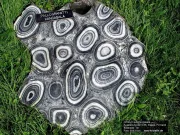
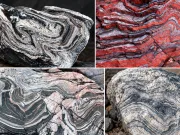



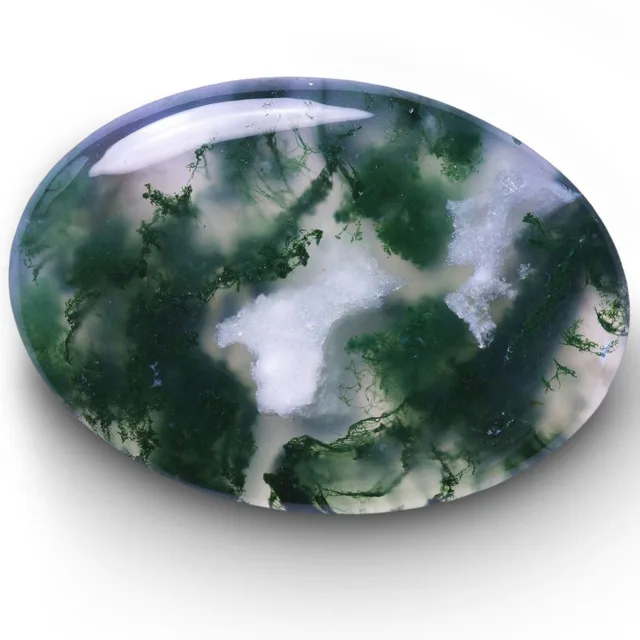
Moss agate is a distinctive variety of chalcedony recognized for its intricate green, brown, and black mineral inclusions that resemble moss, miniature forests, branching plants, or natural landscapes. These patterns occur within a typically translucent, colorless, white, or grayish silica-rich material, making each specimen visually unique.
Despite its name, moss agate contains no actual moss or preserved vegetation. Its natural patterns are produced by inorganic mineral inclusions, commonly including chlorite and hornblende, along with iron and manganese oxides.
Moss agate is particularly interesting because it illustrates how mineral growth and the deposition of silica can combine to create complex patterns that closely resemble living organisms.
Although widely used as a gemstone and ornamental material, moss agate is also an excellent subject for studying chalcedony, mineral inclusions, and the formation of patterned silica deposits.
What Is Moss Agate?
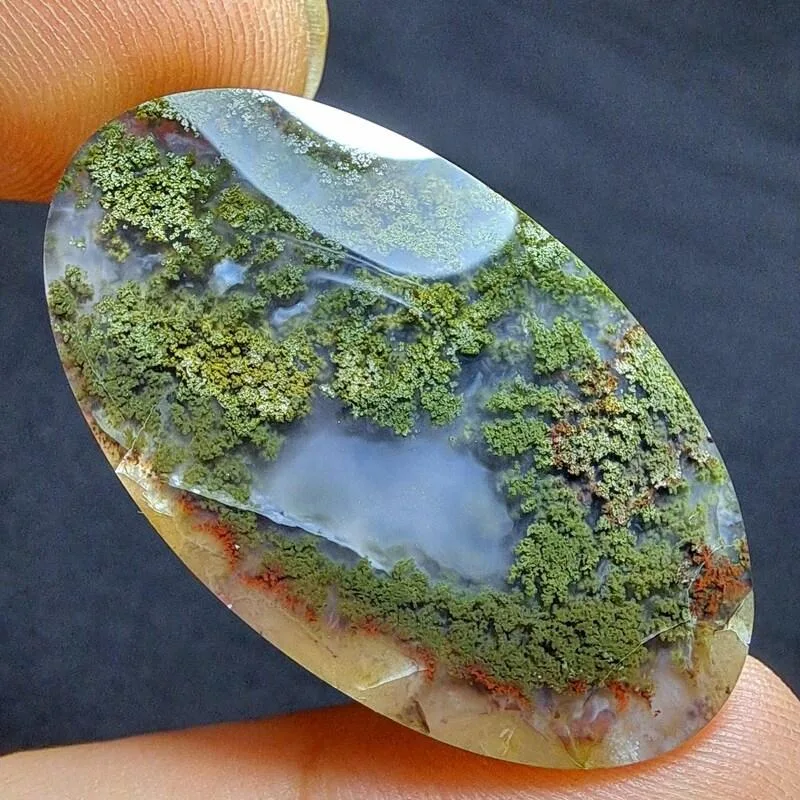
Moss agate is a variety of chalcedony, a fine-grained form of silica composed predominantly of microscopic quartz, commonly accompanied by moganite.
It belongs to the broader quartz family and has a chemical composition dominated by silicon dioxide (SiO₂).
Unlike many varieties of agate that exhibit conspicuous concentric or parallel bands, moss agate is identified primarily by its moss-like mineral inclusions.
The term moss agate is widely accepted in mineral collecting and the gemstone trade, even though many specimens lack the banding traditionally associated with agate.
Its most recognizable features include:
- Green, brown, or black inclusions resembling moss or foliage
- A translucent to milky-white chalcedony background
- Irregular branching, filamentous, or cloud-like mineral patterns
- A hardness similar to other varieties of quartz
- Attractive natural patterns that become especially visible after polishing
The distinctive appearance is caused by mineral inclusions rather than organic material or fossilized plants.
Chemical Composition and Mineral Classification
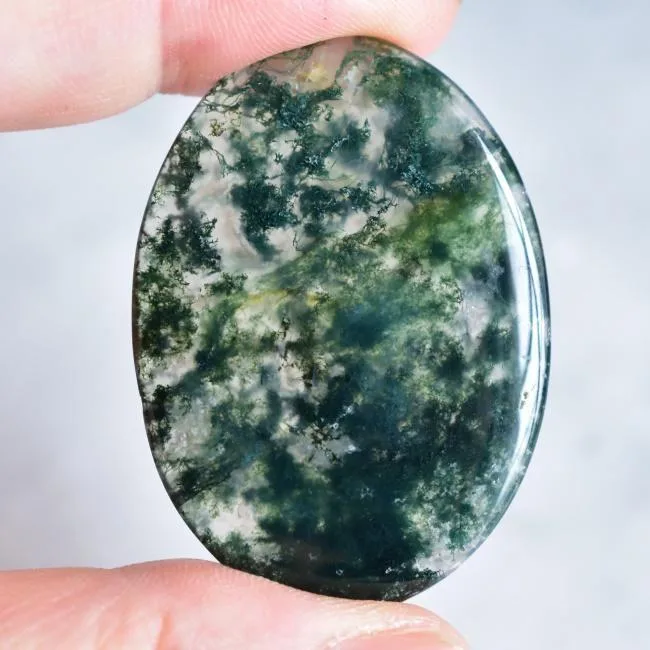
Moss agate is classified as a variety of chalcedony within the quartz family.
Its principal chemical component is silicon dioxide.
Chemical formula: SiO₂
The visible inclusions, however, are composed of other minerals and contribute to the stone’s characteristic appearance.
Mineralogical Properties
| Property | Description |
|---|---|
| Mineral classification | Silicate |
| Mineral family | Quartz |
| Variety | Chalcedony |
| Chemical composition | Predominantly SiO₂ |
| Common colors | Colorless, white, gray, green, brown, black, and reddish tones |
| Main inclusions | Chlorite, hornblende, iron oxides, and manganese oxides |
| Mohs hardness | Approximately 6.5–7 |
| Luster | Waxy to vitreous |
| Transparency | Usually translucent; some portions may be opaque |
| Refractive index | Approximately 1.53–1.54 |
| Specific gravity | Typically around 2.6 |
| Cleavage | None |
| Fracture | Commonly conchoidal to uneven |
| Texture | Microcrystalline to cryptocrystalline |
The values are representative of chalcedony and can vary slightly because natural moss agate contains different proportions of mineral inclusions and microscopic silica phases.
How Does Moss Agate Form?
Moss agate forms through geological processes involving silica deposition and mineral growth.
Its formation is associated with silica-rich fluids moving through openings, cavities, or fractures in rocks.
Under suitable chemical conditions, silica precipitates and gradually develops into chalcedony.
The characteristic moss-like patterns arise when other minerals are incorporated into the silica or form within suitable spaces during the rock’s mineralization history.
1. Movement of Silica-Rich Fluids
Groundwater and hydrothermal fluids can dissolve and transport silica from surrounding rocks.
When environmental conditions change, dissolved silica may become less stable in solution and begin to precipitate.
Changes in temperature, water chemistry, and fluid interaction with surrounding rocks can influence this process.
Silica may accumulate in fractures, cavities, and other available spaces.
2. Formation of Chalcedony
As silica is deposited, fine-grained chalcedony can develop.
Chalcedony consists of intergrown microscopic silica crystals, giving it a compact appearance and allowing some specimens to transmit light.
The resulting material can range from relatively clear to milky white or gray.
3. Development of Mineral Inclusions
The moss-like appearance develops where other minerals occur within the chalcedony.
Green minerals such as chlorite and hornblende can produce irregular patches, filaments, and branching forms.
Iron and manganese oxides may contribute darker patterns or reddish-brown coloration.
These mineral features may originate through more than one growth or alteration process.
Their exact formation history depends on the geological setting and cannot always be determined solely from a polished specimen.
4. Weathering and Exposure
Once formed, moss agate can become exposed through weathering and erosion of its host rock.
Because silica is relatively resistant to many weathering processes, pieces of chalcedony may survive as fragments, nodules, or pebbles.
Some specimens are subsequently transported and concentrated in sedimentary deposits.
What Causes the Moss-Like Patterns?
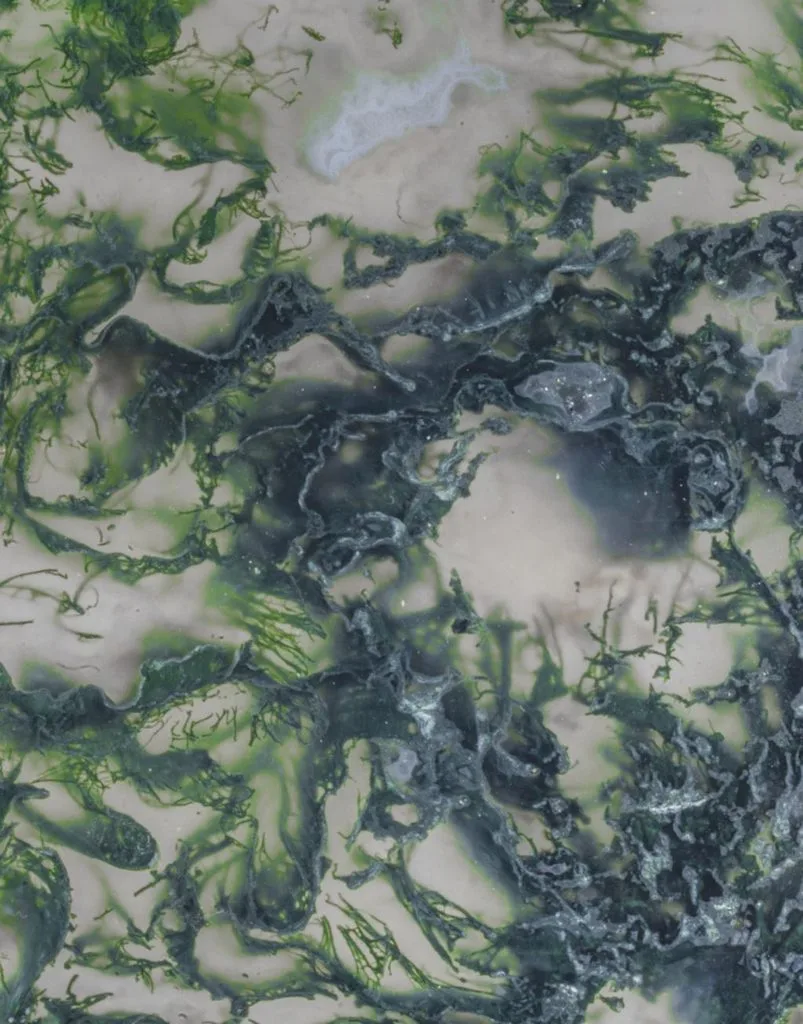
The most distinctive feature of moss agate is the presence of mineral patterns that resemble natural vegetation.
These patterns are not fossils. They result from mineral growth, inclusions, and chemical processes within or associated with the chalcedony.
Chlorite Inclusions
Chlorite is a group of sheet silicate minerals commonly associated with green coloration.
In moss agate, chlorite-group minerals can occur as irregular green patches or fine branching features.
Their distribution may create an appearance resembling moss, algae, or small plants.
Hornblende Inclusions
Hornblende is a name commonly used for dark amphibole minerals.
Green to dark-green amphibole inclusions are among the mineral components historically identified in moss agate.
Depending on their shape and distribution, these inclusions can produce dense or branching patterns.
Iron Oxides
Iron-bearing minerals can contribute yellow, orange, red, and brown colors.
Oxidation of iron-bearing minerals may also modify the appearance of previously green inclusions.
The exact mineral responsible for a particular color cannot always be identified by appearance alone.
Manganese Oxides
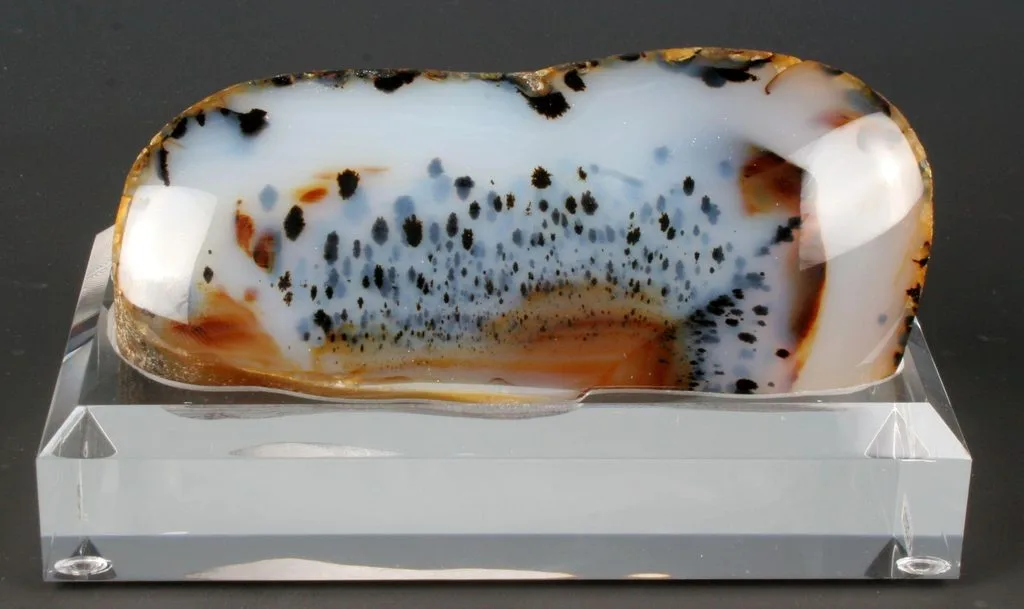
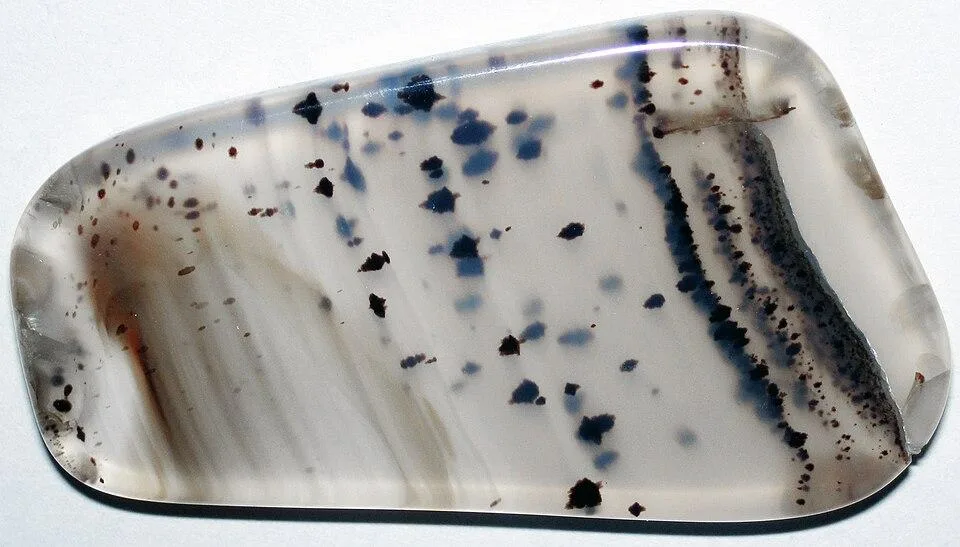
Manganese oxides can produce dark branching patterns called dendrites.
These structures may resemble miniature trees or fern leaves.
Dendritic patterns form through inorganic mineral deposition and do not demonstrate the presence of ancient biological organisms.
Colors and Patterns of Moss Agate
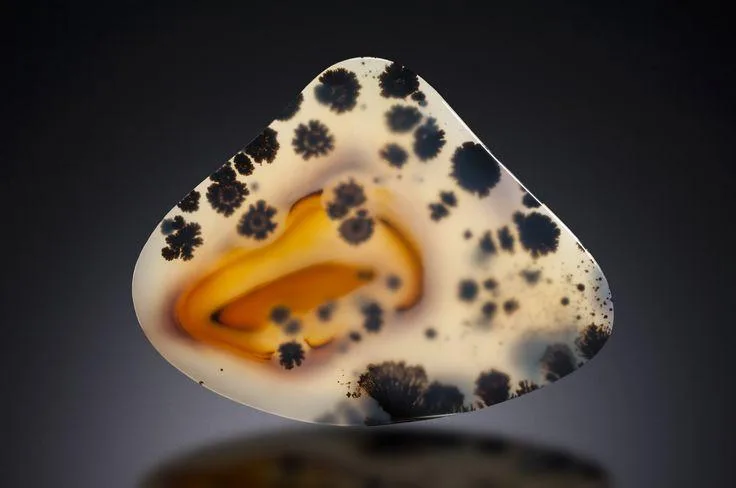
Moss agate displays a wide variety of naturally occurring patterns.
Green Moss Agate
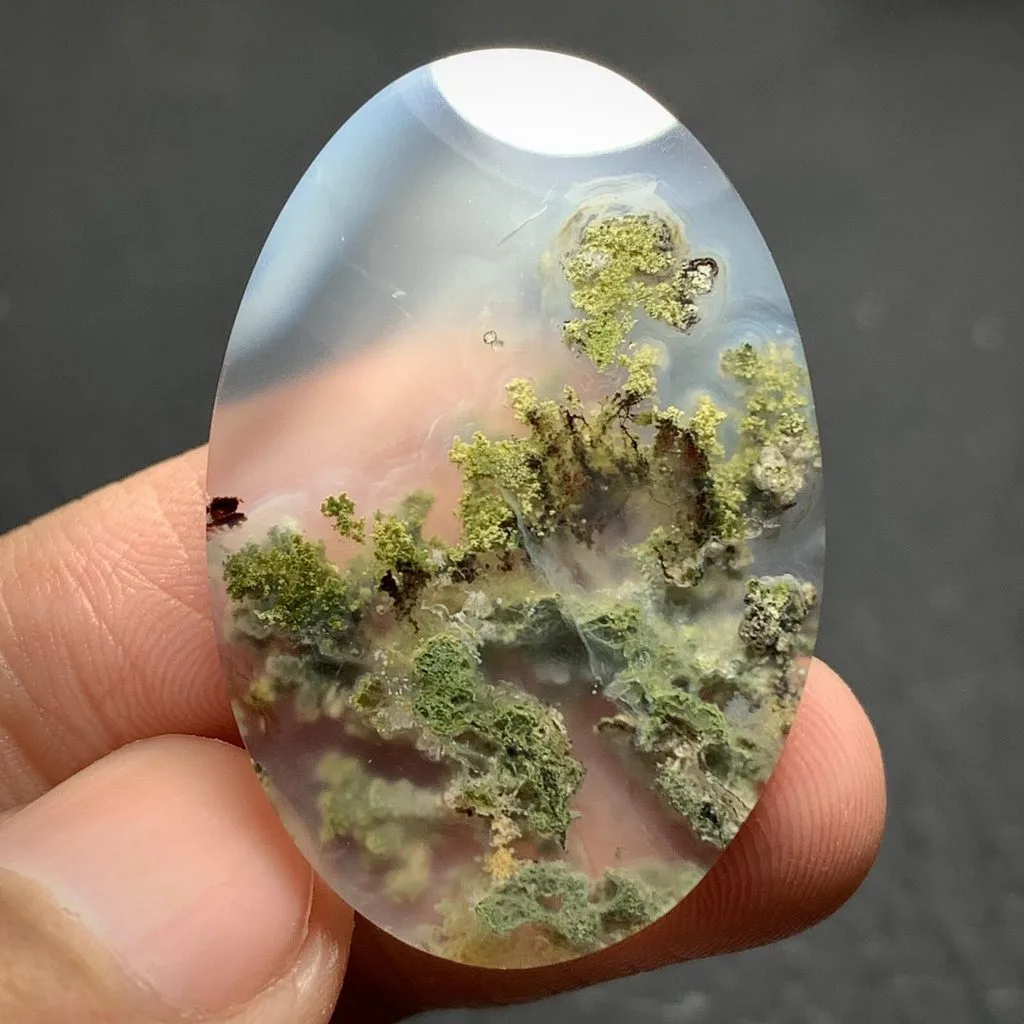
The most familiar variety contains green mineral inclusions within translucent or milky chalcedony.
The green patterns may appear as scattered patches, fine strands, or dense clusters.
Brown and Reddish Moss Agate
Brown, orange, and reddish features are commonly associated with iron-bearing minerals and their oxidation products.
These colors may occur alongside green inclusions.
Black Dendritic Patterns
Some specimens contain dark, branching mineral features resembling trees, roots, or ferns.
Such patterns are often associated with manganese and iron oxides.
Landscape Moss Agate
The term landscape moss agate is sometimes used informally for specimens whose internal patterns resemble forests, mountains, clouds, or miniature landscapes.
This is a descriptive appearance-based name rather than a separate mineralogical classification.
Where Is Moss Agate Found?
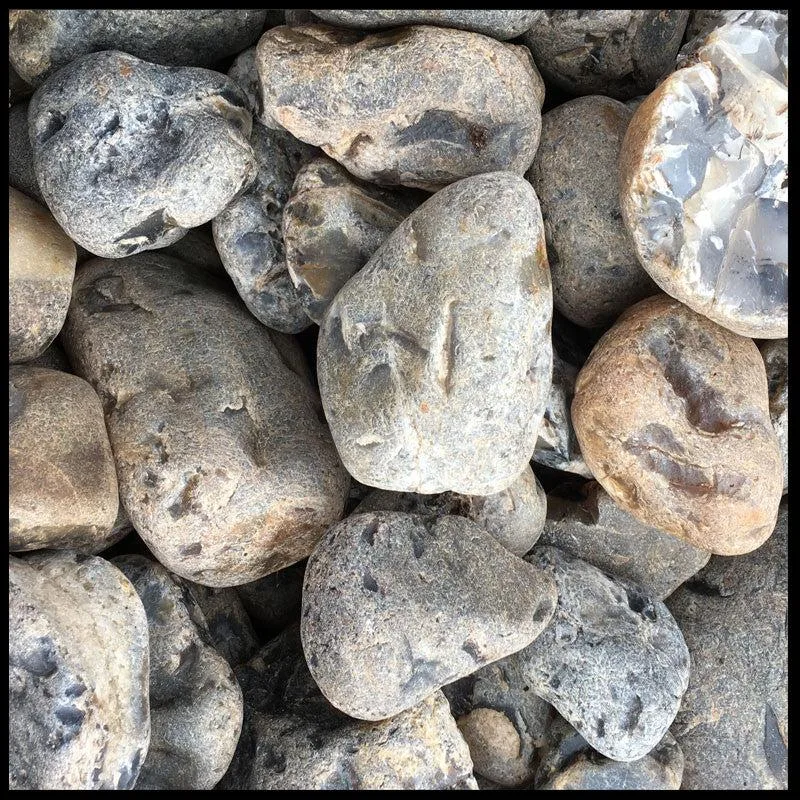
Moss agate occurs in several parts of the world where suitable silica-rich geological environments are present.
Documented occurrences include regions of the United States, India, and other countries.
United States
Moss agate and related patterned chalcedony occur in parts of the western United States.
Montana is particularly well known for collectible agates, including specimens with dark branching inclusions.
However, not all agates containing dendritic patterns are necessarily classified as typical green moss agate.
India
India is a recognized source of moss agate and other varieties of chalcedony.
Some Indian material is known for green, plant-like inclusions within a pale or translucent background.
Other Occurrences
Moss agate and closely related patterned chalcedony have also been reported from additional localities worldwide.
The presence of quartz or ordinary agate in a country does not automatically establish that it is an important commercial source of moss agate.
Reliable locality information should be based on documented specimens and geological records.
Moss Agate vs. Dendritic Agate
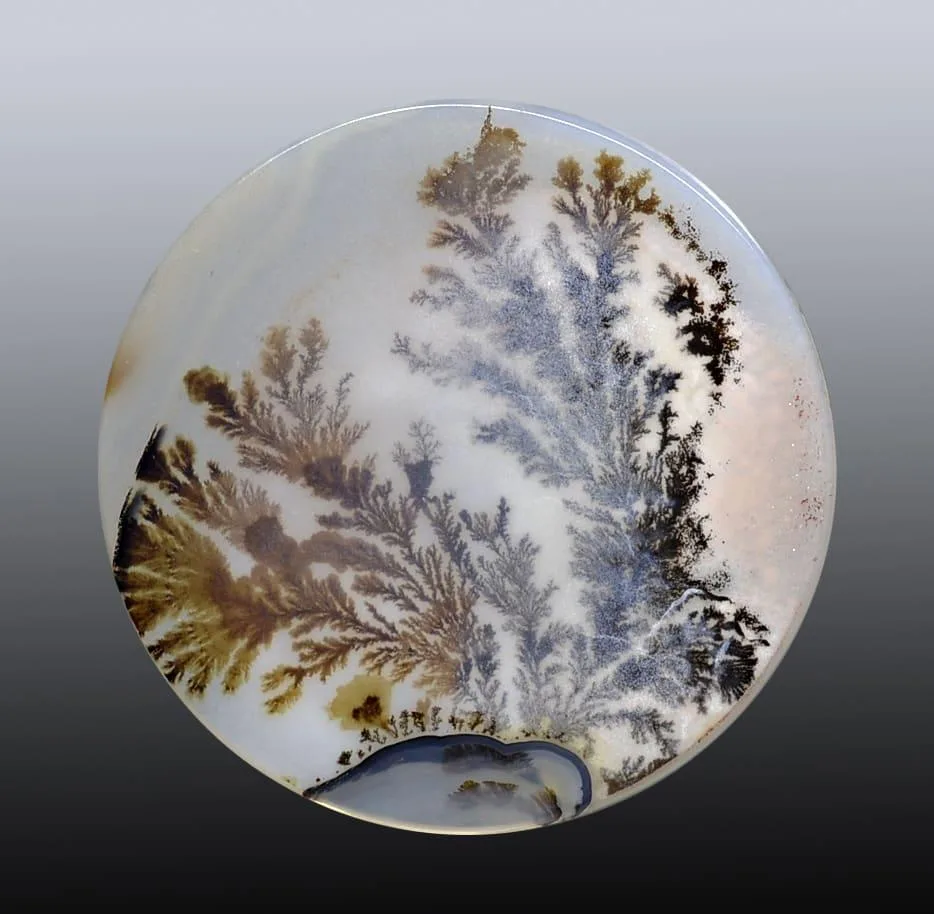
Distinct branching, tree-like dendrites.
Moss agate and dendritic agate are descriptive varieties of chalcedony distinguished mainly by the appearance of their mineral inclusion patterns.
Moss agate and dendritic agate are closely related terms, and their use can overlap.
Both describe varieties of chalcedony containing mineral inclusions that form natural-looking patterns.
However, the names typically emphasize different appearances.
| Feature | Moss Agate | Dendritic Agate |
|---|---|---|
| Base material | Chalcedony | Chalcedony |
| Typical patterns | Moss-like, cloudy, filamentous, or branching | Tree-like or fern-like branching |
| Common inclusion colors | Green, brown, black | Black, brown |
| Characteristic minerals | Chlorite, amphiboles, and other inclusions | Commonly manganese or iron oxides |
| Banding | Usually absent | Usually absent |
| Appearance | Often resembles moss or underwater vegetation | Often resembles small trees or branching landscapes |
These distinctions describe common appearances rather than rigid mineralogical boundaries.
A specimen may exhibit features associated with both terms.
Moss Agate vs. Tree Agate
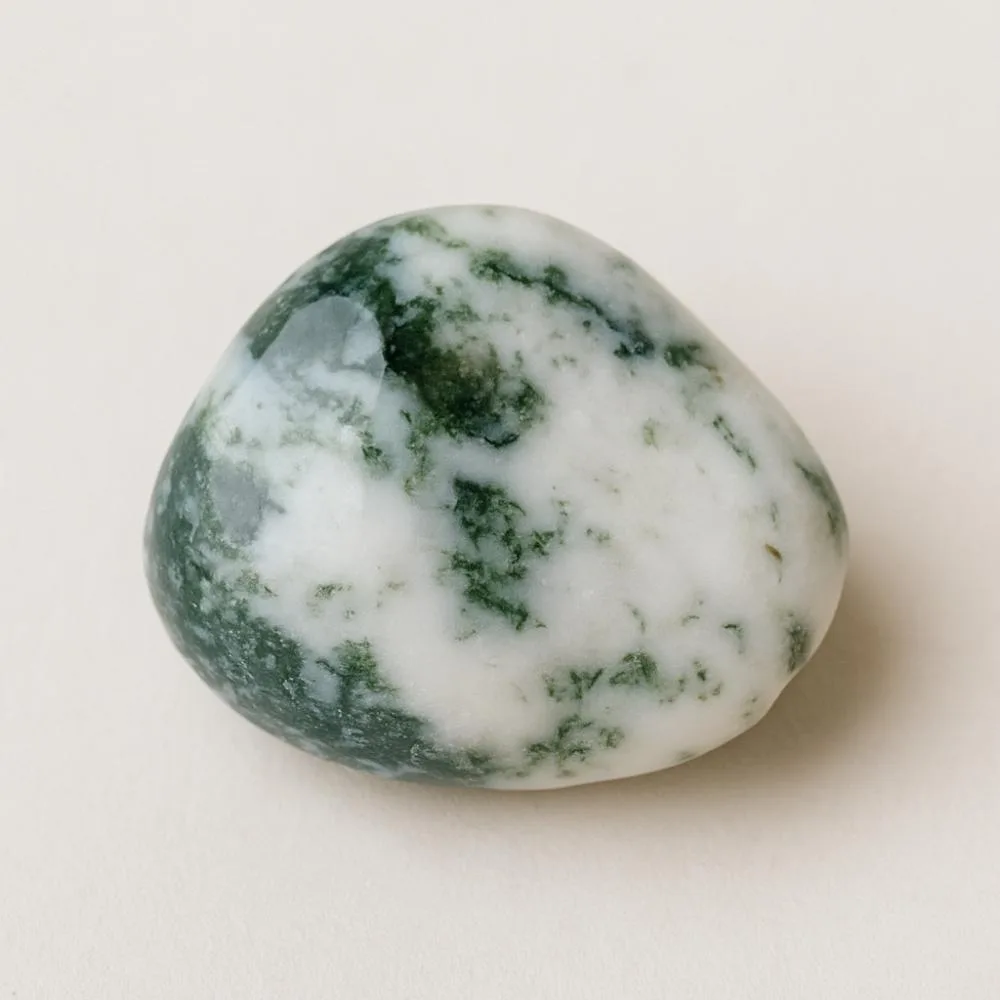
Predominantly opaque white chalcedony with green patterns.
Tree agate is another descriptive variety name used for chalcedony with green mineral patterns.
The distinction is usually based on the background material and overall appearance.
Moss agate commonly has a more translucent background, allowing the inclusions to appear suspended inside the stone.
Tree agate is commonly used for relatively opaque, white chalcedony containing green, branch-like patterns.
Because these are descriptive trade names, individual specimens do not always fit neatly into one category.
How to Identify Moss Agate
Moss agate is generally recognized through a combination of chalcedony properties and its distinctive mineral inclusions.
1. Examine the Patterns
Look for irregular green, brown, or dark mineral features resembling moss, foliage, or branching growth.
The patterns should appear to be part of the stone rather than material attached to its outer surface.
2. Check Transparency
Many moss agates are translucent, particularly where the chalcedony contains relatively few inclusions.
Holding a polished specimen against a light source can help reveal internal patterns.
However, some portions of the stone may be opaque.
3. Observe the Luster
Polished chalcedony generally displays a waxy to vitreous luster.
Rough specimens may have a less reflective surface.
4. Consider Hardness
Chalcedony generally has a Mohs hardness of approximately 6.5–7.
Hardness testing may help distinguish it from softer materials, but destructive scratch testing should be avoided on valuable or polished specimens.
5. Use Professional Testing When Necessary
Gemological examination can help establish whether a specimen is chalcedony.
Advanced methods such as Raman spectroscopy or microscopic mineral analysis may be required when the identity of specific inclusions is uncertain.
Visual appearance alone cannot always determine their exact mineral composition.
Uses of Moss Agate
Moss agate is primarily valued for its decorative appearance.
Jewelry
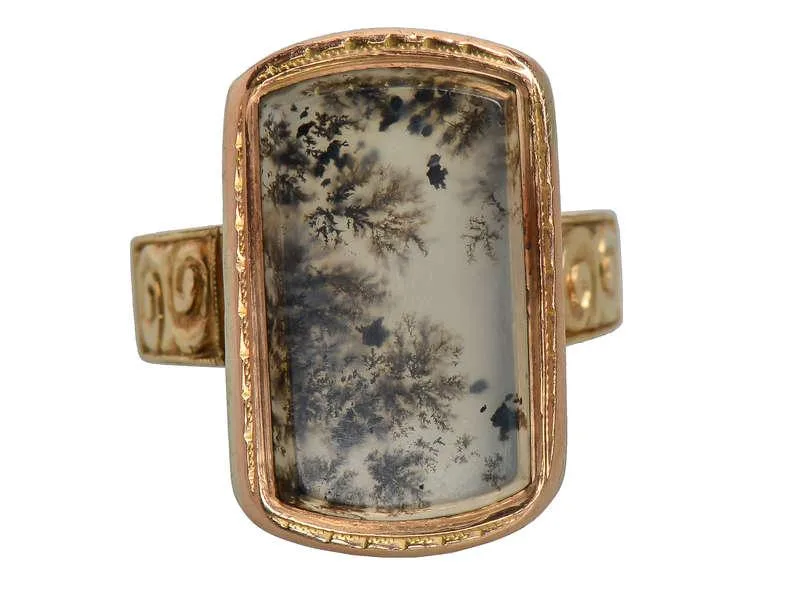
The stone is frequently cut into cabochons and used in rings, pendants, earrings, bracelets, and necklaces.
Cabochon cutting is particularly effective because the smooth polished surface reveals internal patterns without the visual complexity of numerous facets.
Decorative Objects
Larger specimens can be polished into slabs, spheres, carvings, or ornamental pieces.
Patterns resembling forests or natural landscapes are particularly appreciated by collectors.
Mineral Collections
Moss agate is popular among mineral collectors because each specimen displays a distinctive arrangement of inclusions.
Its appearance also makes it useful for illustrating the relationship between silica deposition and secondary mineral formation.
How to Clean and Care for Moss Agate
Moss agate has good resistance to everyday scratching because of its relatively high hardness.
However, it can still fracture or chip when struck.
For routine care:
- Wash gently with lukewarm water and mild soap.
- Use a soft cloth or brush to remove dirt.
- Avoid strong impacts and abrasive cleaning materials.
- Protect the stone from sudden temperature changes.
- Store polished specimens separately from harder gemstones.
- Avoid aggressive chemical treatments and uncertain ultrasonic cleaning procedures.
Gentle cleaning is preferable, especially when the specimen contains fractures or has been incorporated into jewelry.
Frequently Asked Questions
Is moss agate a real agate?
Moss agate is a recognized variety of chalcedony. However, it usually lacks the conspicuous banding characteristic of typical agate. Its name is accepted in mineral collecting and the gemstone trade.
Does moss agate contain real moss?
No. The moss-like patterns consist of inorganic mineral inclusions, not plants, algae, or fossilized vegetation.
What makes moss agate green?
Green coloration is commonly associated with minerals such as chlorite and hornblende occurring as inclusions within chalcedony.
Is moss agate a type of quartz?
Yes. Moss agate is a variety of chalcedony, which belongs to the quartz family and is composed predominantly of silica.
How hard is moss agate?
Moss agate generally has a Mohs hardness of approximately 6.5–7, similar to other chalcedony varieties.
Is moss agate the same as dendritic agate?
Not exactly. Both are descriptive varieties of chalcedony with mineral patterns. Moss agate commonly emphasizes green, moss-like inclusions, while dendritic agate commonly emphasizes dark, tree-like branching patterns. The terminology can overlap.
Is moss agate rare?
Moss agate is not generally considered an exceptionally rare gemstone. However, specimens with particularly attractive, detailed, or unusual patterns can be desirable to collectors.
Can moss agate contain fossils?
The characteristic moss-like patterns are mineral inclusions rather than fossils. Their resemblance to plants is visual, not evidence of biological origin.
Conclusion
Moss agate is a fascinating example of how geological processes can create naturally occurring patterns that resemble living organisms.
Although its appearance suggests moss, ferns, or miniature landscapes, these features are produced by mineral inclusions within chalcedony.
The combination of silica deposition, mineral growth, chemical changes, and geological weathering creates the remarkable variety of colors and patterns found in moss agate.
As both a decorative gemstone and a geological specimen, moss agate provides an accessible illustration of the complexity and beauty of mineral formation.
References
- Mindat.org. Moss Agate: Mineral Information, Data and Localities. Mineral classification, composition, and characteristic inclusions.
- Gemdat.org. Moss Agate: Gemstone Information. Mineralogical properties, colors, inclusions, and gemological description.
- Gemdat.org. Dendritic Agate: Gemstone Information. Dendritic inclusions and terminology.
- International Gem Society. Moss Agate Engagement Ring Guide. Green mineral inclusions, appearance, and jewelry considerations.
- Gemological Institute of America. Gems & Gemology — Fall 1983. Chalcedony properties and moss agate classification.