









Formation, Types, and Pressure Solution
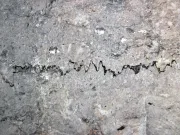
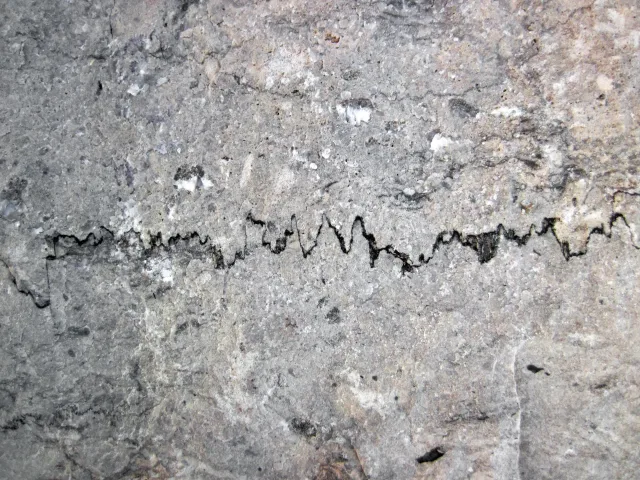
Some limestone surfaces contain dark, jagged lines that look like tiny mountain ranges, lightning bolts, or the teeth of a saw. These irregular seams may appear almost like cracks, but many are actually evidence of rock material that disappeared through chemical dissolution.
These structures are called stylolites, and they preserve important information about how rocks respond to burial, compression, and fluid-assisted deformation.
Stylolites are particularly common in limestone, where calcite can dissolve along stressed surfaces while less soluble materials become concentrated along the resulting boundary.
Unlike ordinary fractures, stylolites record the removal of rock material rather than the opening of a gap.
Stylolites are irregular, interlocking dissolution surfaces formed through pressure solution, a process in which minerals dissolve preferentially along stressed contacts and the dissolved material is transported away by fluids.
They are important for understanding limestone compaction, tectonic stress, rock deformation, and fluid movement through the Earth’s crust.
What Are Stylolites?
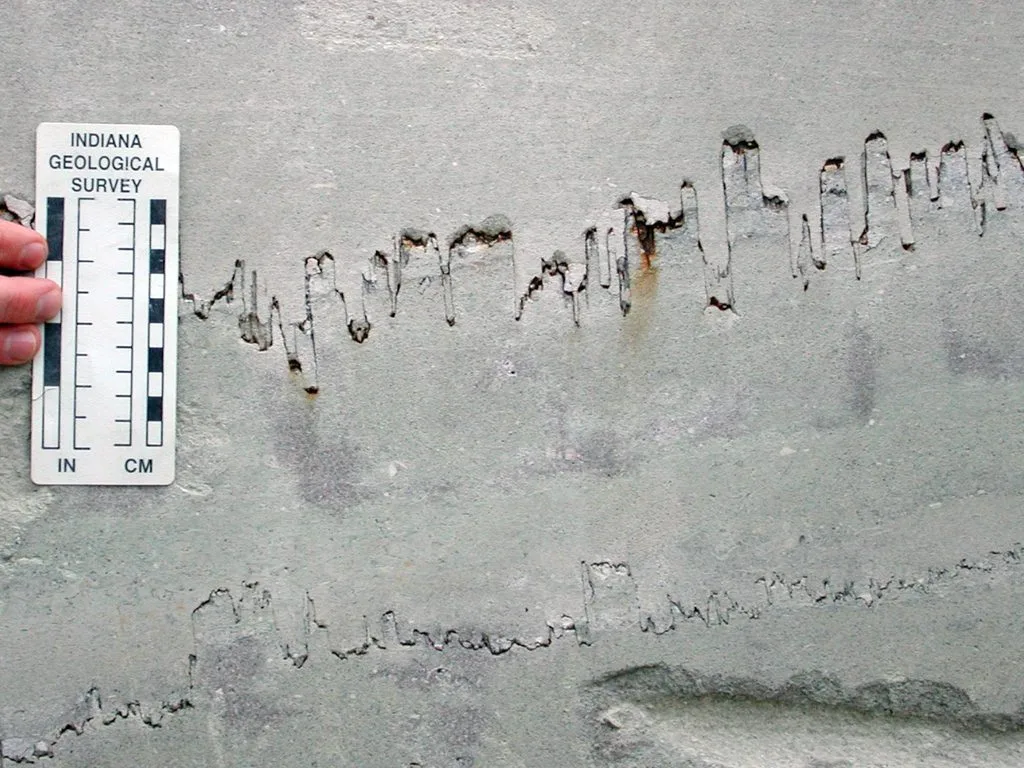
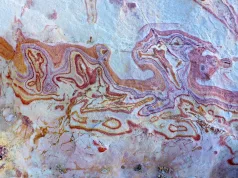
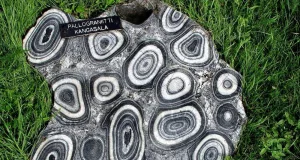
Photo: Michael C. Rygel / Wikimedia Commons.
Stylolites are rough, frequently serrated surfaces that develop within rocks as minerals dissolve under particular stress and chemical conditions.
They commonly appear as dark, zigzagging seams because clay minerals, organic matter, iron oxides, and other relatively insoluble materials may accumulate along the dissolution surface.
Although the word stylolite is often used to describe a dark line visible on a rock face, the actual structure is a three-dimensional surface.
When this irregular surface intersects a cut or exposed rock face, it produces the characteristic sawtooth pattern.
Stylolites are especially widespread in carbonate rocks such as limestone and dolostone, but they can also occur in other rock types.
Main Characteristics of Stylolites
| Property | Description |
|---|---|
| Geological structure | Irregular pressure-solution surface |
| Common host rock | Limestone and other carbonate rocks |
| Typical appearance | Dark, jagged, wavy, or sawtooth seam |
| Main formation process | Localized mineral dissolution under stress |
| Common residue | Clay, organic matter, oxides, and other insoluble particles |
| Typical orientation | Often parallel to bedding in burial-related examples |
| Geological significance | Chemical compaction, stress history, and fluid-rock interaction |
| Relationship to fractures | Dissolution feature rather than an opening-mode fracture |
The shape, orientation, and mineral content of a stylolite can vary considerably depending on the host rock and its geological history.
How Do Stylolites Form?
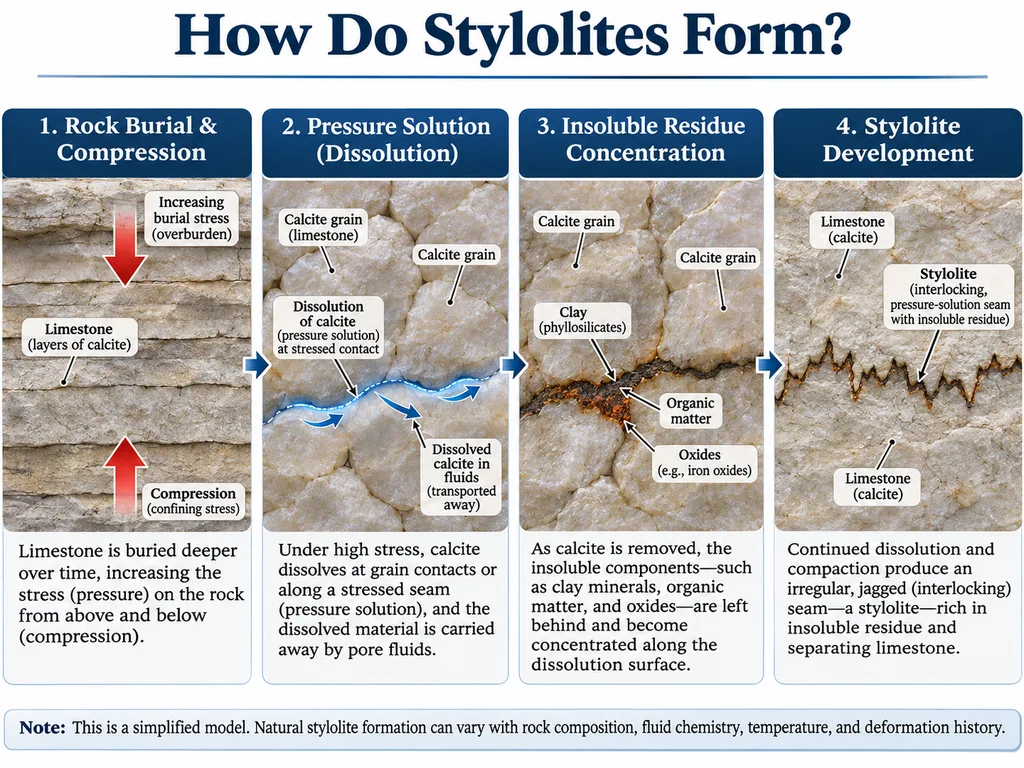
Stylolites develop through a process called pressure solution, also known as pressure dissolution.
The process is especially important in rocks undergoing chemical compaction during burial or deformation.
It involves mineral dissolution along stressed contacts, transport of dissolved material through a fluid phase, and sometimes precipitation elsewhere in the rock.
1. Burial and Compression
As sedimentary rocks become buried beneath additional layers, the weight of the overlying material increases the stress acting on the rock.
Tectonic forces can also produce significant compression.
These conditions contribute to stress differences along grain contacts and within the rock.
However, pressure alone is not enough to explain every stylolite. Mineral composition, pore fluids, temperature, and local rock heterogeneity also influence development.
2. Pressure Solution Begins
At suitable stressed contacts, minerals such as calcite can dissolve preferentially.
Dissolution is influenced by differences in chemical potential associated with stress, surface geometry, and other factors.
A thin fluid film or connected pore-fluid system allows dissolved ions to move away from the dissolution site.
In limestone, calcite is commonly the main mineral removed during this process.
3. Insoluble Residues Accumulate
As soluble minerals are removed, less soluble materials may become concentrated along the developing surface.
These residues can include clay minerals, organic material, quartz particles, and iron-bearing minerals.
Their accumulation often produces the dark seam visible in limestone specimens.
Not every stylolite contains the same material, and some seams are only faintly colored.
4. An Irregular Dissolution Surface Develops
Dissolution is not uniform across the surface.
Variations in mineral composition, grain size, stress, and pre-existing irregularities can cause some areas to dissolve faster than others.
Over time, the surface may develop interlocking projections and depressions.
These features produce the characteristic jagged appearance of stylolites.
5. Rock Shortening Is Preserved
As mineral material is dissolved and transported away, the surrounding rock can undergo chemical compaction.
The stylolite becomes a record of localized material loss and shortening.
The magnitude of its teeth may provide information about displacement and compaction, but tooth height alone does not necessarily represent the total thickness of rock dissolved.
What Is Pressure Solution?
Pressure solution is a deformation and mass-transfer process involving mineral dissolution under conditions where local chemical potential favors dissolution.
The dissolved components move through pore fluids or thin intergranular fluid films and may later precipitate in regions where conditions favor mineral growth.
In carbonate rocks, this process commonly involves the dissolution of calcite.
Pressure Solution vs. Mechanical Compaction
Mechanical compaction involves the physical rearrangement, deformation, or breakage of grains.
Pressure solution produces shortening through chemical removal and redistribution of mineral matter.
Both processes may contribute to the compaction of sedimentary rocks.
| Feature | Mechanical compaction | Pressure solution |
|---|---|---|
| Main process | Grain rearrangement and deformation | Dissolution and mass transfer |
| Fluid involvement | May assist compaction | Essential for dissolution and transport |
| Material removed | Not necessarily | Dissolved minerals are redistributed or transported |
| Common evidence | Tight grain packing, deformed grains | Dissolution seams and stylolites |
| Geological effect | Physical shortening | Chemical shortening |
These processes can operate together during burial and diagenesis.
Why Are Stylolites Common in Limestone?
Limestone is particularly favorable for pressure-solution structures because its principal mineral, calcite, can dissolve relatively readily in natural geological fluids.
Many limestones also contain small quantities of clay, organic matter, or other insoluble components.
As calcite dissolves, these materials may become concentrated at particular surfaces.
The Role of Calcite
Calcite (CaCO₃) is the dominant mineral in many limestones.
Its dissolution and precipitation behavior depends on fluid chemistry, temperature, pressure, and the presence of dissolved carbon dioxide.
Under suitable geological conditions, differential dissolution of calcite contributes to stylolite development.
The Role of Clay Minerals
Clay-rich zones can influence where dissolution localizes.
Clay particles may remain as residues after carbonate dissolution, making stylolite seams easier to recognize.
Rock composition and early cementation can also affect the spacing and geometry of stylolites.
Are Stylolites Found Only in Limestone?
No.
Stylolites are also documented in dolostone, marble, sandstone, and several other rock types.
However, carbonate rocks provide some of the most recognizable and extensively studied examples.
Types of Stylolites
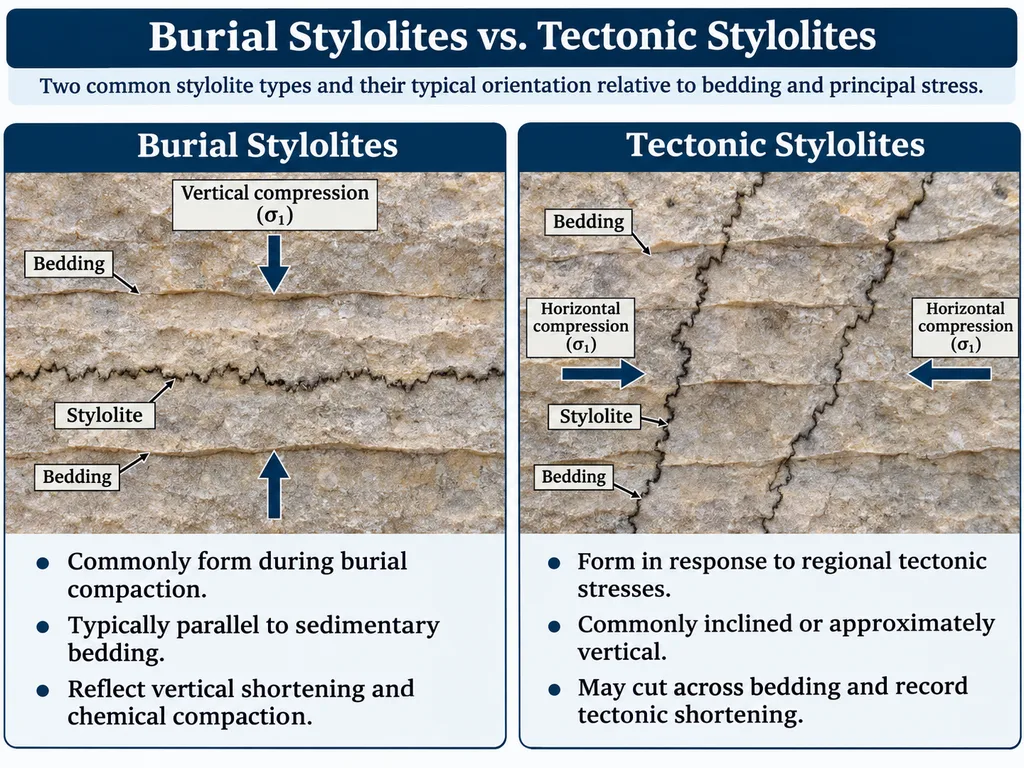
Stylolites can be classified according to their geological origin, orientation, and surface geometry.
Two important genetic categories are burial-related stylolites and tectonic stylolites.
Sedimentary or Burial Stylolites
Burial stylolites develop mainly in response to stresses associated with the weight of overlying rock.
In sedimentary successions, they commonly form approximately parallel to bedding.
Their teeth often develop roughly in the direction of maximum shortening, which is commonly near vertical during normal burial compaction.
These structures are widespread in limestone formations.
Tectonic Stylolites
Tectonic stylolites develop when regional tectonic stresses contribute to localized pressure solution.
They may be inclined or approximately perpendicular to sedimentary bedding.
In a compressional tectonic setting with a dominant horizontal shortening direction, tectonic stylolites may form approximately vertical surfaces.
Their orientation can help geologists reconstruct aspects of an ancient stress field.
Slickolites
Slickolites are stylolitic surfaces that develop under conditions involving a shear component or oblique displacement relative to the mean dissolution surface.
They may display asymmetric tooth geometries.
Slickolites are relevant to studies of deformation along faults, fractures, and other pre-existing discontinuities.
Comparison of Stylolite Types
| Type | Common orientation | Main geological association |
|---|---|---|
| Burial stylolite | Approximately parallel to bedding | Chemical compaction during burial |
| Tectonic stylolite | Commonly oblique or perpendicular to bedding | Regional compression and deformation |
| Slickolite | Oblique relationship between surface and shortening direction | Pressure solution involving shear |
These categories describe common situations, but natural examples may preserve more complicated histories.
Why Do Stylolites Have a Jagged Shape?
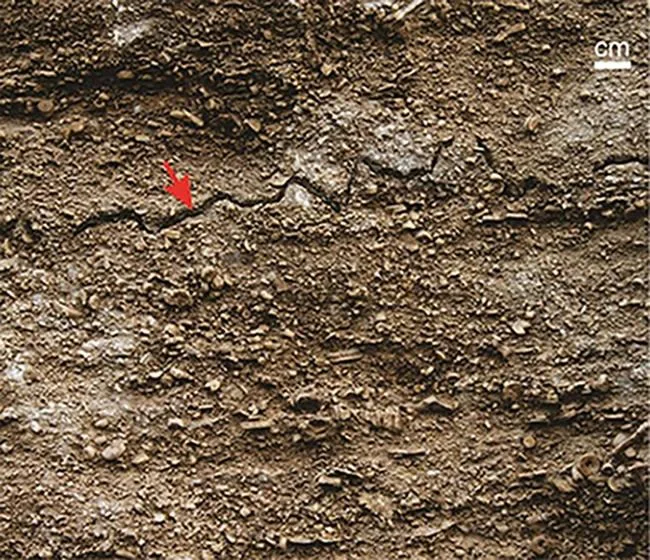
The distinctive teeth of stylolites develop because dissolution occurs unevenly across an evolving surface.
Small differences in the rock can become amplified as pressure solution continues.
For example, variations in mineral solubility, grain size, and the distribution of relatively insoluble particles can influence the geometry.
Stylolite Teeth and Peaks
In a two-dimensional section, a stylolite may contain sharp peaks, rounded projections, or irregular steps.
The pattern reflects the intersection between the cut surface and the three-dimensional stylolite.
Some stylolites have very small irregularities, while others develop centimeter-scale or larger relief.
What Controls Tooth Size?
Important factors may include:
- Rock composition and grain size.
- Distribution of insoluble particles.
- Stress conditions.
- Fluid availability.
- Duration and history of dissolution.
- Interaction between neighboring stylolites.
A larger tooth does not automatically mean that the rock experienced greater tectonic stress.
Stylolite geometry must be interpreted using appropriate geological and quantitative methods.
Stylolites in Limestone and Marble
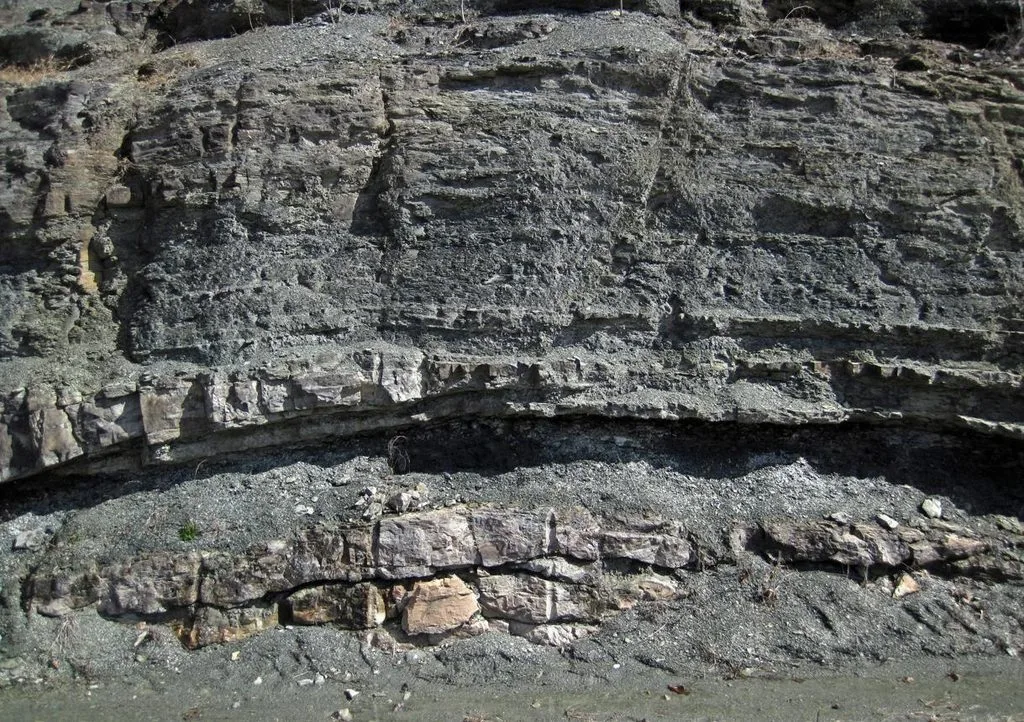
Stylolites occur in both sedimentary carbonate rocks and some recrystallized carbonate rocks.
Stylolites in Limestone
In limestone, stylolites commonly appear as dark zigzag lines cutting across a relatively light-colored rock.
They may occur individually or as networks of multiple seams.
Some follow bedding, while others are related to tectonic deformation.
Stylolites in Marble
Marble forms when limestone or dolostone undergoes metamorphic recrystallization.
Stylolitic features may be inherited from the original carbonate rock or develop during later deformation and pressure-solution processes.
Recrystallization can modify or partially obscure older dissolution surfaces.
For this reason, stylolite-like features in marble require careful petrographic interpretation.
Stylolites vs. Fractures and Sedimentary Bedding
Stylolites can resemble fractures or thin sedimentary layers, but they have different geological origins.
Stylolites vs. Fractures
Fractures form when rock breaks under stress.
An opening-mode fracture involves separation of the rock across a crack.
Stylolites form through mineral dissolution and removal of material along an irregular surface.
A stylolite can later be fractured or reopened, so the two structures may occur together.
Stylolites vs. Sedimentary Bedding
Sedimentary bedding generally reflects the original accumulation of sediments.
Stylolites form through chemical processes during burial, diagenesis, or deformation.
Although burial stylolites commonly parallel bedding, they are not depositional layers.
| Feature | Stylolite | Fracture | Sedimentary bedding |
|---|---|---|---|
| Origin | Pressure solution | Mechanical failure | Sediment deposition |
| Common appearance | Jagged or wavy seam | Planar or irregular crack | Layer boundary |
| Material loss | Commonly significant | Not necessarily | Not inherent |
| Dark residue | Often present | Not required | Depends on sediment |
| Main geological significance | Chemical compaction and stress | Rock failure and deformation | Depositional history |
The presence of dark clay or oxide material alone is not enough to establish that a seam is a stylolite.
How to Identify Stylolites in Rocks
Recognizing stylolites requires examining their geometry and relationships with other rock structures.
1. Look for a Serrated Seam
Search for irregular, interlocking lines with peaks and troughs.
Some resemble a saw blade or an electrocardiogram trace.
2. Examine the Dark Material
Many stylolites contain concentrated clay, organic matter, or iron-rich residues.
However, some seams are pale or contain only small amounts of residue.
3. Compare the Seam With Bedding
Determine whether the feature lies parallel to bedding or cuts across it.
This relationship may help distinguish burial-related and tectonic stylolites.
4. Look for Matching Irregular Surfaces
Where naturally exposed, stylolite surfaces can show interlocking projections and depressions.
Their geometry differs from an ordinary open fracture.
5. Examine Nearby Structures
Observe associated fractures, veins, folds, or other deformation features.
These may help establish the relative timing of pressure solution and tectonic activity.
6. Use Petrographic Analysis When Necessary
Thin-section microscopy can reveal dissolution contacts, insoluble residues, grain truncation, and other microscopic features.
These observations may confirm whether a suspected seam formed through pressure solution.
What Do Stylolites Reveal About Geological Stress?
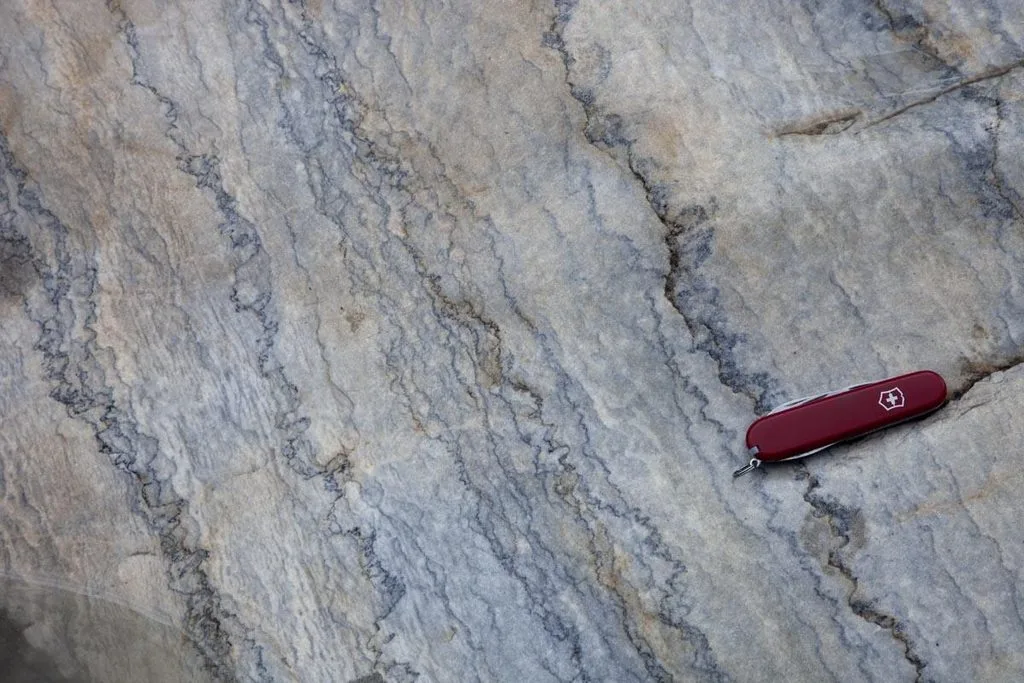
Stylolites are useful markers of deformation because their orientation and geometry can reflect the conditions under which dissolution occurred.
They may provide evidence of burial compaction, tectonic shortening, and changes in stress orientation.
Burial-Related Stress
Bedding-parallel stylolites often indicate chemical compaction associated with burial.
They provide evidence that carbonate material was removed during the sediment’s post-depositional history.
Tectonic Compression
Stylolites that cut across bedding may be associated with regional tectonic stresses.
Their orientation can contribute to paleostress reconstruction when combined with other structural evidence.
Estimating Rock Shortening
Stylolite geometry and the concentration of insoluble residues can sometimes be used to estimate the amount of material removed.
However, these estimates involve assumptions about the initial rock composition, stylolite growth, and redistribution of dissolved material.
The visible height of a stylolite tooth is not a direct measurement of total shortening in every case.
Do Stylolites Affect Rock Porosity and Permeability?
Stylolites can influence how fluids move through limestone, but their effects are not uniform.
Their impact depends on the continuity of the seam, mineral residues, surrounding pores, fractures, and the direction of fluid flow.
Possible Permeability Barriers
Stylolites enriched in clay or other low-permeability material may locally restrict fluid movement.
This effect can be important when a seam lies across a potential flow path.
Possible Fluid Pathways
Some stylolites are discontinuous or contain connected pores and fractures.
Under certain conditions, fluids may move along or through these structures.
Why the Difference Matters
Experimental research has shown that stylolites in some limestones do not substantially reduce permeability.
Therefore, it is inaccurate to describe all stylolites as impermeable barriers.
Their role must be evaluated for the specific rock and geological setting.
Stylolites and Petroleum Reservoirs
Stylolites are important in carbonate reservoir geology because they can influence rock heterogeneity and fluid distribution.
Petroleum geologists examine stylolite networks to understand how porosity and permeability vary within carbonate formations.
In some settings, stylolites may compartmentalize parts of a reservoir.
In others, their impact may be relatively small or they may interact with fractures that influence fluid flow.
Their geometry and mineral content are therefore relevant to reservoir characterization.
The same principles can also matter for groundwater studies and geological fluid storage.
Stylolites in Engineering Geology
In engineering geology, stylolites may form part of the natural discontinuity network within limestone.
Their influence on mechanical behavior depends on factors such as orientation, continuity, surface roughness, and the properties of the surrounding rock.
Some stylolitic seams can affect localized strength or failure behavior, while others may have limited influence under particular loading conditions.
For construction and excavation projects, they should be evaluated together with bedding, joints, fractures, faults, and laboratory rock properties.
The presence of a stylolite alone does not establish that a limestone is unstable.
Can Stylolites Help Reconstruct Geological History?
Yes.
Stylolites can preserve evidence of chemical compaction and tectonic deformation that occurred after the original rock material formed.
Their relationships with bedding, fractures, veins, and folds may help establish a sequence of geological events.
For example, a stylolite that is cut by a younger mineral vein must have formed before that vein, unless later deformation has complicated the relationship.
In suitable cases, quantitative analysis of stylolite roughness and associated geological evidence can help constrain aspects of past stress conditions.
However, stylolites do not provide an independent absolute age simply from their appearance.
Frequently Asked Questions About Stylolites
What are stylolites in limestone?
Stylolites are irregular dissolution surfaces formed by pressure solution, commonly visible as dark, jagged seams in limestone.
How do stylolites form?
They develop when minerals dissolve preferentially along stressed contacts and dissolved material moves away through a fluid phase.
Why are stylolites black?
Many contain concentrated clay, organic matter, iron oxides, or other relatively insoluble residues that remain after carbonate minerals dissolve.
Are stylolites cracks?
Not originally. They are dissolution surfaces rather than ordinary opening-mode fractures, although they may later be affected by fracturing.
Do stylolites form only in limestone?
No. They also occur in other carbonate rocks and several noncarbonate rock types.
What is the difference between a stylolite and a fracture?
A stylolite forms primarily through pressure solution and material removal, while a fracture forms through mechanical failure.
Do stylolites indicate tectonic activity?
Some do. Tectonic stylolites can record compressional deformation, while burial stylolites commonly form during chemical compaction without requiring a major tectonic event.
Can stylolites be used to determine stress direction?
Their orientation and tooth geometry may help constrain past stress directions, especially when analyzed alongside other geological structures.
Do stylolites reduce limestone permeability?
Sometimes, but not always. Their effect depends on seam continuity, mineral content, surrounding pore structure, fractures, and fluid-flow direction.
Can stylolites form in marble?
Stylolitic surfaces may be preserved or develop in metamorphosed carbonate rocks, although recrystallization can modify their original appearance.
Are stylolites fossils?
No. They are geological dissolution structures, not preserved biological remains or traces of organisms.
Conclusion
Stylolites are distinctive geological structures that reveal how rocks can change through chemical dissolution under stress.
Their jagged surfaces form as minerals dissolve preferentially along localized zones, leaving irregular boundaries that may contain concentrated insoluble residues.
In limestone, stylolites provide valuable evidence of burial compaction, deformation, fluid-rock interaction, and material redistribution.
Their orientation and geometry can help geologists investigate stress history, while their influence on permeability and mechanical behavior makes them relevant to petroleum geology and engineering studies.
Although stylolites may look like simple cracks, they are records of a much more complex process: the gradual removal and redistribution of rock material during geological evolution.
Scientific References and Further Reading
- Toussaint, R., et al. (2018). Stylolites: A Review. Journal of Structural Geology, 114, 163–195. https://doi.org/10.1016/j.jsg.2018.05.003
- Park, W. C., and Schot, E. H. (1968). Stylolites: Their Nature and Origin. Journal of Sedimentary Petrology, 38, 175–191. https://doi.org/10.1306/74D71910-2B21-11D7-8648000102C1865D
- Heap, M. J., et al. (2014). Stylolites in Limestones: Barriers to Fluid Flow? Geology, 42, 51–54. https://doi.org/10.1130/G34900.1
- Stylolites in Carbonate Rocks: Morphological Variability According to the Host Rock Texture. Minerals (2025), 15, 132. https://doi.org/10.3390/min15020132
- Sedimentary Stylolite Networks and Connectivity in Limestone: Large-Scale Field Observations and Implications for Structure Evolution. Journal of Structural Geology (2014).
- Impact of Stylolites on the Mechanical Strength of Limestone. Tectonophysics (2016).