


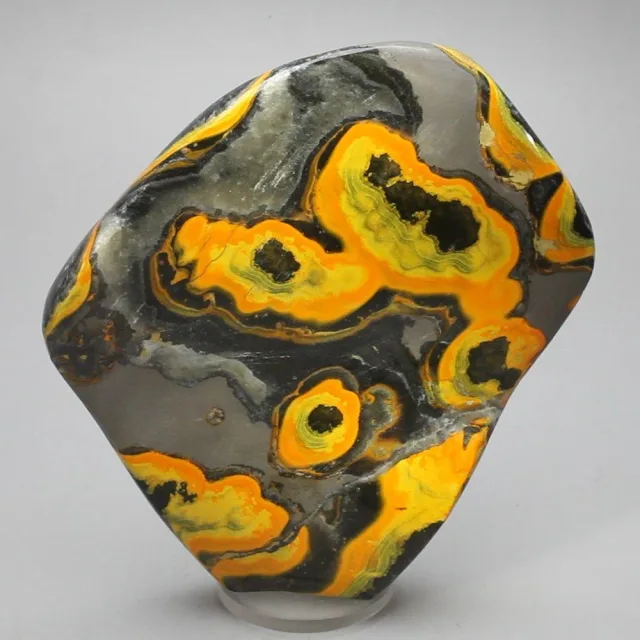
Bumble bee jasper is a striking ornamental stone recognized for its vivid yellow, orange, black, and gray patterns. Its colorful bands, often resembling the markings of a bumblebee, have made it popular among mineral collectors and lapidary enthusiasts.
Despite its name, bumble bee jasper is not true jasper. Rather than being composed primarily of microcrystalline quartz, it is a carbonate-rich rock containing calcite and small amounts of other minerals, including arsenic sulfides and pyrite.
Scientific investigations have identified pararealgar as the principal source of its bright yellow coloration, mixtures of pararealgar and realgar as contributors to orange areas, and microscopic pyrite crystals as the cause of its distinctive black markings.
The material is associated with volcanic environments in West Java, Indonesia, where mineral-rich fluids and sulfur-bearing conditions have contributed to its unusual formation.
Bumble bee jasper is particularly interesting because it demonstrates how successive mineral growth, volcanic activity, and chemical processes can produce remarkable natural patterns.
However, the presence of arsenic-bearing minerals also makes proper identification, handling, and preparation important.
What Is Bumble Bee Jasper?
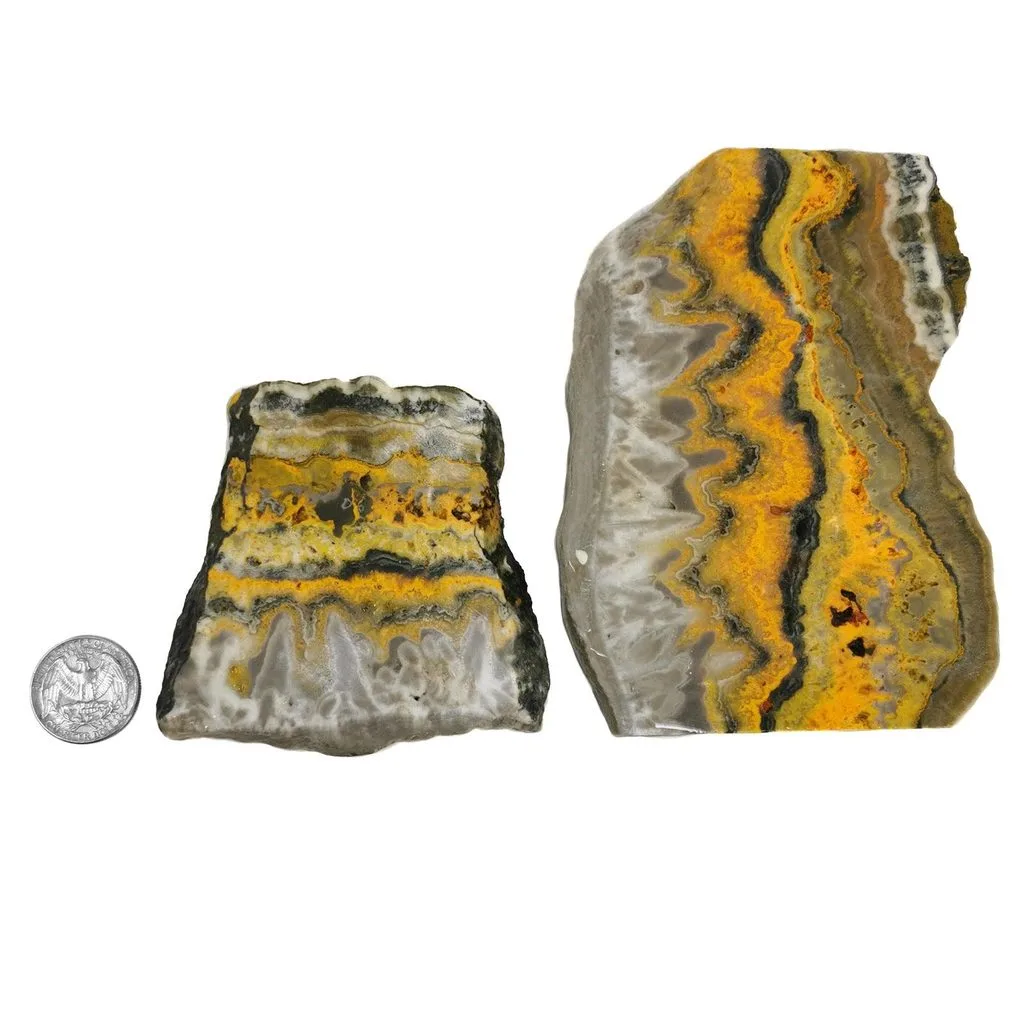
Bumble bee jasper, also known as Bumble Bee Stone, is a decorative carbonate-rich rock recognized by its contrasting yellow, orange, black, white, and gray patterns.
The name is a commercial designation based on appearance rather than a formal mineral species name.
True jasper is an opaque, silica-rich variety of chalcedony, composed predominantly of microcrystalline quartz. Bumble bee jasper differs significantly in both composition and geological origin.
Detailed mineralogical investigations have shown that the material commonly consists predominantly of fibrous calcite, with finely dispersed sulfide minerals responsible for much of its coloration.
Its principal characteristics include:
- Bright yellow and orange mineral-rich bands
- Black markings associated with microscopic pyrite
- White and gray calcite-rich regions
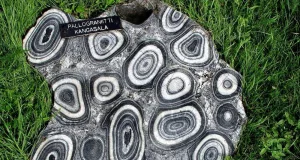
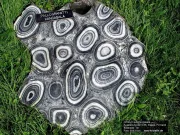
- Irregular, concentric, and sometimes orbicular patterns
- A relatively soft and sometimes porous texture
- Formation associated with sulfur-bearing volcanic environments
Because it is a mixture of minerals, bumble bee jasper does not have the single chemical formula or uniform physical properties of an individual mineral species.
Mineral Composition and Physical Properties
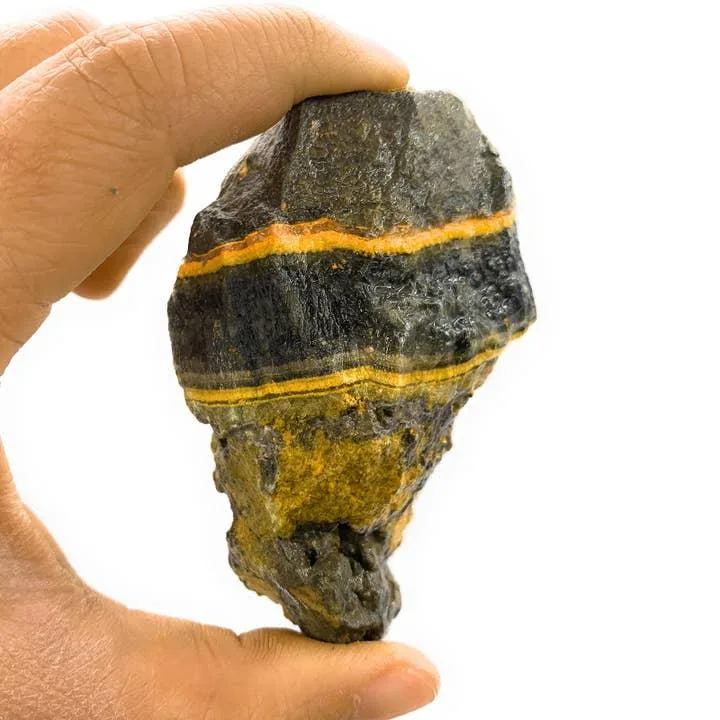
Bumble bee jasper is composed of several mineral phases that occur together in a distinctive patterned rock.
The most important minerals identified in scientific investigations include calcite, pararealgar, realgar, and pyrite.
Main Mineral Components
Calcite (CaCO₃)
Calcite forms much of the pale-colored, carbonate-rich matrix. Fibrous and radiating calcite growth contributes to the stone’s internal textures and layered structures.
Pararealgar (As₄S₄)
Pararealgar is an arsenic sulfide mineral responsible for the intense yellow coloration documented in analyzed specimens.
Realgar (As₄S₄)
Realgar is another arsenic sulfide mineral. It has the same chemical composition as pararealgar but a different crystal structure.
Research has associated orange regions with mixtures of these two arsenic sulfide phases.
Pyrite (FeS₂)
Microscopic pyrite crystals produce many of the dark or black markings. Aggregations of these crystals can form distinctive spots and bands.
Other minerals or components may occur in individual specimens, but their presence should not be assumed without analytical evidence.
Physical Properties of Bumble Bee Jasper
| Property | Description |
|---|---|
| Material type | Carbonate-rich ornamental rock |
| Commercial name | Bumble Bee Jasper / Bumble Bee Stone |
| True jasper? | No |
| Dominant mineral | Calcite |
| Important color-producing minerals | Pararealgar, realgar, and pyrite |
| Colors | Yellow, orange, black, white, and gray |
| Transparency | Opaque |
| Luster | Dull to waxy; polished specimens may appear glossy |
| Hardness | Variable; generally softer than quartz jasper |
| Texture | Fibrous, layered, sometimes porous |
| Geological environment | Sulfide-bearing deposits associated with volcanic activity |
| Principal documented source | West Java, Indonesia |
Because the material is a rock containing multiple minerals, its hardness and other properties can vary between layers.
A single hardness value or chemical formula cannot accurately describe every specimen.
Why Is Bumble Bee Jasper Not a True Jasper?
The distinction between bumble bee jasper and true jasper is based on mineral composition.
Jasper is a silica-rich rock consisting predominantly of cryptocrystalline quartz and related silica phases.
Bumble bee jasper, by comparison, is dominated by carbonate minerals, particularly calcite.
Scientific examinations have demonstrated that the distinctive yellow, orange, and black patterns are produced largely by sulfide mineral inclusions rather than the iron-rich silica textures commonly encountered in true jasper.
The word jasper therefore survives as part of the stone’s commercial name, even though it is mineralogically inaccurate.
For scientific descriptions, Bumble Bee Stone is a more appropriate alternative name.
How Does Bumble Bee Jasper Form?
Bumble bee jasper is associated with an unusual geological environment involving volcanic activity, carbonate mineral deposition, and sulfur-bearing fluids.
The best-documented source occurs in West Java, Indonesia, in a region influenced by active volcanism.
Volcanic and Hydrothermal Conditions
Volcanic areas can release heated fluids and gases containing sulfur and other chemical components.
These fluids may move through fractures and openings in surrounding rocks.
Where conditions change, dissolved substances can precipitate and form new minerals.
The mineral deposits associated with bumble bee jasper developed in a sulfur-bearing environment linked to volcanic activity.
Such environments can involve fumarolic and hydrothermal processes.
Formation of Carbonate-Rich Layers
Calcite is a major component of the stone.
Successive episodes of carbonate deposition can produce fibrous growth structures and layered textures.
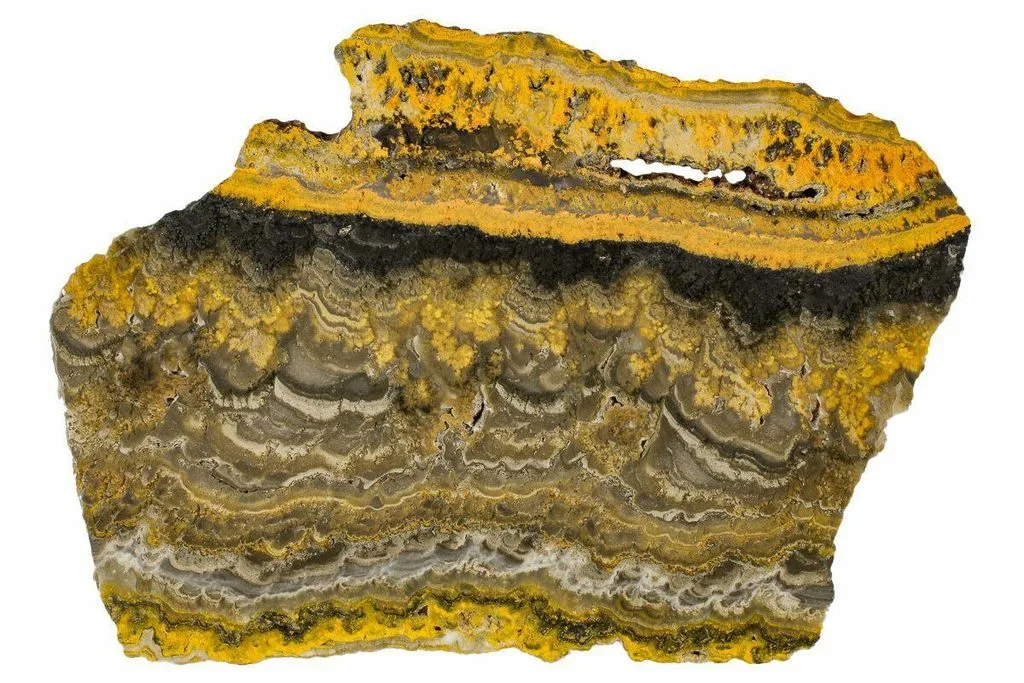
The fibrous and locally radiating growth of calcite contributes to the curved bands and rounded structures visible in polished sections.
Precipitation of Sulfide Minerals
Arsenic-bearing sulfide minerals occur within the calcite-rich material.
Fine particles of pararealgar and realgar contribute yellow and orange colors.
Microscopic pyrite crystals form contrasting dark regions.
Variations in mineral abundance during successive growth stages create the distinctive alternating bands.
Development of Orbicular Patterns
Some specimens display circular or concentric markings resembling eyes, rings, or small targets.
These patterns are related to growth structures within the carbonate-rich rock.
When rounded or botryoidal mineral growth structures are cut in different orientations, they can reveal striking circular or irregular patterns.
The resulting appearance depends on both the original mineral growth and the orientation of the polished surface.
What Causes the Yellow, Orange, and Black Colors?
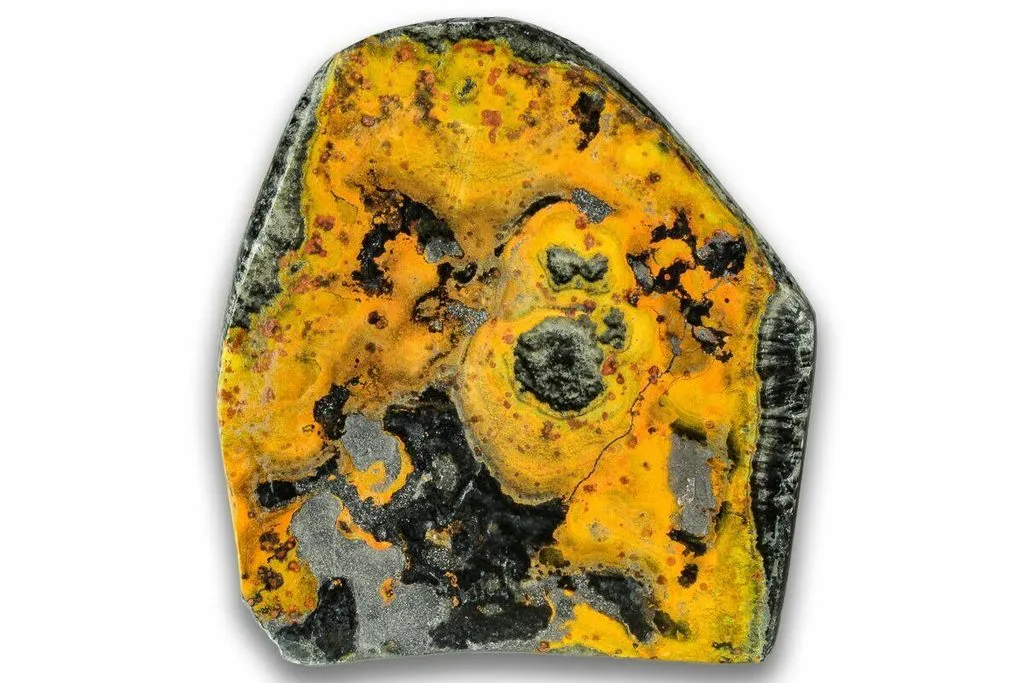
One of the most important scientific findings about bumble bee jasper concerns the origin of its vivid colors.
Early descriptions sometimes attributed its color primarily to elemental sulfur or manganese oxides.
More detailed laboratory investigations have identified specific mineral phases responsible for the characteristic patterns.
Yellow: Pararealgar
The vivid yellow color is principally associated with finely dispersed pararealgar.
Pararealgar is an arsenic sulfide mineral with the formula As₄S₄.
Its presence has been confirmed through mineralogical analytical methods.
Orange: Realgar and Pararealgar
Orange regions can contain mixtures of realgar and pararealgar.
These minerals are polymorphs, meaning they share the same chemical formula but have different crystal structures.
Their relative abundance and distribution influence the appearance of the colored bands.
Black: Microscopic Pyrite
The black areas are associated with aggregates of tiny pyrite crystals.
These particles can occur as dense, dark concentrations within the surrounding carbonate material.
The appearance may range from narrow black lines to larger patches and circular markings.
White and Gray: Carbonate-Rich Areas
Paler regions are largely associated with the calcite-rich matrix.
Variations in mineral textures, the distribution of small inclusions, and the structure of the material produce different gray and white appearances.
A specimen’s exact composition cannot be established from color alone.
Where Is Bumble Bee Jasper Found?
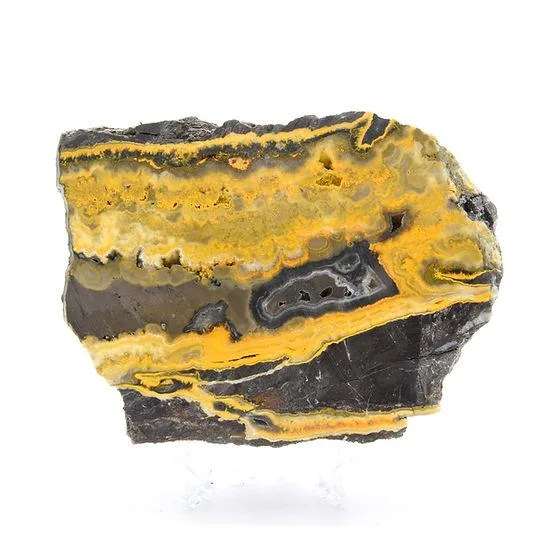
Bumble bee jasper is most closely associated with West Java, Indonesia.
Scientific reports identify the principal mining locality in the Kuningan Regency area on the lower slopes of Mount Ciremai.
Earlier descriptions and some commercial listings have associated the material with Mount Papandayan.
However, the later detailed locality research identifies the Mount Ciremai area as the principal documented source.
Mount Ciremai, West Java
Mount Ciremai is an active volcano in western Java.
The surrounding geological environment contains volcanic deposits and evidence of fluid circulation associated with volcanic processes.
The bumble bee stone occurrence is linked to sulfide-bearing veins within this volcanic setting.
Why Is the Material Unusual?
Its striking appearance results from the combination of several factors:
- Carbonate-rich mineral deposition
- Sulfur- and arsenic-bearing mineral phases
- Fine-grained pyrite inclusions
- Successive growth bands
- Localized volcanic geological conditions
This particular combination produces the dramatic patterns for which the material is known.
Although similar minerals can occur in other volcanic regions, visually similar stones should not automatically be identified as bumble bee jasper without supporting evidence.
Colors and Natural Patterns
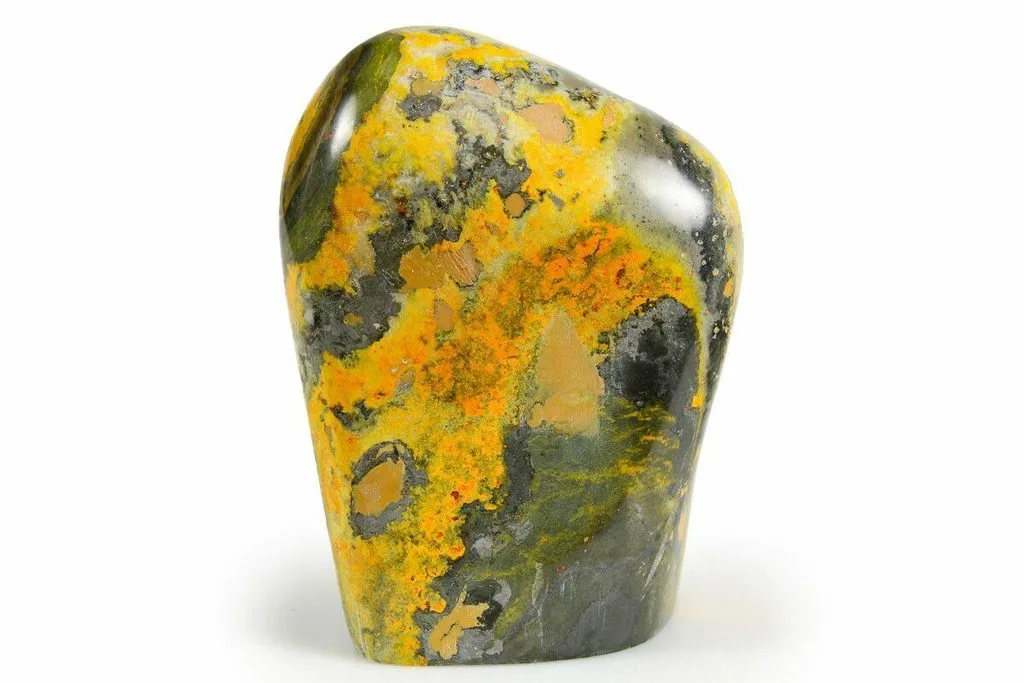
Bumble bee jasper is prized for its highly variable natural designs.
Yellow and Black Banding
Alternating yellow and dark bands create the characteristic bumblebee appearance.
Some specimens have relatively straight or gently curved bands, while others contain irregular patterns.
Orange and Gray Patterns
Orange mineral-rich areas can occur alongside gray and black regions.
These combinations produce strong visual contrasts when the stone is cut and polished.
Orbicular and Bull’s-Eye Patterns
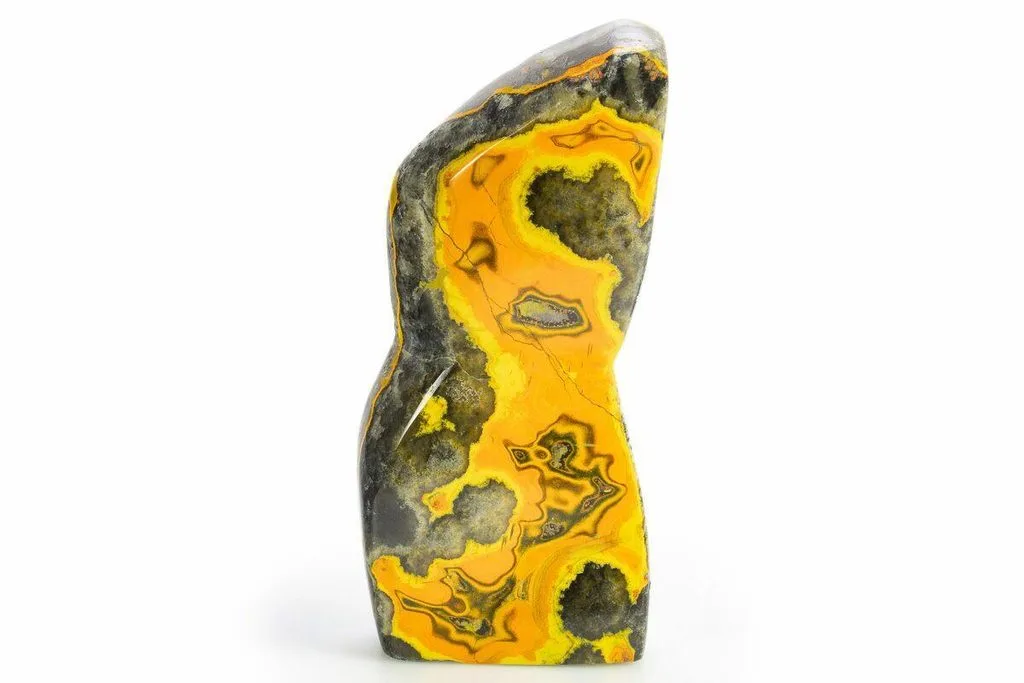
Some specimens display circular or concentric markings.
These can resemble eyes, targets, or rings.
Such patterns are particularly distinctive when the material has been cut across rounded mineral-growth structures.
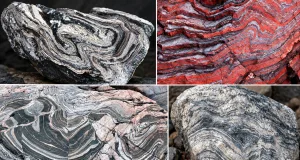
Complex Layered Patterns
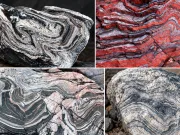
Other specimens contain irregular layers, swirling forms, and overlapping mineral bands.
These patterns record variations in mineral deposition rather than fossil structures or biological activity.
Bumble Bee Jasper vs. True Jasper
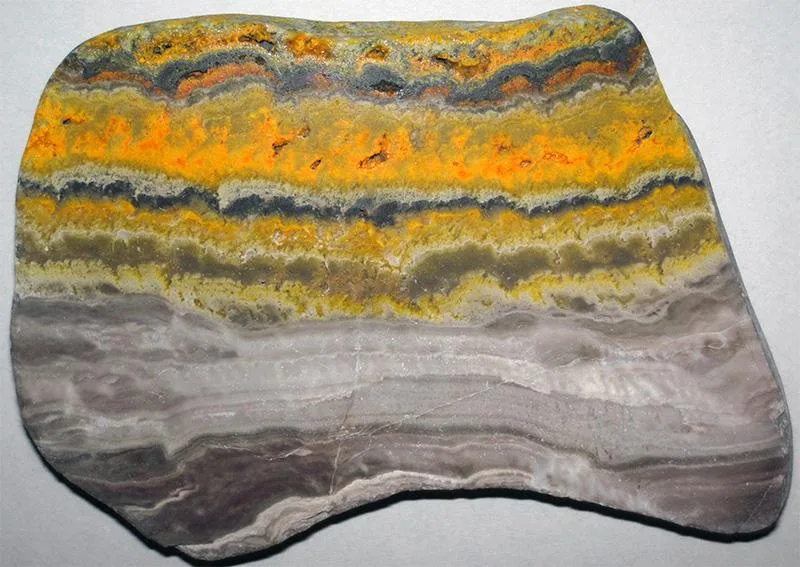
Although the names are similar, the two materials differ considerably.
| Feature | Bumble Bee Jasper | True Jasper |
|---|---|---|
| Composition | Mainly carbonate-rich rock | Predominantly microcrystalline silica |
| Principal mineral | Calcite | Quartz/chalcedony |
| Color-producing phases | Arsenic sulfides and pyrite | Commonly iron oxides and other inclusions |
| Typical hardness | Variable; generally relatively soft | About 6.5–7 |
| Geological association | Volcanic-related mineral deposits | Diverse silica-deposition environments |
| Characteristic appearance | Vivid yellow, orange, and black bands | Wide variety of colors and patterns |
| Special handling concerns | May contain arsenic-bearing minerals | Does not ordinarily present the same arsenic-sulfide concern |
The shared name does not indicate equivalent composition, durability, or safety.
How to Identify Bumble Bee Jasper
The most recognizable feature of bumble bee jasper is its contrasting yellow, orange, and black coloration.
However, appearance alone is insufficient for definitive mineral identification.
Examine the Color Patterns
Look for sharply contrasting mineral-rich bands and irregular yellow, orange, gray, and black areas.
Some specimens also show concentric or orbicular patterns.
Observe the Texture
Bumble bee jasper may contain porous, fibrous, or layered structures.
These differ from the typically dense, silica-rich texture of true jasper.
Consider the Hardness
The material is generally softer than quartz-based jasper because of its calcite-rich composition.
However, its variable mineral content makes destructive scratch testing unsuitable for reliable identification.
Do not produce dust by scratching, grinding, or cutting a suspected specimen for identification.
Laboratory Identification
Raman spectroscopy, X-ray diffraction, and electron microscopy with chemical analysis have been used to identify the minerals present in bumble bee stone.
These methods can distinguish calcite, realgar, pararealgar, and pyrite.
Professional mineralogical testing is preferable when exact identification is required.
Is Bumble Bee Jasper Toxic?
Bumble bee jasper requires special care because some specimens contain arsenic sulfide minerals.
Realgar and pararealgar contain arsenic, an element that can be harmful depending on the chemical form, exposure route, concentration, and duration.
The most important concern is exposure to contaminated dust or particles during cutting, drilling, grinding, or polishing.
Handling Intact Specimens
An intact, stable, polished specimen generally presents a different exposure situation from loose powder or freshly ground material.
However, the presence of a polished surface does not guarantee that every specimen is free from exposure risks.
Avoid unnecessary contact with damaged, friable, or powdery material.
Wash your hands after handling specimens and keep them away from food preparation areas, children, and pets.
Cutting and Polishing Risks
Cutting or polishing arsenic-bearing material can produce hazardous dust and contaminated residues.
Such work requires an appropriate professional risk assessment, engineering controls, suitable protective equipment, and proper waste management.
Uncontrolled home cutting, sanding, drilling, or polishing should be avoided.
Jewelry Safety
Because of its possible arsenic-bearing mineral content, variable durability, and potential surface treatments, bumble bee stone is not an ideal choice for jewelry involving prolonged direct skin contact.
A professional assessment of composition, treatment, and intended use is advisable.
Uses of Bumble Bee Jasper
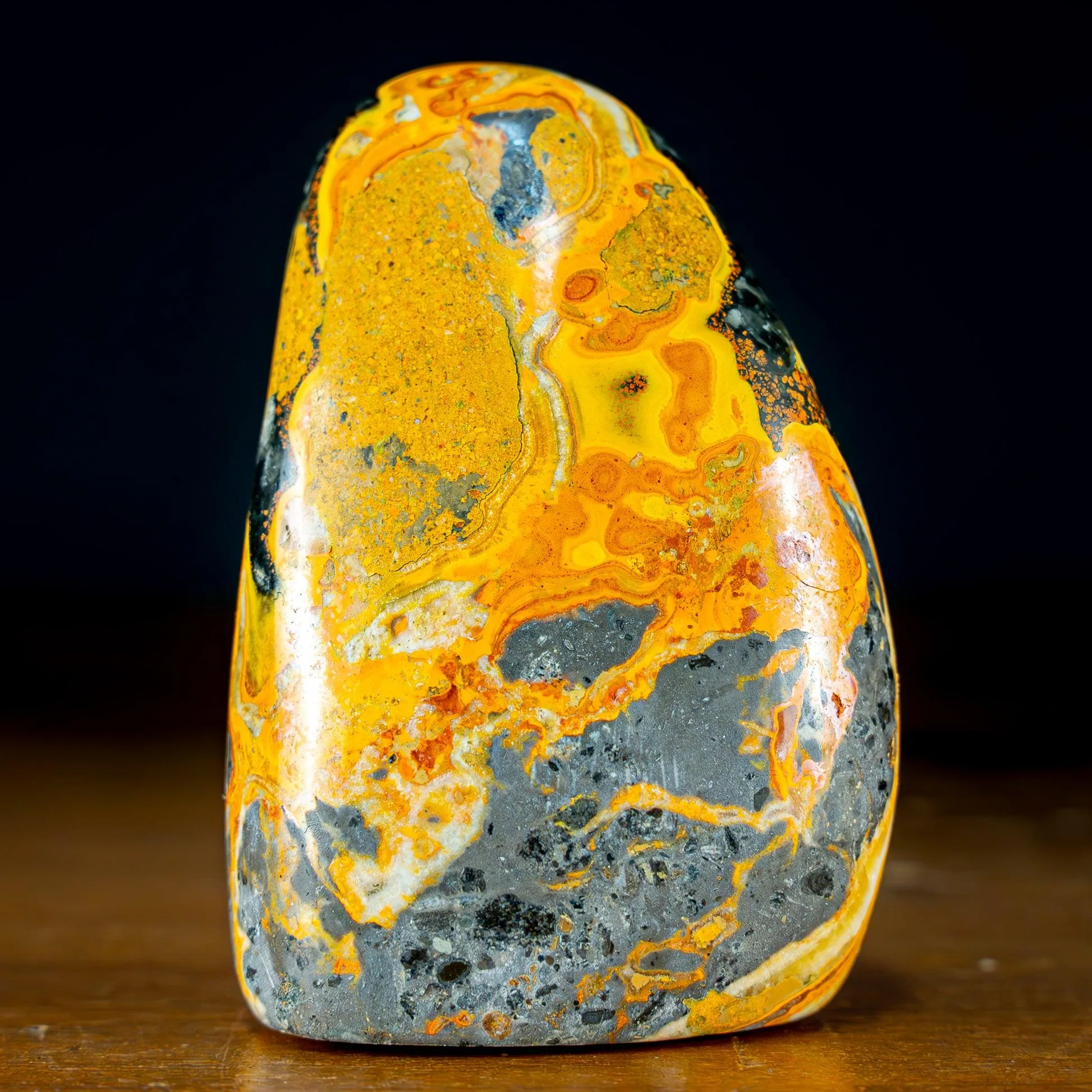
Bumble bee jasper is primarily used as a decorative and collectible material.
Mineral Collections
Its vivid colors and unusual composition make it a notable example of carbonate-rich rock containing sulfide minerals.
It is particularly interesting for collectors studying the relationship between volcanic activity and mineral deposition.
Decorative Objects
The stone is sometimes fashioned into polished slabs, freeform shapes, and ornamental display specimens.
Its patterned appearance can be especially striking when a cut reveals concentric growth structures.
Cabochons and Jewelry
Bumble bee stone has been fashioned into cabochons and jewelry components.
However, its arsenic-bearing phases and relatively soft, sometimes porous nature mean that use in jewelry requires additional caution.
It should not be treated as having the same durability or handling characteristics as ordinary jasper.
How to Store and Care for Bumble Bee Jasper
Because it can contain arsenic sulfides and relatively soft carbonate minerals, bumble bee jasper should be cared for as a specialized mineral specimen rather than an ordinary quartz gemstone.
- Store specimens in a stable, dry location.
- Avoid unnecessary exposure to strong light and excessive heat.
- Keep specimens away from children and pets.
- Avoid acids, abrasive cleaners, and aggressive cleaning methods.
- Do not use ultrasonic or steam cleaning.
- Do not cut, drill, sand, or polish the material without professional controls.
- Avoid handling damaged or powdery surfaces.
- Wash hands after handling.
- Consider an enclosed display case for fragile or potentially friable specimens.
Some arsenic sulfide minerals can undergo changes when exposed to light, so controlled storage is preferable for valuable mineral specimens.
Frequently Asked Questions
Is bumble bee jasper a real jasper?
No. Bumble bee jasper is a commercial name for a carbonate-rich ornamental rock rather than a silica-rich variety of chalcedony.
What minerals make up bumble bee jasper?
Scientific investigations have identified calcite as the principal component, with pararealgar, realgar, and pyrite contributing to the characteristic colors.
What causes the bright yellow color?
Detailed research has identified finely dispersed pararealgar as an important source of the vivid yellow coloration.
Why does it contain black bands?
The dark regions are associated with microscopic aggregates of pyrite crystals.
Where is bumble bee jasper found?
The principal documented source is West Java, Indonesia, particularly the mining area near Mount Ciremai in Kuningan Regency.
Is bumble bee jasper dangerous?
It can contain arsenic-bearing minerals. Dust generated during cutting or polishing presents particular concerns, and damaged or powdery specimens should be handled cautiously.
Can bumble bee jasper be used in jewelry?
It has been used in jewelry, but its composition and potential exposure risks make it less suitable than ordinary quartz-based gemstones, especially for prolonged direct skin contact.
How can it be distinguished from ordinary jasper?
Bumble bee jasper is carbonate-rich and generally softer, whereas true jasper consists predominantly of microcrystalline silica. Laboratory mineral identification provides more reliable confirmation than color alone.
Conclusion
Bumble bee jasper is an unusual ornamental rock whose appearance reflects the interaction of carbonate mineral growth, sulfide precipitation, and volcanic geological processes.
Although the name suggests a variety of jasper, scientific investigations demonstrate that the material is predominantly calcite rather than microcrystalline quartz.
Its vivid yellow and orange colors are associated with pararealgar and realgar, while microscopic pyrite contributes its distinctive black markings.
Found principally in West Java, Indonesia, bumble bee stone provides an excellent example of how mineral chemistry and growth conditions can create visually remarkable natural materials.
Its scientific interest and decorative appeal must be considered alongside its relatively soft composition and the potential hazards associated with arsenic-bearing minerals.
References
- Fritsch, E., & Ivey, J. (2018). Bumble Bee Stone: A Bright Yellow-to-Orange and Black Patterned Gem from West Java, Indonesia. The Journal of Gemmology, 36(3), 228–238.
- Gem-A (2018). Journal Digest: Bumble Bee Stone from Indonesia. Summary of the mineralogical investigation and color-causing minerals.
- Overlin, S. (2014). Bumble Bee “Jasper” from Indonesia. Gems & Gemology, 50(2).
- Mindat.org. Bumblebee Jasper: Mineral Information and Localities. Mineral classification, composition, and locality documentation.
- Mindat.org. Bumble Bee Stone Mining Area, Kuningan Regency, West Java. Geological locality and mineral occurrence records.
- EPI Institute. Eclipse / Bumblebee Stone. Analytical identification and discussion of arsenic-sulfide mineral hazards.