





You find an unusually heavy, dark-colored rock in your backyard, in a field, or while hiking. The moment you pick it up, one question comes to mind: Could this rock have come from space?
Every year, thousands of people believe they have discovered a meteorite. However, most specimens submitted to experts turn out to be terrestrial materials such as magnetite, hematite, basalt, or industrial slag. Rocks mistakenly identified as meteorites are sometimes humorously called “meteorwrongs.”
Still, finding a real meteorite is not impossible. A few simple observations and non-destructive tests can help you decide whether your unusual rock deserves professional examination.
It is important to understand that no single home test can confirm a meteorite. Reliable identification usually requires several matching characteristics followed by laboratory analysis.
1. Test the Rock With a Magnet
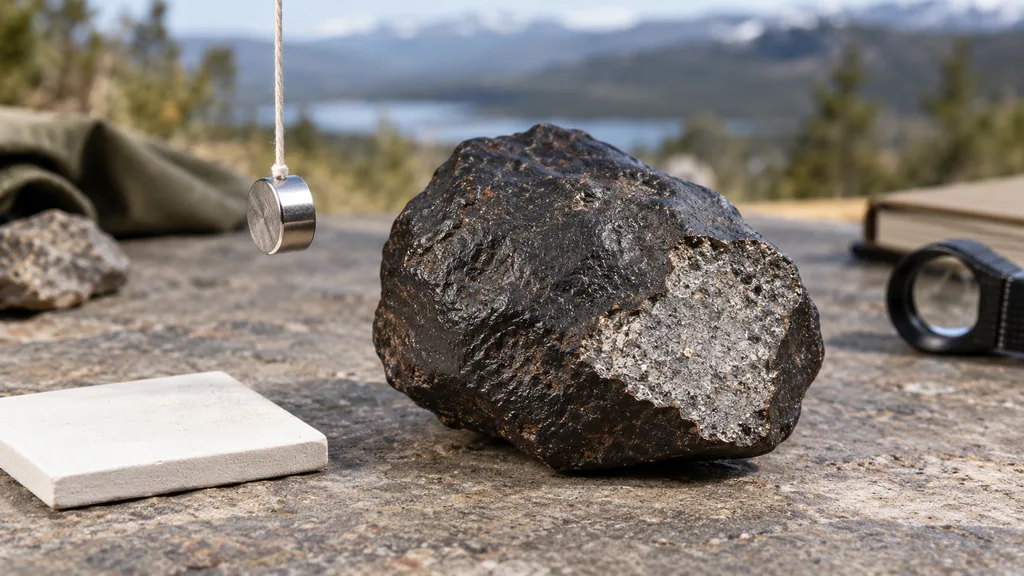
Most meteorites—particularly ordinary chondrites and iron meteorites—contain metallic iron-nickel and therefore respond to a magnet.
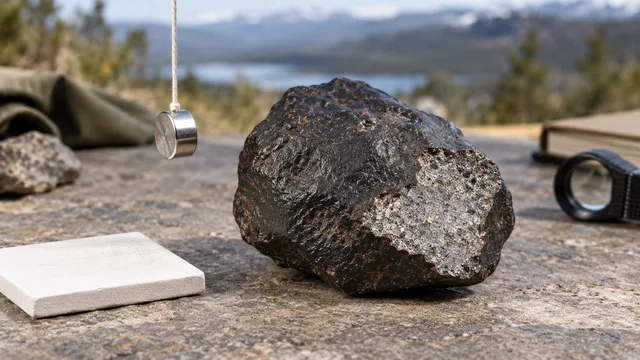
For this test, use a small but reasonably strong magnet. A neodymium magnet works better than a weak refrigerator magnet. Instead of pressing it directly against the specimen, suspend the magnet from a string and slowly move it toward the rock. Even a slight movement toward the specimen may indicate the presence of metal.
Magnetic attraction, however, is only an initial clue.
Many terrestrial materials are also magnetic. Magnetite-rich rocks, iron-bearing industrial waste, and pieces of slag may attract a magnet very strongly. A magnetic response alone does not prove that a rock is a meteorite.
The opposite is also true. Some achondrites and certain meteorites originating from the Moon or Mars contain very little metal and may respond weakly—or not noticeably—to a simple magnet test. A nonmagnetic specimen should not automatically be rejected solely on this basis.
2. Check Whether It Feels Unusually Heavy
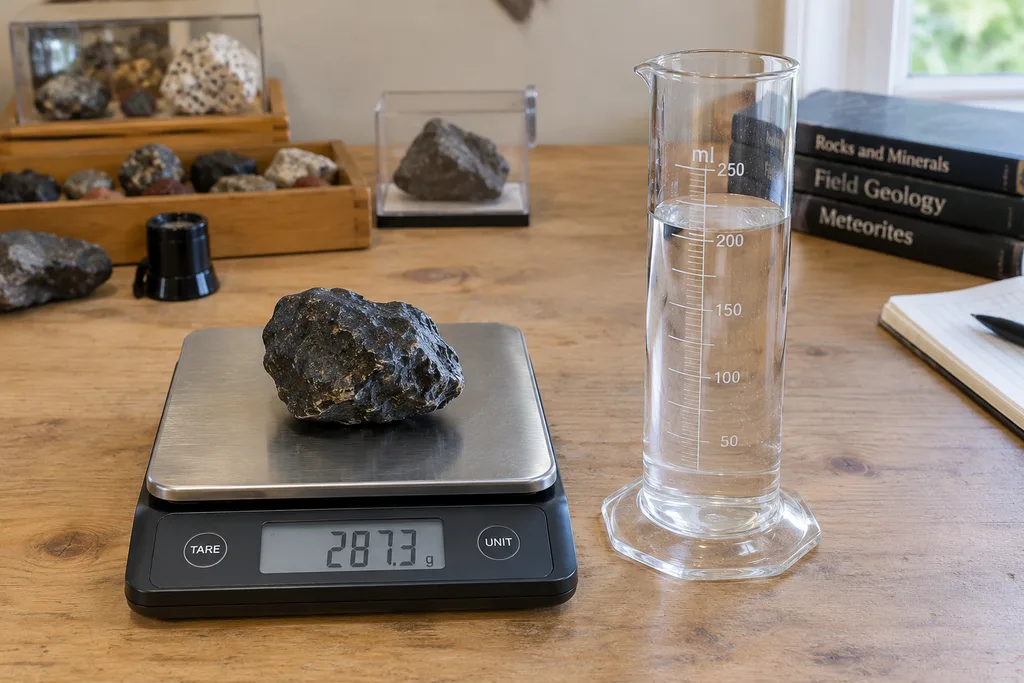
Meteorites are often denser than ordinary surface rocks of comparable size. This is because many contain iron-nickel metal and iron-rich silicate minerals.
If a rock feels unexpectedly heavy for its size, it may deserve closer examination. For a more objective result, you can calculate its density:
Density = Mass ÷ Volume
Its mass can be measured in grams using a kitchen scale. Volume is commonly estimated by measuring the amount of water displaced by the rock. However, directly immersing a potentially important specimen is not always advisable. Water can enter fractures and accelerate the rusting of metallic grains.
If the specimen appears particularly promising, consult an expert before placing it in water.
As a general comparison:
- Most ordinary chondrites have densities of approximately 3.0–3.7 g/cm³.
- Iron meteorites commonly have densities of approximately 7–8 g/cm³.
- Many common terrestrial rocks fall within a range of approximately 2.5–3.0 g/cm³.
These values should not be treated as strict identification limits. Some carbonaceous chondrites are relatively light, while meteorites rich in metal may be considerably heavier. Density is useful only when considered alongside other features.
3. Perform a Streak Test
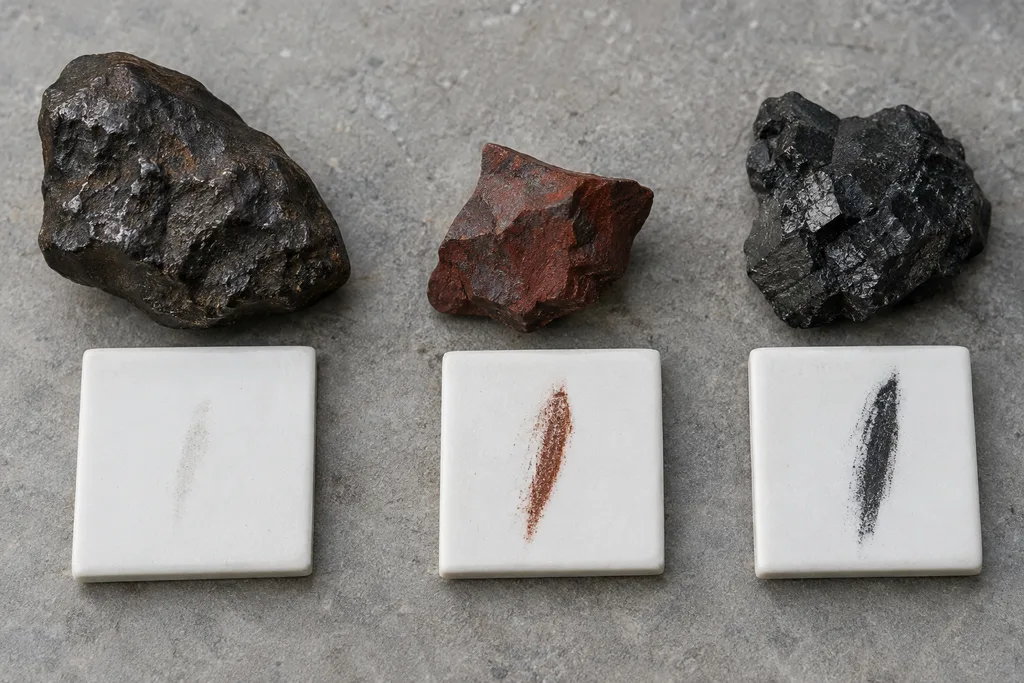
The streak test is particularly useful for eliminating common meteorite look-alikes such as hematite and magnetite.
Lightly rub a small, inconspicuous part of the specimen across unglazed porcelain. A commercial streak plate or the unfinished back of a ceramic tile may be used.
Examine the color of the mark:
- A red or reddish-brown streak commonly indicates hematite.
- A black or dark gray streak may indicate magnetite or another terrestrial iron oxide.
- Little or no colored streak is more consistent with many meteorites, although it does not confirm one.
Most meteorites do not leave a strong, colored mineral streak. Avoid pressing too hard, as this test may scratch or damage the specimen. Always begin on the least visible area.
4. Look for a Thin Fusion Crust
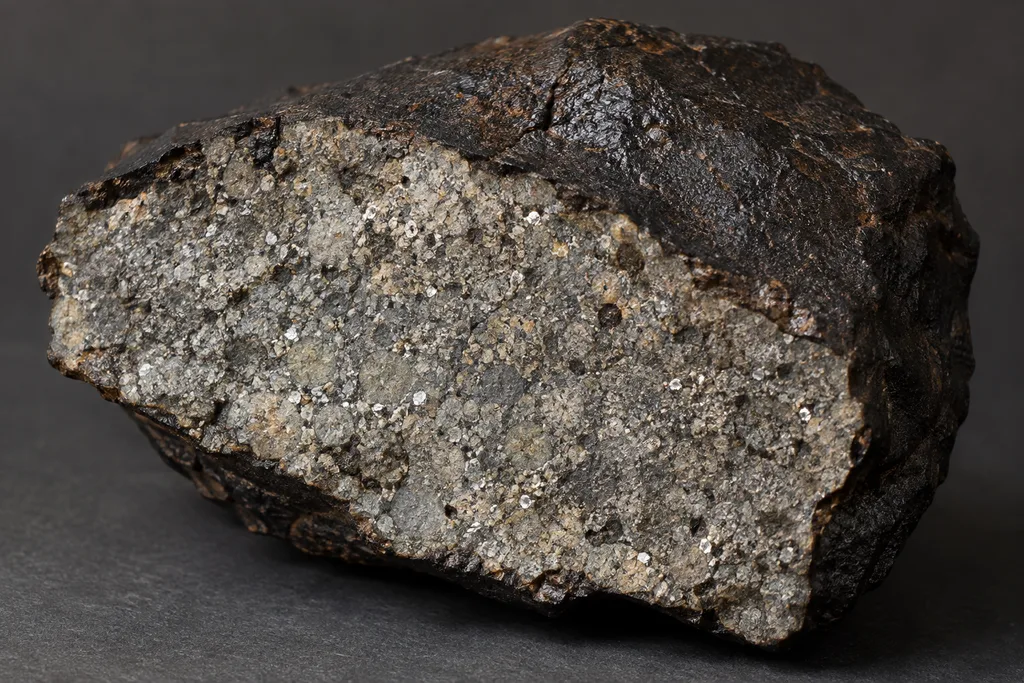
When a meteoroid enters Earth’s atmosphere at high speed, the air in front of it is intensely compressed. The resulting heat melts and removes a very thin layer from the object’s exterior. The interior usually does not melt during this brief atmospheric passage.
The dark outer layer that may remain after landing is known as a fusion crust.
A relatively fresh fusion crust is often:
- Black or very dark brown,
- Usually less than one millimeter thick,
- Visibly different from the material inside the rock,
- Marked by subtle flow lines or small surface irregularities.
On meteorites that have remained in soil or humid conditions for a long time, the crust may become dull, brown, rusty, or partly obscured by weathering. A genuine meteorite does not need to retain a perfect black coating across its entire surface.
A thick, glassy, bubbly, or foamy coating is more likely to indicate industrial slag or volcanic material than a meteorite.
Do not break or cut a promising specimen simply to examine the interior. If the rock is a meteorite, unnecessary cutting can reduce both its scientific importance and its monetary value. Compare the surface with the interior only if a naturally broken area is already present.
5. Search for Regmaglypts
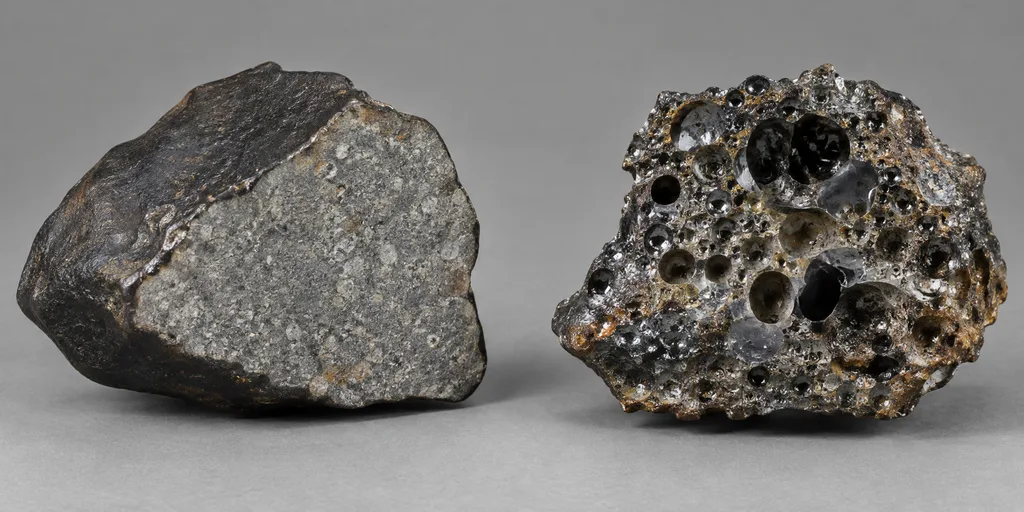
Some meteorites have broad, shallow depressions that resemble fingerprints pressed into soft clay. These features are called regmaglypts.
Regmaglypts develop when different areas of a meteoroid’s surface ablate at slightly different rates during atmospheric flight. They are particularly noticeable on some iron meteorites.
Not every meteorite has regmaglypts. They may be absent or very subtle on small stony meteorites.
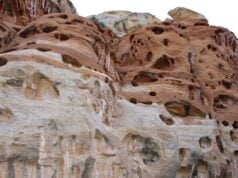
Several terrestrial objects can also develop similar-looking depressions, including:
- Rocks weathered by wind or water,
- Corroded pieces of metal,
- Industrial slag.
Regmaglypts should therefore be treated as supporting evidence rather than proof. Genuine examples usually appear as broad depressions with smooth transitions, rather than sharp, deep holes produced by gas bubbles.
6. Look for Chondrules and Metal Grains
A large proportion of the meteorites that reach Earth are stony meteorites called chondrites. Many chondrites contain tiny round or oval structures, usually measuring a few millimeters or less. These structures are called chondrules.
Chondrules formed as molten or partially molten silicate droplets during the earliest history of the Solar System. They preserve information about processes that occurred approximately 4.56 billion years ago, before the planets fully formed.
If the specimen already has a naturally broken surface, look for:
- Small, rounded mineral grains,
- A gray or relatively pale interior,
- Scattered reflective metal grains,
- Brown rust stains surrounding metallic particles.
Do not intentionally break the rock to search for these features.
Not every rounded grain is a chondrule. Terrestrial mineral grains, concretions, and spherical structures in industrial slag can produce a similar appearance. Proper identification may require microscopic examination.
Chondrules are also absent from several major meteorite groups. Achondrites, iron meteorites, and stony-iron meteorites have different internal structures. Therefore, failing to find chondrules does not prove that a specimen is not a meteorite.
7. Check for Bubbles and a Foamy Texture
This is one of the most useful ways to eliminate common meteorite look-alikes.
Basalt, pumice, and other volcanic rocks may contain rounded spaces left behind by gas bubbles in molten lava. Industrial slag frequently contains numerous holes, bubbles, and glassy surfaces.
Typical meteorites do not have the widespread, frothy gas cavities commonly seen in slag or vesicular volcanic rocks. A specimen is therefore unlikely to be a meteorite if it:
- Contains numerous round holes,
- Has a sponge-like or foamy texture,
- Displays a glassy, melted-looking surface,
- Is filled with sharp-edged cavities.
One small pit or isolated cavity is not necessarily conclusive. Weathering, mineral loss, and surface erosion may produce individual holes in otherwise solid material.
Crystals must also be interpreted carefully. The presence of visible crystals does not automatically disqualify a specimen. Pallasites may contain large olivine crystals, while some achondrites contain recognizable silicate crystals.
The more suspicious combination is a glassy surface accompanied by numerous gas bubbles and a lightweight, foamy texture.
What Does a Meteorite Usually Look Like?
A combination of characteristics is far more meaningful than any single feature. A specimen may deserve professional examination if it displays several of the following:
- It feels heavy for its size.
- It responds weakly or strongly to a magnet.
- It has a thin, dark outer crust.
- It lacks widespread gas bubbles.
- Small metallic grains are visible on a naturally broken surface.
- Chondrules are present in its interior.
- Broad regmaglypt-like depressions occur on the surface, particularly in a metal-rich specimen.
By contrast, a rock that produces a strongly colored streak, contains numerous bubbles, has a thick glassy coating, or was discovered near metalworking waste is more likely to be a terrestrial mineral or industrial slag.
What Should You Do With a Possible Meteorite?
If your specimen passes several preliminary tests, resist the temptation to clean, polish, cut, or break it. Preserve it in its current condition.
Follow these steps:
- Record the exact location where it was found.
- Note the date and the surrounding ground conditions.
- Photograph every side in clear, natural light.
- Include a ruler or coin in the photographs for scale.
- Store the specimen in a clean, dry environment.
- Avoid unnecessary handling with bare hands.
- Contact a university geology department, natural history museum, or recognized meteorite laboratory.
Do not use acids, household chemicals, wire brushes, or sandpaper on the specimen. These methods can damage the surface, remove the fusion crust, and contaminate material needed for later analysis.
How Is a Meteorite Confirmed?
Home tests can only provide preliminary evidence. Professional confirmation requires examination of the specimen’s mineralogy, texture, and chemical composition.
Scientists may use methods such as:
- Petrographic microscopy,
- Measurement of nickel in metallic grains,
- Electron microscopy and microprobe analysis,
- X-ray diffraction,
- Oxygen isotope analysis.
These methods can determine not only whether a specimen is a meteorite but also its classification and, in some cases, the type of parent body from which it originated.
Final Thoughts: Could Your Rock Really Be From Space?
Not every dark, heavy, or magnetic rock is a meteorite. In fact, terrestrial iron-rich rocks and industrial by-products with these characteristics are far more common.
However, a specimen displaying several compatible features—such as a thin fusion crust, high density, metallic grains, chondrules, and an absence of widespread bubbles—may be worth professional investigation.
The most important rule is simple: Never rely on a single test, and do not break a promising specimen.
If your ordinary-looking rock turns out to be a meteorite, you are not merely holding an unusual stone. You are holding a fragment of Solar System history that may be billions of years old.
Frequently Asked Questions About Meteorite Identification
Is every rock that sticks to a magnet a meteorite?
No. Magnetite, some basalts, iron-rich terrestrial rocks, and industrial slag may also attract a magnet. Magnetism is only a preliminary test and must be evaluated alongside other characteristics.
Does a meteorite have to be completely black?
No. Fresh meteorites may have a black fusion crust, but the crust can become brown, rusty, or dull through weathering. The material beneath the crust may be much lighter than the exterior.
Do meteorites contain gold?
Meteorites may contain extremely small concentrations of gold, but a rock displaying visible pieces of gold is unlikely to be a typical meteorite. Bright grains in meteorites are more commonly iron-nickel metal or iron sulfide minerals.
Can meteorites contain bubbles?
Typical meteorites do not display the widespread, foamy gas cavities commonly seen in industrial slag and vesicular volcanic rocks. A specimen containing numerous rounded holes is unlikely to be a meteorite.
Should I cut or break a possible meteorite?
No. Photograph the specimen and consult an expert first. Cutting or breaking a genuine meteorite may damage important scientific features and reduce its value.
Can a mobile app identify a meteorite?
Image-recognition applications can offer rough suggestions, but they cannot measure density, mineral chemistry, nickel content, or microscopic texture. They cannot provide a reliable confirmation.
Is a meteorite valuable?
Its value depends on its type, size, condition, rarity, and documented find location. The specimen must first be authenticated and scientifically classified before its significance or market value can be assessed.