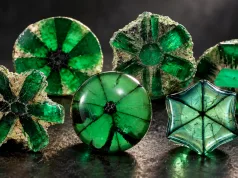






When people see a six-rayed pattern inside a sapphire, the first thing that usually comes to mind is a star sapphire. But the pattern in trapiche sapphire is created by a completely different process.
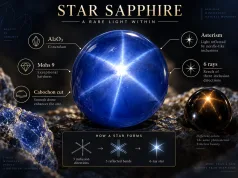
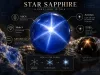
In star sapphire, the star is an optical effect produced when light reflects from oriented microscopic inclusions inside the stone. As the light source moves, the star appears to move across the surface.
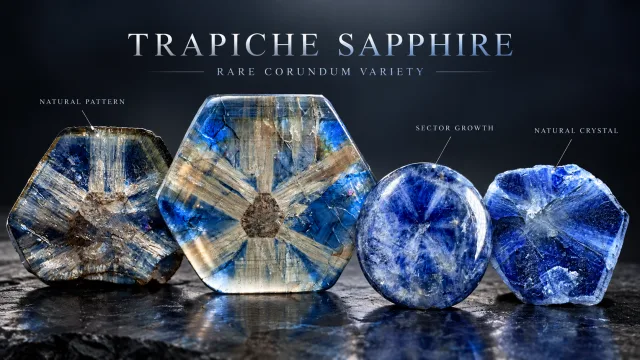
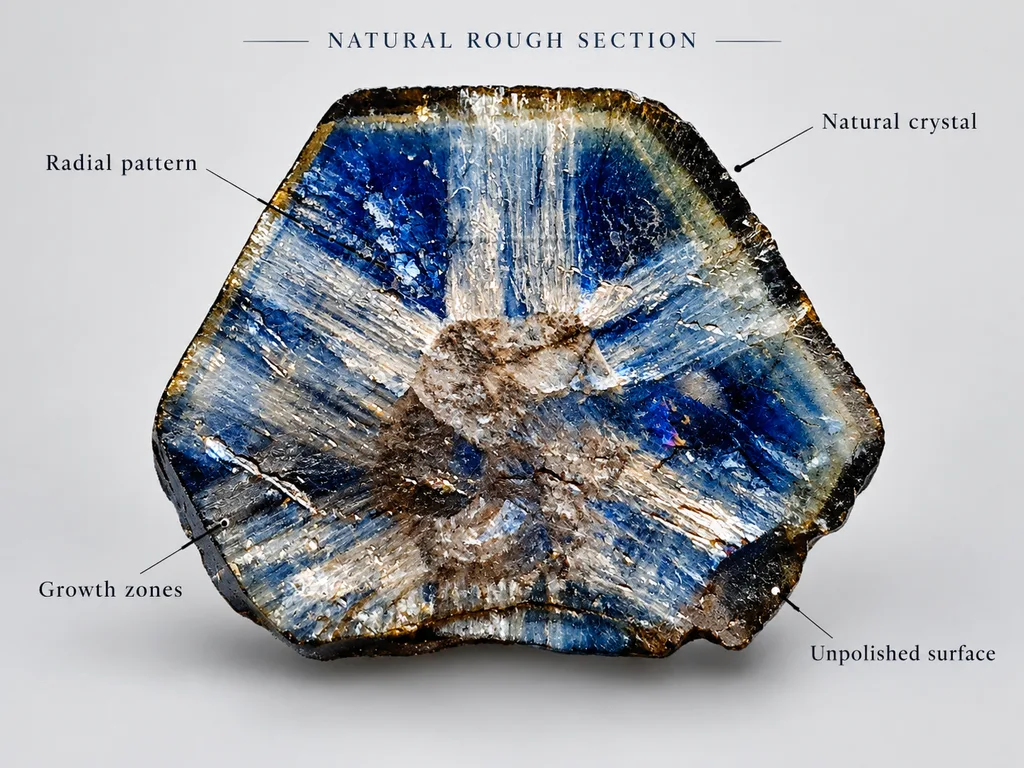
In trapiche sapphire, the six-rayed pattern is fixed inside the crystal. It does not move with the light because it is not an optical reflection. It is a physical record of how the crystal grew.
That is what makes trapiche sapphire so interesting.
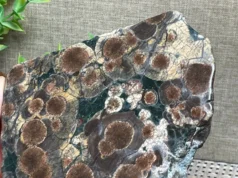
The six-rayed structure can be related to growth sectors, color zoning, inclusions, and chemical changes that occurred during crystal development. In some stones, the rays may appear white, while in others they can be blue, gray, or nearly black. Some specimens show a remarkably regular pattern, while others display only an incomplete structure that resembles true trapiche growth.
This is why not every six-rayed sapphire is a true trapiche sapphire.
What Is Trapiche Sapphire?
Trapiche sapphire is a rare variety of corundum that displays a fixed, six-rayed growth pattern extending outward from the center of the crystal.
The mineral behind sapphire is corundum, with the chemical formula:
Al₂O₃
Corundum crystallizes in the trigonal crystal system and has a Mohs hardness of:
9
This makes it one of the hardest natural minerals, second only to diamond in hardness.
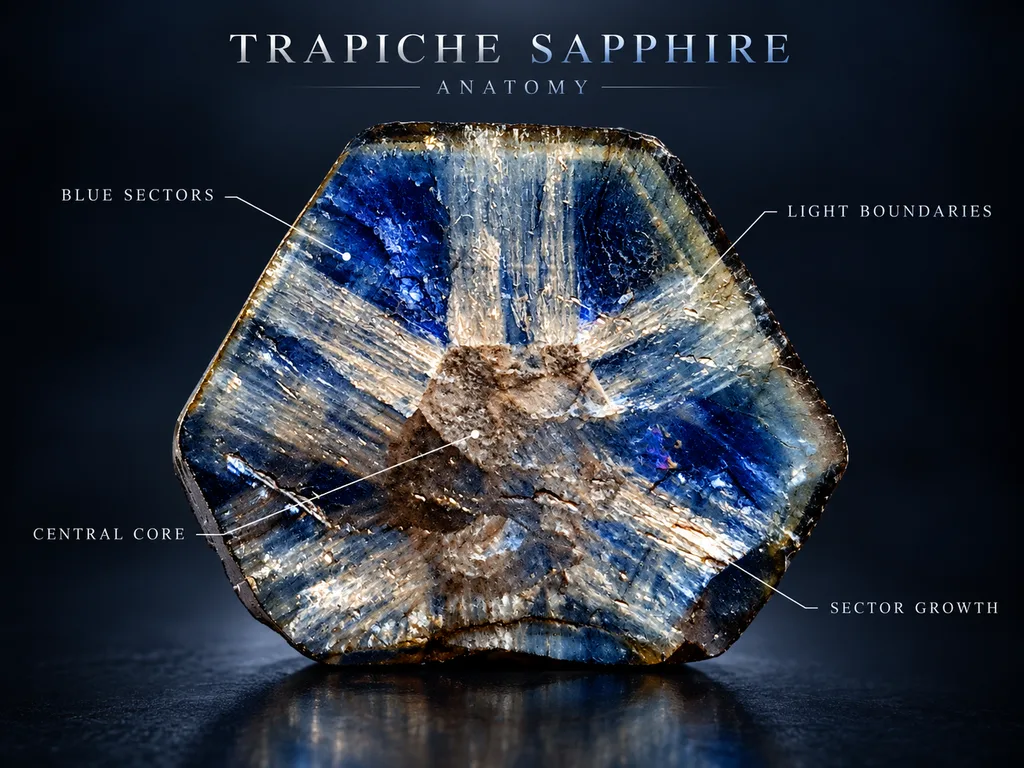
Trapiche sapphire is not chemically a completely different type of sapphire. What makes it unusual is the internal structure, which may include a central core, radial arms, and distinct growth sectors.
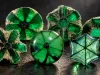
When viewed in cross-section, a well-developed specimen often shows a central region surrounded by six radial arms that divide the crystal into sectors.
The result resembles a wheel or a six-pointed star.
Physical Properties of Trapiche Sapphire
| Property | Trapiche Sapphire |
|---|---|
| Mineral | Corundum |
| Chemical formula | Al₂O₃ |
| Crystal system | Trigonal |
| Mohs hardness | 9 |
| Specific gravity | About 3.9–4.1 |
| Luster | Vitreous |
| Color | Blue, gray, blue-black, sometimes yellow or other colors |
| Distinctive feature | Fixed six-rayed growth pattern |
| Typical cut | Cabochon, tablet, or cross-section |
| Optical star? | No; the pattern is structural |
The last point is especially important.
A trapiche pattern is not asterism.
Trapiche Sapphire vs Star Sapphire
Trapiche sapphire and star sapphire can look surprisingly similar because both may display a six-rayed, star-like appearance.
But the underlying mechanisms are completely different.
In star sapphire, asterism forms when oriented microscopic inclusions such as rutile, hematite, ilmenite, or related phases reflect light in several directions. Because the effect depends on reflection, the star appears to move when the light source or stone moves.
In trapiche sapphire, the six-rayed pattern is fixed inside the gemstone. The arms are part of the crystal’s growth structure and remain in the same position.
In simple terms:
Star sapphire → moving optical star
Trapiche sapphire → fixed growth pattern
A sapphire can theoretically show both a trapiche structure and asterism, but the two phenomena are separate.
True Trapiche vs Trapiche-Like Sapphire
This is one of the most important distinctions when discussing trapiche sapphire.
In gemology, the term “trapiche” is not applied to every stone with a six-rayed pattern.
In a true trapiche structure, the crystal is divided into equivalent growth sectors, and the radial arms form along the boundaries between those sectors.
A true trapiche structure therefore typically includes:
central core + six growth sectors + radial arms separating the sectors
In a trapiche-like sapphire, the pattern may resemble true trapiche growth, but the arms do not necessarily mark actual boundaries between equivalent growth sectors.
For example, some radial structures may develop across or perpendicular to hexagonal growth zones instead of separating true sectors.
This distinction matters because many sapphires sold or described as “trapiche sapphire” may actually be better classified as trapiche-like sapphire.
Why Does the Six-Rayed Pattern Form?
Corundum crystallizes in the trigonal system, but its crystal morphology and growth zoning can display a strong sixfold appearance.
As the crystal grows, different faces and sectors may not develop at exactly the same rate.
Changes in:
- Chemical environment
- Temperature
- Melt or fluid composition
- Trace-element concentration
- Inclusion abundance
- Growth rate
can affect different parts of the crystal in different ways.
Some sectors may grow as relatively clean corundum, while certain directions become enriched in inclusions, thin films, color differences, or other material.
If these differences continue outward from the crystal center, a fixed six-rayed structure can develop.
The trapiche pattern is therefore a geometric record of changing crystal-growth conditions.
What Are the Arms in Trapiche Sapphire Made Of?
There is no single answer.
The radial arms in different trapiche and trapiche-like sapphires can contain different materials and textures.
Depending on the deposit and specimen, they may involve:
- Dense microscopic inclusions
- Fine-film inclusions
- Rutile
- Glassy material
- Color zoning
- Inclusion-rich corundum
In some true trapiche sapphires, both the arms and the sectors may still consist mainly of corundum.
The visual contrast does not necessarily require a completely different mineral.
Instead, the difference may result from variations in inclusion density, trace-element chemistry, or crystal-growth rate.
This is why saying “the arms are made of one specific mineral” is usually too simple.
Where Are True Trapiche Sapphires Found?
One of the best-known and most important sources of well-documented true trapiche sapphire is the Mogok region of Myanmar.
Mogok has produced sapphires showing classic trapiche structures with a central core, radial arms, and sector-controlled growth.
Many of these stones do not resemble the bright, transparent blue sapphires most people imagine.
Some may appear:
- Gray
- Dark blue
- Blue-black
- Pale with darker or brighter radial arms
The most striking examples can show dramatic contrast between a pale body and vivid blue spokes.
These stones are especially valuable because the six-rayed structure is not merely visual—it records controlled crystal growth.
What Does Mogok Trapiche Sapphire Look Like?
Classic Mogok material can show a clear central core surrounded by six sectors and radial arms.
In some specimens, the arms appear blue while the surrounding sectors are pale, gray, or nearly white.
In others, the contrast may be reversed.
This variability suggests that trapiche growth is not controlled by one inclusion species alone.
Differences in trace elements, inclusion concentration, and crystallization conditions can all influence the final appearance.
Where Are Trapiche-Like Sapphires Found?
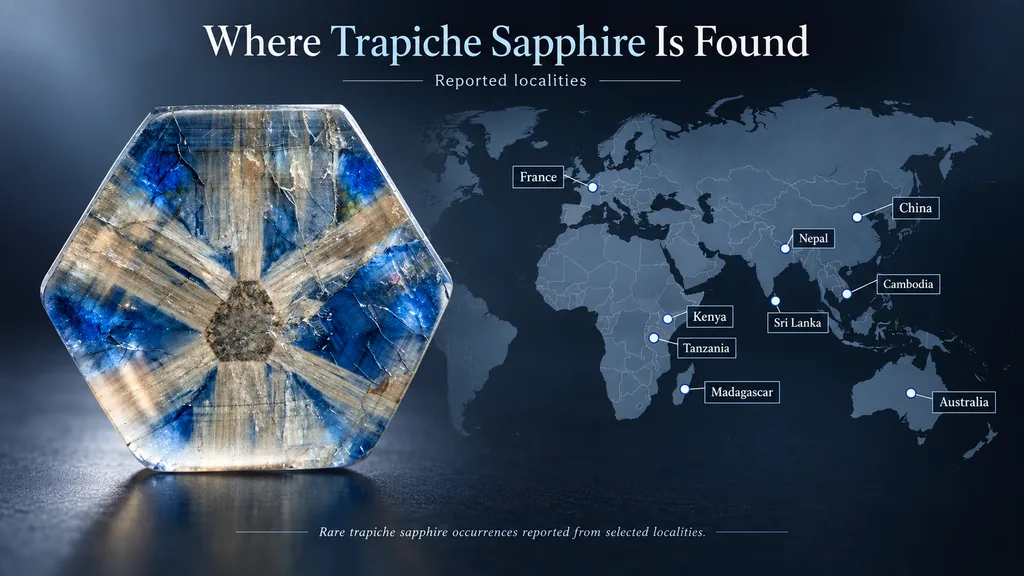
Trapiche-like sapphires are more widely distributed than classic true trapiche material.
They have been reported from several basalt-related sapphire provinces, including areas in:
- Australia
- Vietnam
- China
- Other volcanic sapphire regions
These stones can display striking six-rayed patterns, but their internal growth geometry may not meet the strict criteria for true trapiche structure.
That means a sapphire can look strongly trapiche-like without being a classic trapiche sapphire in the mineralogical sense.
Trapiche-Like Sapphires from China
Some of the most intensively studied recent examples come from Changle, Shandong Province, China.
These sapphires commonly display dark blue or blue-black centers with pale or white radial arms extending outward.
The region is associated with Cenozoic volcanic activity and basaltic rocks.
However, this does not necessarily mean the sapphires crystallized directly from the basalt magma visible at the surface.
As with many basalt-related sapphire deposits, the corundum crystals may have formed deeper in the crust or upper mantle and later been transported upward by ascending basaltic magma.
This distinction is important.
Basalt does not always form the sapphire; sometimes it only transports it.
How May the Changle Trapiche-Like Pattern Have Formed?
Detailed mineralogical studies of Changle sapphire have shown that the different regions of the stone can vary in inclusion abundance and trace-element chemistry.
The radial arms contain numerous fine filamentary inclusions, while the core, arms, and sectors remain dominated by corundum.
Researchers have proposed that some of the pale structures may be related to voids or channels created after the dissolution or alteration of rutile, with later glassy material occupying those spaces.
However, this model applies specifically to the studied Changle material.
It should not be used as a universal explanation for every trapiche or trapiche-like sapphire.
Different deposits can produce similar visual patterns through different geological mechanisms.
Why Is Trapiche Sapphire Blue?
The blue color and the trapiche pattern are separate features.
Pure corundum:
Al₂O₃
is colorless.
The blue color of sapphire is commonly related to iron and titanium, particularly electronic interactions involving Fe²⁺–Ti⁴⁺ charge transfer.
In some basalt-related sapphires, elevated iron content can produce very dark blue or nearly blue-black colors.
The trapiche pattern has a different origin.
So once again, there are two separate stories:
trace elements → color
growth structure and inclusions → trapiche pattern
Is Every Six-Rayed Sapphire a Trapiche Sapphire?
No.
This is one of the most common mistakes.
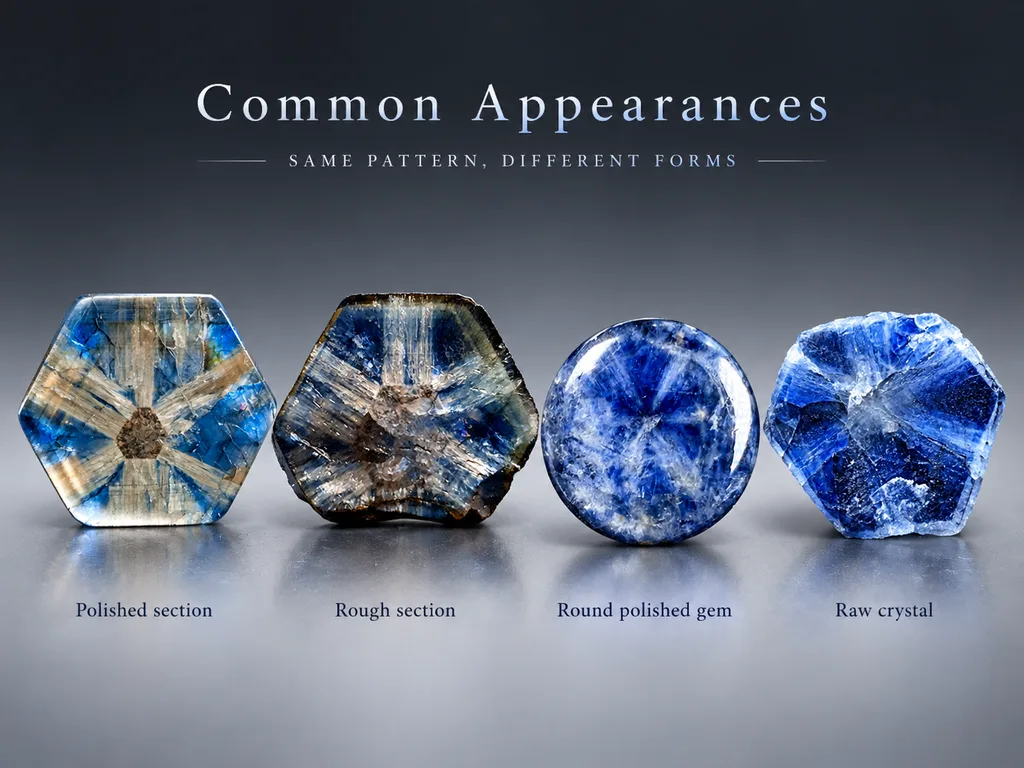
A six-rayed pattern in sapphire can be caused by several different features, including:
- Asterism
- True trapiche growth
- Trapiche-like growth
- Color zoning
- Inclusion zoning
- Fractures
- Other growth-related structures
A photograph alone may therefore not be enough for a confident identification.
Gemologists examine the relationship between the radial arms, central core, growth zones, and inclusion distribution under magnification.
Why Is Trapiche Sapphire Cut as a Cabochon or Tablet?
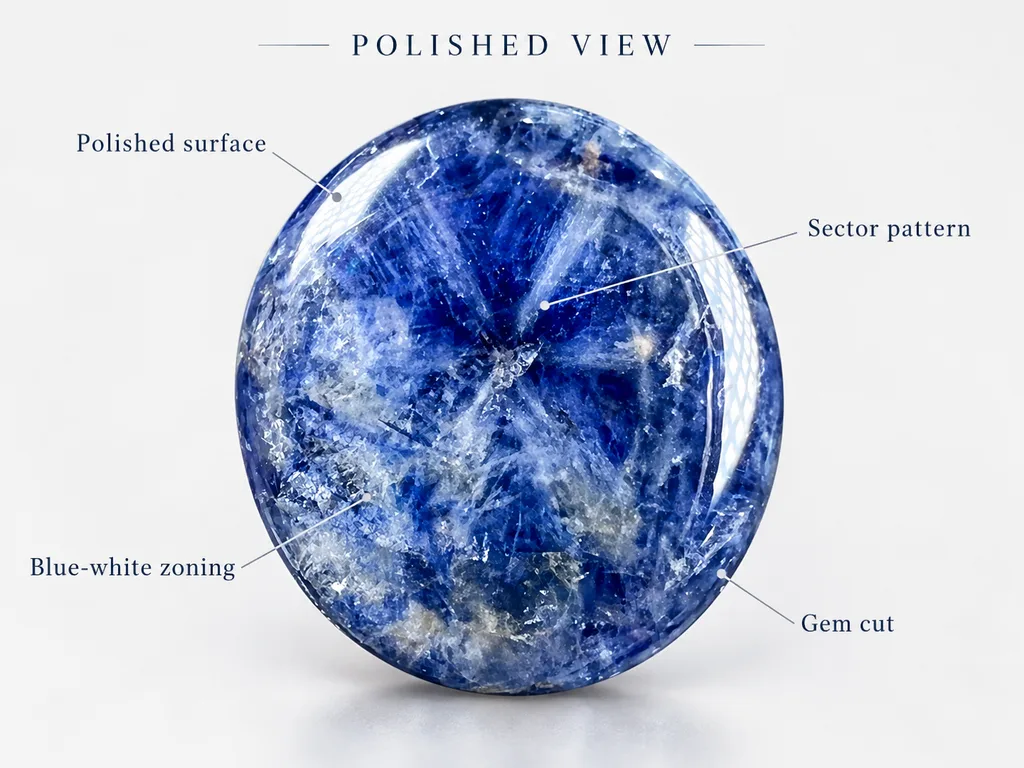
The value of trapiche sapphire usually lies in the visibility of its internal pattern rather than the brilliance expected from a traditional faceted sapphire.
For that reason, specimens are often cut as:
- Cabochons
- Thin tablets
- Polished cross-sections
The orientation of the cut is important.
When the stone is cut roughly perpendicular to the appropriate crystal axis, the complete six-rayed structure can become visible at once.
If the stone is cut at the wrong angle, the pattern may appear incomplete or disappear entirely.
Understanding the internal growth orientation is therefore essential when cutting trapiche sapphire rough.
Does the Trapiche Pattern Continue Through the Entire Crystal?
Not always.
This is one reason trapiche sapphire rough can be difficult to cut.
The pattern may be strongly developed in one part of the crystal but weaker in another.
Toward the ends of a crystal, the radial structure may fade, distort, or disappear.
As a result, the external appearance of a rough sapphire does not always reveal how many good trapiche cross-sections can be produced from it.
The most complete and symmetrical pattern may occur only in the middle portion of the crystal.
Is Trapiche Sapphire Rare?
Yes.
Well-developed true trapiche sapphire is particularly rare.
Trapiche-like sapphire is more common, but even then, fine examples with:
- A centered pattern
- Strong symmetry
- Distinct radial arms
- Good color contrast
- Attractive transparency
are not easy to find.
Origin can also affect collector interest.
True trapiche sapphire from classic localities such as Mogok can be especially desirable among mineral and gemstone collectors.
How Is Trapiche Sapphire Identified?
One of the first observations is whether the six-rayed pattern moves with the light.
If it moves, the phenomenon is more likely to be asterism.
A true trapiche pattern remains fixed.
For a more detailed identification, gemologists examine:
- The central core
- Growth sectors
- Orientation of the arms
- Relationship between arms and sectors
- Color zoning
- Inclusion patterns
When necessary, advanced methods may include:
- Microscopy
- Raman spectroscopy
- FTIR spectroscopy
- UV-Vis spectroscopy
- Trace-element analysis
These methods can help explain not only what the stone is, but how the pattern developed.
Trapiche Sapphire vs Trapiche Ruby
Trapiche sapphire and trapiche ruby are both varieties of:
Corundum — Al₂O₃
The main difference between ruby and sapphire is color classification.
Red gem-quality corundum is classified as ruby.
Other gem-quality colors are generally classified as sapphire.
Trapiche ruby and trapiche sapphire can show related growth structures, but their trace-element chemistry and color mechanisms differ.
Myanmar is especially interesting in this respect.
Mong Hsu is well known for trapiche ruby, while Mogok has produced classic examples of trapiche sapphire.
Do Other Minerals Show Trapiche Patterns?
Yes.
Trapiche and trapiche-like structures are not limited to sapphire or emerald.
Similar radial growth structures have been reported in:
- Ruby
- Emerald
- Tourmaline
- Garnet
- Quartz
- Spinel
However, the mechanism is not necessarily the same in every mineral.
The word “trapiche” should therefore describe more than visual similarity.
Crystal symmetry, growth sectors, inclusion distribution, and growth history all need to be considered.
Why Is Trapiche Sapphire Geologically Interesting?
One of the most fascinating things about trapiche sapphire is that it allows us to see part of a crystal’s growth history with the naked eye.
Different regions of the same sapphire can vary in:
- Trace-element chemistry
- Inclusion density
- Color
- Growth rate
- Internal texture
In an ordinary sapphire, these differences may appear only as subtle color zoning.
In trapiche sapphire, they become a large, geometric structure that can dominate the entire gemstone.
The radial pattern acts almost like a map of crystal growth.
It records how conditions changed as the corundum developed.
That is why trapiche sapphire is more than an unusual gemstone.
It is a geological record preserved inside a single crystal.
Frequently Asked Questions
What is trapiche sapphire?
Trapiche sapphire is a rare sapphire that displays a fixed six-rayed growth pattern. Its mineral is corundum, with the chemical formula Al₂O₃.
Is trapiche sapphire the same as star sapphire?
No. A star sapphire displays a moving optical effect called asterism, while a trapiche pattern is a fixed internal growth structure.
Why does trapiche sapphire have six rays?
The pattern is related to corundum crystal symmetry, growth sectors, and differences in inclusion or chemical distribution during crystal growth.
Are trapiche and trapiche-like sapphire the same?
No. In true trapiche sapphire, the arms separate equivalent growth sectors. Trapiche-like material resembles this pattern but does not meet the same structural criteria.
Where is true trapiche sapphire found?
Mogok in Myanmar is one of the best-known sources of classic true trapiche sapphire.
Where are trapiche-like sapphires found?
Trapiche-like sapphires have been reported from basalt-related sapphire regions including Australia, Vietnam, and China.
How hard is trapiche sapphire?
Because it is corundum, it has a Mohs hardness of 9.
Does trapiche sapphire have to be blue?
No. Blue is one of the best-known colors, but trapiche corundum can occur in other colors as well.
Does the trapiche pattern move with light?
No. A true trapiche pattern is part of the physical growth structure of the crystal and remains fixed.
Is trapiche sapphire rare?
Yes. Well-developed, symmetrical true trapiche sapphire is particularly rare.
Conclusion
Trapiche sapphire may resemble star sapphire at first glance, but the two gemstones tell completely different stories.
The six-rayed structure in trapiche sapphire is not a temporary optical effect created by reflected light. It is a permanent record of what happened while the crystal was growing.
A central core develops, growth sectors form, and inclusions and trace elements become distributed differently through the crystal. Some regions may grow faster than others, while certain boundaries become enriched in inclusions or color differences.
Eventually, a six-rayed structure can become preserved inside the sapphire.
The distinction between true trapiche and trapiche-like sapphire lies in this growth geometry.
Classic Mogok trapiche sapphires, trapiche-like material from basalt-related regions, and inclusion-rich examples from places such as Changle all show that the same mineral can develop very different internal structures under different geological conditions.
That is why trapiche sapphire is more than an unusual-looking gemstone.