





Some sapphires are valued primarily for their color.
Others contain an optical phenomenon that transforms the entire appearance of the gemstone.
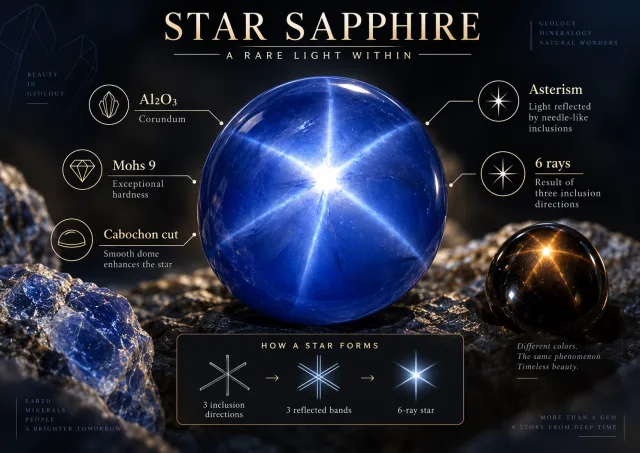
Under a concentrated light source, a bright star can appear on the curved surface of certain sapphires. As the stone or light moves, the star seems to glide across the gem.
This phenomenon is called asterism, and sapphires that display it are known as star sapphires.
Most star sapphires show a six-rayed star, although four-rayed and rare twelve-rayed examples also occur.
The star is produced when light interacts with microscopic, strongly oriented inclusions inside the corundum crystal.
These inclusions may include rutile, hematite, ilmenite, or related oriented phases, depending on the sapphire.
The effect therefore brings together several different parts of Earth science:
- Mineral chemistry
- Crystal structure
- Microscopic inclusions
- Geological formation
- Solid-state mineral processes
- Optical reflection
- Lapidary orientation
A star sapphire is not simply a sapphire with an unusual surface reflection.
Its star is a visible expression of structures hidden inside the crystal.
What Is a Star Sapphire?
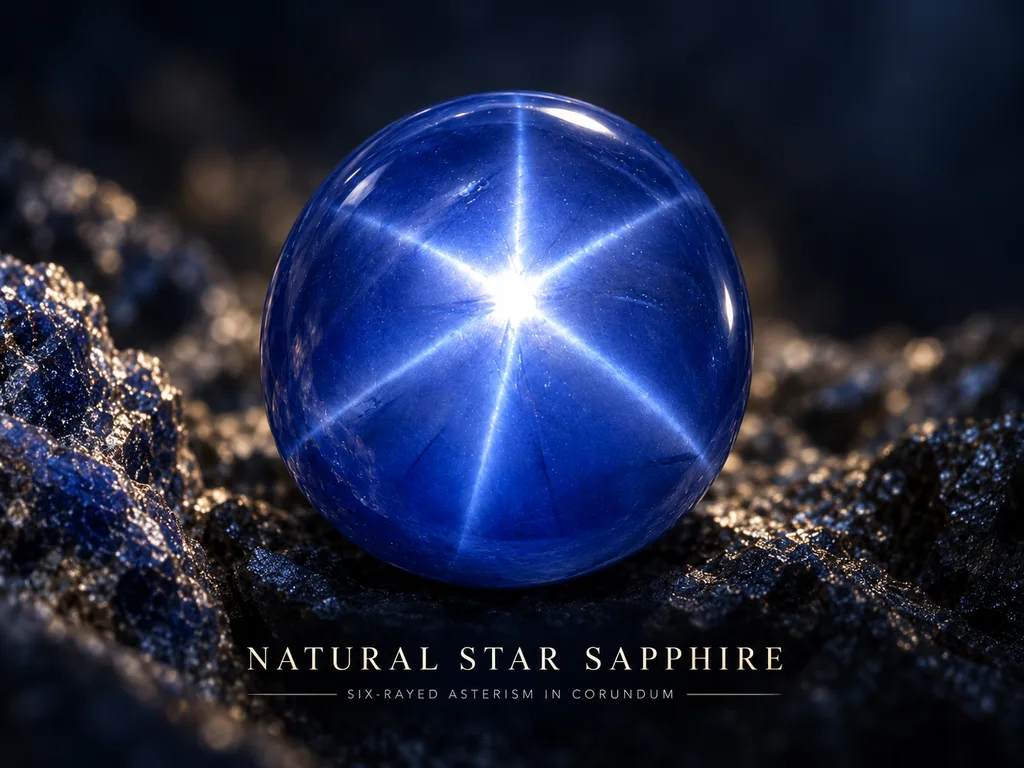
Star sapphire is sapphire that displays the optical phenomenon known as asterism.
Sapphire is a gem variety of the mineral corundum.
Its ideal chemical formula is:
Al₂O₃
Corundum crystallizes in the trigonal crystal system and has a Mohs hardness of:
9
This makes corundum one of the hardest natural minerals and an exceptionally durable gemstone material.
Corundum occurs in many colors, including:
- Blue
- Yellow
- Pink
- Purple
- Green
- Gray
- Brown
- Nearly colorless
- Very dark colors approaching black
Red gem-quality corundum is traditionally classified separately as ruby.
Therefore:
asteriated red corundum = star ruby
while asteriated corundum of other gem colors is generally described as star sapphire.
Star Sapphire Physical Properties
| Property | Star Sapphire |
|---|---|
| Mineral | Corundum |
| Chemical formula | Al₂O₃ |
| Crystal system | Trigonal |
| Mohs hardness | 9 |
| Specific gravity | About 3.98–4.10 |
| Luster | Vitreous to adamantine |
| Transparency | Transparent to opaque |
| Common colors | Blue, gray, black, pink, purple, yellow |
| Optical phenomenon | Asterism |
| Typical star | Six rays |
| Typical cut | Cabochon |
| Tenacity | Brittle |
Star sapphire is therefore not a separate mineral species.
Its chemistry and fundamental crystal structure are those of ordinary sapphire.
What makes it different is the presence and orientation of microscopic inclusions capable of producing a star.
What Is Asterism?
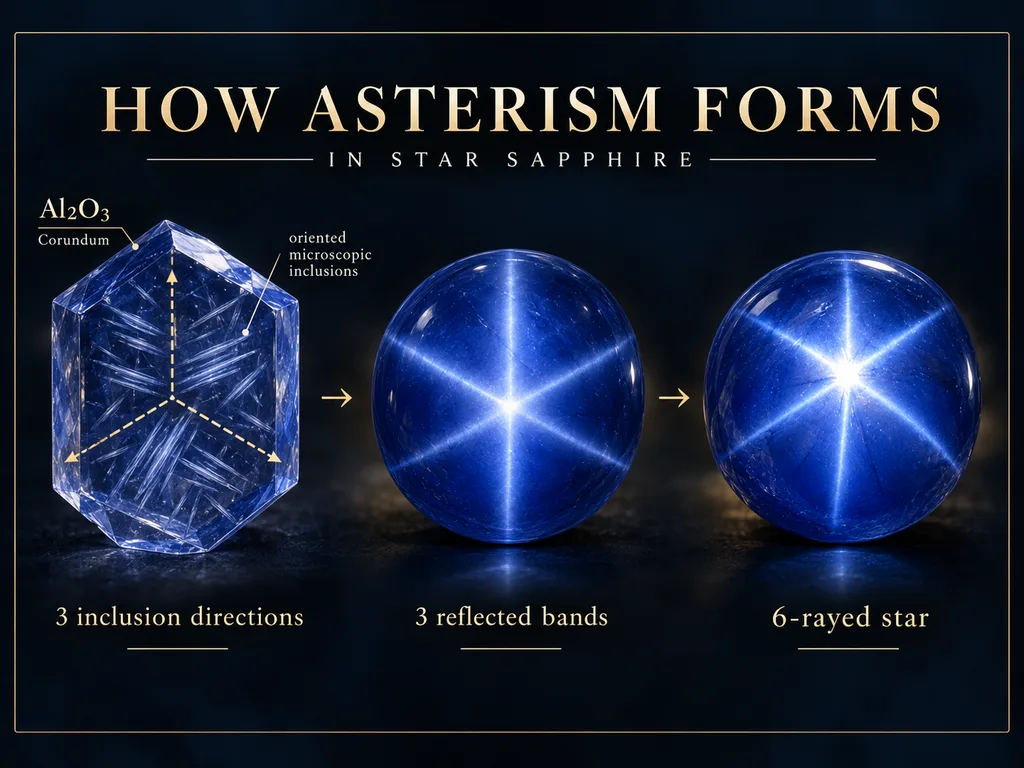
Asterism is an optical phenomenon in which several bands of reflected light intersect across the surface of a gemstone and create a star-shaped pattern.
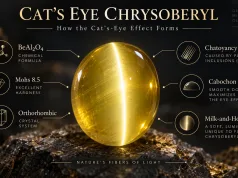
It is closely related to chatoyancy, the cat’s-eye effect.
A simple way to understand the relationship is:
one dominant set of parallel inclusions → one light band → chatoyancy
several oriented sets of inclusions → intersecting light bands → asterism
In star sapphire, microscopic elongated inclusions occur in crystallographically controlled orientations.
When a point or concentrated light source illuminates the stone, these inclusions reflect and scatter light in preferred directions.
The resulting bands intersect on the curved surface of the cabochon.
A star appears.
What Causes the Star in Star Sapphire?
The star is produced by dense populations of microscopic elongated inclusions often referred to collectively as silk.
Historically, star sapphire silk was frequently described simply as rutile needles.
The real mineralogy is more complicated.
Natural star corundum can contain oriented inclusions of:
- Rutile — TiO₂
- Hematite — Fe₂O₃
- Ilmenite — FeTiO₃
- Closely related iron- and titanium-bearing phases
Different sapphires can therefore produce asterism through different inclusion systems.
Fine rutile needles are well documented in natural sapphire.
However, detailed studies have also demonstrated that hematite and ilmenite can be major star-forming inclusions, particularly in dark and black star sapphires.
The essential requirement is not that every star sapphire must contain the same mineral inclusion.
What matters is that large numbers of microscopic inclusions are strongly oriented relative to the corundum crystal structure.
Why Do Most Star Sapphires Have Six Rays?
Most star sapphires display a six-rayed star.
The geometry comes from three dominant sets of elongated inclusions arranged in crystallographically controlled directions.
These inclusion sets commonly intersect at approximately:
60° / 120°
Each set generates one band of reflected light.
Three intersecting bands therefore produce six visible directions:
3 bands × 2 ends = 6 rays
This is why a six-rayed star is so characteristic of asteriated corundum.
The star is not a random decorative pattern.
Its geometry reflects the internal crystallographic organization of the gemstone.
Can Star Sapphire Have Four or Twelve Rays?
Yes.
Although six-rayed stars are the most familiar, asteriated corundum can display different numbers of rays.
Four-rayed stars can occur when the geometry and visible inclusion population produce two dominant intersecting bands.
More spectacular are twelve-rayed star sapphires.
These are relatively rare.
A twelve-rayed star can form when two different sets of six-ray-producing inclusions occur in slightly different orientations within the same sapphire.
One inclusion system may be dominated by rutile.
Another may involve hematite and/or ilmenite.
The two six-rayed patterns overlap.
The result is:
12 rays
In some exceptional stones, the two stars may even show different colors, such as a silvery-white rutile-related star combined with a more golden star associated with iron-rich inclusions.
What Is Black Star Sapphire?
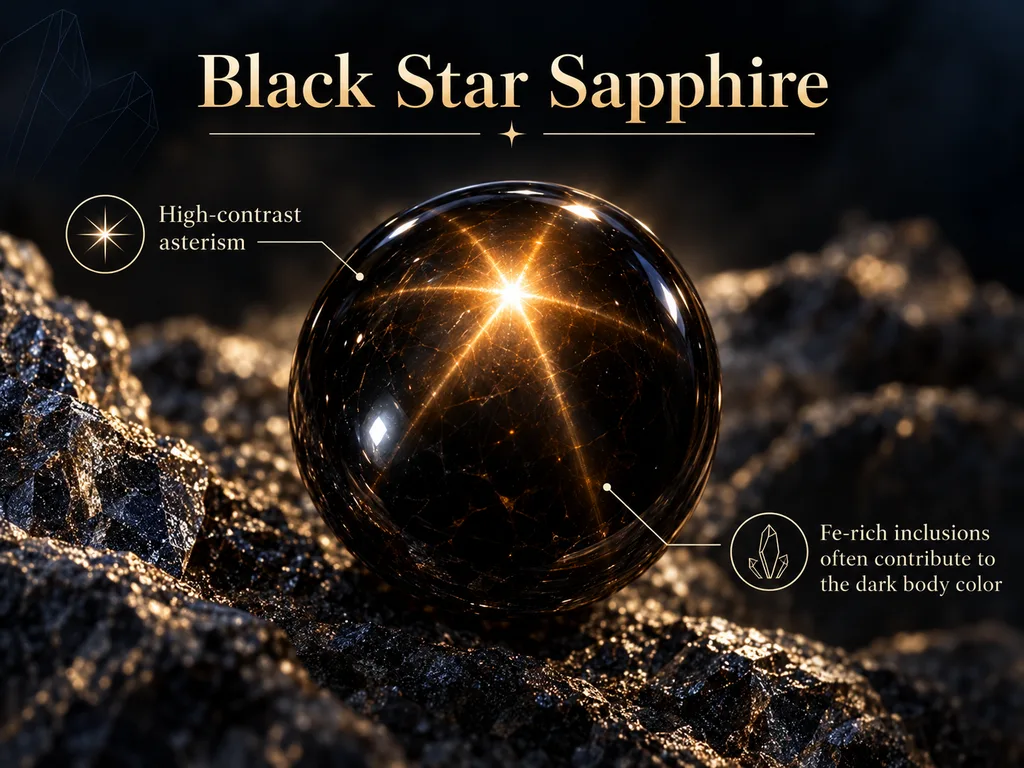
Black star sapphires are among the most dramatic examples of asterism.
Their dark appearance does not necessarily mean the underlying corundum itself is truly black.
Dense iron-rich inclusions can mask the original body color and make a sapphire appear:
- Dark brown
- Nearly black
- Blackish blue
- Blackish green
Hematite and ilmenite inclusions are particularly important in many black star sapphires.
When these inclusions are strongly oriented, they can also generate a visible star.
Some black star sapphires display a striking:
golden-yellow or silvery star against an almost black background
Strong backlighting may sometimes reveal that the underlying body color is actually blue, green, or yellow.
Why Is Star Sapphire Cut as a Cabochon?
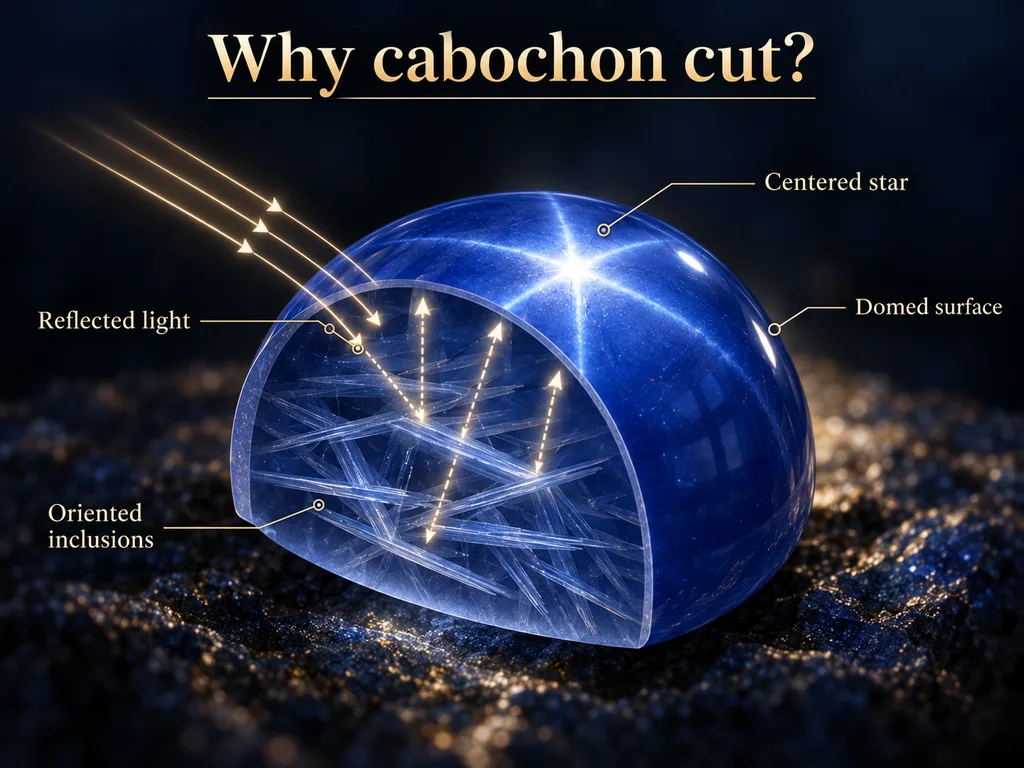
Asterism is best displayed by a cabochon cut.
A cabochon has a smooth, curved dome rather than flat facets.
The dome is important because it allows the reflected light from the oriented inclusions to concentrate into visible bands across the surface.
But shape alone is not enough.
The cutter must also orient the rough sapphire correctly relative to the internal inclusion directions.
If the orientation is wrong, the finished star may become:
- Weak
- Off-center
- Incomplete
- Crooked
- Visible only at certain angles
In a well-oriented star sapphire, the star should appear close to the center of the dome when the stone is illuminated from above.
Cutting is therefore part of the optical system.
The inclusions create the potential for asterism.
The cabochon reveals it.
Why Does the Star Move?
The star appears to move when the stone or light source moves.
The inclusions themselves remain fixed inside the sapphire.
What changes is the geometry between:
- The light source
- The oriented inclusions
- The curved cabochon
- The observer
Only certain inclusions strongly reflect light toward the observer at a particular angle.
When the stone is tilted, the position where this ideal reflection occurs changes.
The star therefore appears to glide across the surface.
This smooth movement is an important quality characteristic in fine star sapphires.
What Makes a Good Star Sapphire?
The quality of a star depends on more than simply whether a star is visible.
A fine example typically shows rays that are:
- Bright
- Sharp
- Straight
- Complete
- Well centered
- Similar in intensity
- Strongly contrasted against the body color
Ideally, the rays extend across much of the cabochon and intersect near the top center.
The star should also move smoothly when the gemstone is rocked beneath a light.
Poorer stars may appear:
- Fuzzy
- Broken
- Uneven
- Off-center
- Weak
- Wavy
Transparency also matters.
The finest star corundum often contains enough silk to produce a strong star while retaining attractive translucency.
Too few inclusions can create a weak star.
Too many can make the stone excessively cloudy or opaque.
There is therefore a balance between:
asterism, transparency, and body color
What Is “Silk” in Sapphire?
Gemologists use the term silk for extremely fine oriented inclusions that give some corundum a soft or silky appearance.
These microscopic inclusions can influence the gem in several ways.
They may:
- Scatter light
- Reduce transparency
- Create a soft glow
- Record internal geological processes
- Produce asterism when correctly oriented
Rutile is one well-known component of sapphire silk.
But modern studies show that natural corundum silk should not automatically be assumed to consist entirely of rutile.
Hematite and ilmenite can also occur as oriented needle- or platelet-like inclusions capable of producing asterism.
The exact mineralogy can vary between deposits and individual stones.
How Do the Star-Forming Inclusions Develop?
This part of the story is particularly interesting geologically.
The sapphire crystal forms first as corundum containing small quantities of elements such as:
- Titanium
- Iron
- Other trace elements
Under changing geological conditions, some of these elements can become less soluble within the corundum crystal structure.
They may then separate from the host crystal and form microscopic oriented precipitates.
This type of solid-state separation is called:
exsolution
Rutile silk in sapphire is strongly associated with such precipitation processes.
The complete origin of every type of natural star-forming inclusion is still being studied, especially hematite- and ilmenite-bearing systems.
Star sapphire therefore records not only initial crystal growth, but potentially later changes that occurred inside the already-formed corundum crystal.
How Does Sapphire Form Geologically?
Gem corundum forms only under particular chemical conditions.
Aluminum is abundant in Earth’s crust, but it commonly occurs in silicate minerals such as:
- Feldspar
- Mica
- Clay minerals
For corundum to become stable, the environment must favor aluminum oxide rather than ordinary aluminum silicates.
This commonly happens in aluminum-rich environments with low silica activity, or where geological reactions remove silica from the system.
Gem sapphire deposits are broadly divided into two primary genetic groups:
- Metamorphic
- Magmatic
Secondary placer deposits form later when weathering and erosion remove sapphires from their original host rocks and concentrate them in sediment.
Metamorphic Sapphire Formation
Many famous sapphires formed during high-grade metamorphism.
Metamorphism alters rocks through combinations of:
- Heat
- Pressure
- Fluids
- Deformation
- Chemical reactions
Gem corundum can occur in metamorphosed:
- Mafic rocks
- Ultramafic rocks
- Marbles
- Gneisses
- Metapelites
- Metasomatically altered rocks
Important metamorphic gem-corundum systems commonly reached amphibolite- to granulite-facies conditions.
These environments can provide the combination of temperature and chemistry necessary for corundum to crystallize.
Sapphire and Ancient Mountain Building
Several major sapphire provinces are closely connected with ancient mountain-building events.
Continental collision can:
- Bury crustal rocks deeply
- Increase pressure and temperature
- Drive deformation
- Move chemically active fluids
- Trigger mineral reactions
Under suitable conditions, sapphire can form during these processes.
Later tectonic uplift brings the rocks back toward the surface.
Weathering exposes the sapphire-bearing rocks.
Erosion releases the crystals.
Rivers can then transport and concentrate them.
A sapphire found in modern gravel can therefore preserve a history that began deep beneath an ancient mountain range.
Important metamorphic sapphire regions include parts of:
- Sri Lanka
- Madagascar
- Myanmar
- Kashmir
- Tanzania
Magmatic and Basalt-Related Sapphire
Some sapphires belong to geological populations associated with magmatic systems.
These include corundum linked with:
- Syenitic rocks
- Lamprophyres
- Alkali basalt provinces
- Other evolved or unusual magmatic environments
However, the term basalt-related sapphire requires care.
In many occurrences, sapphire did not simply crystallize directly from the basalt visible at the surface.
Instead, the ascending basaltic magma acted as a transport mechanism, carrying sapphire crystals or sapphire-bearing rock fragments from deeper levels toward the surface.
The original sapphire may have formed under magmatic or metamorphic conditions before being captured and transported by the basalt.
This explains why determining the geological origin of basalt-related sapphires can be complex.
Why Are Sapphires Common in Placer Deposits?
Corundum is extremely resistant to mechanical and chemical weathering.
It has:
- Mohs hardness 9
- High chemical durability
- Relatively high density
- No easy cleavage
When a sapphire-bearing rock breaks down, the surrounding minerals may weather more rapidly than corundum.
Sapphire crystals can survive.
Streams and rivers transport the released material.
Because sapphire is relatively dense, crystals may become concentrated in gravel layers alongside other resistant heavy minerals.
These deposits are called:
placer or alluvial deposits
Many important sapphires from Sri Lanka, Madagascar, Southeast Asia, and other gem regions are recovered from secondary gravels rather than directly from their primary host rocks.
Where Are Star Sapphires Found?
Star sapphires occur in several major sapphire-producing regions, including:
- Sri Lanka
- Myanmar
- Thailand
- Madagascar
- Australia
- India
- Tanzania
- Cambodia
Different deposits can have very different geological histories.
Some originate in high-grade metamorphic terrains.
Others belong to basalt-related gem provinces.
Many are ultimately recovered from secondary placer deposits.
This means that the country where a star sapphire is mined does not by itself tell the complete story of how the stone formed.
What Makes Blue Sapphire Blue?
The blue color and the star are two separate features.
Pure corundum is essentially colorless.
Blue coloration commonly develops when trace amounts of iron and titanium occupy sites in the corundum structure.
An important mechanism involves:
Fe²⁺–Ti⁴⁺ intervalence charge transfer
This interaction produces strong absorption in part of the visible spectrum, allowing the sapphire to appear blue.
The asterism has a different origin.
Trace-element chemistry → body color
Oriented inclusions → star
A blue star sapphire therefore combines at least two independent mineralogical and optical processes.
Star Sapphire vs Ordinary Sapphire
Star sapphire and ordinary sapphire are both corundum.
| Feature | Ordinary Sapphire | Star Sapphire |
|---|---|---|
| Mineral | Corundum | Corundum |
| Formula | Al₂O₃ | Al₂O₃ |
| Mohs hardness | 9 | 9 |
| Optical phenomenon | Usually absent | Asterism |
| Oriented silk | May be absent or insufficient | Dense enough to create star |
| Typical cut | Faceted | Cabochon |
| Appearance | Transparent or translucent colored gem | Moving star across domed surface |
The star therefore does not define a new mineral.
It is an optical feature produced by the internal texture of the sapphire.
Star Sapphire vs Cat’s Eye Chrysoberyl
Star sapphire and cat’s eye chrysoberyl demonstrate related but different optical phenomena.
Star Sapphire
Several sets of oriented inclusions create:
multiple intersecting light bands
This phenomenon is:
asterism
Cat’s Eye Chrysoberyl
One dominant aligned inclusion system creates:
one moving band of light
This phenomenon is:
chatoyancy
Both effects are usually displayed with a cabochon cut.
The main difference lies in how the internal reflective structures are oriented.
Star Sapphire vs Star Ruby
Star sapphire and star ruby are both asteriated varieties of:
corundum — Al₂O₃
Their crystal structure and Mohs hardness are essentially the same.
Their main difference is color classification.
Red gem corundum is called:
ruby
Therefore a red asteriated corundum is:
star ruby
Corundum of other gem colors showing asterism is generally described as star sapphire.
Natural vs Synthetic Star Sapphire
Star sapphire can also be produced synthetically.
Synthetic sapphire is laboratory-grown corundum and has the same basic chemical formula:
Al₂O₃
Manufacturers can grow titanium-bearing corundum and use controlled thermal treatment to encourage microscopic oriented rutile precipitates to develop.
These precipitates can create genuine asterism inside the synthetic crystal.
Synthetic star sapphire therefore does not necessarily have a painted or superficial star.
The optical effect can result from real internal inclusions.
Gemologists distinguish natural from synthetic star corundum using combinations of:
- Microscopic growth structures
- Inclusion patterns
- Gas bubbles
- Fluorescence
- Spectroscopy
- Trace-element chemistry
- Other laboratory observations
Can Asterism Be Created or Modified by Treatment?
Yes.
Treatment can change the appearance of a star sapphire.
Heat treatment can alter microscopic inclusions inside corundum.
Depending on temperature and treatment conditions, rutile silk may:
- Develop
- Coarsen
- Partially dissolve
- Completely dissolve
Because asterism depends on these internal structures, heat can either improve or reduce the star effect.
Diffusion treatment can also be used on some natural or synthetic sapphires to modify color and, in certain cases, create or enhance an asterism-producing near-surface structure.
A sharp six-rayed star is therefore not proof that a sapphire is untreated or natural.
Important stones may require laboratory testing.
Can Heating Destroy a Natural Star?
Yes.
High-temperature heating can dissolve rutile silk.
When the oriented needles become partially or completely dissolved, the reflections responsible for asterism weaken.
The star may become:
- Less distinct
- Broken
- Weak
- Completely absent
This is why intact, well-developed silk can sometimes provide evidence that a sapphire has not experienced certain high-temperature treatment conditions.
However, treatment interpretation should be based on full gemological examination rather than a single feature.
Why Are Some Star Sapphires Nearly Opaque?
Asterism requires a significant concentration of oriented inclusions.
But these same inclusions scatter light.
As their abundance increases, transparency may decrease.
The stone may become:
- Milky
- Cloudy
- Gray
- Dark
- Nearly opaque
This creates a natural compromise.
Very clean sapphire may not contain enough inclusions to form a visible star.
Extremely included sapphire may show a star but poor transparency or body color.
Fine star sapphire generally falls between these extremes.
Why Is Star Sapphire Geologically Interesting?
A natural star sapphire can record several stages of Earth history inside a single gemstone.
Its corundum host records the environment in which sapphire crystallized.
Its trace elements preserve information about the chemistry of that environment.
Its oriented inclusions can record later solid-state precipitation and exsolution.
Its placer occurrence may record weathering, uplift, erosion, river transport, and sedimentary concentration.
Finally, cutting exposes the optical structure.
The visible star may therefore represent the final stage of a sequence involving:
crystal formation → trace-element incorporation → inclusion precipitation → tectonic uplift → erosion → sediment transport → cabochon cutting → optical reflection
The star we see at the surface is the final expression of a geological history that can span millions of years.
Frequently Asked Questions
What is a star sapphire?
A star sapphire is a sapphire — gem-quality corundum, Al₂O₃ — that contains oriented microscopic inclusions capable of producing asterism.
What causes the star in star sapphire?
The star forms when light interacts with several sets of oriented microscopic inclusions. These may include rutile, hematite, ilmenite, or related mineral phases.
Are all star sapphires caused by rutile?
No. Rutile is an important star-forming inclusion, but natural star sapphires can also contain hematite and ilmenite as major contributors to asterism.
Why do most star sapphires have six rays?
Three sets of oriented inclusions commonly produce three intersecting light bands. Each band extends in two directions, creating six rays.
Can star sapphires have twelve rays?
Yes. Rare twelve-rayed stars may form when two differently oriented six-ray inclusion systems overlap, such as rutile combined with hematite or ilmenite.
What causes the star in black star sapphire?
Many black star sapphires contain dense hematite and/or ilmenite inclusions that both darken the stone and produce asterism.
Why are star sapphires cut as cabochons?
The curved dome concentrates reflections from the oriented inclusions and allows the star to appear clearly.
How hard is star sapphire?
Star sapphire has a Mohs hardness of 9, the same as other corundum.
Can star sapphire be synthetic?
Yes. Synthetic corundum can be manufactured with oriented inclusions that produce genuine asterism.
Can heating affect a star sapphire?
Yes. Heating can change or dissolve the inclusions responsible for the star, depending on temperature and treatment conditions.
Does star sapphire have to be blue?
No. Star sapphires can occur in blue, gray, pink, purple, yellow, dark brown, and nearly black colors.
What is the difference between star sapphire and star ruby?
Both are asteriated corundum. Red gem corundum is ruby, so red asteriated corundum is called star ruby.
Conclusion
Star sapphire is one of the clearest examples of geology becoming visible through light.
The host mineral is corundum:
Al₂O₃
It crystallizes in the trigonal system and has a Mohs hardness of:
9
The sapphire itself may originate in metamorphic or magmatic geological environments and may later be transported and concentrated in placer deposits.
But the star requires another part of the mineral’s history.
Microscopic oriented inclusions develop inside the corundum.
These inclusions can include rutile, hematite, ilmenite, and related phases.
When several inclusion sets are arranged in crystallographically controlled directions, they reflect light into intersecting bands.
Three principal bands commonly produce the classic:
six-rayed star
Rare combinations of different inclusion systems can create twelve rays.
The cabochon cut then turns this microscopic internal structure into something visible to the naked eye.
As the gemstone moves, the reflection geometry changes and the star glides across the surface.
A natural star sapphire therefore records far more than color.
It can preserve evidence of:
crystal chemistry, mineral growth, exsolution, tectonic history, erosion, sediment transport, and optical physics.
The star is simply the part of that geological story that we are able to see.