






Our planet may look calm from the surface, but deep beneath our feet lies a world of incredible complexity and motion. The Earth is not a solid sphere — it’s made up of distinct layers, each with its own composition, density, and behavior.
From the fragile crust we live on to the fiery outer core that generates Earth’s magnetic field, these layers reveal how our planet formed and how it continues to evolve today.
Understanding the structure of the Earth’s layers helps scientists explain volcanoes, earthquakes, mountain building, and even the magnetic shield that protects us from solar radiation.
How We Know About Earth’s Interior
We cannot drill very far into Earth — the deepest borehole (Kola Superdeep, Russia) reached only 12.2 km, just a fraction of the planet’s radius (6,371 km). So how do geologists know what lies beneath?
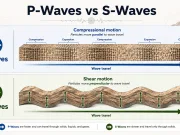
The key lies in seismic waves. When earthquakes occur, they generate waves that travel through Earth’s interior. By measuring how these waves speed up, slow down, or reflect at certain depths, scientists can infer what materials exist below the surface.
There are two main types of seismic waves:
- P-waves (Primary waves): Travel through both solids and liquids.
- S-waves (Secondary waves): Move only through solids, not liquids.
When S-waves suddenly disappear at a certain depth, it indicates a liquid layer — this is how we know the outer core is molten.
The Main Layers of the Earth
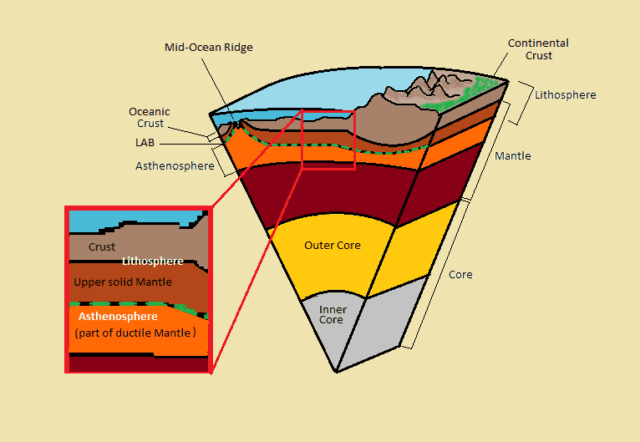
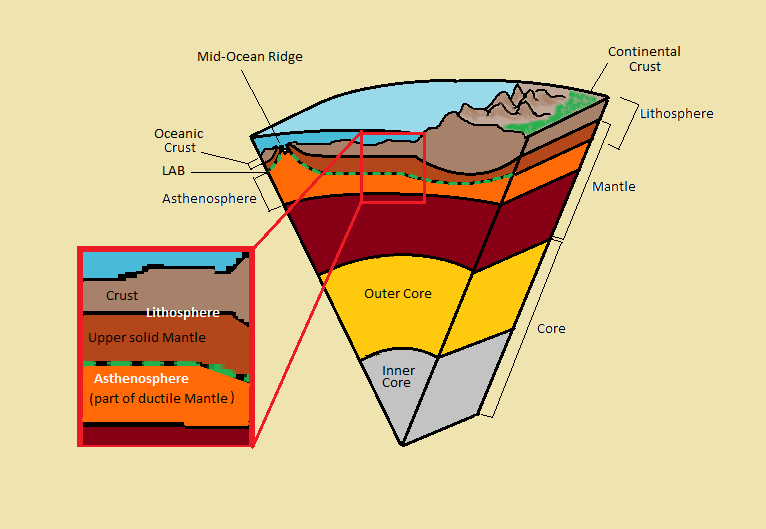
Earth is commonly divided into three main compositional layers — the crust, mantle, and core — and five physical layers (lithosphere, asthenosphere, mesosphere, outer core, inner core).
1. The Crust – Earth’s Thin, Rocky Skin
The crust is the outermost solid shell of the Earth — thin, brittle, and broken into tectonic plates that float atop the semi-fluid mantle.
Despite being the surface we live on, it represents less than 1% of Earth’s total mass.
Types of Crust
- Continental Crust:
- Average thickness: 30–70 km
- Composition: Granitic rocks (rich in silica and aluminum)
- Density: ~2.7 g/cm³
- Older (up to 4 billion years) and less dense
- Oceanic Crust:
- Average thickness: 5–10 km
- Composition: Basalt and gabbro (rich in iron and magnesium)
- Density: ~3.0 g/cm³
- Younger (less than 200 million years)
Where the crust meets the mantle lies the Mohorovičić Discontinuity (Moho) — a sharp boundary where seismic waves suddenly speed up, marking the change in composition from crustal rocks to mantle peridotite.
Interesting Facts
- The crust is constantly recycled by plate tectonics — new crust forms at mid-ocean ridges, and old crust is destroyed at subduction zones.
- Continental crust is thicker beneath mountain ranges and thinner beneath ocean basins.
2. The Mantle – The Engine of the Planet
Beneath the crust lies the mantle, a vast layer of hot, semi-solid rock extending to about 2,900 km deep. It makes up nearly 84% of Earth’s volume.
Although it behaves like a solid on short timescales, over millions of years it flows slowly — this convection drives the movement of tectonic plates on the surface.
Upper Mantle
- Depth: ~35–670 km
- Composition: Mainly olivine, pyroxene, and peridotite
- The asthenosphere (100–300 km deep) is a weak, plastic zone where rocks are close to melting. This is where tectonic plates “float.”
Lower Mantle
- Extends from ~670 km to 2,900 km depth
- Composed of dense silicate minerals like bridgmanite and ferropericlase
- Under immense pressure, making it rigid yet capable of slow flow
Mantle Convection
Heat from radioactive decay and the core creates slow, swirling convection currents in the mantle. These currents cause plates to move, volcanoes to erupt, and mountains to form — shaping the face of the planet.
3. The Core – Earth’s Fiery Heart
At the center of the planet lies the core, a metallic region that makes up about 15% of Earth’s volume but nearly one-third of its mass. It’s composed mainly of iron (Fe) and nickel (Ni) with smaller amounts of sulfur and oxygen.
Outer Core
- Depth: 2,900 km to 5,100 km
- State: Liquid
- Temperature: ~4,000–6,000 °C
- Composition: Molten iron and nickel
- Generates Earth’s magnetic field through a process called the geodynamo — the movement of liquid metal creates electric currents that produce magnetic forces encircling the planet.
Inner Core
- Depth: 5,100 km to 6,371 km (the planet’s center)
- State: Solid
- Temperature: ~6,000 °C — as hot as the Sun’s surface
- Despite the high temperature, it remains solid because of immense pressure (~3.5 million atm).
Interestingly, recent seismic studies suggest that the inner core may be slowly rotating at a different rate than the rest of the planet — possibly even reversing direction over geological time.
Compositional vs. Mechanical Layers
While crust, mantle, and core describe composition, scientists often classify Earth by mechanical behavior (how materials move or deform):
| Physical Layer | Approx. Depth | Description |
|---|---|---|
| Lithosphere | 0–100 km | Rigid outer shell (crust + uppermost mantle) forming tectonic plates |
| Asthenosphere | 100–300 km | Soft, plastic zone that allows plate motion |
| Mesosphere | 300–2,900 km | Strong lower mantle beneath asthenosphere |
| Outer Core | 2,900–5,100 km | Liquid iron-nickel layer generating magnetic field |
| Inner Core | 5,100–6,371 km | Solid metallic center under immense pressure |
This dual classification helps scientists explain both the composition and dynamics of the Earth’s interior.
How the Layers Interact
Earth’s layers aren’t static — they interact constantly, exchanging heat and materials in a cycle that shapes everything from continents to climate.
- Mantle–Crust Interaction:
Rising mantle plumes cause volcanic hotspots (e.g., Hawaii), while subducting crust carries oceanic slabs deep into the mantle. - Core–Mantle Boundary:
This interface (at 2,900 km) is extremely complex, featuring ultra-low-velocity zones and possibly partial melting. It controls the flow of heat that powers the geodynamo. - Tectonic Motion:
The lithosphere’s rigid plates drift atop the ductile asthenosphere, forming boundaries where earthquakes and volcanoes cluster.
How Earth’s Layers Formed
About 4.6 billion years ago, the early Earth was a molten mass of rock and metal. As it cooled, heavier elements (like iron and nickel) sank toward the center, forming the core, while lighter silicates rose to form the mantle and crust.
This process, called planetary differentiation, created the layered structure we see today.
Meteorite studies confirm this model — most stony meteorites resemble mantle composition, while iron meteorites reflect the metallic core of early protoplanets.
New Research and Discoveries
Modern geoscience continues to refine our understanding of Earth’s interior:
- Seismic Tomography: Uses 3D imaging (similar to medical CT scans) to map variations in mantle density. It reveals plumes like those beneath Hawaii and Iceland.
- Ultra-Deep Diamonds: Contain trapped minerals from >600 km depth, offering direct samples from the lower mantle.
- Inner Core Structure: 2023 studies suggest multiple layers within the inner core — a “super-ionic” zone where atoms move like liquid yet remain ordered.
- Magnetic Field Fluctuations: Evidence shows that the geodynamo may occasionally weaken or reverse, influencing climate and radiation exposure.
Earth Compared to Other Planets
Studying Earth’s interior helps us understand other planetary bodies:
- Mars has a smaller, partly solidified core, explaining its weak magnetic field.
- Venus likely has a molten core but lacks plate tectonics, leading to different surface evolution.
- The Moon has a very thin crust and nearly inactive mantle — a frozen geological engine compared to Earth’s dynamic system.
Earth’s layered, mobile interior is what makes it geologically alive — shaping continents, recycling materials, and maintaining an atmosphere suitable for life.
Conclusion
The Earth’s layers — crust, mantle, outer core, and inner core — form a delicate but powerful system in constant motion. Heat, pressure, and gravity continuously reshape the planet from within, driving the processes that create earthquakes, volcanoes, and continents.
From seismic waves to satellite observations, every new discovery deepens our understanding of this dynamic planet. The next time you stand on solid ground, remember that beneath you lies a realm of molten metal, moving rock, and magnetic storms — an inner world that makes life on the surface possible.